
NLP Text Preprocessing Utility Package





Table of Contents
- Package Overview
- What's New in 0.5.0
- Key Features
- Architecture Diagram
- Quickstart and Setup
- Pipeline Automation Engine
- Preparing Text for Transformers
- Command Line (
nlp-prep) - Complete API Reference
- Code Examples
- Type Hints
- Development
- Troubleshooting and Resource Setup
- License and Author
Package Overview
nlp_text_preprocessing is a modular Python library designed to streamline text cleaning, feature extraction, linguistic analysis, content moderation, and visualization for Natural Language Processing (NLP) pipelines and Machine Learning workflows.
Maintained by Uditya Narayan Tiwari.
It provides over 60 single-purpose functions and an extensible Pipeline Engine with defensive guards so None, NaN and missing values are treated as empty text, which makes it convenient to run over Pandas DataFrame columns and raw text datasets.
What's New in 0.5.0
readability_scores(x): five readability measures in one dictionary (Flesch Reading Ease, Flesch-Kincaid grade, Gunning Fog, ARI, Coleman-Liau). See Readability Scores.mask_pii(x, names=True): also redacts people's names with spaCy's entity recogniser. Off by default. See Masking Personal Data.- Faster batches:
Pipeline.run_batch,transformandrun_seriesprocess the spaCy steps withnlp.pipe(about 2x faster, identical output). - Type hints on the public API and a
py.typedmarker, so mypy, Pyright and IDEs use them. See Type Hints. - Developer tooling: ruff, mypy, coverage, Python 3.13 in CI and Dependabot. See Development.
Everything from earlier versions still works the same way. The full history is in CHANGELOG.md.
Key Features
- Safe Inputs:
None,NaN,pd.NAand bytes are handled by every function (treated as empty text). - Pipeline Automation Engine: Chain cleaning steps by name or custom functions via
Pipeline(['to_lower_case', 'remove_urls', 'lemmatize']). - Light Import, Lazy Models:
import nlp_text_preprocessingloads no heavy library and downloads nothing. spaCy, TextBlob and NLTK data are loaded on first use and cached. - Advanced Cleaning: Remove emojis, phone numbers, PII mask, URLs, emails, HTML, retweets, special symbols, and expand contractions/hashtags.
- Feature & Readability Extraction: Extract word counts, sentence counts, readability scores (Flesch Ease, plus Flesch-Kincaid, Gunning Fog, ARI and Coleman-Liau via
readability_scores), punctuation density, capital ratios, and full batch statistics. - Linguistic Utilities: Named Entity Recognition (NER), POS tagging, dependency parsing, language detection, keyword extraction, synonyms, antonyms, and n-grams.
- Safety & Moderation (baseline): Lexicon-based profanity, toxicity, spam and emotion helpers. They are transparent keyword baselines, not a moderation system: use a trained model for anything high-stakes.
- Visualization: Generate and save custom WordClouds to disk or display interactively.
- Fast Batches:
Pipeline.run_batch/run_seriesuse spaCy'snlp.pipefor the spaCy steps. - Typed: annotated public API with a
py.typedmarker.
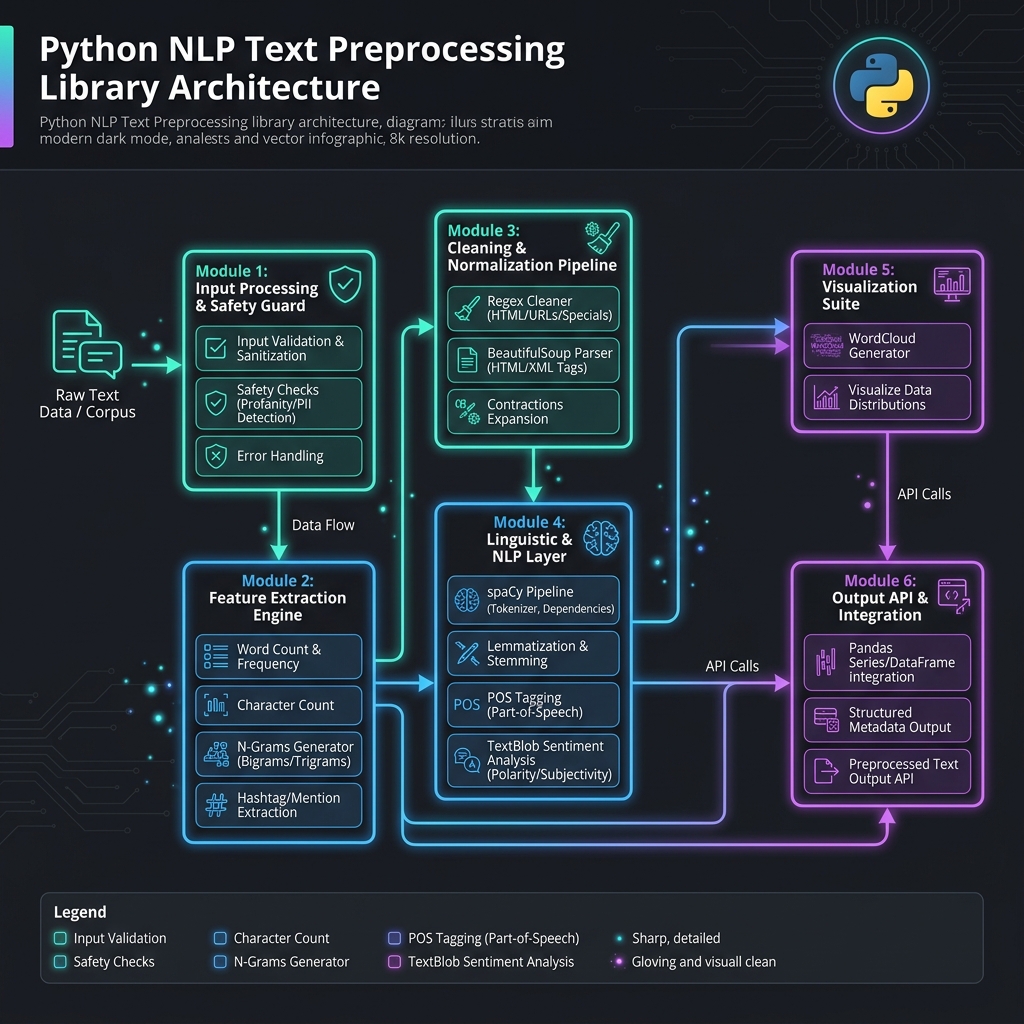
Architecture Diagram
The package integrates spaCy, NLTK, TextBlob, BeautifulSoup4, and WordCloud through a unified API surface:
Quickstart and Setup
1. Installation
pip install nlp-text-preprocessing            # core
pip install "nlp-text-preprocessing[viz]"     # + wordcloud, matplotlib (get_wordcloud)
pip install "nlp-text-preprocessing[pandas]"  # + pandas (text_stats_batch, Pipeline.run_series)
pip install "nlp-text-preprocessing[sklearn]" # + scikit-learn (TextPreprocessor)
pip install "nlp-text-preprocessing[transformers]" # + transformers (tokenizers for truncate_text / chunk_text)
pip install "nlp-text-preprocessing[all]"     # everything optional
pip install "nlp-text-preprocessing[dev]"     # tests, ruff, mypy (for contributors)
2. Downloading Required Corpora and Models
Nothing is downloaded behind your back. Run the one-time setup, which fetches the NLTK data (punkt_tab, wordnet, omw-1.4) and the spaCy model en_core_web_sm:
import nlp_text_preprocessing as tp

tp.download_nltk_packages()                 # one-time setup
tp.check_resources(verbose=True)            # see what is installed / missing
sentiment_analysis(x, method="naive_bayes") additionally needs the movie_reviews corpus:
tp.download_nltk_packages(include_sentiment_corpus=True).
Set the environment variable NLP_TEXT_PREPROCESSING_AUTO_DOWNLOAD=1 if you want the spaCy model to be downloaded automatically on first use.
Pipeline Automation Engine
The Pipeline class allows chaining cleaning and transformation steps cleanly:
import nlp_text_preprocessing as tp

# 1. Create default zero-config pipeline
pipe = tp.Pipeline.default()

# 2. Or build a custom step pipeline
pipe = tp.Pipeline([
    'to_lower_case',
    'expand_hashtags',
    'remove_urls',
    'remove_emails',
    'remove_extra_whitespace',
    'lemmatize'
])

# Process single text
clean_result = pipe.run("Check out #MachineLearning at https://example.com!")

# Process batch list or Pandas Series
clean_batch = pipe.run_batch(["Text 1", "Text 2"])
clean_series = pipe.run_series(df['text_column'])

# Generate diff report of changes
report = tp.diff_report(raw_texts, clean_batch)
run_batch and run_series are faster than looping over run: the spaCy steps (lemmatize, convert_to_base, singularize_words, pluralize_words) process the whole list with spaCy's nlp.pipe (about 2x faster in our test; the result is identical). run_series keeps the Series index and name.
Steps with arguments, saving and scikit-learn
# Pass arguments as (name, {argument: value})
pipe = tp.Pipeline([
    'to_lower_case',
    ('remove_stop_words', {'keep_negations': False}),
])
print(pipe)   # Pipeline(['to_lower_case', "remove_stop_words{'keep_negations': False}"])

# Save and reload (custom functions must be registered with @tp.register_step('name'))
pipe.save('my_pipeline.json')
pipe = tp.Pipeline.load('my_pipeline.json')

# Use it inside scikit-learn:  pip install "nlp-text-preprocessing[sklearn]"
from sklearn.pipeline import make_pipeline
from sklearn.feature_extraction.text import TfidfVectorizer

model = make_pipeline(tp.TextPreprocessor(['to_lower_case', 'remove_special_chars']),
                      TfidfVectorizer())
X = model.fit_transform(["Hello, World!", "HELLO there"])
Every step except the last must return a string. The last step may return anything,
for example Pipeline(['to_lower_case', 'text_stats']).
Preparing Text for Transformers (BERT, GPT, ...)
Modern models work best with lightly cleaned text: keep the case, punctuation and
word forms, and only remove noise. light_clean does exactly that, and truncate_text
/ chunk_text help you stay inside a model's token limit.
import nlp_text_preprocessing as tp
tp.light_clean("<p>Great & fast! Visit https://x.com or mail me@x.com</p>",
urls='[URL]', emails='[EMAIL]')
# 'Great & fast! Visit [URL] or mail [EMAIL]'
# Use the real tokenizer so the limits are counted in model tokens
# (pip install "nlp-text-preprocessing[transformers]")
from transformers import AutoTokenizer
tok = AutoTokenizer.from_pretrained('bert-base-uncased')
tp.truncate_text(long_text, 256, tokenizer=tok)
chunks = tp.chunk_text(long_text, 256, overlap=32, tokenizer=tok)
Without a tokenizer, the limits are counted in whitespace-separated words.
tokenizer may be a HuggingFace tokenizer (anything with .tokenize() and
.convert_tokens_to_string()) or a plain function that returns a list of tokens.
Command Line (nlp-prep)
Installing the package also installs the nlp-prep command (python -m nlp_text_preprocessing works too).
# one document per line, written to a new file
nlp-prep clean reviews.txt -o reviews_clean.txt

# a CSV column (adds a 'text_clean' column; use --output-column text to overwrite)
nlp-prep clean data.csv --column text -o data_clean.csv

# standard input / output
cat notes.txt | nlp-prep clean - --lowercase --url-token "[URL]"

# classic cleaning, or your own steps / a saved Pipeline
nlp-prep clean reviews.txt --mode standard --stopwords
nlp-prep clean reviews.txt --steps to_lower_case,remove_urls
nlp-prep clean reviews.txt --pipeline my_pipeline.json

# check or install the NLTK data and spaCy model
nlp-prep resources --download
Complete API Reference
Below is the complete reference guide for all functions available in the library:
1. General Feature Extraction
| Function | Parameters | Return Type | Description |
|---|---|---|---|
word_count(x) |
x: str |
int |
Returns total whitespace-separated word count. |
char_count(x) |
x: str |
int |
Returns total characters excluding spaces. |
avg_word_len(x) |
x: str |
float |
Returns average word length (0.0 for empty inputs). |
stop_words_count(x) |
x: str |
int |
Returns count of stop words (case-insensitive). |
sentence_count(x) |
x: str |
int |
Returns total number of sentences. |
avg_sentence_len(x) |
x: str |
float |
Returns average sentence length in words. |
punctuation_density(x) |
x: str |
float |
Returns proportion of punctuation characters in text. |
capital_ratio(x) |
x: str |
float |
Returns proportion of uppercase words relative to total words. |
unique_word_ratio(x) |
x: str |
float |
Returns lexical diversity ratio (unique words / total words). |
readability_score(x) |
x: str |
float |
Calculates Flesch Reading Ease score. |
readability_scores(x) |
x: str |
dict |
Flesch Reading Ease, Flesch-Kincaid grade, Gunning Fog, Automated Readability Index and Coleman-Liau (English, approximate). |
hashtags_count(x) |
x: str |
int |
Returns count of hashtag tokens (#tag). |
mentions_count(x) |
x: str |
int |
Returns count of user handle mentions (@user). |
numerics_count(x) |
x: str |
int |
Returns count of numeric tokens. |
upper_case_count(x) |
x: str |
int |
Returns count of uppercase words. |
text_stats(x) |
x: str |
dict |
Returns a dictionary containing all extracted feature statistics at once. |
text_stats_batch(df, col) |
df, col |
DataFrame |
Returns a DataFrame of stats for a pandas DataFrame column. |
2. Text Cleaning and Normalization
| Function | Parameters | Return Type | Description |
|---|---|---|---|
to_lower_case(x) |
x: str |
str |
Converts input text to lowercase. |
contraction_to_expansion(x) |
x: str |
str |
Expands contractions using contractions dictionary. |
remove_emails(x) |
x: str |
str |
Removes email addresses from text. |
count_emails(x) |
x: str |
int |
Counts email addresses present in text. |
remove_urls(x) |
x: str |
str |
Removes http(s)://, ftp:// and www. URLs (trailing punctuation is kept). |
count_urls(x) |
x: str |
int |
Counts URLs present in text. |
remove_rt(x) |
x: str |
str |
Removes retweet headers (RT @user:). |
count_rt(x) |
x: str |
int |
Counts retweet occurrences in text. |
remove_html_tag(x) |
x: str |
str |
Strips HTML/XML tags using BeautifulSoup. |
remove_accented_chars(x) |
x: str |
str |
Strips accents (café -> cafe); non-Latin scripts are kept. |
remove_mentions(x) |
x: str |
str |
Removes user handle mentions (@username). |
remove_special_chars(x) |
x: str |
str |
Strips punctuation and symbols (well-known -> well known). |
remove_repeated_chars(x) |
x: str |
str |
Shortens elongated words (soooo -> soo); digits and punctuation are untouched. |
remove_stop_words(x, keep_negations=True) |
x: str |
str |
Removes stop words (case-insensitive); negations like not are kept by default. |
remove_emojis(x) |
x: str |
str |
Strips emoji (flags, skin tones and ZWJ sequences included). |
extract_emojis(x) |
x: str |
list[str] |
Returns list of emojis found in text. |
emoji_to_text(x) |
x: str |
str |
Converts emojis to descriptive text (e.g. 😂 -> face_with_tears_of_joy). |
remove_phone_numbers(x) |
x: str |
str |
Strips phone numbers (international formats; dates and decimals are ignored). |
count_phone_numbers(x) |
x: str |
int |
Counts phone numbers present in text. |
mask_pii(x, token='[REDACTED]', names=False) |
x: str |
str |
Redacts emails, card numbers, US SSNs and phone numbers. names=True also redacts people's names with spaCy's entity recogniser (statistical, so review the result). |
remove_extra_whitespace(x) |
x: str |
str |
Collapses consecutive spaces, tabs, and newlines to a single space. |
expand_hashtags(x) |
x: str |
str |
Splits hashtags (#MachineLearning2024 -> Machine Learning 2024). |
normalize_unicode_punctuation(x) |
x: str |
str |
Replaces smart quotes, em-dashes, and ellipsis with ASCII equivalents. |
remove_numbers(x) |
x: str |
str |
Removes standalone numbers; digits inside words (3rd, H2O) stay. |
remove_currency_symbols(x) |
x: str |
str |
Strips every Unicode currency symbol. |
normalize_whitespace_and_casing(x) |
x: str |
str |
Canonical combination of lowercasing and whitespace collapse. |
clean_text(text, remove_stopwords=False) |
text: str |
str |
End-to-end cleaning (HTML, URLs, emails, lower-case, contractions, punctuation, lemmatization). |
light_clean(x, html=True, urls='', emails='', mentions=None, emojis=None, normalize='NFKC', keep_newlines=False, lowercase=False) |
x: str |
str |
Minimal cleaning for transformer models: Unicode normalisation, zero-width/control characters, HTML and entities, URLs/emails/mentions (remove, replace or keep), optional emoji handling. Case and punctuation are kept. |
truncate_text(x, max_tokens, tokenizer=None) |
x: str |
str |
Keeps the first max_tokens tokens (words, or tokens of a HuggingFace-style tokenizer). |
chunk_text(x, max_tokens, overlap=0, tokenizer=None) |
x: str |
list[str] |
Splits long text into pieces of at most max_tokens, with optional overlap. |
3. Linguistic and Morphological Processing
| Function | Parameters | Return Type | Description |
|---|---|---|---|
convert_to_base(x) |
x: str |
str |
Lemmatizes nouns and verbs via spaCy while keeping other POS tags. |
lemmatize(x) |
x: str |
str |
Performs full lemmatization across all tokens via spaCy. |
extract_entities(x) |
x: str |
list[tuple] |
Extracts named entities (text, label) using spaCy. |
extract_pos_tags(x) |
x: str |
list[tuple] |
Extracts full POS tag breakdown (token, pos, tag) using spaCy. |
get_dependency_tree(x) |
x: str |
list[tuple] |
Extracts dependency parse tree (token, dep, head) using spaCy. |
detect_language(x) |
x: str |
str |
Language code ('en', 'fr', 'hi', ...) via langdetect; 'unknown' if undetectable. |
keyword_extraction(x, top_n) |
x: str, top_n: int |
list[str] |
Extracts top N keywords by term frequency. |
text_similarity(x1, x2) |
x1, x2 |
float |
Calculates token Jaccard similarity between two texts (0.0 to 1.0). |
get_synonyms(word) |
word: str |
list[str] |
Sorted WordNet synonyms. |
get_antonyms(word) |
word: str |
list[str] |
Sorted WordNet antonyms. |
chunk_noun_phrases(x) |
x: str |
list[dict] |
spaCy noun chunks with exact character start/end offsets. |
correct_spelling(x) |
x: str |
str |
Corrects misspelled words (TextBlob); punctuation, case, URLs and acronyms are preserved. |
get_noun_phrase(x) |
x: str |
list[str] |
Extracts noun phrases from text. |
n_grams(x, n=2) |
x: str, n: int |
list[tuple] |
Word-level n-grams as tuples. |
singularize_words(x) |
x: str |
str |
Converts plural nouns (NNS) into singular forms. |
pluralize_words(x) |
x: str |
str |
Converts singular nouns (NN) into plural forms. |
4. Safety, Moderation and Sentiment
| Function | Parameters | Return Type | Description |
|---|---|---|---|
detect_profanity(x, include_mild=True, extra_words=(), allow_words=()) |
x: str |
bool |
True if the text has profanity. Matches endings (shitty) and leetspeak (sh1t); ignores Hell's Kitchen; include_mild=False skips words like damn. Masked words such as f*** are not detected. |
censor_profanity(x, include_mild=True, extra_words=(), allow_words=(), mask_char='*') |
x: str |
str |
Masks each profane word, keeping its length and the text layout. |
detect_toxicity(x) |
x: str |
float |
Score from 0.0 to 1.0. Counts insults and threats aimed at people; kill the process and I do not hate you score 0. |
toxicity_report(x) |
x: str |
dict |
Explains the score: score, matches (word, weight, targeted) and ignored (negated) words. |
detect_spam_signals(x) |
x: str |
dict |
Flags shouting, punctuation runs, links and spam phrases (spam_phrases); is_spam_candidate needs at least two signals. Short texts like OK are not flagged. |
sentiment_analysis(x, method='pattern') |
x: str |
str |
'pos' / 'neg' / 'neu'. Default is instant; method='naive_bayes' is the legacy opt-in model. |
polarity_subjectivity(x) |
x: str |
dict |
Returns fast pattern-based sentiment polarity (-1.0 to 1.0) and subjectivity. |
emotion_detection(x) |
x: str |
dict |
Emotion counts (joy, anger, sadness, fear). Handles endings (loved, happier) and ignores negated words (not happy). |
5. Visualization Suite
| Function | Parameters | Return Type | Description |
|---|---|---|---|
get_wordcloud(x, save_path=None, show=True) |
x: str, save_path: str, show: bool |
WordCloud |
Generates a WordCloud object, with optional file saving and GUI toggle options. |
Code Examples
1. Basic Text Cleaning
import nlp_text_preprocessing as tp

raw_text = "Check out https://example.com! Contact support@company.org or RT @user 'I'm loving #NLP'."
cleaned = tp.clean_text(raw_text)

print(cleaned)
# Output: check out contact support company org or i am love nlp
2. Pipeline Engine Usage
import nlp_text_preprocessing as tp

# Build custom pipeline
pipe = tp.Pipeline(['to_lower_case', 'expand_hashtags', 'remove_urls', 'remove_extra_whitespace'])

text = "Check out #MachineLearning at https://example.com!"
print(pipe.run(text))
# Output: check out machine learning at!
3. Pandas DataFrame Integration
All functions seamlessly support Pandas .apply() and handle missing values (NaN/None):
import pandas as pd
import nlp_text_preprocessing as tp

df = pd.DataFrame({
    'text': [
        "I'm loving this NLP package! #awesome",
        "Contact me at info@test.com or visit https://test.com",
        None
    ]
})

# Apply end-to-end text cleaning
df['clean_text'] = df['text'].apply(tp.clean_text)

# Extract word counts safely
df['word_count'] = df['text'].apply(tp.word_count)
4. Batch Feature Extraction
Extract full feature matrices directly into Pandas columns:
import pandas as pd
import nlp_text_preprocessing as tp

df = pd.DataFrame({'text': ["Hello #world! Visit https://example.com", "Contact user@test.com"]})

# Extract all summary stats into a new DataFrame
stats_df = tp.text_stats_batch(df, 'text')
print(stats_df)
5. WordCloud Generation
import nlp_text_preprocessing as tp

text = "python natural language processing machine learning text mining data science spaCy nltk textblob"

# Save directly to disk without opening interactive GUI window
tp.get_wordcloud(text, save_path="wordcloud.png", show=False)
6. Readability Scores
import nlp_text_preprocessing as tp

scores = tp.readability_scores("The cat sat on the mat. It was a sunny day.")
print(scores)
# {'flesch_reading_ease': ..., 'flesch_kincaid_grade': ..., 'gunning_fog': ...,
#  'automated_readability_index': ..., 'coleman_liau': ...}

# Higher Flesch = easier. The other four are US school grade levels (higher = harder).
# Empty or None text returns 0.0 for every key.
tp.readability_score(x) still returns only the Flesch Reading Ease number. The scores are approximate and meant for English.
7. Masking Personal Data, Including Names
import nlp_text_preprocessing as tp

text = "Barack Obama emailed me at obama@example.com or 555-123-4567."

tp.mask_pii(text)
# 'Barack Obama emailed me at [REDACTED] or [REDACTED].'   (names are left alone by default)

tp.mask_pii(text, names=True)
# '[REDACTED] emailed me at [REDACTED] or [REDACTED].'   (needs the spaCy model; run tp.download_nltk_packages() once)

tp.mask_pii(text, token='<PII>', names=True)   # custom replacement token
Names are found by spaCy's statistical entity recogniser, so it can miss or over-match some names. Review the output when privacy matters.
8. Fast Batch Processing
import nlp_text_preprocessing as tp

pipe = tp.Pipeline(['to_lower_case', 'remove_urls', 'lemmatize'])

texts = ["Dogs are barking at https://example.com", "Cats were running"] * 500
clean = pipe.run_batch(texts)             # list in, list out
clean_series = pipe.run_series(df['text'])  # keeps the Series index and name
Type Hints
The package ships a py.typed marker and annotated function signatures, so type checkers and IDEs show parameter and return types:
import nlp_text_preprocessing as tp

n: int = tp.word_count("hello world")
scores: dict = tp.readability_scores("Hello there.")
Development
git clone https://github.com/udityamerit/Text-Processing-Package-For-Natural-Language-Processing.git
cd Text-Processing-Package-For-Natural-Language-Processing
pip install -e ".[dev,all]"
python -m spacy download en_core_web_sm

pytest -q --cov          # tests with coverage
ruff check .             # lint
mypy                     # type check
CI runs the same checks on Python 3.10 to 3.13. Release steps, and how to set up PyPI Trusted Publishing, are in RELEASING.md.
Troubleshooting and Resource Setup
If a function reports a missing NLTK corpus or spaCy model, check what is missing and install it:
import nlp_text_preprocessing as tp
tp.check_resources(verbose=True)
tp.download_nltk_packages()
Or manually download spaCy model via terminal:
python -m spacy download en_core_web_sm
License and Author
- Author: Uditya Narayan Tiwari
- License: MIT License (LICENSE)
1 maintainer

Metadata
1 maintainer
Release files for nlp-text-preprocessing 0.5.1
For a detailed explanation of source distributions (sdists) and built distributions (wheels), please see the package formats documentation.
Source distribution (sdist)
| File | Size | Uploaded | Provenance | Actions |
|---|---|---|---|---|
| nlp_text_preprocessing-0.5.1.tar.gz | 1.6 MB | Without provenance | Details for nlp_text_preprocessing-0.5.1.tar.gz |
Built distribution (wheel)
| File | Interpreter | ABI | Platform | Actions Reset |
|---|---|---|---|---|
| nlp_text_preprocessing-0.5.1-py3-none-any.whl | Python 3 | none | any | Details for nlp_text_preprocessing-0.5.1-py3-none-any.whl |
Total release size: 1.6 MB
Release files / nlp_text_preprocessing-0.5.1.tar.gz
| Download URL | nlp_text_preprocessing-0.5.1.tar.gz |
|---|---|
| Size | 1.6 MB |
| Tags | Source |
|
SHA-256 checksum How to use checksums |
4408d9caab6748aac2b89f4306c19bfe5aa962438b77c2123ccb792c19bc08cc
|
|
BLAKE2b-256 checksum How to use checksums |
4e5a187aec59ef1699e66431d8b67180d495c658a8da143a67e2064c7fa8b213
|
| Upload date | |
|
Uploaded using Trusted Publishing? What is trusted publishing? |
No |
| Uploaded via |
twine/7.0.0 CPython/3.12.10
|
Release files / nlp_text_preprocessing-0.5.1-py3-none-any.whl
| Download URL | nlp_text_preprocessing-0.5.1-py3-none-any.whl |
|---|---|
| Size | 41.7 kB |
| Tags | Python 3 |
|
SHA-256 checksum How to use checksums |
603fe39fccb238aaa46b7c62dc48c2effb09f34a9f99e37f1fcf08902c35a64c
|
|
BLAKE2b-256 checksum How to use checksums |
7eed068dd99d1eee81b5733f2e64df767a54b5b83bed960041b3c92d9c54c17f
|
| Upload date | |
|
Uploaded using Trusted Publishing? What is trusted publishing? |
No |
| Uploaded via |
twine/7.0.0 CPython/3.12.10
|
Security for nlp-text-preprocessing 0.5.1
Provenance
Provenance describes where a file came from. On PyPI, provenance is shared via attestations, which provide a verifiable record of the build or publishing details. View details, limitations and caveats.
No provenance found
None of the files in this release were uploaded with provenance metadata.
A note on package security
PyPI is a repository for distributing packages, not a service for auditing them. While third-party security researchers and our staff do their best to detect and remove malicious packages, PyPI cannot guarantee the quality, security or suitability of any given package.
To learn more about protecting yourself from malicious actors, visit our package security documentation.














