







A fast library for reading, writing, and modifying STL files, powered by NumPy. Every mesh operation uses vectorized array math for speed.
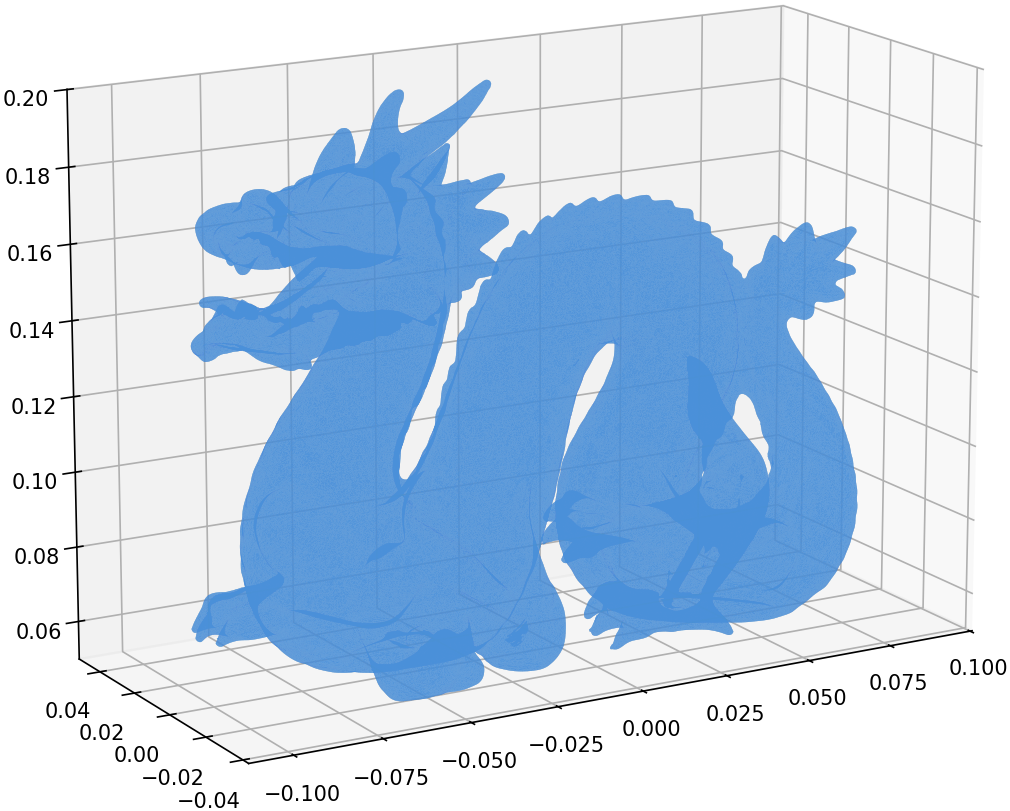
Stanford Dragon — 871,414 triangles loaded in 0.63s, rendered with matplotlib
Quick Start
pip install numpy-stl
from stl import mesh

# Load an STL file (auto-detects binary/ASCII)
your_mesh = mesh.Mesh.from_file('model.stl')

# Inspect
print(f'{len(your_mesh)} triangles')
print(f'Bounding box: {your_mesh.min_} to {your_mesh.max_}')

# Save
your_mesh.save('output.stl')
Features
- Read and write binary and ASCII STL files
- Read PLY and 3MF files (3MF is experimental, read-only)
- Mesh operations: rotate, translate, transform (4x4 matrix)
- Properties: surface area, volume, center of gravity, inertia tensor, convexity
- Combine multiple meshes by concatenating data arrays
- CLI tools:
stl,stl2ascii,stl2binfor format conversion - Fast: all operations backed by NumPy vectorized math
Supported Formats
| Format | Read | Write | Notes |
|---|---|---|---|
| STL (binary) | ✅ | ✅ | Auto-detected on load |
| STL (ASCII) | ✅ | ✅ | ~5x faster with optional speedups |
| PLY | ✅ | ✅ | Binary and ASCII; from_ply_file / save_ply |
| 3MF | ✅ | — | Experimental; from_3mf_file |
Requirements & Compatibility
- Python: 3.10+
- NumPy: 1.24+ (installed automatically)
- Platforms: Linux, macOS, Windows
- Optional:
numpy-stl[fast]for the Cython ASCII speedups (see below)
Performance / Optional Speedups
numpy-stl is fast out of the box. For even faster ASCII STL I/O, install the optional Cython speedups:
pip install numpy-stl[fast]
This installs the speedups
package, a compiled C extension for ASCII parsing. The library works
identically without it -- pure Python is the default.
Benchmark
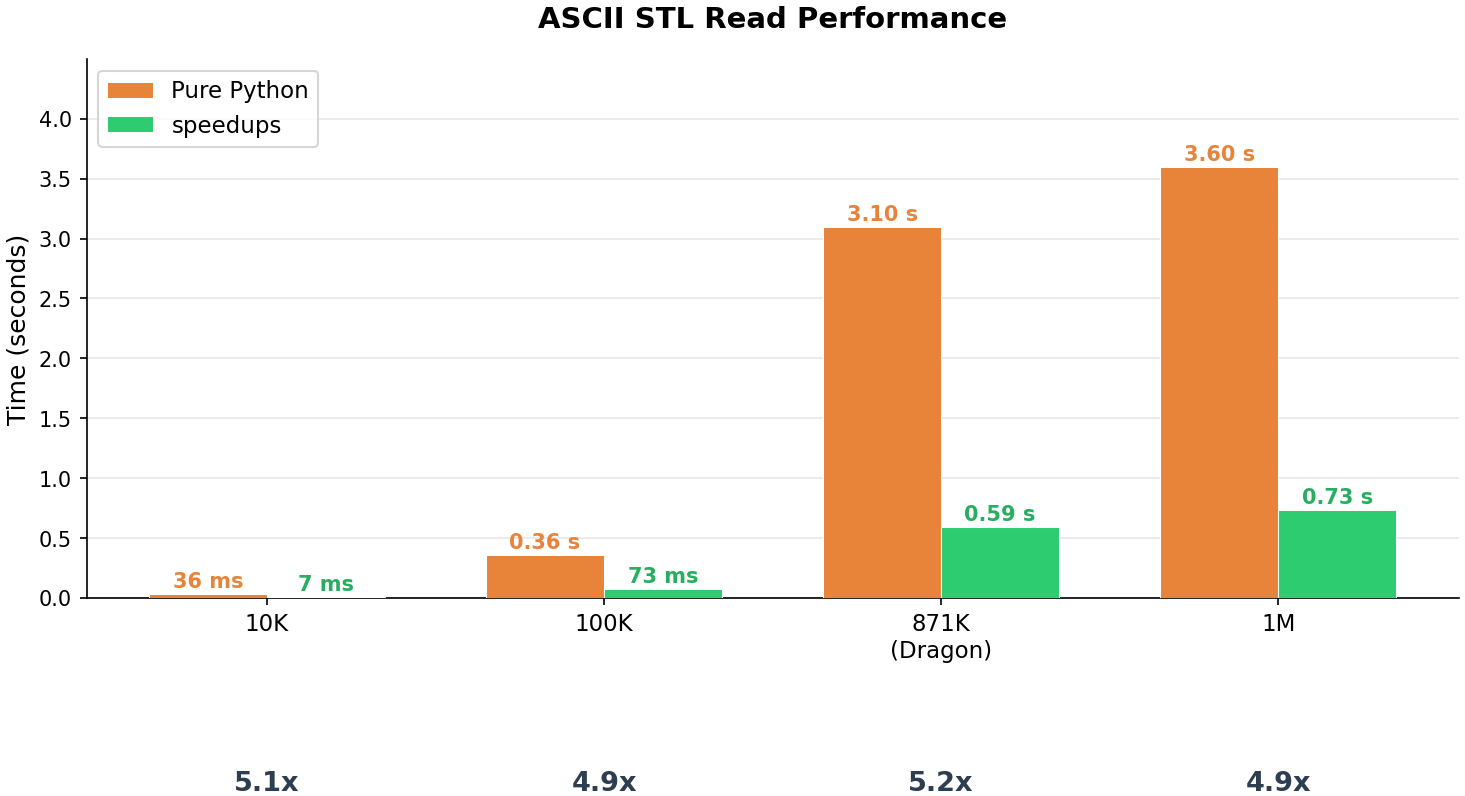
ASCII STL read performance — ~5x faster with the speedups C extension, consistent across data sizes (median of 5 runs):
| Facets | Pure Python | Speedups | Factor |
|---|---|---|---|
| 10,000 | 36 ms | 7 ms | 5.1x |
| 100,000 | 0.36 s | 73 ms | 4.9x |
| 871,414 | 3.10 s | 0.59 s | 5.2x |
| 1,000,000 | 3.60 s | 0.73 s | 4.9x |
Note: Results will vary by hardware. Run the benchmark yourself:
python benchmarks/benchmark_ascii_read.py
Usage Examples
Creating a Mesh from Scratch
import numpy as np
from stl import mesh

# Define vertices and faces of a cube
vertices = np.array([
    [-1, -1, -1], [+1, -1, -1], [+1, +1, -1], [-1, +1, -1],
    [-1, -1, +1], [+1, -1, +1], [+1, +1, +1], [-1, +1, +1],
])
faces = np.array([
    [0, 3, 1], [1, 3, 2], [0, 4, 7], [0, 7, 3],
    [4, 5, 6], [4, 6, 7], [5, 1, 2], [5, 2, 6],
    [2, 3, 6], [3, 7, 6], [0, 1, 5], [0, 5, 4],
])

cube = mesh.Mesh(np.zeros(faces.shape[0], dtype=mesh.Mesh.dtype))
for i, f in enumerate(faces):
    for j in range(3):
        cube.vectors[i][j] = vertices[f[j], :]

cube.save('cube.stl')
Rotating and Translating
import math
from stl import mesh

m = mesh.Mesh.from_file('model.stl')
m.rotate([0, 0, 1], math.radians(90))
m.translate([10, 0, 0])
m.save('transformed.stl')
Mass Properties
from stl import mesh

m = mesh.Mesh.from_file('closed_model.stl')
volume, cog, inertia = m.get_mass_properties()
print(f'Volume: {volume:.4f}')
print(f'Center of gravity: {cog}')
Combining Meshes
import numpy as np
from stl import mesh

m1 = mesh.Mesh.from_file('part1.stl')
m2 = mesh.Mesh.from_file('part2.stl')
combined = mesh.Mesh(np.concatenate([m1.data, m2.data]))
combined.save('combined.stl')
Plotting with Matplotlib
import math
from stl import mesh
from mpl_toolkits import mplot3d
from matplotlib import pyplot

figure = pyplot.figure(figsize=(8, 6))
axes = figure.add_subplot(projection='3d')

dragon = mesh.Mesh.from_ply_file('dragon_vrip.ply')
dragon.rotate([1, 0, 0], math.radians(-90))

axes.add_collection3d(
    mplot3d.art3d.Poly3DCollection(dragon.vectors)
)

scale = dragon.points.flatten()
axes.auto_scale_xyz(scale, scale, scale)
pyplot.show()
API Cheatsheet
Assumes import math, import numpy as np, from stl import mesh, and
from stl import Mode (for the ASCII save).
| Task | Call |
|---|---|
| Load (auto-detect) | mesh.Mesh.from_file('m.stl') |
| Load PLY | mesh.Mesh.from_ply_file('m.ply') |
| Load 3MF (experimental) | list(mesh.Mesh.from_3mf_file('m.3mf')) |
| Save (auto/format) | m.save('out.stl') |
| Save as ASCII | m.save('out.stl', mode=Mode.ASCII) |
| Save PLY | m.save_ply('out.ply') |
| Rotate (axis, radians) | m.rotate([0, 0, 1], math.radians(90)) |
| Translate | m.translate([x, y, z]) |
| Transform (4x4 matrix) | m.transform(matrix) |
| Bounding box | m.min_, m.max_ |
| Mass properties | volume, cog, inertia = m.get_mass_properties() |
| With density | vol, mass, cog, inertia = m.get_mass_properties_with_density(d) |
| Combine meshes | mesh.Mesh(np.concatenate([a.data, b.data])) |
CLI Tools
# Convert ASCII to binary
stl2bin input.stl output.stl

# Convert binary to ASCII
stl2ascii input.stl output.stl

# Auto-detect and convert
stl input.stl output.stl
Documentation
Full documentation is available at numpy-stl.readthedocs.io.
Contributing
Contributions are welcome! See CONTRIBUTING.md for the development setup guide.
Links
License
BSD-3-Clause
2 maintainers


Release files for numpy-stl 4.0.1
For a detailed explanation of source distributions (sdists) and built distributions (wheels), please see the package formats documentation.
Source distribution (sdist)
| File | Size | Uploaded | |
|---|---|---|---|
| numpy_stl-4.0.1.tar.gz | 30.2 kB | Details |
Built distribution (wheel)
| File | Interpreter | ABI | Platform | Reset |
|---|---|---|---|---|
| numpy_stl-4.0.1-py3-none-any.whl | Python 3 | none | any | Details |
Total release size: 62.9 kB
Release files / numpy_stl-4.0.1.tar.gz
| Download URL | numpy_stl-4.0.1.tar.gz |
|---|---|
| Size | 30.2 kB |
| Tags | Source |
|
SHA-256 checksum How to use checksums |
1e15e32d7de01fec66706a54c40b234f357c877c07d3add0fbe247aa9151a583
|
|
BLAKE2b-256 checksum How to use checksums |
15140242990083251bdf748706a5043816f5adee6a12109fb6c8b5279ee2312b
|
| Upload date | |
|
Uploaded using Trusted Publishing? What is trusted publishing? |
Yes |
| Uploaded via |
twine/7.0.0 CPython/3.13.14
|
Provenance
Provenance describes where a file came from. On PyPI, provenance is shared via attestations, which provide a verifiable record of the build or publishing details. View details, limitations and caveats.


PyPI Publish Attestation
PyPI verified that this artifact, at this checksum, originated from the publisher listed below.
Signed by GitHub Actions, verified by PyPI on Sep 7, 2026.
Transparency logRelease files / numpy_stl-4.0.1-py3-none-any.whl
| Download URL | numpy_stl-4.0.1-py3-none-any.whl |
|---|---|
| Size | 32.8 kB |
| Tags | Python 3 |
|
SHA-256 checksum How to use checksums |
c5f59a996d30c6e6948f9f855d5a7dd853b8faa466846b8b2d3cf553e5526489
|
|
BLAKE2b-256 checksum How to use checksums |
98370700f20f963c381ae7dde97b6036a2acfd92c2656a2581fb292a573fc63f
|
| Upload date | |
|
Uploaded using Trusted Publishing? What is trusted publishing? |
Yes |
| Uploaded via |
twine/7.0.0 CPython/3.13.14
|
Provenance
Provenance describes where a file came from. On PyPI, provenance is shared via attestations, which provide a verifiable record of the build or publishing details. View details, limitations and caveats.
PyPI Publish Attestation
PyPI verified that this artifact, at this checksum, originated from the publisher listed below.
Signed by GitHub Actions, verified by PyPI on Sep 7, 2026.
Transparency log













