
Try OpenDPD Studio in your browser →
No installation. Explore example data or upload your own CSV, train PA/DPD models on shared CUDA compute, and download your checkpoints. During the trial, 2 hours without user activity clears that IP’s temporary workspaces; all data is deleted within 12 hours.
OpenDPD


Model a power amplifier. Train a digital predistorter. Understand the result.
OpenDPD is a PyTorch framework for power amplifier (PA) modeling and digital predistortion (DPD), developed by the Efficient Machine Intelligence Lab at TU Delft. Use OpenDPD Studio in the browser or locally for a guided workflow, or automate experiments with the CLI and Python API. All three use the original OpenDPD training core.



Documentation · Studio walkthrough · Examples & Colab · Papers & citation
What's new
OpenDPD 2.2.12 fixes DeltaGRU PA training failing when Triton cannot find a C compiler. The hosted GPU runtime includes the required toolchain; local installations fall back to PyTorch on the same device. Studio also includes: 1,186 compact matrix presets, multi-preset datasets, optional ideal input filtering, automatic Virtual PA dataset creation, and CSV/ZIP downloads with a standalone PA replay script. Signal Analyzer accepts real or complex CSV signals.
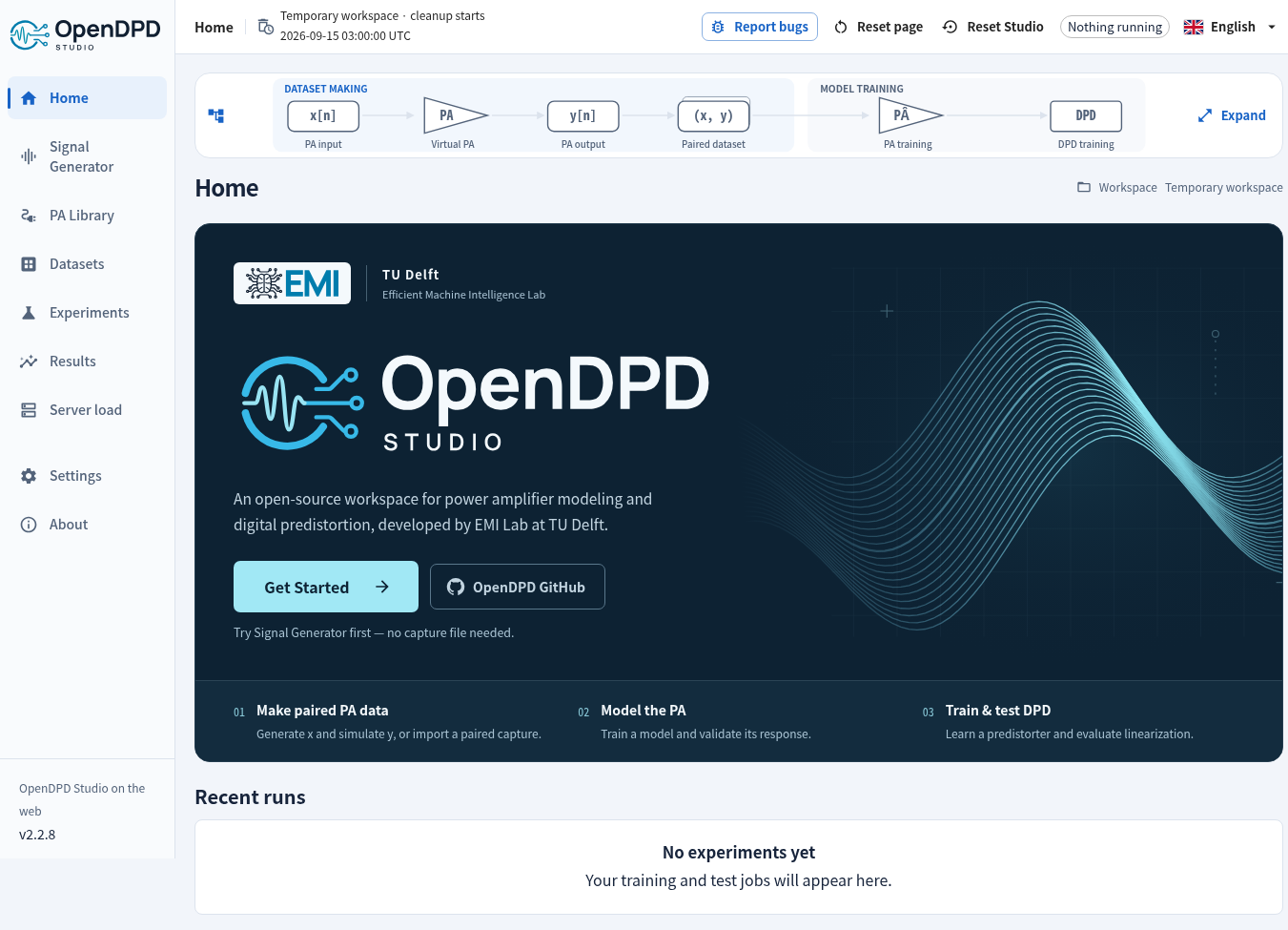
Signal Generator → PA Library → PA training → DPD training/testing. Generate a PA input, simulate its output with one of nine Virtual PAs, or use existing input/output data. Standard presets are uncoded engineering stimuli; each capture keeps its own sample rate and length.
2.2.12 release notes · Signal Generator · Signal Analyzer. During the hosted trial, 2 hours of inactivity clears that IP’s temporary workspaces; the top bar shows the expiry time.
Feature history · Verified platform status
Get started with Studio
Use Studio on the web, or install locally:
1. Install uv (then open a new terminal).
macOS / Linux:
curl -LsSf https://astral.sh/uv/install.sh | sh
Windows PowerShell:
powershell -ExecutionPolicy ByPass -c "irm https://astral.sh/uv/install.ps1 | iex"
2. Create an environment, install, and launch (same commands on all three platforms):
mkdir opendpd-lab
cd opendpd-lab
uv venv --python 3.12
uv pip install --python .venv "opendpd==2.2.12" --torch-backend=auto
uv run --no-project --python .venv opendpd gui
PyTorch, Studio and pywebview install together; no Node.js is needed. uv selects a PyTorch backend for the detected platform/drivers. Studio prefers available CUDA or Apple MPS, then CPU. Keep the terminal running. A 127.0.0.1 link opens on the computer running OpenDPD; for SSH, use the port-forwarding instructions.
Click Get Started → Signal Generator, or Use an existing dataset. See Installation for drivers, Linux system libraries, native-window troubleshooting and pip; Studio walkthrough for your first experiment.
Develop from source (Git and Node.js 22.22+ required)
git clone https://github.com/lab-emi/OpenDPD.git
cd OpenDPD
uv venv --python 3.12
uv pip install --python .venv -e ".[dev]" --torch-backend=auto
npm --prefix frontend ci
npm --prefix frontend run build
uv run --no-project --python .venv opendpd gui
The PA → DPD workflow
| Step | What you do | What you learn |
|---|---|---|
| 1. Make or select data | Generate x → configure a Virtual PA → simulate y → create a paired dataset; or open existing x/y data. | Input/output provenance, signal quality and data splits. |
| 2. Model the PA | Train a behavioral model, then test it on held-out data. | How closely it predicts the dataset response, measured or explicitly synthetic. |
| 3. Train DPD | Place a predistorter before the trained PA model. | Whether the simulated cascade becomes more linear. |
| 4. Test & export | Compare results and export the predistorted I/Q signal. | A PA input signal ready for a separate measurement experiment. |
A DPD result evaluated through a PA model is a simulation. Exported u = DPD(x) is the PA input; a physical PA measurement is needed to establish measured linearization performance. See the Studio walkthrough and measured DPD guide.
PA Library guide · Reading signal-chain PSD plots

Choose your next step
| I want to… | Read |
|---|---|
| Run the same workspace experiments from a terminal | Headless CLI |
| Train from Python or try a notebook | Examples · API reference |
| Understand the original training pipeline and quantization | Training guide |
| Use my own I/Q measurements through Python or the CLI | Dataset formats · Import & preprocessing |
| Configure plots, animations and dashboards | Visualization guide |
| Compare models or reproduce a paper | Benchmark · Reproduction guide |
| Evaluate waveforms, streaming or hardware export | Advanced guides |
| Resolve installation or signal-metric questions | FAQ |
Contribute & cite
Contributions of models, tests and documentation are welcome. Start with CONTRIBUTING.md; see testing and how we maintain the docs.
If you use OpenDPD in research, cite the OpenDPD paper. BibTeX and related papers · CITATION.cff
Chang Gao — Project Leader · Yizhuo Wu — Leading Developer. Meet the team · EMI Lab
1 maintainer

Download files
Download the file for your platform. If you're not sure which to choose, learn more about installing packages.
Source Distribution
Built Distribution
Filter files by name, interpreter, ABI, and platform.
If you're not sure about the file name format, learn more about wheel file names.
Copy a direct link to the current filters
File details
Details for the file opendpd-2.2.12.tar.gz.
File metadata
- Download URL: opendpd-2.2.12.tar.gz
- Upload date:
- Size: 26.1 MB
- Tags: Source
- Uploaded using Trusted Publishing? Yes
- Uploaded via:
twine/7.0.0 CPython/3.13.14
File hashes
| Algorithm | Hash digest | |
|---|---|---|
| SHA256 |
445a4f069f81de38fb800124982720ff97c95fc48c9e65d913310a0823d3e83a
|
|
| MD5 |
967fd411e38506f3372a77fae9d8b4ef
|
|
| BLAKE2b-256 |
247500775019f4da1837a9048f19da047a5fd51775e0c482128eed5555c86c1d
|
Provenance
The following attestation bundles were made for opendpd-2.2.12.tar.gz:
Publisher:
publish.yml on lab-emi/OpenDPD
-
Statement:
-
Statement type:
https://in-toto.io/Statement/v1 -
Predicate type:
https://docs.pypi.org/attestations/publish/v1 -
Subject name:
opendpd-2.2.12.tar.gz -
Subject digest:
445a4f069f81de38fb800124982720ff97c95fc48c9e65d913310a0823d3e83a - Sigstore transparency entry: 2883409963
- Sigstore integration time:
-
Permalink:
lab-emi/OpenDPD@f377ad36bf4a8f720ca22680f33883da2c896de4 -
Branch / Tag:
refs/tags/v2.2.12 - Owner: https://github.com/lab-emi
-
Access:
public
-
Token Issuer:
https://token.actions.githubusercontent.com -
Runner Environment:
github-hosted -
Publication workflow:
publish.yml@f377ad36bf4a8f720ca22680f33883da2c896de4 -
Trigger Event:
release
-
Statement type:
File details
Details for the file opendpd-2.2.12-py3-none-any.whl.
File metadata
- Download URL: opendpd-2.2.12-py3-none-any.whl
- Upload date:
- Size: 26.4 MB
- Tags: Python 3
- Uploaded using Trusted Publishing? Yes
- Uploaded via:
twine/7.0.0 CPython/3.13.14
File hashes
| Algorithm | Hash digest | |
|---|---|---|
| SHA256 |
1efa817a6a68c94c651e7788c63c0a561fb99c870836aefbb55235082f81b361
|
|
| MD5 |
ac88e2dff48db0dc4c198c6511498899
|
|
| BLAKE2b-256 |
c7bc097aec58cc9a85aff43189f7447c9cacb6b20970e43a734b25a25a15c564
|
Provenance
The following attestation bundles were made for opendpd-2.2.12-py3-none-any.whl:
Publisher:
publish.yml on lab-emi/OpenDPD
-
Statement:
-
Statement type:
https://in-toto.io/Statement/v1 -
Predicate type:
https://docs.pypi.org/attestations/publish/v1 -
Subject name:
opendpd-2.2.12-py3-none-any.whl -
Subject digest:
1efa817a6a68c94c651e7788c63c0a561fb99c870836aefbb55235082f81b361 - Sigstore transparency entry: 2883409972
- Sigstore integration time:
-
Permalink:
lab-emi/OpenDPD@f377ad36bf4a8f720ca22680f33883da2c896de4 -
Branch / Tag:
refs/tags/v2.2.12 - Owner: https://github.com/lab-emi
-
Access:
public
-
Token Issuer:
https://token.actions.githubusercontent.com -
Runner Environment:
github-hosted -
Publication workflow:
publish.yml@f377ad36bf4a8f720ca22680f33883da2c896de4 -
Trigger Event:
release
-
Statement type:














