
English · 中文

Let AI agents see and drive a real iPhone from your Mac, over USB or Wi-Fi.


Install · Tools · Sharing · Scripts · Troubleshooting · Security
An MCP server for screenshots, on-screen text, taps, swipes, typing, buttons, apps and the clipboard on an iPhone connected to your Mac. Nothing to install on the phone.
 |
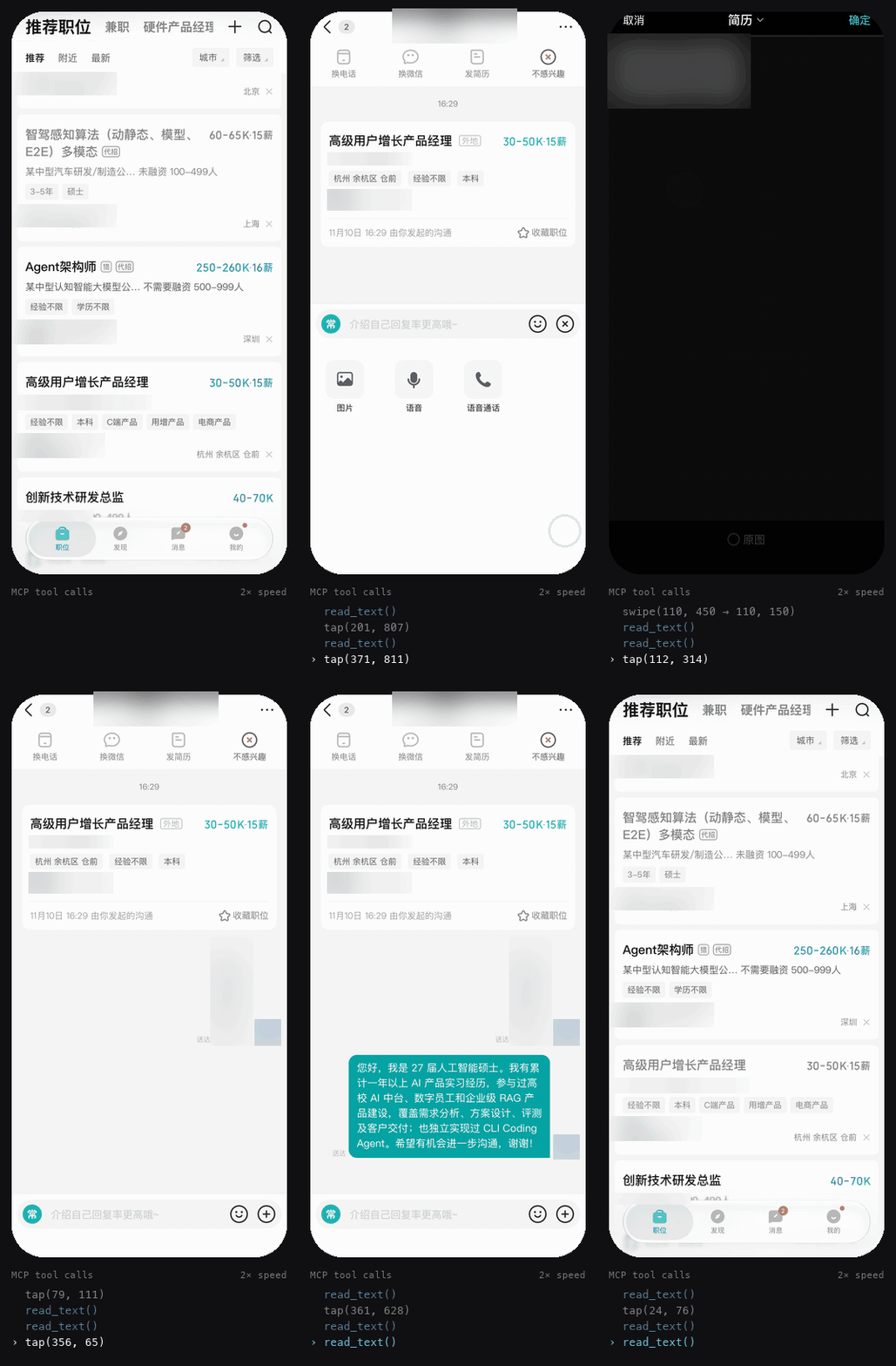 |
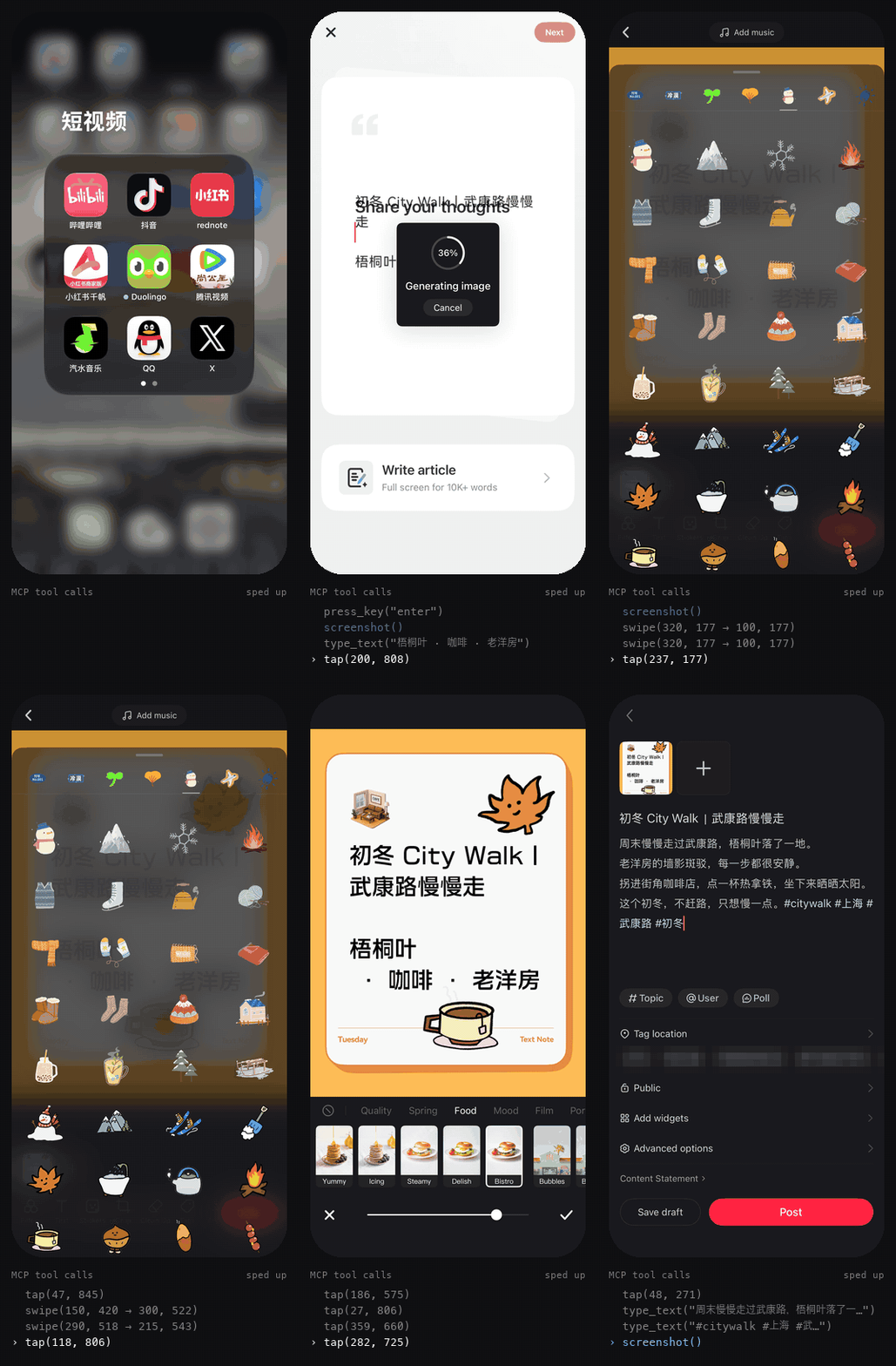
| An AI agent makes a rednote post: text card, template, stickers, filter, caption. It stops before Post. Sped up. | A script applies to a job in a recruiting app: read_text finds the buttons, tap presses them. 2× speed. |
Requirements
- A Mac with uv
- An iPhone on iOS 27 or later, with Developer Mode on
- A USB data cable for the first setup. After that, Wi-Fi works too
Tested on an iPhone 17 Pro with iOS 27.2 and macOS 27.
Install
Let your agent install it
Paste this to your coding agent (Claude Code, Codex, Cursor…):
Install phonectl-mcp by following https://github.com/jiefeng-ai/phonectl-mcp#install-by-hand and add it to your MCP config. Run
phonectl doctoruntil it passes. When I need to do something on the phone, tell me step by step and wait for me. Finally, tell me how to restart you so the phone tools load.
After the restart, ask the agent for a screenshot of the phone.
Install by hand
Run all three:
uv tool install phonectl-mcp
phonectl install-service   # runs the server at login on http://127.0.0.1:47321/mcp
phonectl doctor            # checks cable, trust, Developer Mode, disk image and server
install-service also creates an access token in ~/.config/phonectl/token. Then connect the agent you use, one command per agent:
phonectl setup claude-code # or: codex, gemini (the desktop app), deepseek-harness
setup adds the server to the agent's MCP config, with the token, installs the phonectl-scripts skill (the rules for a script that shares the phone: wait in line, yield between units of work, survive being interrupted), and, for Claude Code, Codex and Gemini, a hook that frees the phone when the agent's turn ends (Codex asks you to approve it once, under Hooks need review). Before it first changes a file, it keeps the original as <file>.phonectl.bak, and it prints what it changed. phonectl setup alone lists the agents it knows; phonectl setup --remove <agent> takes all of it out again. After upgrading phonectl, phonectl update brings the skill up to date in every agent set up this way (doctor says when one is behind); a skill you edited by hand is left as it is.
Other clients by hand (~/.cursor/mcp.json and others with streamable HTTP). This gives the agent the phone, but not the skill: scripts it writes will not know to yield the phone to other agents.
{
  "mcpServers": {
    "phone": {
      "url": "http://127.0.0.1:47321/mcp",
      "headers": { "Authorization": "Bearer <contents of ~/.config/phonectl/token>" }
    }
  }
}
Restart the client so it loads the server, then ask your agent for a screenshot of the phone.
After one setup over the cable, it also works over Wi-Fi while the phone and the Mac share a network.
Tools
Coordinates are iOS points, the same as the pixels of the returned screenshot.
| Tool | What it does |
|---|---|
screenshot |
Captures the screen |
read_text |
Text on screen with positions, as JSON. Much cheaper than an image |
tap_text, wait_text |
Tap text found on screen; wait until text appears or goes away |
tap, long_press, swipe |
Touch. To scroll down, swipe upward |
type_text |
Types into the focused field by pasting, so the phone's input method cannot change it; submit with press_key('enter'). method="keys" types key by key, for fields that refuse pasting |
press_key |
A key or chord, such as enter or cmd+a |
press_button |
home, lock, volume-up, volume-down, mute, siri |
launch_app, list_apps |
Opens apps (with url, hands the app a link to open), finds bundle ids |
get_clipboard, set_clipboard |
The phone's clipboard |
status |
The server, the phone link, and who is using the phone |
Tools that act on the phone return a screenshot taken afterwards (screenshot=False skips it). Taps are not confirmed, so check that screenshot.
Several agents, one phone
All clients of the server share the phone, and they take turns: a client that starts using it keeps it for its whole task, until it says it is done: its turn ends (an end-of-turn hook, below), a script yields between units of work, or its process exits. The server does not guess the end of a task from the pauses between calls; only a client that made no call for 90 s while someone waits is taken to be done, and it gets back in line on its next call. A call from another client meanwhile waits in line instead of landing on the other agent's screen. A wait lasts at most 50 s, shorter than any agent's own tool timeout; then the call ends with WAITING, having done nothing, and the client keeps its place in line for 2 minutes: calling again carries on from there. Agents read WAITING as a reason to call again, not as a failure. status says who has the phone and who waits.
- Clients are told apart by their process: a Claude Code session and its subagents are one client. A script that an agent runs counts as that agent, so it neither waits for the agent nor takes the phone from it; a script started from a terminal is a client of its own. A process that runs several independent tasks sends a header
X-Phonectl-Client: <name>per task. When a client's process exits, the phone is free at once, named or not. - A tap, swipe, typing or key press is sent only if the process making it has looked at the screen since anyone else changed it (a script an agent runs is its own process here: its look does not show the agent the screen, and its taps make the agent look again). Otherwise the call fails with
NOT DONEand nothing is sent; look at the screen and repeat it. This also holds for a process's first such input after the server starts, since the server cannot know who used the phone before.tap_textis held to the same rule, since the text it finds may be in someone else's app, unless the caller has opened its own app withlaunch_appsince.launch_appandpress_buttonneed no old coordinates and are always sent. A process an agent starts for the first time counts as having seen what the agent last saw (a tool run once per call looks in one run and taps in the next); the server cannot tell which of an agent's processes it read the screen from. - A long-running script gives the phone up between two units of work with
POST /phonectl/yield(same token), which hands it over only if someone is waiting. Without that, others wait until it exits, makes no call for 90 s, or has held the phone for 30 minutes. - When an agent's turn ends, its hook can say so with
POST /phonectl/done, and the phone is free at once instead of after 90 s;phonectl setupadds that hook to Claude Code, Codex and Gemini. The server tells clients apart by process, so all conversations of one desktop app (Codex's, Gemini's) are one client: any of them ending its turn frees the phone, and another that was using it gets back in line on its next call. - The server cannot see you using the phone by hand:
phonectl hold 30mkeeps agents off it,phonectl hold offends that.
Scripts
A fixed sequence of steps does not need a model to think between them. As a script, it is one command for the agent instead of one model round trip per step. A script is just another MCP client of the same server, on any MCP library; with the official Python SDK:
# /// script
# dependencies = ["mcp>=2.3,<3"]
# ///
import asyncio, json
from pathlib import Path
from mcp.client.session import ClientSession
from mcp.client.streamable_http import streamable_http_client
from mcp.shared._httpx_utils import create_mcp_http_client

async def main():
    token = (Path.home() / ".config/phonectl/token").read_text().strip()
    http = create_mcp_http_client(headers={"Authorization": f"Bearer {token}"})
    async with streamable_http_client("http://127.0.0.1:47321/mcp", http_client=http) as (read, write, *_):
        async with ClientSession(read, write) as phone:
            await phone.initialize()
            for tool, args in [("launch_app", {"bundle_id": "com.apple.Preferences", "restart": True}),
                               ("tap_text", {"text": "Wi-Fi", "timeout_s": 5, "settle_ms": 1000}),
                               ("read_text", {})]:
                args = {**args, "screenshot": False} if tool != "read_text" else args
                result = await phone.call_tool(tool, args)
                while result.is_error and result.content[0].text.startswith("WAITING"):
                    result = await phone.call_tool(tool, args)  # another client has the phone: same place in line
                if result.is_error:  # NOT DONE, the phone gone: stop instead of carrying on
                    return f"{tool}: {result.content[0].text}"
            return [line["t"] for line in json.loads(result.content[0].text)]

print(asyncio.run(main()))
Run it with uv run script.py. Its calls share the phone like an agent's: they wait while another client has it, a refused call is an error result, and the phone is free as soon as the script exits.
Troubleshooting
Run phonectl doctor first. It tells you which link is broken.
| Symptom | Fix |
|---|---|
| No iPhone found | Use a data cable, unlock the phone, replug |
| "Mac is not trusted" | Unlock the phone, replug, tap Trust |
| No Developer Mode switch | Run phonectl doctor --fix; the switch appears under Settings › Privacy & Security |
| Disk image install fails | The server installs the developer disk image on first connect and downloads it from GitHub; check the network or proxy, then phonectl restart |
| Taps do nothing | Needs iOS 27+; keep the screen on and unlocked |
| Wi-Fi link drops | A locked phone leaves the network for up to minutes at a time. Unlock it and wait a few seconds |
| Clients cannot connect | phonectl restart, then check ~/Library/Logs/phonectl.error.log. A 401 means the client's token differs from ~/.config/phonectl/token |
Security
- The server listens only on
127.0.0.1and rejects requests without the token. - An agent can do anything your finger can: send messages, pay, delete. Keep its instructions narrow and watch the screen. Use at your own risk; automating third-party apps may break their terms.
Settings
Environment variables (set them, then run phonectl install-service again; restart keeps the old values)
| Variable | Default | Meaning |
|---|---|---|
PHONECTL_UDID |
first connected iPhone | Which phone to use when several are connected |
PHONECTL_PORT |
47321 |
HTTP port (127.0.0.1 only) |
PHONECTL_TOKEN_FILE |
~/.config/phonectl/token |
Where the token is kept |
PHONECTL_SCALE |
3 |
Pixels per point; 2 on iPhone SE, XR, 11. Only affects screenshot size |
PHONECTL_OCR_LANGS |
zh-Hans,en-US |
read_text languages, in priority order |
PHONECTL_SETTLE |
0.6 |
Seconds to wait before the screenshot after an action; settle_ms overrides it per call |
PHONECTL_TOUCH_IDLE |
30 |
Idle seconds before the input stream closes (reopening takes ~0.6 s) |
PHONECTL_KEY_IDLE |
5 |
Seconds without a key before the virtual keyboard detaches, so the on-screen keyboard comes back |
PHONECTL_CALL_TIMEOUT |
15 |
Seconds to wait for the phone, on top of the gesture time |
PHONECTL_IDLE |
90 |
Seconds without a call after which a client that has not said it is done counts as done, if someone waits |
PHONECTL_WAIT |
50 |
Seconds a call waits in line before it ends with WAITING; keep it below the clients' own tool timeouts |
PHONECTL_MAX_HOLD |
1800 |
After holding the phone this long, a client lets a waiting one go first |
PHONECTL_LOG |
WARNING |
Log level (INFO for the service, which logs each call with its client); logs in ~/Library/Logs/phonectl*.log; a log over 10 MB moves to <file>.1, replacing the older one |
Other commands: phonectl restart (e.g. after uv tool upgrade phonectl-mcp). To remove: phonectl uninstall-service, uv tool uninstall phonectl-mcp, and delete ~/.config/phonectl.
License
MIT
1 maintainer

Metadata
1 maintainer
Release files for phonectl-mcp 0.2.0
For a detailed explanation of source distributions (sdists) and built distributions (wheels), please see the package formats documentation.
Source distribution (sdist)
| File | Size | Uploaded | Provenance | Actions |
|---|---|---|---|---|
| phonectl_mcp-0.2.0.tar.gz | 180.6 kB | With provenance | Details for phonectl_mcp-0.2.0.tar.gz |
Built distribution (wheel)
| File | Interpreter | ABI | Platform | Actions Reset |
|---|---|---|---|---|
| phonectl_mcp-0.2.0-py3-none-any.whl | Python 3 | none | any | Details for phonectl_mcp-0.2.0-py3-none-any.whl |
Total release size: 239.0 kB
Release files / phonectl_mcp-0.2.0.tar.gz
| Download URL | phonectl_mcp-0.2.0.tar.gz |
|---|---|
| Size | 180.6 kB |
| Tags | Source |
|
SHA-256 checksum How to use checksums |
1a60f441e62b1e42270409e2d382b20826c7eb2a320e129ae6e26cbfc185c8ad
|
|
BLAKE2b-256 checksum How to use checksums |
c122776c6847aaed21eb2c818cee363f7b52e4a8acb5b8c5b99b5d49d390354d
|
| Upload date | |
|
Uploaded using Trusted Publishing? What is trusted publishing? |
Yes |
| Uploaded via |
twine/7.0.0 CPython/3.13.16
|
Provenance
Provenance describes where a file came from. On PyPI, provenance is shared via attestations, which provide a verifiable record of the build or publishing details. View details, limitations and caveats.


PyPI Publish Attestation
PyPI verified that this artifact, at this checksum, originated from the publisher listed below.
Signed by GitHub Actions, verified by PyPI on Nov 23, 2026.
Transparency logRelease files / phonectl_mcp-0.2.0-py3-none-any.whl
| Download URL | phonectl_mcp-0.2.0-py3-none-any.whl |
|---|---|
| Size | 58.4 kB |
| Tags | Python 3 |
|
SHA-256 checksum How to use checksums |
9e80ae9d92036f1b528165bbd341049f1165a23ef1b0f74a798768be03b3228a
|
|
BLAKE2b-256 checksum How to use checksums |
a82eac128a11ec3211235880bc7f8232bc9237dfe9aa9c2b201a7cb6a172d610
|
| Upload date | |
|
Uploaded using Trusted Publishing? What is trusted publishing? |
Yes |
| Uploaded via |
twine/7.0.0 CPython/3.13.16
|
Provenance
Provenance describes where a file came from. On PyPI, provenance is shared via attestations, which provide a verifiable record of the build or publishing details. View details, limitations and caveats.
PyPI Publish Attestation
PyPI verified that this artifact, at this checksum, originated from the publisher listed below.
Signed by GitHub Actions, verified by PyPI on Nov 23, 2026.
Transparency logSecurity for phonectl-mcp 0.2.0
Provenance
Provenance describes where a file came from. On PyPI, provenance is shared via attestations, which provide a verifiable record of the build or publishing details. View details, limitations and caveats.
Full provenance
Both files in this release have been uploaded with provenance metadata.
Attestation for phonectl_mcp-0.2.0.tar.gz
PyPI Publish Attestation
PyPI verified that this artifact, at this checksum, originated from the publisher listed below.
Signed by GitHub Actions, verified by PyPI on Nov 23, 2026.
Transparency logA note on package security
PyPI is a repository for distributing packages, not a service for auditing them. While third-party security researchers and our staff do their best to detect and remove malicious packages, PyPI cannot guarantee the quality, security or suitability of any given package.
To learn more about protecting yourself from malicious actors, visit our package security documentation.














