

Turn your expertise into an AI-powered App, MCP or API
Describe how the work gets done in plain English, and your coding agent builds it into a method with the Pipelex plugin. A method is a multi-step, deterministic AI procedure that chains LLMs, OCR, image generation and more. Then run it as a webapp for your team or as SaaS for your customers, from your agent or your chatbot via MCP, or via API in any software.



Quick start
Pipelex lets you build AI methods with your coding agent and run them anywhere — from your agent or your chatbot via MCP, as a webapp, or via API in any software.
1. Sign up at app.pipelex.com.
2. Install the Pipelex plugin in your coding agent. The plugin is how you build methods: it gives your agent the skills that write and run them, a hook that checks every edit, and the Pipelex tools.
Claude Code
claude plugin marketplace add Pipelex/pipelex-plugins
claude plugin install pipelex@pipelex-plugins
Claude Code asks for an API key when you enable the plugin, and stores it in your OS keychain — create one in your console at app.pipelex.com. The skills, the hook that checks every edit and the Pipelex tools load with it. The plugin's hook and the Pipelex tools run on Node.js, so you need Node.js on your PATH.
Claude Code also loads what you have added to your Claude account, so if the Pipelex MCP is there, turn it off in Claude Code with /mcp: an agent with the plugin never takes both, since they register the same tool names.
Codex
codex plugin marketplace add Pipelex/pipelex-plugins
export PIPELEX_API_KEY=plx_sk_...     # create one in your console at app.pipelex.com
Restart Codex, run /plugins to install pipelex, and trust the plugin hook on first run. Requires Codex 0.141 or later. The plugin's hook and the Pipelex tools run on Node.js, so you need Node.js on your PATH.
3. Ask your agent for the method you want.
Design a method that reads an invoice PDF and returns the supplier, the total and the line items. Then run it on
~/Downloads/invoice.pdfand save it to my Pipelex account.
/pipelex-design writes the method, the hook checks it on every edit, /pipelex-run starts it and prints a run id you can come back to, and /pipelex-catalog saves it to your account, where your chatbot can run it too.
Run your methods from your chatbot. The Pipelex MCP is a connector for your chatbot (ChatGPT, Claude): it gives it access to the Pipelex service, so it can list the methods saved in your account and run them right in the conversation. Your methods become your chatbot's tools. To build a method, use the Pipelex plugin in a coding agent such as Claude Code or Codex, as in steps 2 and 3 above.
Add the Pipelex MCP in your chatbot's settings by the address below — in Claude, that is Add custom connector — then sign in with your Pipelex account when asked. Nothing to install and no key: the Pipelex MCP runs on your signed-in session.
https://mcp.pipelex.com/mcp
Then ask your chatbot:
What methods do I have?
Run the invoice method on https://example.com/invoice.pdf
You get a run id straight away, and you can ask for its status, its results or the files it produced at any time.
Give the file as a URL the Pipelex MCP can reach. In ChatGPT you can attach it to the conversation instead and ask for a run on it; Claude has no way yet to hand the Pipelex MCP a file you attached.
The other two ways. Turn the method into a webapp with the method-app template, or use it via API in any software through POST /v1/start — in TypeScript with @pipelex/sdk, in Python with pipelex-sdk, or with any HTTP client.
Next: what Pipelex is · documentation · your console · Discord
Prefer to run it yourself? This repository is the Pipelex runtime — its own install and configuration are below.
Run it yourself
This repository is the Pipelex runtime: the Python package that reads a .mthds file and runs it. Install it and everything happens on your own machine, against the model providers you choose.
Install
uv tool install pipelex
pipelex init
pipelex doctor
pipelex init writes your ~/.pipelex configuration and offers to install the editor extension; pipelex doctor reports what is configured and what is missing.
Some providers and features need an extra:
anthropic: Anthropic/Claude support for text generationgoogle: Google models (Vertex) support for text generationgoogle-genai: Google Gemini API support for text and image generationmistralai: Mistral AI support for text generation and OCRbedrock: Amazon Bedrock support for text generationfal: Image generation through fallinkup: Web search with Linkupdocling: OCR with Docling
Name the ones you need when you install, or take them all:
uv tool install "pipelex[anthropic,google,google-genai,mistralai,bedrock,fal,linkup,docling]"
Configure AI Access
- Bring Your Own Keys — Use existing API keys from OpenAI, Anthropic, Google, Mistral, etc. See Configure AI Providers.
- Local AI — Ollama, vLLM, LM Studio, or llama.cpp — no API keys required. See Configure AI Providers.
Run a method
Save the method shown under What a method looks like, further down, as summarize.mthds, and its inputs as inputs.json:
{
  "article": "Paste the text of an article here.",
  "audience": "busy executives"
}
The method names no model, so it runs on the deck's default-general alias, which pipelex init points at an OpenAI model. With a provider other than OpenAI or Azure OpenAI, point that alias at one of your provider's models first, by adding it to ~/.pipelex/inference/deck/x_custom_llm_deck.toml — the models each provider serves are listed under ~/.pipelex/inference/backends/:
[llm.aliases]
default-general = "claude-5-sonnet"     # an Anthropic model, for example
Then run it:
pipelex run bundle summarize.mthds --inputs inputs.json
The result is written under results/. For a method with several steps, typed concepts and a batch, run from the CLI and from Python, read CV batch screening, step by step.
Editor extension
.mthds syntax highlighting and flowchart visualization: the VS Code Marketplace, or the Open VSX Registry for Cursor, Windsurf and other VS Code forks. pipelex init offers to install it when it detects your IDE.
See Pipelex in action
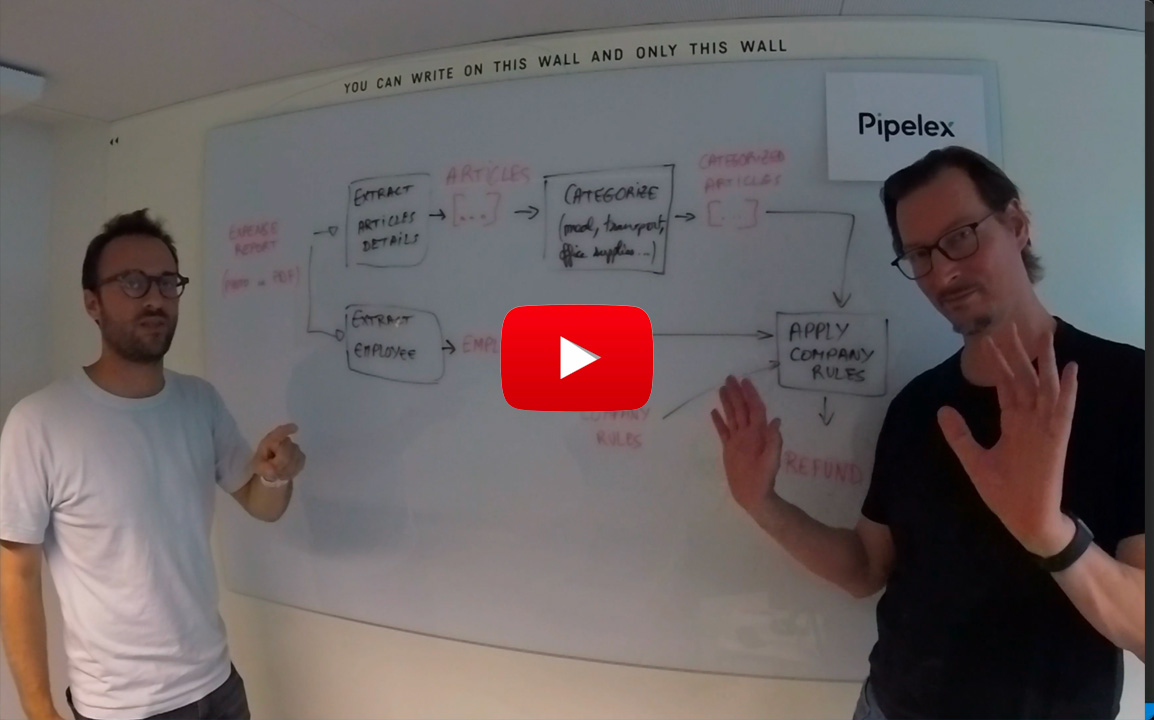
Claude Code builds your AI method
What a method looks like
A method is a reusable, typed AI procedure, written in MTHDS, an open standard, and saved as a .mthds file. Each step is explicit, each output is structured, and every run is repeatable.
domain    = "articles"
main_pipe = "summarize_article"

[pipe.summarize_article]
type        = "PipeLLM"
description = "Summarize an article for a given audience"
inputs      = { article = "Text", audience = "Text" }
output      = "Text"
prompt      = "Summarize $article in three bullet points for $audience."
From here, Pipelex handles model routing across providers, structured output parsing, and pipeline orchestration.
Why methods?
Declarative — Human-readable .mthds files that work across models |
Typed — Semantic types: AI understands what you mean, every input/output connects with purpose |
| Repeatable — Deterministic orchestration with controlled room for AI creativity | Composable — Chain pipes into sequences, nest methods inside methods, share with the community |
Run anywhere
The same .mthds file runs from multiple execution targets:
| Target | How |
|---|---|
| CLI | pipelex run bundle method.mthds --inputs inputs.json |
| Python | PipelexMTHDSProtocol().execute(...) |
| TypeScript / Node | @pipelex/sdk against the hosted API, or mthds against any MTHDS API |
| REST API | Self-host pipelex-api; the hosted API is the one in the Quick start above |
| MCP | The Pipelex MCP: your chatbot runs the methods saved in your account |
| n8n | n8n-nodes-pipelex for workflow automation |
The ecosystem
| Description | Link | |
|---|---|---|
| MTHDS standard | The open standard specification — language, package system, and typed concepts | mthds.ai |
| MTHDS Hub | Discover and share methods — browse packages, search by signature | mthds.sh |
| Pipelex plugin | The Pipelex plugin for Claude Code and Codex: skills that build and run methods, a hook that checks every edit, and the Pipelex tools | github.com/Pipelex/pipelex-plugins |
| Pipelex MCP | The Pipelex MCP, which ChatGPT or Claude adds to run the methods saved in your account | github.com/Pipelex/pipelex-mcp |
| Method library | Public methods to run by their address or to fork — github.com/Pipelex/methods/<method_name> |
github.com/Pipelex/methods |
| TypeScript starter | A Next.js app that runs methods through @pipelex/sdk, with worked examples to copy |
github.com/Pipelex/pipelex-starter-js |
Documentation
- docs.pipelex.com: the Pipelex documentation, from the MTHDS language tutorial to the CLI reference.
- CV batch screening, step by step: a production method with its concepts, its pipes and its flowchart, and how to run it from the CLI and from Python.
- The cookbook: methods to clone, run and adapt.
- The MTHDS standard: the language a method is written in.
- The changelog.
Develop
To work on Pipelex itself, fork and clone the repository, then:
make install   # create .venv and install the dependencies
make check     # formatting, lint and type checks
make test      # the unit tests
The contributing guide says how to configure .env, name a branch and open a pull request.
Community
Ask questions and share what you build on Discord, report a bug in GitHub Issues, propose an idea in Discussions, and watch demos on YouTube.
License
The Pipelex runtime is source-available under the Elastic License 2.0 (ELv2); see LICENSE for the terms, and the license page for how Pipelex reads them. Runtime dependencies are distributed under their own licenses via PyPI.
"Pipelex" is a trademark of Evotis S.A.S.
© 2025-2026 Evotis S.A.S.
1 maintainer

Release files for pipelex 0.64.2
For a detailed explanation of source distributions (sdists) and built distributions (wheels), please see the package formats documentation.
Source distribution (sdist)
| File | Size | Uploaded | |
|---|---|---|---|
| pipelex-0.64.2.tar.gz | 1.6 MB | Details |
Built distribution (wheel)
| File | Interpreter | ABI | Platform | Reset |
|---|---|---|---|---|
| pipelex-0.64.2-py3-none-any.whl | Python 3 | none | any | Details |
Total release size: 3.8 MB
Release files / pipelex-0.64.2.tar.gz
| Download URL | pipelex-0.64.2.tar.gz |
|---|---|
| Size | 1.6 MB |
| Tags | Source |
|
SHA-256 checksum How to use checksums |
d4d94484c46e0f96c446abe41be8b49b13e129d5ae7bf89ad2d38381bd20ac68
|
|
BLAKE2b-256 checksum How to use checksums |
6851a2983d9b4b32ca7d9ba7dd20f9b477686a67dcfb0844fa30a433df3f837e
|
| Upload date | |
|
Uploaded using Trusted Publishing? What is trusted publishing? |
Yes |
| Uploaded via |
twine/7.0.0 CPython/3.13.14
|
Provenance
Provenance describes where a file came from. On PyPI, provenance is shared via attestations, which provide a verifiable record of the build or publishing details. View details, limitations and caveats.


PyPI Publish Attestation
PyPI verified that this artifact, at this checksum, originated from the publisher listed below.
Signed by GitHub Actions, verified by PyPI on Sep 24, 2026.
Transparency logRelease files / pipelex-0.64.2-py3-none-any.whl
| Download URL | pipelex-0.64.2-py3-none-any.whl |
|---|---|
| Size | 2.2 MB |
| Tags | Python 3 |
|
SHA-256 checksum How to use checksums |
8418ff2e089630c6611234bca110830c7a1c26d8d13ebda3257133f21341f88e
|
|
BLAKE2b-256 checksum How to use checksums |
23d4ce40c2db0498930da27900f90bea40f1190182325bd5a3ca6e316fb37d5c
|
| Upload date | |
|
Uploaded using Trusted Publishing? What is trusted publishing? |
Yes |
| Uploaded via |
twine/7.0.0 CPython/3.13.14
|
Provenance
Provenance describes where a file came from. On PyPI, provenance is shared via attestations, which provide a verifiable record of the build or publishing details. View details, limitations and caveats.
PyPI Publish Attestation
PyPI verified that this artifact, at this checksum, originated from the publisher listed below.
Signed by GitHub Actions, verified by PyPI on Sep 24, 2026.
Transparency log













