
Plex MCP Server
An MCP server for managing Plex libraries, media, and playback from Claude, ChatGPT, and other MCP clients.
Features
- JSON responses: Structured results for Plex operations.
- Multiple Transports: Supports
stdio, SSE (Server-Sent Events), and Streamable HTTP. - Comprehensive Control: Manage libraries, media, collections, playlists, clients, and users.
- Remote Ready: Built-in OAuth 2.1 support for integration with remote AI platforms like Claude.ai.
- Admin Tools: Access logs, monitor bandwidth, and run Butler tasks.
Installation
Option 1: Using uv (Recommended)
Run directly without installation:
uvx plex-mcp-server --transport stdio --plex-url http://your-server:32400 --plex-token your-token
Option 2: Install via pip
pip install plex-mcp-server
Option 3: Development / Source
git clone https://github.com/vladimir-tutin/plex-mcp-server.git
cd plex-mcp-server
pip install -e .
Option 4: Docker
The published image is ghcr.io/vladimir-tutin/plex-mcp-server:latest for Linux
amd64 and arm64. It runs as a non-root user and serves Streamable HTTP at /mcp
and legacy SSE at /sse. No media folders need to be mounted: it uses Plex's API.
Follow the Docker setup below, then see Public HTTPS access for hosted clients such as Claude.ai or ChatGPT.
Docker Compose
git clone https://github.com/vladimir-tutin/plex-mcp-server.git
cd plex-mcp-server
cp .env.docker.example .env
Edit .env before starting. For a trusted LAN deployment, for example:
PLEX_URL=http://192.168.1.10:32400
PLEX_TOKEN=your-plex-token
MCP_BIND_ADDRESS=192.168.1.20
MCP_PUBLISHED_PORT=3001
MCP_SERVER_URL=http://192.168.1.20:3001
MCP_OAUTH_ENABLED=false
Replace 192.168.1.10 with the Plex address and 192.168.1.20 with the Docker
host's address. Without OAuth, anyone who can reach this port can use the tools.
The supplied example file defaults to loopback (127.0.0.1) instead, for access
from the Docker host only. Keep .env private.
docker compose pull
docker compose up -d --no-build
docker compose logs -f
The LAN example's client URL is http://192.168.1.20:3001/mcp. Hosted clients
need a reachable HTTPS endpoint; follow Public HTTPS access.
Other Docker deployments
Use ghcr.io/vladimir-tutin/plex-mcp-server:latest, publish container port
3001 (TCP), and set these environment variables:
| Key | Example value |
|---|---|
PLEX_URL |
http://192.168.1.10:32400 |
PLEX_TOKEN |
your-plex-token |
MCP_SERVER_URL |
http://192.168.1.20:3001 |
MCP_TRANSPORT |
streamable-http (default; serves both /mcp and /sse) |
Use your Docker host's address and published port in MCP_SERVER_URL.
MCP_BIND_ADDRESS and MCP_PUBLISHED_PORT only configure this repository's
Compose file; for other deployments, set the port mapping directly.
Public HTTPS access
Setting MCP_SERVER_URL does not create DNS records, configure HTTPS, or
publish the container. Complete these steps before connecting a hosted client:
-
Create an OAuth provider using Remote Access & OAuth.
-
Set these values in Compose's
.envor your container's environment:MCP_SERVER_URL=https://plexmcp.example.com MCP_OAUTH_ENABLED=true MCP_OAUTH_ISSUER=https://auth.example.com/application/o/plexmcp-oauth/ MCP_OAUTH_AUDIENCE=your-oauth-client-id
Keep
PLEX_URLandPLEX_TOKENset as above. These are separate from your OAuth credentials.MCP_SERVER_URLis the public base URL, without/mcpor/sse.MCP_OAUTH_ISSUERis the provider's exact issuer URL, including its path and trailing slash. -
Point the public hostname at your reverse proxy and configure a valid HTTPS certificate. Forward that hostname to the MCP container's published address, for example
http://192.168.1.20:3001. This is the Docker host and host port, not Plex's port32400or Authentik's address. -
Forward all paths on that hostname unchanged, preserve the public
HostandAuthorizationheaders, and allow streaming responses without buffering. With Compose, the published address must be reachable by the proxy: use the Docker host's LAN address when the proxy runs elsewhere. A proxy in another container cannot reach this container through its own127.0.0.1. -
Let requests reach the MCP server's OAuth middleware rather than intercepting them with a browser-login page at the proxy. This includes
/mcp,/sse,/messages/,/.well-known/discovery paths,/authorize, and/token. The MCP server validates bearer tokens; Authentik handles the OAuth login. -
Recreate the container with the updated settings (
docker compose up -d --no-buildfor Compose). Configure clients withhttps://plexmcp.example.com/mcp(Streamable HTTP) orhttps://plexmcp.example.com/sse(legacy SSE).
With OAuth enabled, an unauthenticated request to /mcp or /sse should return
401, while /.well-known/oauth-protected-resource should return JSON. A proxy
login page or a 502 indicates the request is not reaching the expected MCP handler.
Finish by signing in from your client and asking it to list your Plex libraries.
When moving an existing deployment, update the reverse proxy's upstream to the
new host and port. You can retain the public MCP URL and client URLs. If the OAuth
provider also moves, preserve its issuer URL and configuration or update
MCP_OAUTH_ISSUER and the client credentials to match.
Updating or building the image
latest tracks published releases; edge tracks main. Use a version tag such as
1.2.0 to pin a release. Running containers do not update automatically.
For Compose, update with:
docker compose pull
docker compose up -d --no-build
To build from source, run docker compose build --pull, then
docker compose up -d --no-build.
To run the published image without Compose, prepare .env with the server
variables above and choose the host binding explicitly:
docker run -d --name plex-mcp-server --restart unless-stopped --init \
  --env-file .env -p 127.0.0.1:3001:3001 ghcr.io/vladimir-tutin/plex-mcp-server:latest
This command publishes on loopback only. For standalone SSE, append
--transport sse --host 0.0.0.0 --port 3001. For stdio, use
docker run --rm -i --env-file .env ghcr.io/vladimir-tutin/plex-mcp-server:latest --transport stdio
without publishing a port.
Configuration
For containers, use the Docker setup. The following options also
apply to direct Python installations. PLEX_URL points to Plex; MCP_SERVER_URL
is the address of this MCP service. Inside a container, localhost refers to the
container itself, so use a reachable network address for Plex.
Set your Plex server URL and Token using one of these methods:
1. Command Line Arguments
plex-mcp-server --plex-url "http://192.168.1.10:32400" --plex-token "ABC123XYZ"
2. Environment Variables (.env)
Create a .env file in the current directory or ~/.config/plex-mcp-server/.env:
PLEX_URL=http://localhost:32400
PLEX_TOKEN=your-authentication-token
MCP_OAUTH_ENABLED=false
For OAuth settings, see Remote Access & OAuth.
3. MCP Client Config
Example for Claude Desktop (%APPDATA%/Claude/claude_desktop_config.json):
{
  "mcpServers": {
    "plex": {
      "command": "uvx",
      "args": [
        "plex-mcp-server",
        "--transport",
        "stdio",
        "--plex-url",
        "http://your-server:32400",
        "--plex-token",
        "your-token"
      ]
    }
  }
}
Remote servers from stdio-only clients
If your client only supports launching a local stdio process, use
mcp-remote to connect it to a remote Plex MCP
server. Install Node.js (which provides npx) on the client machine, then use:
{
  "mcpServers": {
    "plex": {
      "command": "npx",
      "args": ["-y", "mcp-remote", "https://plexmcp.example.com/mcp"]
    }
  }
}
Use /mcp when the server runs with --transport streamable-http. For an SSE
deployment, use /sse instead. For plain HTTP on a trusted private network, append
"--allow-http" to the arguments. If OAuth is enabled, follow the bridge's
OAuth configuration instructions,
including any required client credentials and callback registration.
Clients with native remote HTTP support can connect directly to /mcp and do not
need Node.js, npx, or this bridge. The local stdio setup above also needs no bridge.
4. Claude Connector Installation
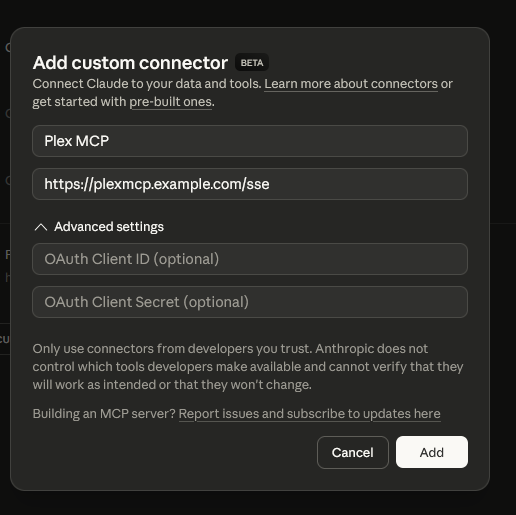
Go to https://claude.ai/settings/connectors and add a new connector with the following settings:
- Name: Plex MCP
- URL:
https://plexmcp.example.com/ssefor SSE, orhttps://plexmcp.example.com/mcpwhen running with--transport streamable-http. - If OAuth is enabled, enter your provider's Client ID and Client Secret in the advanced settings and complete sign-in.
Register Claude's callback in your OAuth provider: https://claude.ai/api/mcp/auth_callback.
See Remote Access & OAuth for provider and reverse-proxy configuration.
5. ChatGPT Connector Installation
Start the server with --transport streamable-http and make it reachable at a public HTTPS URL.
In ChatGPT's plugin settings, choose Add custom MCP server:
- Name: Plex MCP
- Server URL:
https://plexmcp.example.com/mcp - Authentication: OAuth if enabled on the server; otherwise None.
- For a confidential OAuth client, open Advanced OAuth settings and supply your provider's Client ID and Client Secret. These are separate from your Plex token.

The screenshot shows where to find the OAuth settings if your server requires them. It uses a placeholder server URL, so discovery fails in this example. Use your real server URL and the token endpoint authentication method required by your provider.
Register the exact ChatGPT callback URL with your OAuth provider. It can look like
https://chatgpt.com/connector/oauth/<callback-id>; use the value requested by your
connection, not the literal placeholder. Create the plugin, complete sign-in, and
refresh its tools. Test it by asking ChatGPT to list your Plex libraries.
For reverse-proxy routing, see Public HTTPS access.
The website plugin and a local Codex MCP entry are separate connections. For local Codex OAuth configuration, see the client setup instructions.
Streamable HTTP
Start the server with --transport streamable-http to expose /mcp:
plex-mcp-server --transport streamable-http --port 3001 --server-url https://plexmcp.example.com
Configure your client with https://plexmcp.example.com/mcp. This mode also keeps
the legacy /sse and /messages/ endpoints available for existing clients.
Set MCP_TRANSPORT in .env or your container's environment to select
streamable-http, sse, or stdio. An explicit --transport flag overrides it.
Docker defaults to streamable-http, serving both /mcp and legacy /sse.
Direct execution defaults to sse when neither the variable nor flag is supplied.
For Docker stdio, the MCP client must launch the container with docker run --rm -i;
no port mapping is needed.
OAuth is optional on both HTTP transports. Enable it with --oauth-enabled or
MCP_OAUTH_ENABLED=true, using the issuer settings below. Without OAuth, anyone
who can reach the endpoints can call the tools; use an appropriate network boundary.
Both SSE and Streamable HTTP validate Host and Origin headers to block DNS-rebinding
attacks (a malicious web page driving your server through your browser). --server-url
(or MCP_SERVER_URL) permits your public hostname and origin even with OAuth disabled.
For additional proxy names, LAN addresses, or browser origins, set comma-separated
MCP_ALLOWED_HOSTS and MCP_ALLOWED_ORIGINS (e.g. MCP_ALLOWED_HOSTS=192.168.1.20:3001).
Loopback hosts are allowed by default. If a remote client gets 421 Invalid Host header,
add its host and port to MCP_ALLOWED_HOSTS. For a rejected browser origin,
add the full origin (scheme, host, and port) to MCP_ALLOWED_ORIGINS.
Remote Access & OAuth
OAuth protects both HTTP transports. The following setup uses Authentik as the identity provider.
How it works
The MCP server acts as the OAuth front door: clients discover it via
/.well-known/oauth-protected-resource, are sent to /authorize (which redirects to
your identity provider), and exchange codes at /token (which the server proxies to the
provider). Clients therefore only ever need your MCP server URL plus the provider's
Client ID / Secret. The browser visits the provider to complete sign-in. Access tokens are JWTs
validated against the provider's JWKS; the server checks signature, expiry, issuer, and
(optionally) audience on every request, on both SSE and Streamable HTTP.
1. Create an OAuth provider (Authentik example)
-
Providers → Create → OAuth2/OpenID Provider. Client type Confidential, signing key set (RS256). Note the Client ID and Client Secret.
-
Redirect URIs — add one entry per client you plan to use. These are the values seen in practice:
Client Redirect URI Claude.ai / Claude Desktop https://claude.ai/api/mcp/auth_callbackChatGPT connector https://chatgpt.com/connector/oauth/<connector-id>— shown in the connector dialogCodex CLI / local tools loopback, random port: regex ^http://127\.0\.0\.1:[0-9]+/callback/<callback-id>$Keep this list tight. A catch-all like
.*lets anyone who can get you to click a link capture an authorization code. -
Applications → Create, bind it to the provider, and bind an access policy (your user or group). Any Authentik user who can authorize this application gets full control of Plex — there are no per-user roles inside the MCP server.
-
Copy the provider's OpenID Configuration Issuer URL, e.g.
https://auth.example.com/application/o/plexmcp-oauth/(trailing slash included).
2. Configure the server
For Docker, enter these as environment variables using the public HTTPS setup, which also covers DNS and the reverse proxy.
MCP_OAUTH_ENABLED=true
MCP_OAUTH_ISSUER=https://auth.example.com/application/o/plexmcp-oauth/
MCP_SERVER_URL=https://plexmcp.example.com
MCP_OAUTH_AUDIENCE=<Client ID>        # optional, recommended
or the equivalent flags: --oauth-enabled --oauth-issuer … --server-url … --oauth-audience ….
MCP_SERVER_URLmust be the public HTTPS URL clients reach; it also becomes the allowed Host/Origin for DNS-rebinding protection. Use the base URL without/mcpor/sse; HTTPS is provided by your reverse proxy.MCP_OAUTH_AUDIENCEmakes the server reject tokens minted for any other client of the same provider. Set it to the Client ID from step 1. Leaving it unset disables audience validation for compatibility with existing deployments.
3. Configure each client
Use the Client ID and Secret from step 1 and one of these URLs:
| Client | URL | Notes |
|---|---|---|
| Claude.ai / Claude Desktop | https://plexmcp.example.com/sse |
Claude probes with a Streamable HTTP POST first and falls back to SSE automatically |
| ChatGPT | https://plexmcp.example.com/mcp |
Authentication: OAuth, paste Client ID/Secret |
| Codex CLI | codex mcp add plex --url https://plexmcp.example.com/mcp --oauth-client-id <id> --oauth-client-secret <secret> |
opens a browser for login |
Clients configured with /mcp use Streamable HTTP; /sse uses the legacy transport.
Both are protected identically.
Discovery Endpoints
When OAuth is active, the following standard endpoints are exposed without authentication:
/.well-known/oauth-protected-resource/.well-known/oauth-authorization-server/authorize(redirects to the provider) and/token(proxied to the provider)
Command Reference
Library Module
Tools for exploring and managing your Plex libraries.
| Command | Description | Parameters |
|---|---|---|
library_list |
Lists all available libraries. | None |
library_get_stats |
Gets statistics (count, size, types) for a library. | library_name |
library_refresh |
Triggers a metadata refresh for a library. | library_name |
library_scan |
Scans a library for new files. | library_name |
library_get_details |
Gets detailed information about a library. | library_name |
library_get_recently_added |
Lists recently added items in a library. | library_name, limit: int |
library_get_contents |
Lists current library items with media IDs, filters, and pagination. | library_name (optional), media_type, watched: bool, unwatched: bool, offset: int, limit: int, sort, title, genre, year, content_rating, director, actor, writer, resolution, network, studio, username |
To list watched movies currently in your library (rather than playback history):
{"library_name": "Movies", "watched": true, "offset": 0, "limit": 50}
Each result includes media_id (Plex's ratingKey) for looking up or deleting that
specific item. The default page size is 50; increase offset to retrieve later pages.
totalItems is the count matching the server-side filters, not just the current page.
Use title to combine a case-insensitive Plex title search with other filters:
{"library_name":"Movies","title":"Avengers","watched":true}.
This returns all matches with normal pagination. It is not exact-only or arbitrary
substring matching: Avengers matches titles containing that word, while venger
does not. Title searches use the selected media type; TV libraries default to show names.
Watch state belongs to the selected username, or the configured account when omitted.
To search across all accessible libraries, omit library_name and supply media_type:
{"media_type":"movie","watched":true,"genre":"Action"}
Supported types are movie, show, episode, artist, album, and track.
You can also select a type within a named library, such as episode in a TV library
or track in a music library. Type-selected results include the originating library
and library_id; episodes include their show/season/episode and tracks their artist/album.
Filters and sorting apply before pagination across the combined results. At least
one of library_name or media_type is required. Broad episode queries can be slower
on large libraries; a library or title filter narrows the search.
For music, watched/unwatched select played/unplayed items. Artist and album played
state does not imply every track is complete.
Movie, episode, and track results also include inProgress and progressPercent, based on Plex's
saved playback offset, even if the movie is absent from Continue Watching.
inProgress is true when that offset is positive; it does not mean the movie is
currently playing. progressPercent is the saved position as a percentage of
duration, rounded to one decimal and bounded to 0-100 (null if duration is unknown).
A movie with no saved position has inProgress: false and, when duration is known,
progressPercent: 0, even if it was previously watched.
These fields are independent of watched: a movie can be both watched and in
progress, for example during a rewatch. The watched and unwatched filters still
use Plex's watched state, not saved progress. For cleanup, inspect inProgress
as well as watched to avoid selecting movies with a saved playback position.
For shows, watched=true selects series with no unwatched episodes;
unwatched=true selects those with episodes remaining, including partially watched
series. Results include watchStatus (unwatched, partial, or watched),
watchedEpisodeCount, and episodeCount. Completion refers to episodes currently
in the library, not future or missing episodes. Empty shows report watched=false.
Do not set both filters to true.
Filters must apply to the selected media type; unsupported combinations return an
error rather than being silently ignored. Episode genre, rating, people, network,
and studio filters use the parent show. Track year and studio use the parent album.
Artist filters support title and genre; albums and tracks also support year and studio.
Resolution applies to movies and episodes (sd, 480, 576, 720, 1080, 2k,
4k, or 8k).
Media Module
Tools for searching, inspecting, and editing specific media items.
| Command | Description | Parameters |
|---|---|---|
media_search |
Search for media across all libraries. | query, library_name, content_type |
media_get_details |
Get comprehensive details for an item. | media_title, library_name, media_id, username |
media_edit_metadata |
Update tags, genres, summary, or title. | media_title, library_name, new_title, new_summary, new_rating, new_release_date, new_genre, remove_genre, new_director, new_studio, new_tags |
media_delete |
Remove an item from Plex. | media_title, library_name, media_id, username |
media_get_artwork |
Retrieve posters or background artwork. | media_title, library_name, art_type: str |
media_set_artwork |
Set artwork from a local path or URL. | media_title, library_name, poster_path, poster_url, background_path, background_url |
media_list_available_artwork |
List alternative artwork available for selection. | media_title, library_name, art_type |
library_get_contents and media_get_details accept username for a Home or
shared user, using the configured admin credentials. Omit it for your account.
Watched filters and saved playback progress belong to the selected user; failed
access returns an error. Movie, episode and track details include watched,
view_count, playback_offset_ms, in_progress, and progress_percent.
Watchlist Module
Manage the Plex account Watchlist, including movies and shows outside your library.
Listings and search results include release_date, duration_ms (runtime in
milliseconds), and content_rating when Plex supplies them, without extra lookups.
The release date does not distinguish theatrical, physical, or streaming releases.
By default, listing also looks up the selected user's library state. Movies include saved
progress and watched status; shows include watched and total episode counts. Matching
uses Plex GUIDs first, then searches by title and verifies shared IMDb, TMDB, or TVDB
IDs. Each matching library copy is returned in library_items. Unmatched items have
unknown availability (null), not an unwatched state. Lookup failures leave the
Watchlist available with a state_error. Set include_state=false to skip library
lookups. Individual episode progress is not included.
| Command | Description | Parameters |
|---|---|---|
watchlist_list |
List Watchlist titles with local availability and watched/progress state. | offset, limit (1–100), include_state (default true) |
watchlist_search |
Search Plex Discover for titles to add. | query, content_type (movie/show), limit (1–100) |
watchlist_add |
Add a movie or show. | guid |
watchlist_remove |
Remove a movie or show. | guid |
Search first, then pass the chosen result's guid to watchlist_add. To remove
an entry, use its GUID from watchlist_list. These plex://movie/... or
plex://show/... identifiers are cloud IDs, not local media_id/ratingKey values.
List results default to 50 items; increase offset for the next page.
All four tools use the configured PLEX_TOKEN. Pass username to select a user
by exact username or profile title, or home_user_id to select by ID (takes
precedence). Supply pin if Plex requires it. If Plex cannot access that user's
Watchlist, the tool returns an error without falling back to your Watchlist.
Omit the selectors to use the configured account.
Add/remove operations confirm membership and leave media files and watched status unchanged.
Playlist Module
Manage your personal and shared playlists.
| Command | Description | Parameters |
|---|---|---|
playlist_list |
List playlists. | library_name, content_type, username |
playlist_get_contents |
List playlist items. | playlist_title, playlist_id, username |
playlist_create |
Create a playlist. | playlist_title, item_titles, library_name, summary, username |
playlist_delete |
Delete a playlist. | playlist_title, playlist_id, username |
playlist_add_to |
Add media items. | playlist_title, playlist_id, item_titles, item_ids, username |
playlist_remove_from |
Remove playlist items. | playlist_title, playlist_id, item_titles, username |
playlist_edit |
Change title or summary. | playlist_title, playlist_id, new_title, new_summary, username |
playlist_upload_poster |
Upload a poster. | playlist_title, playlist_id, poster_url, poster_filepath, username |
playlist_copy_to_user |
Copy a playlist to another user. | playlist_title, playlist_id, username, source_username |
Pass username to work with a Home or shared user's playlists using the configured
admin credentials. Omit it to use the configured account. Failed access returns an
error. For playlist_copy_to_user, username is the destination; source_username
selects the source account and defaults to the configured account.
Smart playlists
Smart playlists save library filters that Plex reapplies as your library changes.
All three tools accept username, including Home and shared users.
| Tool | Purpose |
|---|---|
playlist_get_smart_filter_options |
Discover fields, operators, sorting and field values for library_name and optional libtype. |
playlist_create_smart |
Save filters, sort, limit and libtype as a playlist. |
playlist_edit_smart_filters |
Update a playlist by ID or title, preserving omitted settings. |
Use libtype="show" with {"title": "Band of Brothers"} to match the show.
Use libtype="episode" to match episode titles. Show and artist searches produce
playable episodes and tracks. Use the same libtype when discovering filters.
Creation and editing return the saved definition, item count and up to 20 items.
playlist_get_contents returns all current items and the saved definition.
On edit, omitted values remain unchanged; {} clears filters, an empty sort string
clears sorting, and limit=0 removes the limit. libtype changes only when supplied.
Collection Module
Organize movies and shows into collections.
| Command | Description | Parameters |
|---|---|---|
collection_list |
List collections in a specific library. | library_name |
collection_create |
Create a new collection. | library_name, title, items: List[str] |
collection_add_to |
Add items to an existing collection. | library_name, collection_title, items: List[str], collection_id |
collection_remove_from |
Remove items from a collection. | library_name, collection_title, items: List[str], collection_id |
collection_edit |
Edit collection metadata and settings. | collection_title, collection_id, library_name, new_title, new_sort_title, new_summary, new_content_rating, new_labels, add_labels, remove_labels, poster_path, poster_url, background_path, background_url, new_advanced_settings |
collection_delete |
Delete a collection. | collection_title, collection_id, library_name |
User Module
Information about the server owner and shared users.
| Command | Description | Parameters |
|---|---|---|
user_search_users |
Search for shared users. | search_term |
user_list_all_users |
List all users with types and IDs. | None |
user_get_info |
Detailed info for a specific user. | username |
user_get_on_deck |
Get "On Deck" items for a user. | username |
user_get_continue_watching |
Get partially watched items to resume. | limit, username, user_id |
user_get_watch_history |
Retrieve personal watch history. | username, limit, content_type, user_id |
user_get_statistics |
Watch progress and usage statistics. | time_period, username |
user_get_continue_watching accepts an exact username/profile title or a user_id
from user_list_all_users. The ID takes precedence; omit both for the configured
account. Access to other users requires the server administrator's token and is
limited to this Plex server. Failed access returns an error.
Sessions Module
Monitor real-time server activity.
| Command | Description | Parameters |
|---|---|---|
sessions_get_active |
Get currently playing items and clients. | None |
sessions_get_media_playback_history |
History for a specific media item. | media_title, library_name, media_id, username |
Server Module
Maintenance and administrative tools.
| Command | Description | Parameters |
|---|---|---|
server_get_plex_logs |
Retrieve lines from Plex logs. | num_lines, log_type, start_line, list_files, search_term |
server_get_info |
Basic server health and version info. | None |
server_get_bandwidth |
Bandwidth usage statistics. | timespan, lan |
server_get_current_resources |
CPU/Memory usage of the host/process. | None |
server_get_butler_tasks |
List scheduled maintenance tasks. | None |
server_get_alerts |
Listen for server notifications/alerts. | timeout |
server_run_butler_task |
Manually trigger a Butler task. | task_name |
server_empty_trash |
Empty trash for libraries. | library_name |
server_optimize_database |
Run database optimization. | None |
server_clean_bundles |
Clean up unused media bundles. | None |
Client Module
Control playback and navigation on Plex clients.
| Command | Description | Parameters |
|---|---|---|
client_list |
List all available playback clients. | include_details: bool, active_only: bool |
client_get_details |
Detailed info for a client. | client_name, client_id |
client_get_timelines |
Current playback state/trackers. | client_name, client_id |
client_start_playback |
Start playing a media item on a client. | media_title, client_name, rating_key, offset, library_name, use_external_player |
client_control_playback |
Play, Pause, Stop, Seek, Skip. | client_name, action, offset, client_id |
client_navigate |
Send remote control navigation commands. | client_name, command, client_id |
client_set_streams |
Changes audio or subtitle tracks. | client_name, audio_stream_id, subtitle_stream_id, client_id |
Response Formats
All tools return information in JSON format for consistent parsing.
Success Example
{
  "status": "success",
  "data": {
    "title": "Inception",
    "year": 2010,
    "rating": 8.8
  }
}
Error Example
{
  "status": "error",
  "message": "Library 'Missing' not found."
}
Multiple Matches
If an operation finds multiple items with the same name, it returns a list of specific identifiers:
[
  {
    "title": "The Office",
    "id": 123,
    "type": "show",
    "year": 2005
  },
  {
    "title": "The Office",
    "id": 456,
    "type": "show",
    "year": 1995
  }
]
Troubleshooting OAuth
- 401 Unauthorized: Ensure your
MCP_OAUTH_ISSUERexactly matches the issuer URL in your identity provider (including trailing slashes). IfMCP_OAUTH_AUDIENCEis set, it must equal the client ID your provider puts in the token'saudclaim. - Public URL:
MCP_SERVER_URLmust be reachable by the client (e.g., plexmcp.example.com) and should use HTTPS. - Redirect URI mismatch (provider error page after login): the client's callback isn't in the provider's redirect list — see the table in step 1. Use the exact callback requested by the client. For Codex, replace
<callback-id>in the example with the actual callback ID; only the loopback port should vary. - Client hangs after login / "Couldn't connect": check the server log for
Token validvsToken validation failed. A failure right after a successful/tokenusually meansMCP_OAUTH_AUDIENCEdoesn't match the token'saud— unset it to confirm, then set it to the Client ID. - First request slow: token validation caches discovery metadata until restart and caches JWKS for
MCP_OAUTH_JWKS_CACHE_TTLseconds (default 3600). After rotating signing keys in the provider, restart the server or wait for the cache to expire.
1 maintainer

Metadata
1 maintainer
Release files for plex-mcp-server 1.4.1
For a detailed explanation of source distributions (sdists) and built distributions (wheels), please see the package formats documentation.
Source distribution (sdist)
| File | Size | Uploaded | |
|---|---|---|---|
| plex_mcp_server-1.4.1.tar.gz | 113.6 kB | Details |
Built distribution (wheel)
| File | Interpreter | ABI | Platform | Reset |
|---|---|---|---|---|
| plex_mcp_server-1.4.1-py3-none-any.whl | Python 3 | none | any | Details |
Total release size: 199.7 kB
Release files / plex_mcp_server-1.4.1.tar.gz
| Download URL | plex_mcp_server-1.4.1.tar.gz |
|---|---|
| Size | 113.6 kB |
| Tags | Source |
|
SHA-256 checksum How to use checksums |
ffd82f0a918a963a3143a9693c549aa9a25befe1209a119ea01365975a455e9d
|
|
BLAKE2b-256 checksum How to use checksums |
bcfe2b82fcf46cad400abc301c867b07bedd5fad89f5d49959c0a8b37cd41113
|
| Upload date | |
|
Uploaded using Trusted Publishing? What is trusted publishing? |
Yes |
| Uploaded via |
twine/7.0.0 CPython/3.13.14
|
Provenance
Provenance describes where a file came from. On PyPI, provenance is shared via attestations, which provide a verifiable record of the build or publishing details. View details, limitations and caveats.


PyPI Publish Attestation
PyPI verified that this artifact, at this checksum, originated from the publisher listed below.
Signed by GitHub Actions, verified by PyPI on Oct 12, 2026.
Transparency logRelease files / plex_mcp_server-1.4.1-py3-none-any.whl
| Download URL | plex_mcp_server-1.4.1-py3-none-any.whl |
|---|---|
| Size | 86.1 kB |
| Tags | Python 3 |
|
SHA-256 checksum How to use checksums |
a16bc1dc46984817270f0491cd923e32dd451fb9eab77e1744262d43ec2221f4
|
|
BLAKE2b-256 checksum How to use checksums |
ceb518ec018b35833dbb879f24c265f41802f73baa93dc2376f1d8e51a8e7b81
|
| Upload date | |
|
Uploaded using Trusted Publishing? What is trusted publishing? |
Yes |
| Uploaded via |
twine/7.0.0 CPython/3.13.14
|
Provenance
Provenance describes where a file came from. On PyPI, provenance is shared via attestations, which provide a verifiable record of the build or publishing details. View details, limitations and caveats.
PyPI Publish Attestation
PyPI verified that this artifact, at this checksum, originated from the publisher listed below.
Signed by GitHub Actions, verified by PyPI on Oct 12, 2026.
Transparency log













