
This release is a pre-release and may not be stable for production use.
plr-ivoryos

PyLabRobot 1.0 in IvoryOS, with PyLabRobot's own steps.
PyLabRobot 1.0 drives each machine through a class of its own, whose methods are the machine's
operations: flex.left.aspirate(target, volume). plr-ivoryos puts those classes into IvoryOS
with no wrapper steps of its own: every step is a PyLabRobot method, with PyLabRobot's name,
arguments and defaults. What a form cannot fill in, a live PyLabRobot Well or Plate, is
written as text the way PyLabRobot writes it (assay_plate[A1:H1]) and read back when the step
runs. The worktable, and what is mounted on the robot, is a file rather than code, and in IvoryOS
NextGen the Labware panel shows it live and lets you build it by dragging.
Liquid handlers
| Robot | plr_ivoryos |
PyLabRobot 1.0.0b1 | Its instruments in IvoryOS | simulated=True runs |
|---|---|---|---|---|
| Opentrons Flex | opentrons.Flex |
pylabrobot.opentrons.Flex |
the Flex, _left, _right or _head96, _gripper |
PyLabRobot's Flex on this package's simulated robot-server |
| Opentrons OT-2 | opentrons.OT2 |
pylabrobot.opentrons.OT2 |
the OT-2, _left, _right |
PyLabRobot's OT-2 on the same simulated robot-server |
| Hamilton STAR, STARlet, STARplus | hamilton.STAR |
pylabrobot.hamilton.STAR, STARlet, STARPlus |
the STAR, _pipettes, _head96 or _head384, _iswap, _core_grippers, _autoload |
PyLabRobot's STARSimulationDriver |
| Hamilton Prep | hamilton.Prep |
pylabrobot.hamilton.Prep |
the Prep, _pipettes, _head8, _core_grippers, _heater_shaker, _lights |
PyLabRobot's PrepSimulationDriver |
| Hamilton Nimbus | legacy.Nimbus |
pylabrobot.legacy NimbusBackend |
one, with every LiquidHandler operation |
PyLabRobot's legacy LiquidHandlerChatterboxBackend |
| Hamilton Vantage (1.3 m) | legacy.Vantage |
pylabrobot.legacy VantageBackend |
one, as above | the same chatterbox |
| Tecan Freedom EVO 100/150/200 | legacy.EVO |
pylabrobot.legacy EVOBackend |
one, as above | the same chatterbox |
| any other legacy backend | legacy.LiquidHandler(backend=...) |
pylabrobot.legacy.liquid_handling.LiquidHandler |
one, as above | the same chatterbox |
Every robot works the same way: its steps are PyLabRobot's own methods, wells are written as
plate[A1:H1], the worktable is a file the Labware panel edits, and liquids are tracked by name.
What differs is PyLabRobot's: a STAR channel takes one volume per well (volumes=[30] * 8), a Flex
or OT-2 one for all (volume=30); a legacy robot's aspirate takes resources and vols.
from plr_ivoryos.hamilton import STAR, Prep
from plr_ivoryos.opentrons import Flex, OT2
from plr_ivoryos.legacy import Nimbus, Vantage, EVO

star = STAR(simulated=True)                       # a STARlet; deck_type="STARDeck" for a STAR
star = STAR(worktable="star.json")                # the real one on USB (plr-ivoryos[usb])
prep = Prep(host="192.168.1.50")
ot2 = OT2(host="10.0.0.6")
nimbus = Nimbus(host="192.168.100.100")
evo = EVO(simulated=True, deck_type="EVO150Deck")
# a STAR's channels, in a deck that calls it `star` (one IvoryOS step each)
star_pipettes.pick_up_tips(tip_spots="tips[A1:H1]")
star_pipettes.aspirate(containers="assay_plate[A1:H1]", volumes=[30] * 8)
star_pipettes.dispense(containers="sample_plate[A1:H1]", volumes=[30] * 8)
star_pipettes.drop_tips(destinations="tips[A1:H1]")
star_head96.pick_up_tips(tip_rack="tips_b")

# a Nimbus, Vantage or EVO: PyLabRobot's legacy LiquidHandler, one instrument
nimbus.pick_up_tips(tip_spots="tips[A1:H1]")
nimbus.aspirate(resources="assay_plate[A1:H1]", vols=[30] * 8)
nimbus.move_plate(plate="sample_plate", to="plate_carrier-4")
What is fitted to each robot is the worktable file's equipment, because IvoryOS reads a deck's
instruments once, when it starts: on a Flex or OT-2 the pipette on each mount; on a STAR or Prep which
parts it has ({"pipettes": true, "head96": true, "iswap": true, ...}). Simulated, it is what the
simulator has (on a STAR, PyLabRobot's recording of that frame; {"head384": true} picks the
384-head recording). A real robot is asked once when the file does not say, and the answer is
written to the file; each time it is set up, what it reports is checked against the file.
Each robot module keeps a SKIPPED table of the PyLabRobot methods it cannot offer as a step, and
why: an argument of a type a form cannot fill (a callback, a colour) with no default.
Opentrons Flex
from plr_ivoryos.opentrons import Flex

flex = Flex(simulated=True)                              # PyLabRobot's Flex on a simulated robot
flex = Flex(host="10.0.0.5")                             # a real Flex over Ethernet
flex = Flex(serial_port="/dev/cu.usbmodem1201")          # over its USB-B port (plr-ivoryos[serial])

if __name__ == "__main__":
    import ivoryos_edge
    from plr_ivoryos.labware_view import plugin as labware_view
    ivoryos_edge.run(__name__, plugins=[labware_view])
In PyLabRobot a Flex is one object and each thing mounted on it is an object of its own:
flex.left and flex.right (a pipette on each mount), flex.head96 (the 96-channel head, which
takes both mounts) and flex.gripper. IvoryOS shows them the same way: the Flex is an instrument
with the robot's own steps (home, set_rail_lights, stop, ...), and each mounted thing is an
instrument too, named after it. In a deck that calls the Flex flex:
| Instrument | PyLabRobot | Its steps |
|---|---|---|
flex |
Flex |
home, set_status_bar, set_rail_lights, add_comment, wait_for_duration, move_axes_to, sync_tips_to_robot, labware_moved_off_deck, reload_labware, get_health, get_instruments, send_command, setup, stop; and load_liquid, read_volumes, tips_left, summary (not PyLabRobot's) |
flex_left, flex_right |
FlexHead1 or FlexHead8 |
every public method of the pipette's class: pick_up_tips, aspirate, dispense, mix, aspirate_container, drop_tips, discard_tips, touch_tip, probe_liquid_heights, blow_out, ... |
flex_head96 |
FlexHead96 |
the same, for the 96-channel head |
flex_gripper |
FlexGripper |
move_labware, grip, ungrip, open_jaw, move_to_position |
# PyLabRobot
await flex.left.pick_up_tips(tips.column(0))
await flex.left.aspirate_container(reservoir["A2"][0], 40)
await flex.left.dispense(plate["A1:H1"], 40)
await flex.gripper.move_labware(plate, "B2")

# plr-ivoryos (and an IvoryOS step each)
flex_left.pick_up_tips(target="tips[A1:H1]")
flex_left.aspirate_container(container="reservoir[A2]", volume=40)
flex_left.dispense(target="assay_plate[A1:H1]", volume=40)
flex_gripper.move_labware(resource="assay_plate", to_slot="B2")
The parts are found by IvoryOS NextGen through Flex.__ivoryos_instruments__(); from plain Python
they are flex.__ivoryos_instruments__()["left"]. Steps are synchronous: each blocks until the
robot is done.
PyLabRobot's own rules apply, because it is PyLabRobot doing it: an 8-channel pipette takes from a
single trough well with aspirate_container, not aspirate; a 50 µL pipette has no default flow
rate on a 200 µL tip; columns are counted from 0. Its error is what the step reports.
Simulation
simulated=True runs PyLabRobot's Flex unchanged against a simulated robot-server
(plr_ivoryos.opentrons.simulator, which the OT-2 uses too): it answers the HTTP API the Flex speaks, so PyLabRobot sets up,
discovers what is mounted, uploads labware and sends every command a real run would, with its own
tip and volume tracking and its own refusals. What it does not check is the robot's own motion
planning. PyLabRobot 1.0.0b1 has no Flex or OT-2 simulator for its 1.0 classes; which robots
have one, and what to do about those that do not, is in docs/simulators.md.
A host or serial_port beside simulated=True is refused: it would be ignored, and a run would
look like one on that robot. A pickup from spots holding no tip leaves the tip sensor reading
absent, so the step fails there, as the sensor on a robot makes it.
The worktable is a file
What is mounted, what sits where, and what was put in it before the run:
{
  "deck_type": "FlexDeck",
  "equipment": {"left": "p1000_multi_flex", "right": "p50_single_flex", "gripper": true, "trash": "A3"},
  "resources": [
    {"name": "tips", "type": "flex_96_tiprack_200ul", "slot": "C1"},
    {"name": "reservoir", "type": "nest_12_troughplate_15000uL_Vb", "slot": "C2"},
    {"name": "assay_plate", "type": "cor_96_wellplate_360uL_Fb", "slot": "D2"}
  ],
  "liquids": [{"labware": "reservoir", "wells": "A1", "liquid": "buffer", "volume_ul": 14000}]
}
equipment: the pipette on each mount (p50_single_flex,p1000_single_flex,p50_multi_flex,p1000_multi_flex), orhead96(p1000_96,p200_96) instead of both, whether the gripper is fitted, and the slot of the trash bin. Each mounted thing becomes an instrument, so this has to be known when IvoryOS starts, before the robot is connected. When the file does not say, a simulated Flex starts with an 8-channel and a 1-channel 1000 µL pipette and a gripper, and a real one is asked once what it has (the answer is written to the file). Every time the robot is set up, what it reports is checked against the file, and a difference stops the first step, saying what differs.resources: any labware definition inpylabrobot.resources, placed byslot(on a Flex A1 to D3 and the staging slots A4 to D4; on an OT-2 1 to 11; on a Prep its spots 0 to 7), or, on a robot with tracks, a carrier byrails(the track on a Hamilton, the rail on a Tecan) with what it holds aschildren, each with itssite.deck_type:FlexDeck,OTDeck,STARLetDeck,STARDeck,STARPlusDeck,PrepDeck,NimbusDeck,VantageDeck,EVO100Deck,EVO150DeckorEVO200Deck.liquids: what a person put on the worktable before the run. With tracking on (the default), an aspirate from a well nobody filled is refused; fill it here or with aload_liquidstep.
worktable is optional. Without it the file is worktable.json in the deck's data folder when
IvoryOS runs it (IVORYOS_DATA_DIR, which the desktop app sets), else in the working directory; a
relative path is in that folder too. A file that does not exist yet is not an error: the simulator
starts from a ready-made worktable (tips, a reservoir with buffer and dye, two plates), a real
robot from an empty one, and the file is written on the first change.
Beside the file, PyLabRobot's own copy of the worktable is written (worktable.pylabrobot.json,
which Deck.load_from_json_file reads) for every robot whose deck PyLabRobot 1.0.0b1 can read back:
the OT-2, the STAR family and the Prep. It cannot yet read back its own Flex, Nimbus, Vantage or
Tecan deck, so those have no copy (the Labware panel says why).
Wells as text
Where PyLabRobot takes Well, TipSpot or Container objects, a step takes the same thing written
as text, and where it takes a Plate, TipRack or other labware, its name:
| PyLabRobot takes | Write | Example |
|---|---|---|
| one well or tip spot | labware[A1] |
flex_right.aspirate(target="assay_plate[A1]", volume=20) |
several (Sequence[Well]) |
labware[A1:H1] |
flex_left.dispense(target="assay_plate[A1:H1]", volume=40) |
| a labware | its name | flex_left.mix(target="assay_plate", volume=50, column=0) |
| the trash | trash (the default) |
flex_left.discard_tips() |
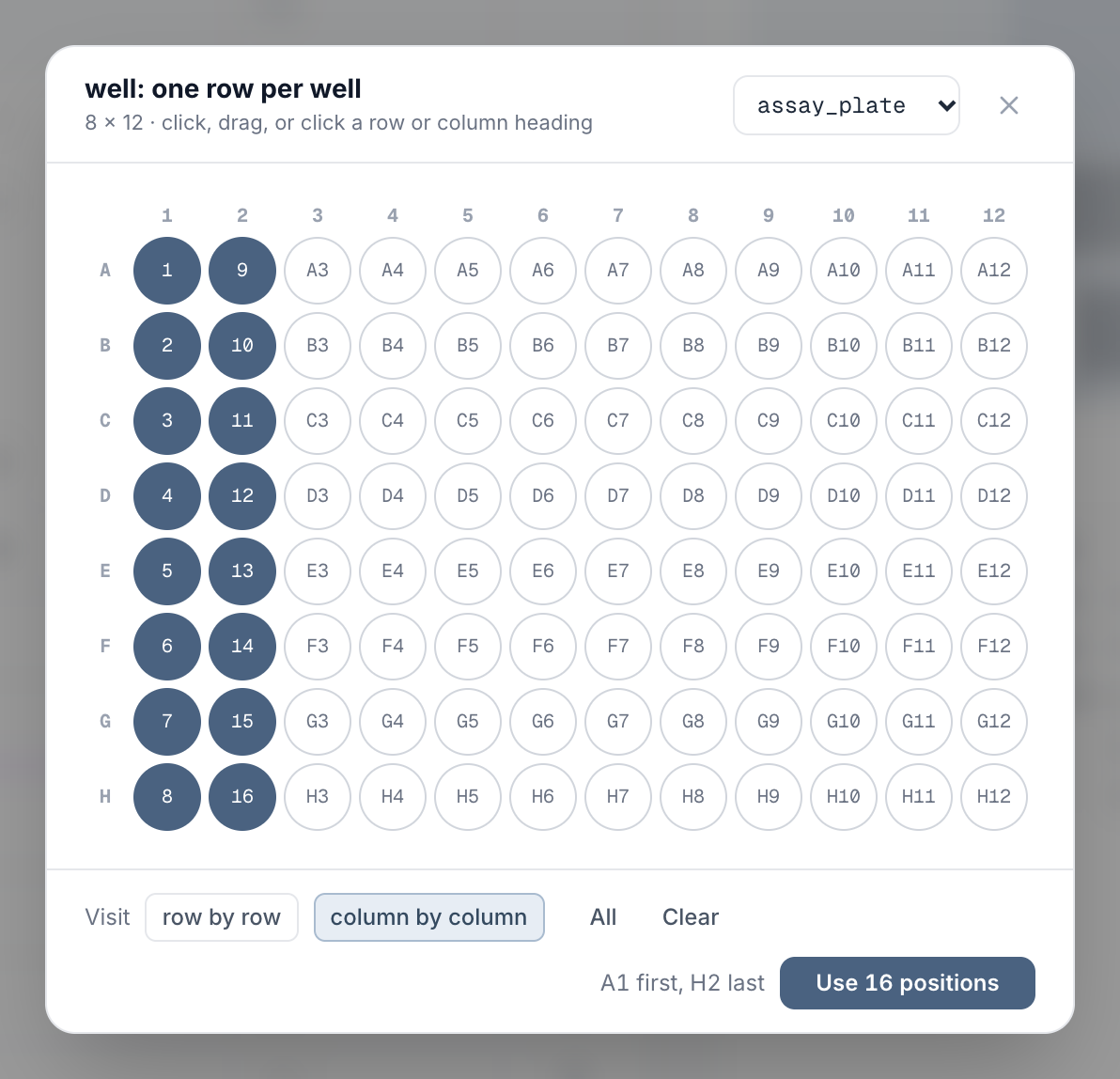
Inside the brackets: A1, A1:H1 (down a column), A1:A12 (along a row), A1:H3 (a rectangle,
column by column, the order a multichannel head works in; PyLabRobot's plate["A1:B2"] goes
row by row), all, or several separated by commas. use_channels and other lists take
0, 1, 2 as well as a list; offset and pre_mix are PyLabRobot's own Coordinate and Mix.
In IvoryOS NextGen
The arguments are marked with Annotated[...] (plr_ivoryos.wells), the worktable is reported
through __ivoryos_labware__() and the mounted things through __ivoryos_instruments__(). IvoryOS
reads all three by duck typing; this package imports nothing from it. From that:
- wells are picked on a drawing of the plate, choosing the plate in the same picker;
- a well that is not on the plate is refused before a run starts;
- a batch step is given every row of its batch in one call: one spreadsheet row per sample,
batch size 8, and the 8-channel's
dispensegets eight wells at once; - the Labware panel shows the worktable live: what each well holds (by liquid), which tips are left, and the wells a step is working on.
The original IvoryOS shows these arguments as text fields.
The Labware panel
"plugins": ["plr_ivoryos.labware_view:plugin"]
in a deck file (or ivoryos_edge.run(__name__, plugins=[plr_ivoryos.labware_view.plugin])) adds it
beside every page. Edit layout changes the worktable file as you go, with nothing to confirm.
It shows the layout and the labware to place; the rest is under ⋯, and ? explains it all:
- on a Flex, what is mounted (⋯ → Pipettes and gripper…): the pipette on each mount or the 96-channel head, the gripper, the trash slot; on a robot with several worktables (a STAR, STARlet or STARplus, an EVO 100, 150 or 200), which one (⋯ → Robot…);
- drag labware from PyLabRobot's catalogue (the robot's own tip racks and carriers, and any plate, reservoir or tube rack) onto an empty slot or carrier position; drag what is there to move it, × to take it off, rename it in the list;
- click a plate or reservoir, pick wells, and Fill them with a liquid and a volume: the
liquidsa run starts from; - ⋯ → Import a layout… takes a worktable file you already have; the one it replaces is kept as
worktable.before-import.json.
Steps offer added, removed or renamed labware, and changed equipment, once the deck restarts (the panel offers the restart). Moving labware, filling wells, and going back to the worktable the deck started with need no restart. The panel is the only part of this package that imports IvoryOS, and only IvoryOS NextGen loads it.
Saved layouts
The worktable file is the layout in use. In Edit layout, the Layout row keeps others beside it by name:
- Save as… saves the layout in use under a name. Once it has changed, Save and Revert appear beside its name: Save keeps the changes in the layout it came from.
- The list switches to another saved layout. If the one in use has changes that are not saved, the panel asks first.
- Revert goes back to the layout as it was saved. This is how a layout is changed for one experiment: change it, run, revert. Until then the panel says what differs, "layout changed" or "liquids changed" (topping up a reservoir is not a different layout), and the change survives a restart.
- ⋯ → Download gives the layout as a file, which Import a layout… takes on another deck.
Each saved layout is one worktable file in worktable.layouts/ beside the worktable file
(worktable.layouts/Dye dilution.json). They are plain files, so the folder can be kept in a git
repository, and a file put there by hand is a saved layout like any other. layouts_folder puts
the folder somewhere else, for decks that share their layouts:
flex = Flex(simulated=True, layouts_folder="/labs/flex-layouts")
Installation
pip install plr-ivoryos==1.0.0b2            # with PyLabRobot 1.0.0b1: Flex, OT-2, Prep, Nimbus over the network
pip install "plr-ivoryos[serial]==1.0.0b2"  # a Flex over USB
pip install "plr-ivoryos[usb]==1.0.0b2"     # a STAR, Vantage or EVO over USB
Name the version: plain pip install plr-ivoryos installs 0.2.0, which has no Flex, and --pre
lets every other dependency be a pre-release too. uv takes a pre-release only for a package named
in the command, so name PyLabRobot as well: uv pip install plr-ivoryos==1.0.0b2 pylabrobot==1.0.0b1.
Python 3.10 or newer. A Python environment holds one PyLabRobot, so every deck sharing one (the IvoryOS desktop app's decks do) uses the same plr-ivoryos and PyLabRobot.
How it works
bridge.pyreads each PyLabRobot method's signature and makes the step: same parameter names, kinds and defaults; wells and labware as text, marked for IvoryOS; dataclasses and plain values as they are. What it returns is made into plain data. A parameter of a type it cannot offer is left out when PyLabRobot has a default for it, and a method it cannot offer at all is listed inplr_ivoryos.opentrons.flex.SKIPPED(empty for the Flex).robot.pyis the worktable side of any robot: the file, the Labware panel's hooks and edits, readingplate[A1]as PyLabRobot objects, and running a step. A part of a robot that PyLabRobot gives a class of its own (a mount, a 96-head, a gripper) is arobot.Part, an instrument whose steps run on that object. A robot module (opentrons/,hamilton/,legacy.py) says how to connect, what is fitted, and which PyLabRobot classes its parts are. PyLabRobot 1.0 tracks volumes but no longer which liquid, soliquids.pycompares the worktable before and after each step and moves liquids between wells and channels by that.- Async bridge: PyLabRobot is built on
asyncio, and a connection has to stay on the loop that opened it. Every step runs on one event loop on a background thread for the life of the process, so steps are ordinary synchronous calls, from IvoryOS or plain Python. The robot connects at the first step, so a deck starts with the robot switched off.
What changed in 1.0.0b2 (still on PyLabRobot 1.0.0b1)
- Every liquid handler PyLabRobot 1.0.0b1 drives: the OT-2, the STAR, STARlet and STARplus and
the Prep through their 1.0 classes, and the Nimbus, Vantage and Tecan EVO (or any legacy backend)
through
pylabrobot.legacy, each with a simulator. - An argument PyLabRobot types as labware or a coordinate (
drop_tips(destinations=...)on a STAR,move_plate(to=...)) is a step now, offered as the labware; so is one typedUnion[str, float]. Methods of the resource tree (serialize,assign_child_resource, ...) are not offered as steps on a robot that is itself a resource. - The simulated robot-server remembers where each pipette was sent, so a position query answers it.
- A default PyLabRobot gives as a
Coordinateor an enum (offset=Coordinate(0, 0, 0),direction=GripDirection.FRONT) is shown to IvoryOS as data ({"x": 0, "y": 0, "z": 0}, the enum's value; its name is taken too) and made PyLabRobot's again when the step runs: IvoryOS NextGen stores a deck's steps as JSON, and could not record a deck that had one. - Saved layouts in the Labware panel (below The Labware panel), on every robot: save a
worktable under a name, switch, revert, download;
layouts_folderon each robot.
What changed in 1.0.0b1
- PyLabRobot 1.0 only. The 0.2
LiquidHandler, its worktables for the OT-2, Hamilton and Tecan robots, and the single-purpose devices (Scale,Pump,PlateReader,Sealer, ...) are gone: they wrapped PyLabRobot's older interfaces, which 1.0 keeps only aspylabrobot.legacy. Saved workflows using them need redoing (1.0.0b2 brings the liquid handlers back on PyLabRobot 1.0). Where each robot is now: docs/liquid-handlers.md. - The Opentrons Flex, its mounts and gripper as instruments, and a simulated Flex.
- No steps of this package's own design: no
transfer, no "next unused tips" from a bare rack name. Steps are PyLabRobot's.
License
MIT
1 maintainer

Metadata
1 maintainer
Release files for plr-ivoryos 1.0.0b2
For a detailed explanation of source distributions (sdists) and built distributions (wheels), please see the package formats documentation.
Source distribution (sdist)
| File | Size | Uploaded | Provenance | Actions |
|---|---|---|---|---|
| plr_ivoryos-1.0.0b2.tar.gz | 103.9 kB | Without provenance | Details for plr_ivoryos-1.0.0b2.tar.gz |
Built distribution (wheel)
| File | Interpreter | ABI | Platform | Actions Reset |
|---|---|---|---|---|
| plr_ivoryos-1.0.0b2-py3-none-any.whl | Python 3 | none | any | Details for plr_ivoryos-1.0.0b2-py3-none-any.whl |
Total release size: 198.7 kB
Release files / plr_ivoryos-1.0.0b2.tar.gz
| Download URL | plr_ivoryos-1.0.0b2.tar.gz |
|---|---|
| Size | 103.9 kB |
| Tags | Source |
|
SHA-256 checksum How to use checksums |
dbbadb765c021372026d6992d31a59635bbf271a431b4fb7cfcf3eb669e86898
|
|
BLAKE2b-256 checksum How to use checksums |
146f779a06da04bd13fe73fb4e9b2b8c340a57648c404cbf270b32485eb1aa8e
|
| Upload date | |
|
Uploaded using Trusted Publishing? What is trusted publishing? |
No |
| Uploaded via |
twine/7.0.0 CPython/3.13.16
|
Release files / plr_ivoryos-1.0.0b2-py3-none-any.whl
| Download URL | plr_ivoryos-1.0.0b2-py3-none-any.whl |
|---|---|
| Size | 94.8 kB |
| Tags | Python 3 |
|
SHA-256 checksum How to use checksums |
f0103dc58b9850a03b119d3e4cc071d93e34463de9b89b8702579530fb1dcab5
|
|
BLAKE2b-256 checksum How to use checksums |
2eb586e69c326f1230d28730d40b3af320208b6c17ad2af009dd995c91a9e547
|
| Upload date | |
|
Uploaded using Trusted Publishing? What is trusted publishing? |
No |
| Uploaded via |
twine/7.0.0 CPython/3.13.16
|
Security for plr-ivoryos 1.0.0b2
Provenance
Provenance describes where a file came from. On PyPI, provenance is shared via attestations, which provide a verifiable record of the build or publishing details. View details, limitations and caveats.
No provenance found
None of the files in this release were uploaded with provenance metadata.
A note on package security
PyPI is a repository for distributing packages, not a service for auditing them. While third-party security researchers and our staff do their best to detect and remove malicious packages, PyPI cannot guarantee the quality, security or suitability of any given package.
To learn more about protecting yourself from malicious actors, visit our package security documentation.














