
probixi - Self-Calibrating (PROB)ab(I)listic Peak Detection for Serial (X)-Ray Crystallograph(I)c Data









probixi treats peakfinding as anomaly detection. Bragg signal is sparse, and the stream of frames is therefore mostly a sample of the detector's background. probixi learns that background at every pixel as frames arrive, whitens each frame against it, and reports the pixels the background does not explain. The peak contrast, peak prior, background blend, and detection threshold are calibrated on the data, and no parameter requires tuning. Each frame is then indexed, predicted, and integrated, with every peak weighted by its detection posterior.
Installation
pip install probixi
On Linux with CUDA, the gpu extra adds the Triton kernels and nvCOMP decompression. Without it, probixi runs its reference implementations on the same device.
pip install "probixi[gpu]"
The development version:
pip install git+https://github.com/ryan-odea/probixi.git
Usage
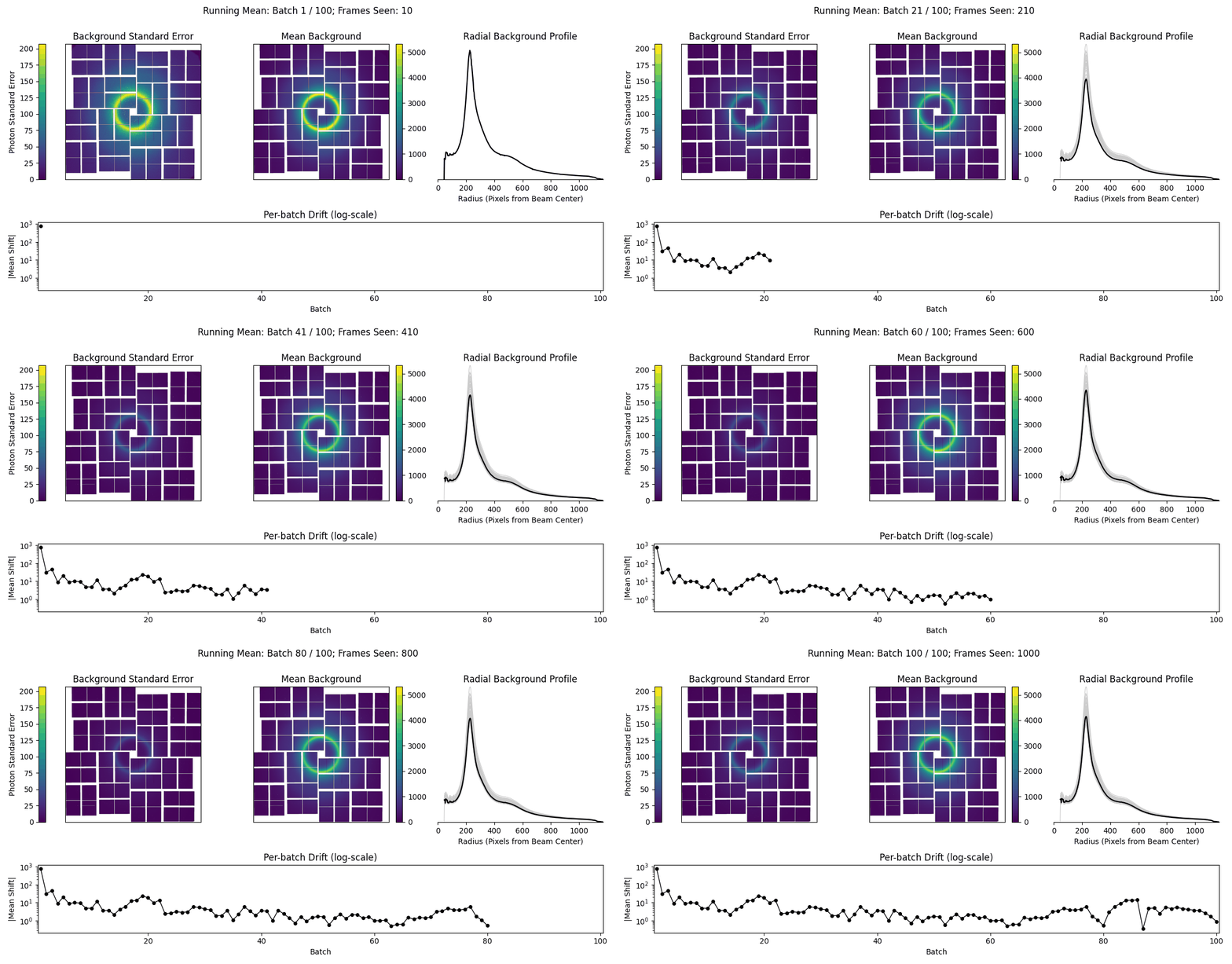
The command line goes from raw frames to integrated reflections in one call. The Python API returns lazy streams whose results stay on the GPU until collected, and any stage can feed further torch processing. probixi calibrates on a set of seed frames before detection, and --gif writes an animation of the noise model over the first frames of the run.
probixi -i files.lst -g myGeometry.geom -p myCell.cell -o stream.stream --device cuda --gif myNoiseModel.gif
The same run in Python:
import torch

from probixi import Probixi, DataOffloader

pipeline = Probixi(
    list_file="files.lst",
    geometry_file="myGeometry.geom",
    cell_file="myCell.cell",
    device=torch.device("cuda"),
)

pipeline.noise_diagnostics("myNoiseModel.gif", stop=32)
cal = pipeline.calibrate(n_seed=1636)
print(f"kappa={cal.kappa:.2f}  prior_peak={cal.prior_peak:.4f}  "
      f"threshold={pipeline.threshold_calibration.threshold:.2f}")

with DataOffloader(
    "stream.stream",
    geometry=pipeline.geometry,
    cell=pipeline.target_cell,
    geometry_file="myGeometry.geom",
    files=pipeline.metadata.files,
) as off:
    for result in pipeline.index_stream(pipeline.frames(), batch_size=8):
        off.write(result)  # or: pipeline.index_stream(...).to_stream(off)
        for crystal in result.crystals:
            print(f"frame {result.frame_index}: "
                  f"{crystal.n_indexed}/{crystal.n_peaks} indexed (rmsd {crystal.rmsd:.4f})")
DuckDB output
A .stream file suits partialator, but querying it means parsing a large text file. An output ending in .duckdb or .db is written as a DuckDB database instead, which may become the default.
probixi -i files.lst -g myGeometry.geom -p myCell.cell -o run.duckdb --device cuda
stream = pipeline.index_stream(pipeline.frames(), batch_size=8)
stream.to_db(
    "run.duckdb",
    geometry=pipeline.geometry,
    cell=pipeline.target_cell,
    geometry_file="myGeometry.geom",
    files=pipeline.metadata.files,
)
The database holds the run metadata (geometry, panels, cell, integration) and four result tables joined on frame_id: frames, crystals, reflections, and peaks. The schema lists their columns.
Indexing ambiguity
When the lattice symmetry is higher than the structure's point group, each crystal can be indexed in more than one way. probixi-resolve clusters the crystals in a database into the two choices and reindexes those on the wrong side. It is a torch and Triton implementation of CrystFEL's ambigator, by Thomas White.
probixi-resolve -i run.duckdb -y 3 -w 321 -o detwinned.duckdb
Without -o the database is rewritten in place. Reindexing transforms h k l in reflections together with the reciprocal axes and cell of each crystal in crystals, and records every assignment in an ambiguity table. In Python:
from probixi import Ambigator

amb = Ambigator("run.duckdb", symmetry="3", apparent="321")
result = amb.resolve()
print(f"{result.n_reindexed}/{len(result)} crystals reindexed")
amb.reindex(result, output="detwinned.duckdb")
Peak export for other indexers
To use another indexer, run probixi as a peakfinder with the CLI's --peaks-only flag or the Python API's peak_stream. The output directory receives one CXI file per input file, a peaks.lst, and a geometry for indexamajig --peaks=cxi. The exported peaks also improve conventional indexers on strong data (see the vignettes).
probixi -i files.lst -g myGeometry.geom -o peaks/ --peaks-only --device cuda
import torch

from probixi import Probixi, PeakOffloader

pipeline = Probixi(
    list_file="files.lst",
    geometry_file="myGeometry.geom",
    device=torch.device("cuda"),
)
pipeline.calibrate(n_seed=1636)

peaks = pipeline.peak_stream(pipeline.frames(), estimate_scale=False)
with PeakOffloader(
    "peaks/",
    geometry_file="myGeometry.geom",
    files=pipeline.metadata.files,
) as off:
    for result in peaks:
        if len(result):  # frames without peaks are not exported
            off.write(result)
Dependencies
- python >= 3.10
- click
- deflate
- duckdb
- h5py
- hdf5plugin
- matplotlib
- numpy
- pillow
- torch
- optional (
gpu): triton >= 3.5, nvidia-libnvcomp-cu12
Contributing
Report bugs and request features on the issue tracker. A pull request should meet the following conventions:
- Code is formatted with
isort, thenblack, and passesruff check. The same checks run on every PR. - Only user-facing objects carry docstrings, in
numpystyle. - Comments are single lines that state what the code does not show: a reason, a unit, a convention, or a source. The explanation of a bug fix belongs in the PR, not in the code.
1 maintainer

Metadata
1 maintainer
Release files for probixi 0.10.0
For a detailed explanation of source distributions (sdists) and built distributions (wheels), please see the package formats documentation.
Source distribution (sdist)
| File | Size | Uploaded | Provenance | Actions |
|---|---|---|---|---|
| probixi-0.10.0.tar.gz | 17.4 MB | With provenance | Details for probixi-0.10.0.tar.gz |
Built distribution (wheel)
| File | Interpreter | ABI | Platform | Actions Reset |
|---|---|---|---|---|
| probixi-0.10.0-py3-none-any.whl | Python 3 | none | any | Details for probixi-0.10.0-py3-none-any.whl |
Total release size: 17.6 MB
Release files / probixi-0.10.0.tar.gz
| Download URL | probixi-0.10.0.tar.gz |
|---|---|
| Size | 17.4 MB |
| Tags | Source |
|
SHA-256 checksum How to use checksums |
3fbbbc5d41d54bd5ca6ced0096233418741c7e2e02be047e91506d87c0e3d271
|
|
BLAKE2b-256 checksum How to use checksums |
07f32c9be99f5cc1540bc0931f8044d2e5be4d43b16049c3027c1845cd0bd52f
|
| Upload date | |
|
Uploaded using Trusted Publishing? What is trusted publishing? |
Yes |
| Uploaded via |
twine/7.0.0 CPython/3.13.16
|
Provenance
Provenance describes where a file came from. On PyPI, provenance is shared via attestations, which provide a verifiable record of the build or publishing details. View details, limitations and caveats.


PyPI Publish Attestation
PyPI verified that this artifact, at this checksum, originated from the publisher listed below.
Signed by GitHub Actions, verified by PyPI on Oct 25, 2026.
Transparency logRelease files / probixi-0.10.0-py3-none-any.whl
| Download URL | probixi-0.10.0-py3-none-any.whl |
|---|---|
| Size | 206.1 kB |
| Tags | Python 3 |
|
SHA-256 checksum How to use checksums |
d82f75b359a2dc781686dfaa62974e000d2547c2beeb1b24d6b1b4b7da71bea7
|
|
BLAKE2b-256 checksum How to use checksums |
598245b603c043f891069a7bfb22d3c50cd748f99179559445b6492f0bd9de50
|
| Upload date | |
|
Uploaded using Trusted Publishing? What is trusted publishing? |
Yes |
| Uploaded via |
twine/7.0.0 CPython/3.13.16
|
Provenance
Provenance describes where a file came from. On PyPI, provenance is shared via attestations, which provide a verifiable record of the build or publishing details. View details, limitations and caveats.
PyPI Publish Attestation
PyPI verified that this artifact, at this checksum, originated from the publisher listed below.
Signed by GitHub Actions, verified by PyPI on Oct 25, 2026.
Transparency logSecurity for probixi 0.10.0
Provenance
Provenance describes where a file came from. On PyPI, provenance is shared via attestations, which provide a verifiable record of the build or publishing details. View details, limitations and caveats.
Full provenance
Both files in this release have been uploaded with provenance metadata.
Attestation for probixi-0.10.0.tar.gz
PyPI Publish Attestation
PyPI verified that this artifact, at this checksum, originated from the publisher listed below.
Signed by GitHub Actions, verified by PyPI on Oct 25, 2026.
Transparency logA note on package security
PyPI is a repository for distributing packages, not a service for auditing them. While third-party security researchers and our staff do their best to detect and remove malicious packages, PyPI cannot guarantee the quality, security or suitability of any given package.
To learn more about protecting yourself from malicious actors, visit our package security documentation.














