
Process-Bigraph


Process-Bigraph is a compositional runtime and protocol for building and executing multiscale biological models from interoperable processes.
It provides a shared architectural layer for:
- declaring process interfaces
- wiring processes through typed shared state
- orchestrating execution across heterogeneous timescales
- supporting dynamic structure (workflows, division, graph rewrites)
Process-Bigraph is the execution core of Vivarium 2.0, designed to integrate models built with different formalisms—including ODEs, FBA, agent-based models, spatial solvers, and machine-learning components—into a single coherent simulation.
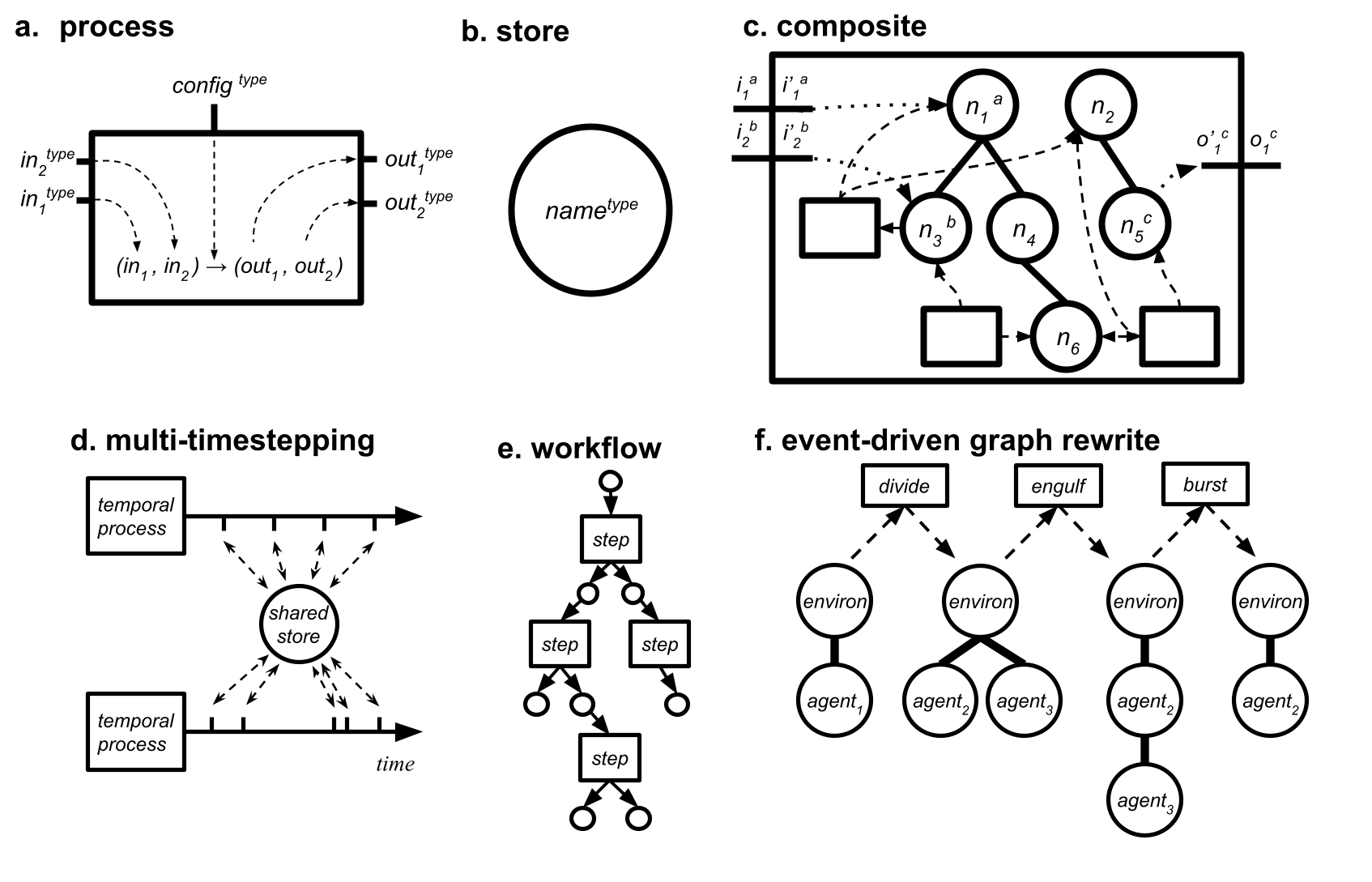
🧩 What is a Process Bigraph?
A process bigraph combines:
- Typed stores — hierarchical, schema-validated state defined with bigraph-schema
- Processes — executable components with explicit input/output ports
- Composites — encapsulated sub-simulations with their own internal structure
- Orchestration patterns — multi-timestepping, directed workflows, and event-driven rewrites
Processes do not mutate state directly. Instead, they emit typed deltas that are merged by the runtime.
This allows:
- numerical updates
- structural rewrites
- scheduling and orchestration
to coexist under a single execution semantics.
In this sense, Process-Bigraph is a composition protocol, not a domain-specific simulator.
📄 Paper reference
The conceptual framework and formal semantics of process bigraphs are introduced in:
Agmon, E. & Spangler, R. K.
Process Bigraphs and the Architecture of Compositional Systems Biology
https://arxiv.org/abs/2512.23754
🚀 Getting Started
Installation
pip install process-bigraph
Quickstart — composites, drafts & templates in code
A runnable five-minute tour of the core concepts. Every block below runs as-is
against process-bigraph ≥ 1.8.3. Concepts explained in
docs/concepts/composites-and-templates.md.
1. A process wired into a composite over a shared store. A composite is a state
map of typed nodes; processes couple only by reading/writing shared stores.
from process_bigraph import Composite, Process, allocate_core
from process_bigraph.emitter import emitter_from_wires, gather_emitter_results

class Grow(Process):                                  # a Process = ports + an update
    config_schema = {'rate': 'float'}
    def inputs(self):  return {'level': 'float'}
    def outputs(self): return {'level': 'float'}
    def update(self, state, interval):
        return {'level': state['level'] * self.config['rate'] * interval}  # a delta

core = allocate_core()
core.register_link('Grow', Grow)                      # register it in the local registry

composite = Composite({'state': {
    'level': 1.0,                                     # a shared store
    'grow': {'_type': 'process', 'address': 'local:Grow', 'config': {'rate': 0.5},
             'interval': 1.0, 'inputs': {'level': ['level']}, 'outputs': {'level': ['level']}},
    'emitter': emitter_from_wires({'level': ['level'], 'time': ['global_time']}),
}}, core=core)
composite.run(5.0)
print(gather_emitter_results(composite))
# {('emitter',): [{'level': 1.0, 'time': 0.0}, {'level': 1.5, ...}, ... {'level': 7.59, 'time': 5.0}]}
2. A draft process — a present-but-inert placeholder node. It declares a contract
(ports + description) but has no update, so a composite containing it still runs; the
draft just no-ops. Complementary to a site (step 3): a draft is a node that is there
but inert, a site is an empty hole.
from process_bigraph import DraftProcess, draft_process

@draft_process(name="PTH secretion",
    inputs={'ca_sense': 'float'}, outputs={'pth_out': 'float'},
    contract={'summary': 'senses serum Ca, secretes PTH', 'senses': 'calcium', 'makes': 'PTH'})
class PTHSecretion(DraftProcess):
    pass

core.register_link('PTHSecretion', PTHSecretion)
print(PTHSecretion({}, core=core).describe())
# DRAFT — senses serum Ca, secretes PTH  ·  makes: PTH  ·  senses: calcium  ·  status: draft - no update dynamics yet
A module-scope draft auto-registers, so it appears in the vivarium-workbench dashboard
(Modules → Processes) marked DRAFT with its ports and contract — no code change
needed. Replace it with a real Process once the mechanism is committed.
3. A template — a composite with an open site (hole). A template is a document that
isn't ground: it has open sites ({"_type": "site"}). Composite refuses to run
one until every required site is filled.
from process_bigraph import Step
from process_bigraph.templates import open_sites, is_ground_document, template_document

class ReportCard(Step):                               # a fixed downstream verdict
    config_schema = {'threshold': 'float'}
    def inputs(self):  return {'level': 'float'}
    def outputs(self): return {'verdict': 'string'}
    def update(self, state):
        return {'verdict': 'pass' if state['level'] >= self.config['threshold'] else 'fail'}

core.register_link('ReportCard', ReportCard)
MODEL_FACE = {'_type': 'link', '_inputs': {'level': 'float'}, '_outputs': {'level': 'float'}}

template = core.access({'study': {                     # analysis fixed, the model is a HOLE
    'level': 1.0, 'verdict': 'string',
    'model':  {'_type': 'site', '_sort': MODEL_FACE},
    'report': {'_type': 'step', 'address': 'local:ReportCard', 'config': {'threshold': 2.0},
               'inputs': {'level': ['level']}, 'outputs': {'verdict': ['verdict']}}}})

print(open_sites(template), is_ground_document(template))   # [('study', 'model')] False

def model(rate):                                      # any conforming composite fits the hole
    return core.access({'_type': 'process', 'address': 'local:Grow', 'config': {'rate': rate},
                        'interval': 1.0, 'inputs': {'level': ['level']}, 'outputs': {'level': ['level']}})

sim = Composite({'state': template_document(core, template, {'study/model': model(0.5)})}, core=core)
sim.run(4.0)
print(sim.state['study']['verdict'])                  # pass  (a slower model → fail)
# template_document(core, template, {}) → ValueError: not ground — required site 'study/model'
4. An investigation — one site per member study; gating is filling. Fill a member's site to admit it; leave it open and it is pruned from the built document, so a blocked prerequisite simply never runs.
from process_bigraph.templates import investigation_document

study = lambda: {'level': 1.0, 'verdict': 'string',
    'model':  {'_type': 'site', '_sort': MODEL_FACE},
    'report': {'_type': 'step', 'address': 'local:ReportCard', 'config': {'threshold': 2.0},
               'inputs': {'level': ['level']}, 'outputs': {'verdict': ['verdict']}}}

inv = core.access({'investigation': {'study_A': study(), 'study_B': study()}})
document, blocked = investigation_document(
    core, inv, {'investigation/study_A/model': model(0.5)}, member_depth=2)  # fill A only
print(blocked, sorted(document['investigation']))     # ['investigation/study_B'] ['study_A']
This same template/site machinery is what viva-superpowers uses to compile a whole investigation into a composite (one
StudyStepper member). The study/investigation layer is documented in viva-superpowersdocs/concepts/composites-templates-and-the-study-investigation-stack.md.
📘 Tutorials
The Process-Bigraph tutorials are executable Jupyter notebooks, rendered to HTML and published automatically on GitHub Pages.
- 📚 Tutorial Index (all tutorials)
https://vivarium-collective.github.io/process-bigraph/notebooks/index.html
Learning Path (Featured Tutorials)
-
Tutorial 0 — A Process in 12 Lines (quickstart)
The new front door: define a process with the@processdecorator, wire and run it end-to-end on one screen, and watch a_units-bearing port auto-convert
https://vivarium-collective.github.io/process-bigraph/notebooks/tutorial_0_quickstart.html -
Tutorial 1 — Process-Bigraph Basics
Processes, Steps, ports, Composites, workflows, and emitters
https://vivarium-collective.github.io/process-bigraph/notebooks/tutorial_1.html -
Tutorial 2 — Wrapping an ODE Solver (
odeint)
How to expose an existing scientific API as a Process
https://vivarium-collective.github.io/process-bigraph/notebooks/tutorial_2.html -
Tutorial 3 — Declarative Math
Defining mathematical relationships, signal pipelines, and events usingMathExpressionStep
https://vivarium-collective.github.io/process-bigraph/notebooks/tutorial_3.html -
Tutorial 4 — Composing a Biological Model
The central dogma from four small processes: composition over shared molecular state, biological units in the port types, and adding regulation by adding a wire
https://vivarium-collective.github.io/process-bigraph/notebooks/tutorial_4.html
More tutorials are added continuously and appear automatically in the index.
Architecture
- The framework, end to end — start here to understand the whole system:
what the objects are (documents, sites, handles), how they compose, the
higher-order DAG, templates and gating, content-addressed artifacts, the
git:protocol, and the laws everything else follows from. docs/architecture.md
Topic Guides
-
Emitters — Recording Simulation Results Built-in emitters (RAM, console, JSON, SQLite), how to wire them, retrieve results, store runs long-term, and write your own. docs/emitters.md
-
Tick lifecycle — how a step network is ordered and advanced, and how a protocol runtime batches remote dispatch. docs/tick_lifecycle.md
-
Distributed lifecycles — running parts of a composite off-process. docs/distributed_lifecycles.md
-
Deploying a Step network to Nextflow — opt-in: compile a composite's Step network into a Nextflow DSL2 workflow and run it on a batch backend (local / SLURM). Nothing changes about
Composite.run(). docs/nextflow.md
🧪 Reference Implementation: spatio-flux
Process-Bigraph is exercised end-to-end in spatio-flux, a multiscale reference model built entirely using the process-bigraph protocol.
spatio-flux composes spatial fields, particle dynamics, and metabolic processes using typed shared state and declarative orchestration.
GitHub: https://github.com/vivarium-collective/spatio-flux
Live test report: https://vivarium-collective.github.io/spatio-flux/report/index.html
🔗 Related Resources
-
Bigraph Schema Basics
https://vivarium-collective.github.io/bigraph-viz/notebooks/basics.html
Introduction to the schema language underlying Process-Bigraph -
Visualization of Bigraph Document — diagramming and rendering with bigraph-viz
https://vivarium-collective.github.io/bigraph-viz/notebooks/format.html -
E. coli Whole-Cell Wiring Diagram
https://raw.githubusercontent.com/vivarium-collective/bigraph-viz/main/doc/_static/ecoli.png -
Claude Code skills — wrap simulators, compose
pbg-*packages, and scaffold process-bigraph research workspaces with the pbg-superpowers Claude Code plugin (install with/plugin install pbg-superpowers).
📜 License
Process-Bigraph is open-source software released under the
Apache 2 License.
2 maintainers


Metadata
2 maintainers
Release files for process-bigraph 1.8.4
For a detailed explanation of source distributions (sdists) and built distributions (wheels), please see the package formats documentation.
Source distribution (sdist)
| File | Size | Uploaded | |
|---|---|---|---|
| process_bigraph-1.8.4.tar.gz | 216.0 kB | Details |
Built distribution (wheel)
| File | Interpreter | ABI | Platform | Reset |
|---|---|---|---|---|
| process_bigraph-1.8.4-py3-none-any.whl | Python 3 | none | any | Details |
Total release size: 451.0 kB
Release files / process_bigraph-1.8.4.tar.gz
| Download URL | process_bigraph-1.8.4.tar.gz |
|---|---|
| Size | 216.0 kB |
| Tags | Source |
|
SHA-256 checksum How to use checksums |
f4649771ba5090e9d1a4ad00557f1ed0ab7614eb1e57626f75bc5c62d3f966be
|
|
BLAKE2b-256 checksum How to use checksums |
21742f2537f1fa21858be64daad60ded3291ea7b418f151b4e1859e6e29f000c
|
| Upload date | |
|
Uploaded using Trusted Publishing? What is trusted publishing? |
Yes |
| Uploaded via |
twine/7.0.0 CPython/3.13.14
|
Provenance
Provenance describes where a file came from. On PyPI, provenance is shared via attestations, which provide a verifiable record of the build or publishing details. View details, limitations and caveats.


PyPI Publish Attestation
PyPI verified that this artifact, at this checksum, originated from the publisher listed below.
Signed by GitHub Actions, verified by PyPI on Sep 4, 2026.
Transparency logRelease files / process_bigraph-1.8.4-py3-none-any.whl
| Download URL | process_bigraph-1.8.4-py3-none-any.whl |
|---|---|
| Size | 235.0 kB |
| Tags | Python 3 |
|
SHA-256 checksum How to use checksums |
271d8d281dffa5486f9df515eb72a8a133315f67c6f78983b079284cc4e37baa
|
|
BLAKE2b-256 checksum How to use checksums |
e8289290d69d2ace293cfa4de660ccc229fe2b49139b36ac7d0b3b54667e5d4f
|
| Upload date | |
|
Uploaded using Trusted Publishing? What is trusted publishing? |
Yes |
| Uploaded via |
twine/7.0.0 CPython/3.13.14
|
Provenance
Provenance describes where a file came from. On PyPI, provenance is shared via attestations, which provide a verifiable record of the build or publishing details. View details, limitations and caveats.
PyPI Publish Attestation
PyPI verified that this artifact, at this checksum, originated from the publisher listed below.
Signed by GitHub Actions, verified by PyPI on Sep 4, 2026.
Transparency log














