

Profilis
A high-performance, non-blocking profiler for Python web applications.



Overview
Profilis gives you drop-in observability across APIs, functions, and database queries with minimal performance impact.
- Non-blocking: async collection with configurable batching and backpressure handling
- Framework-agnostic: Flask, FastAPI, and Sanic (plus optional ASGI middleware for any ASGI app)
- Database-aware: SQLAlchemy (sync and async), MongoDB (PyMongo), Neo4j, and pyodbc
- Production-ready: configurable sampling, error tracking, and export formats
TL;DR
Install:
pip install profilis
Pick a framework integration:
- Flask:
pip install profilis[flask] - FastAPI:
pip install profilis[fastapi] - Sanic:
pip install profilis[sanic] - Prometheus exporter:
pip install profilis[prometheus] - Performance extras:
pip install profilis[perf] - All integrations:
pip install profilis[all]
Then jump to Quick Start.
Contents
- Features
- Installation
- Quick Start
- Advanced Usage
- Configuration
- Exporters
- Performance Characteristics
- Documentation
- Development
- Roadmap
- License
- Contact
Features
- Request profiling: automatic HTTP request/response timing and status tracking
- Frameworks: Flask, FastAPI (ASGI middleware), and Sanic, with a built-in dashboard (Flask blueprint, FastAPI router, Sanic blueprint)
- Function profiling: decorator-based function timing with exception tracking
- Database instrumentation: SQLAlchemy (sync and async), MongoDB (PyMongo), Neo4j, pyodbc with query/command monitoring
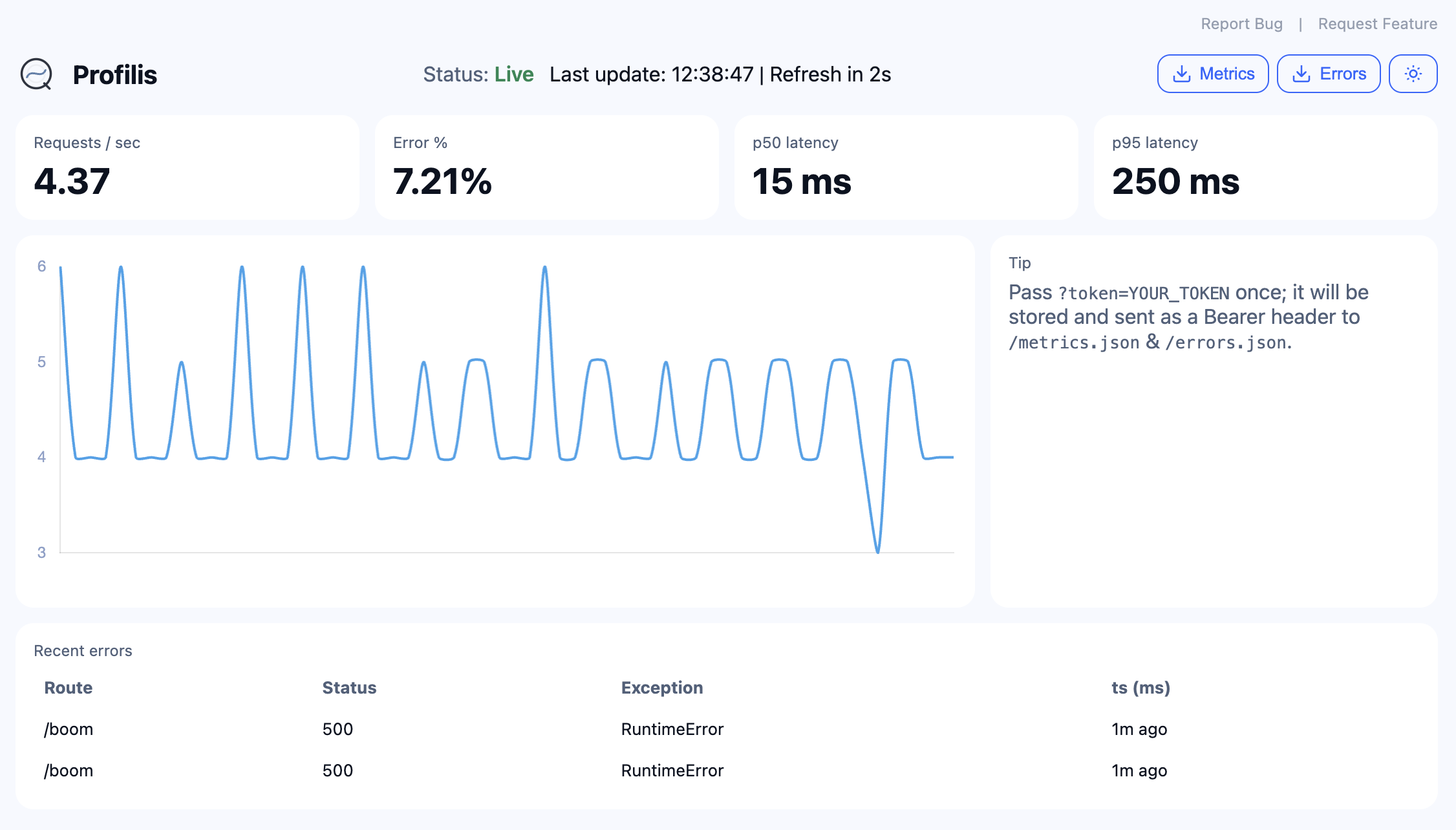
- Built-in UI: real-time dashboard for monitoring and debugging
- Exporters: JSONL (with rotation), Console (Prometheus is supported; see docs)
- Runtime context: trace/span ID management
- Configurable sampling: control data collection volume (Flask, ASGI, Sanic)
Installation
Install the core package with optional dependencies for your specific needs:
Option 1: Using pip with extras (Recommended)
# Core package only
pip install profilis

# With Flask support
pip install profilis[flask]

# With FastAPI support
pip install profilis[fastapi]

# With Sanic support
pip install profilis[sanic]

# With database support
pip install profilis[flask,sqlalchemy]

# With all integrations
pip install profilis[all]
Option 2: Using requirements files
# Minimal setup (core only)
pip install -r requirements-minimal.txt

# Flask integration
pip install -r requirements-flask.txt

# FastAPI integration
pip install -r requirements-fastapi.txt

# SQLAlchemy integration
pip install -r requirements-sqlalchemy.txt

# MongoDB integration
pip install -r requirements-mongo.txt

# All integrations
pip install -r requirements-all.txt
Option 3: Fine-grained installs
If you need fully explicit dependency control, install your framework/DB libs directly and only
install the Profilis extras you need. The authoritative list of extras lives in pyproject.toml
under [project.optional-dependencies].
Quick Start
Core concepts (one-minute mental model)
- Collector:
AsyncCollectorbuffers events off the request hot path and flushes them in batches. - Emitter:
Emittercreates tinydictevents (REQ/FN/DB) and enqueues them to a collector. - Exporter (sink): a callable that consumes batches of events (e.g. JSONL, Console, Prometheus).
- UI: a small HTTP dashboard that reads from a
StatsStore(which you populate).
Flask Integration
from flask import Flask
from profilis.flask.adapter import ProfilisFlask
from profilis.flask.ui import make_ui_blueprint
from profilis.core.stats import StatsStore
from profilis.exporters.jsonl import JSONLExporter
from profilis.core.async_collector import AsyncCollector

stats = StatsStore()
jsonl = JSONLExporter(dir="./logs", rotate_bytes=1024*1024, rotate_secs=3600)

def sink(batch: list[dict]) -> None:
    # Persist events
    jsonl(batch)
    # Feed the UI stats store (record request timing + errors)
    for ev in batch:
        if ev.get("kind") == "REQ":
            status = int(ev.get("status", 0) or 0)
            stats.record(int(ev.get("dur_ns", 0) or 0), error=status >= 500)

collector = AsyncCollector(sink, queue_size=2048, batch_max=128, flush_interval=0.1)

app = Flask(__name__)
ProfilisFlask(
    app,
    collector=collector,
    exclude_routes=["/health", "/metrics"],
    sample=1.0  # 100% sampling
)

app.register_blueprint(make_ui_blueprint(stats, ui_prefix="/_profilis"))

@app.route('/api/users')
def get_users():
    return {"users": ["alice", "bob"]}

# Visit http://localhost:5000/_profilis
if __name__ == "__main__":
    app.run(debug=True)
FastAPI Integration
from fastapi import FastAPI
from profilis.fastapi.adapter import instrument_fastapi
from profilis.fastapi.ui import make_ui_router
from profilis.core.stats import StatsStore
from profilis.exporters.jsonl import JSONLExporter
from profilis.core.async_collector import AsyncCollector
from profilis.core.emitter import Emitter

stats = StatsStore()
jsonl = JSONLExporter(dir="./logs", rotate_bytes=1024*1024, rotate_secs=3600)

def sink(batch: list[dict]) -> None:
    jsonl(batch)
    for ev in batch:
        # FastAPI/ASGI emits kind="HTTP"
        if ev.get("kind") == "HTTP":
            status = int(ev.get("status", 0) or 0)
            stats.record(int(ev.get("dur_ns", 0) or 0), error=status >= 500)

collector = AsyncCollector(sink, queue_size=2048, batch_max=128, flush_interval=0.1)
emitter = Emitter(collector)

app = FastAPI()
instrument_fastapi(app, emitter, route_excludes=["/profilis"])
app.include_router(make_ui_router(stats, prefix="/profilis"))

@app.get("/api/users")
async def get_users():
    return {"users": ["alice", "bob"]}

# Run with: uvicorn your_module:app --reload
# Visit http://localhost:8000/profilis for the dashboard
Sanic Integration
from sanic import Sanic
from profilis.sanic.adapter import SanicConfig, instrument_sanic_app
from profilis.sanic.ui import make_ui_blueprint
from profilis.core.async_collector import AsyncCollector
from profilis.core.emitter import Emitter
from profilis.core.stats import StatsStore
from profilis.exporters.console import ConsoleExporter

app = Sanic("app")
stats = StatsStore()
console = ConsoleExporter(pretty=True)

def sink(batch: list[dict]) -> None:
    console(batch)
    for ev in batch:
        if ev.get("kind") == "HTTP":
            status = int(ev.get("status", 0) or 0)
            stats.record(int(ev.get("dur_ns", 0) or 0), error=status >= 500)

collector = AsyncCollector(sink)
emitter = Emitter(collector)

instrument_sanic_app(app, emitter, SanicConfig(route_excludes=["/profilis"]))
app.blueprint(make_ui_blueprint(stats, ui_prefix="/profilis"))
Function Profiling
from profilis.decorators.profile import profile_function
from profilis.core.emitter import Emitter
from profilis.exporters.console import ConsoleExporter
from profilis.core.async_collector import AsyncCollector

# Setup profiling
exporter = ConsoleExporter(pretty=True)
collector = AsyncCollector(exporter, queue_size=128, flush_interval=0.2)
emitter = Emitter(collector)

@profile_function(emitter)
def expensive_calculation(n: int) -> int:
    """This function will be automatically profiled."""
    result = sum(i * i for i in range(n))
    return result

@profile_function(emitter)
async def async_operation(data: list) -> list:
    """Async functions are also supported."""
    processed = [item * 2 for item in data]
    return processed

# Use the profiled functions
result = expensive_calculation(1000)
Manual Event Emission
from profilis.core.emitter import Emitter
from profilis.exporters.jsonl import JSONLExporter
from profilis.core.async_collector import AsyncCollector
from profilis.runtime import use_span, span_id

# Setup
exporter = JSONLExporter(dir="./logs")
collector = AsyncCollector(exporter)
emitter = Emitter(collector)

# Create a trace context
with use_span(trace_id=span_id()):
    # Emit custom events
    emitter.emit_req("/api/custom", 200, dur_ns=15000000)  # 15ms
    emitter.emit_fn("custom_function", dur_ns=5000000)      # 5ms
    emitter.emit_db("SELECT * FROM users", dur_ns=8000000, rows=100)

# Close collector to flush remaining events
collector.close()
Built-in Dashboard
Dashboard is available per framework:
- Flask:
make_ui_blueprint(stats, ui_prefix="/_profilis")→app.register_blueprint(ui_bp) - FastAPI:
make_ui_router(stats, prefix="/profilis")→app.include_router(router) - Sanic:
make_ui_blueprint(stats, ui_prefix="/profilis")→app.blueprint(bp)
# Example: Flask
from flask import Flask
from profilis.flask.ui import make_ui_blueprint
from profilis.core.stats import StatsStore

app = Flask(__name__)
stats = StatsStore()
ui_bp = make_ui_blueprint(stats, ui_prefix="/_profilis")
app.register_blueprint(ui_bp)
# Visit http://localhost:5000/_profilis
Advanced Usage
Custom Exporters
from profilis.core.async_collector import AsyncCollector
from profilis.exporters.base import BaseExporter

class CustomExporter(BaseExporter):
    def export(self, events: list[dict]) -> None:
        for event in events:
            # Custom export logic
            print(f"Custom export: {event}")

# Use custom exporter
exporter = CustomExporter()
collector = AsyncCollector(exporter)
Runtime Context Management
from profilis.runtime import use_span, span_id, get_trace_id, get_span_id

# Create distributed trace context
with use_span(trace_id="trace-123", span_id="span-456"):
    current_trace = get_trace_id()  # "trace-123"
    current_span = get_span_id()    # "span-456"

    # Nested spans inherit trace context
    with use_span(span_id="span-789"):
        nested_span = get_span_id()  # "span-789"
        parent_trace = get_trace_id() # "trace-123"
Performance Tuning
from profilis.core.async_collector import AsyncCollector

# High-throughput configuration
collector = AsyncCollector(
    exporter,
    queue_size=8192,        # Large queue for high concurrency
    batch_max=256,          # Larger batches for efficiency
    flush_interval=0.05,    # More frequent flushing
    drop_oldest=True        # Drop events under backpressure
)

# Low-latency configuration
collector = AsyncCollector(
    exporter,
    queue_size=512,         # Smaller queue for lower latency
    batch_max=32,           # Smaller batches for faster processing
    flush_interval=0.01,    # Very frequent flushing
    drop_oldest=False       # Don't drop events
)
Configuration
Environment Variables
# Note: Environment variable support is planned for future releases
# Currently, all configuration is done programmatically
Sampling Strategies
# Random sampling
profilis = ProfilisFlask(app, collector=collector, sample=0.1)  # 10% of requests

# Route-based sampling
profilis = ProfilisFlask(
    app,
    collector=collector,
    exclude_routes=["/health", "/metrics", "/static"],
    sample=1.0
)
Exporters
JSONL Exporter
from profilis.exporters.jsonl import JSONLExporter

# With rotation
exporter = JSONLExporter(
    dir="./logs",
    rotate_bytes=1024*1024,  # 1MB per file
    rotate_secs=3600         # Rotate every hour
)
Console Exporter
from profilis.exporters.console import ConsoleExporter

# Pretty-printed output for development
exporter = ConsoleExporter(pretty=True)

# Compact output for production
exporter = ConsoleExporter(pretty=False)
Performance Characteristics
- Event Creation: ≤15µs per event
- Memory Overhead: ~100 bytes per event
- Throughput: 100K+ events/second on modern hardware
- Latency: Sub-millisecond collection overhead
Documentation
Full documentation is available at: Profilis Docs
Docs are written in Markdown under docs/ and built with MkDocs Material.
Available Documentation
- Getting Started - Quick setup and basic usage
- Configuration - Tuning and customization
- Flask Integration - Flask adapter
- FastAPI Integration - FastAPI/ASGI adapter
- Sanic Integration - Sanic adapter
- SQLAlchemy Support - Database instrumentation
- MongoDB · Neo4j · pyodbc - Additional databases
- JSONL Exporter - Log file output
- Built-in UI - Dashboard documentation
- Architecture - System design
To preview locally:
pip install mkdocs mkdocs-material mkdocs-mermaid2-plugin
mkdocs serve
Development
Setting up the project
-
Clone and enter the repo
git clone https://github.com/ankan97dutta/profilis.git
cd profilis
-
Create a virtual environment and install in editable mode with dev dependencies
python -m venv .venv
source .venv/bin/activate   # Windows: .venv\Scripts\activate
pip install -e ".[dev]"
-
Install pre-commit hooks (optional but recommended)
pre-commit install -
Run the test suite
pytest
Use
pytest -vfor verbose output,pytest path/to/test_file.pyto run a single file, orpytest -k "test_name"to run tests matching a pattern. Coverage:pytest --cov=profilis --cov-report=term-missing.
Working with TDD
We encourage test-driven development (TDD):
- Red — Write a failing test that describes the behaviour you want.
- Green — Implement the minimum code to make the test pass.
- Refactor — Improve the implementation while keeping tests green.
Run tests frequently (e.g. pytest or pytest tests/ -q) as you work. See Development Guidelines for the full TDD workflow and test layout.
Branching and commits
- See Contributing and Development Guidelines.
- Branch strategy: trunk‑based (
feat/*,fix/*,perf/*,chore/*). - Commits follow Conventional Commits.
Roadmap
See Profilis – v0 Roadmap Project and docs/overview/roadmap.md.
License
Contact
- Email: connect@ankandutta.in
- Website: https://www.ankandutta.in
- Blog: Signals & Noise
- GitHub: @ankan97dutta
Feel free to reach out if you have questions, suggestions, or would like to contribute to Profilis!
1 maintainer

Metadata
1 maintainer
Release files for profilis 1.0.0
For a detailed explanation of source distributions (sdists) and built distributions (wheels), please see the package formats documentation.
Source distribution (sdist)
| File | Size | Uploaded | |
|---|---|---|---|
| profilis-1.0.0.tar.gz | 67.5 kB | Details |
Built distribution (wheel)
| File | Interpreter | ABI | Platform | Reset |
|---|---|---|---|---|
| profilis-1.0.0-py3-none-any.whl | Python 3 | none | any | Details |
Total release size: 122.9 kB
Release files / profilis-1.0.0.tar.gz
| Download URL | profilis-1.0.0.tar.gz |
|---|---|
| Size | 67.5 kB |
| Tags | Source |
|
SHA-256 checksum How to use checksums |
4d382e896fd1767c79d90c609561cec07490e8a51afa8a488aec9f3ea431d93b
|
|
BLAKE2b-256 checksum How to use checksums |
4825e855444ec059a9daa50d1f63b476feeab868d2932f10f0f5bac756df515e
|
| Upload date | |
|
Uploaded using Trusted Publishing? What is trusted publishing? |
No |
| Uploaded via |
twine/6.2.0 CPython/3.13.5
|
Release files / profilis-1.0.0-py3-none-any.whl
| Download URL | profilis-1.0.0-py3-none-any.whl |
|---|---|
| Size | 55.3 kB |
| Tags | Python 3 |
|
SHA-256 checksum How to use checksums |
cb34a298780d1a22bfc0746ebaa6e71096662688aaabb103565ec8d7fee49cca
|
|
BLAKE2b-256 checksum How to use checksums |
66bf2ecb5f68ed0f502ce83fa0a301d59f677cd5b74c1f9fb829137c7008af8e
|
| Upload date | |
|
Uploaded using Trusted Publishing? What is trusted publishing? |
No |
| Uploaded via |
twine/6.2.0 CPython/3.13.5
|














