
promoterai-torch



A PyTorch port of PromoterAI v1 from Illumina — a deep learning model that predicts the regulatory impact of promoter DNA variants on gene expression.
Install
Python 3.10, 3.11, 3.12, 3.13, and 3.14 are supported.
For variant scoring, embedding extraction, and ordinary PyTorch inference from an already-converted checkpoint, install the core package:
pip install promoterai-torch
Or with uv:
uv add promoterai-torch
The core package also converts the official Keras SavedModels (no TensorFlow needed). Optional workflows are split into extras so inference installs do not pull in HDF5/BigWig tooling or attribution libraries:
| Extra | Enables |
|---|---|
train |
Preprocess data, train from scratch, or fine-tune |
wandb |
Weights & Biases logging (combine with train) |
interpret |
DeepLIFT/SHAP references and logo plots (tangermeme) |
uv add is for installing into an existing project; for a
cloned checkout with development dependencies, see
CONTRIBUTING.md.
Choosing a PyTorch build
pip install promoterai-torch and uv add promoterai-torch take torch from
PyPI. On Linux that build uses CUDA 13.0 and supports NVIDIA GPUs of compute
capability 7.5 (Turing) and newer. For an older GPU, or a CPU-only machine,
install a different build from PyTorch's own package index:
| GPU | Compute capability | Build |
|---|---|---|
| Maxwell, Pascal, Volta (e.g. GTX 10xx, TITAN X/Xp, P100, V100) | 5.0–7.0 | CUDA 12.6 (cu126) |
| Turing and newer (RTX 20xx+, T4, A100, H100, Blackwell) | 7.5+ | PyPI default, or cu130 |
| None | — | cpu |
Check your GPU's compute capability with
nvidia-smi --query-gpu=name,compute_cap --format=csv. A build that doesn't
support your GPU fails at the first CUDA operation with
"no kernel image is available for execution on the device".
With pip, install torch from the matching index first, then the package:
pip install torch --index-url https://download.pytorch.org/whl/cu126   # or cu130, cpu
pip install promoterai-torch
In a clone of this repository, uv selects the build with a dependency group
(cu126, cu130 or cpu; use at most one):
uv sync --group cu126                          # CUDA 12.6 build, for Pascal etc.
uv sync --group dev --extra train --group cu126
uv run --group cu126 pytest tests/             # pass the same group to uv run
uv sync and uv run without the group switch the environment back to the
PyPI build (and download it), so pass the group every time. To keep several
builds side by side, give each its own environment:
export UV_PROJECT_ENVIRONMENT=/path/to/venv-cu126
uv sync --group dev --group cu126
uv run --group cu126 promoterai-torch score ...
The CUDA 12.6 line is PyTorch's legacy build: its last release is older than
the newest PyPI torch, so a cu126 environment may resolve an older torch
version than the default one.
Convert a pretrained Keras model
Download the pretrained PromoterAI SavedModel from Illumina/PromoterAI and convert it to a PyTorch checkpoint. Conversion reads the SavedModel files directly with numpy, so it works with the core install and does not need TensorFlow:
promoterai-torch convert \
    --keras_model models/promoterAI_v1_hg38_mm10_finetune \
    --output models/promoterAI_v1_hg38_mm10_finetune.pt \
    --input_length 20480 \
    --output_length 4096
Architecture parameters (num_blocks, model_dim, output_dims) are inferred automatically from the Keras model. (The [convert] extra that earlier versions used for this is gone; pip install "promoterai-torch[convert]" still installs the package, with a warning that the extra doesn't exist.) --input_length and --output_length are optional metadata.
Usage
Score variants
Given a pretrained checkpoint and a variant TSV with columns chrom, pos, ref, alt, strand:
promoterai-torch score \
    --model_checkpoint models/promoterAI_v1_hg38_mm10_finetune.pt \
    --var_file variants.tsv \
    --fasta_file hg38.fa \
    --input_length 20480
Scores are written by default to variants.{model_name}.tsv as a new score column in [−1, 1] (or to a file path provided by --output). Thresholds: ±0.1 (weak effect), ±0.2 (moderate), ±0.5 (strong).
Same-length substitutions (SNVs and MNVs) are scored incrementally by default:
each site's reference window runs through the model once, and each alt then
recomputes only the window of every layer its edit can reach (the fastISM idea,
exact up to floating-point rounding), so the three SNVs at a site cost about one
full pass plus three small ones instead of six full passes. On 150 TERT promoter
SNVs (50 sites) this took 100 s instead of 527 s on a TITAN Xp, with identical
scores. Indels always use full ref/alt passes. Pass --no-incremental to score
everything with full passes. The paper benchmark
(examples/paper_benchmark/benchmark_variant_scores.py) scores the same way and
takes the same flag.
Run inference on a genomic sequence
One can also generate predictions for all the tracks that PromoterAI was trained on (these are aggregated and diff'ed to generate the variant scores).
import torch
from promoterai_torch.dataset import onehot_encode
from promoterai_torch.utils import load_pretrained

model, args = load_pretrained("models/promoterAI_v1_hg38_mm10_finetune.pt")
model.eval()

# One-hot encode a DNA sequence → (L, 4), add batch dim → (1, L, 4)
# Use the full input_length the model was trained on (20480 bp for the published model)
seq = "ACGT" * (args["input_length"] // 4)   # replace with your sequence
x = torch.from_numpy(onehot_encode(seq)).unsqueeze(0)

with torch.no_grad():
    predictions = model(x)   # tuple of (1, output_length, n_tracks) per output head

track_predictions = predictions[0]   # (1, output_length, n_tracks) — arcsinh-scale signal
The output is one tensor per species head. Each tensor has shape (batch, output_length, n_tracks) where n_tracks=498 for the published human head (histone marks, TF ChIP-seq, ATAC-seq, RNA-seq) and n_tracks=472 for the mouse head (per Illumina's released data/bigwig/mm10.tsv track list).
Extract embeddings
import torch
from promoterai_torch.dataset import onehot_encode
from promoterai_torch.utils import load_pretrained

model, args = load_pretrained("model.pt")
model.eval()

seq = "ACGT" * (args["input_length"] // 4)   # replace with your sequence
x = torch.from_numpy(onehot_encode(seq)).unsqueeze(0)

with torch.no_grad():
    embeddings = model.encode(x)   # (1, input_length, model_dim)
model.encode() returns the final MetaFormer block output — a per-position representation of shape (B, L, model_dim) suitable for downstream tasks.
DeepLIFT/SHAP attribution
Install the optional interpretation dependencies first:
pip install "promoterai-torch[interpret]"
# or
uv add promoterai-torch --extra interpret
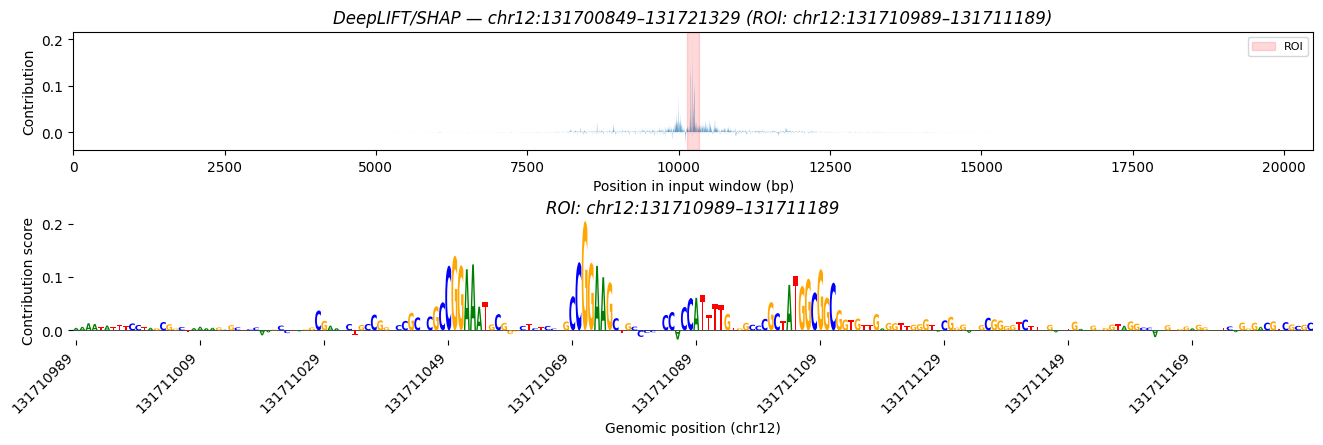
promoterai_torch.attribution.deep_lift_shap computes DeepLIFT/SHAP attributions of
the model's mean prediction with an engine written for this architecture. It gives
the same attributions as tangermeme's
deep_lift_shap (same dinucleotide-shuffled references for a given random_state,
same rescale rule), but the full published model fits on a 10 GB GPU:
from promoterai_torch.attribution import deep_lift_shap
from promoterai_torch.utils import load_pretrained

model, args = load_pretrained("model.pt")
model = model.to("cuda")

# X: (N, 4, input_length) one-hot, channels-first (tangermeme's layout)
attributions, deltas = deep_lift_shap(
    model, X,
    head=0,             # which species head
    tracks=None,        # or a list of track indices; the output is their mean
    n_shuffles=20, random_state=0,
    return_deltas=True, # |sum(attr) - (y(x) - y(ref))| per reference, ~1e-7 in float32
)
# attributions: (N, 4, input_length) on the CPU, already multiplied by X
# (hypothetical=True returns every base's attribution instead)
How many references (and, for very short sequences, how many sequences) go through
the GPU per step is chosen to saturate it within the free device memory (at the
published scale, up to 4 references per step: ~16 GB, ~10% faster than 1 on an A100;
12 GB cards fit 2, 10 GB cards 1); pass ref_chunk / batch_size / max_memory to
override it. compile=True fuses the
elementwise work: torch.compile on CPUs and CUDA GPUs of compute capability 7.0+,
and TorchScript's fuser on older GPUs (e.g. Pascal), where torch.compile's Triton
backend doesn't run. Both are measured below: TorchScript on Pascal is ~12% faster,
and torch.compile is ~21% faster on an RTX 3080 and 12-40% faster on an A100 once
compiled (the first call adds 12-70 s of compilation), agreeing with eager to a
relative L2 of ~1e-7. torch.compile here needs torch >= 2.6; eager mode works from
torch 2.1.
On Ampere and newer GPUs, PyTorch runs convolutions in TF32 by default
(torch.backends.cudnn.allow_tf32 = True), so GPU attributions differ from
tangermeme's by a relative L2 of ~1e-4 (2.7e-4 measured on an RTX 3080). This is
floating-point noise, not an engine difference, and it matches the original
TensorFlow model, which also uses TF32 on these GPUs. For an exact comparison, set
torch.backends.cudnn.allow_tf32 = False first; the gap then drops to ~1e-7, at no
cost in speed (1.7e-6 at the published scale on an A100, where the default gives 3e-4).
Turning TF32 on for matmuls too (torch.backends.cuda.matmul.allow_tf32 = True, off
by default) makes both implementations ~3x faster on an A100, at ~2e-4 relative L2
from strict float32 on the real hg38 model (~3e-3 on random weights) and convergence
deltas ~1e-3 instead of ~1e-6: fine for logo plots, not for exact checks.
Full published model (24 blocks x 1024, 20,480 bp), one sequence x 20 shuffles, float32 with PyTorch's default precision flags unless noted (A100 rows: strict float32, or TF32 for both convolutions and matmuls):
| Hardware | Method | Time | Peak GPU memory |
|---|---|---|---|
| A100 80 GB | tangermeme.deep_lift_shap, batch_size=1 |
44 s | 65.5 GB |
| A100 80 GB | deep_lift_shap |
32 s | 15.6 GB |
| A100 80 GB | deep_lift_shap(compile=True) |
28 s | 14.1 GB |
| A100 80 GB, TF32 | tangermeme.deep_lift_shap, batch_size=1 |
14 s | 65.5 GB |
| A100 80 GB, TF32 | deep_lift_shap |
9.9 s | 15.6 GB |
| A100 80 GB, TF32 | deep_lift_shap(compile=True) |
5.9 s | 14.1 GB |
| TITAN X (Pascal) 12 GB | tangermeme.deep_lift_shap |
out of memory | |
| TITAN X (Pascal) 12 GB | deep_lift_shap |
96 s | 6.5 GB |
| TITAN X (Pascal) 12 GB | deep_lift_shap(compile=True) |
86 s | 7.7 GB |
| TITAN Xp 12 GB | deep_lift_shap |
78 s | 6.5 GB |
| TITAN Xp 12 GB | deep_lift_shap(compile=True) |
70 s | 7.7 GB |
| RTX 3080 10 GB | tangermeme.deep_lift_shap |
out of memory | |
| RTX 3080 10 GB | deep_lift_shap |
40 s | 6.5 GB |
| RTX 3080 10 GB | deep_lift_shap(compile=True) |
32 s | 5.9 GB |
examples/deepliftshap_region.py attributes a genomic region and plots it;
examples/benchmark_deep_lift_shap.py compares the two implementations at reduced
width; examples/benchmark_deep_lift_shap_compile.py times eager vs compile=True
on a real checkpoint.
The engine relies on PromoterAI's structure (ReLU as the only nonlinearity,
eval-mode BatchNorm, row-wise ops). For other attribution targets or methods, the
model still works with tangermeme directly: its non-linearities are distinct
nn.ReLU() modules, as tangermeme requires. Wrap it to take (B, 4, L) and return
(B, n_targets), e.g. model(x.transpose(1, 2))[0].mean(dim=(1, 2)).unsqueeze(1).
Numerical equivalence
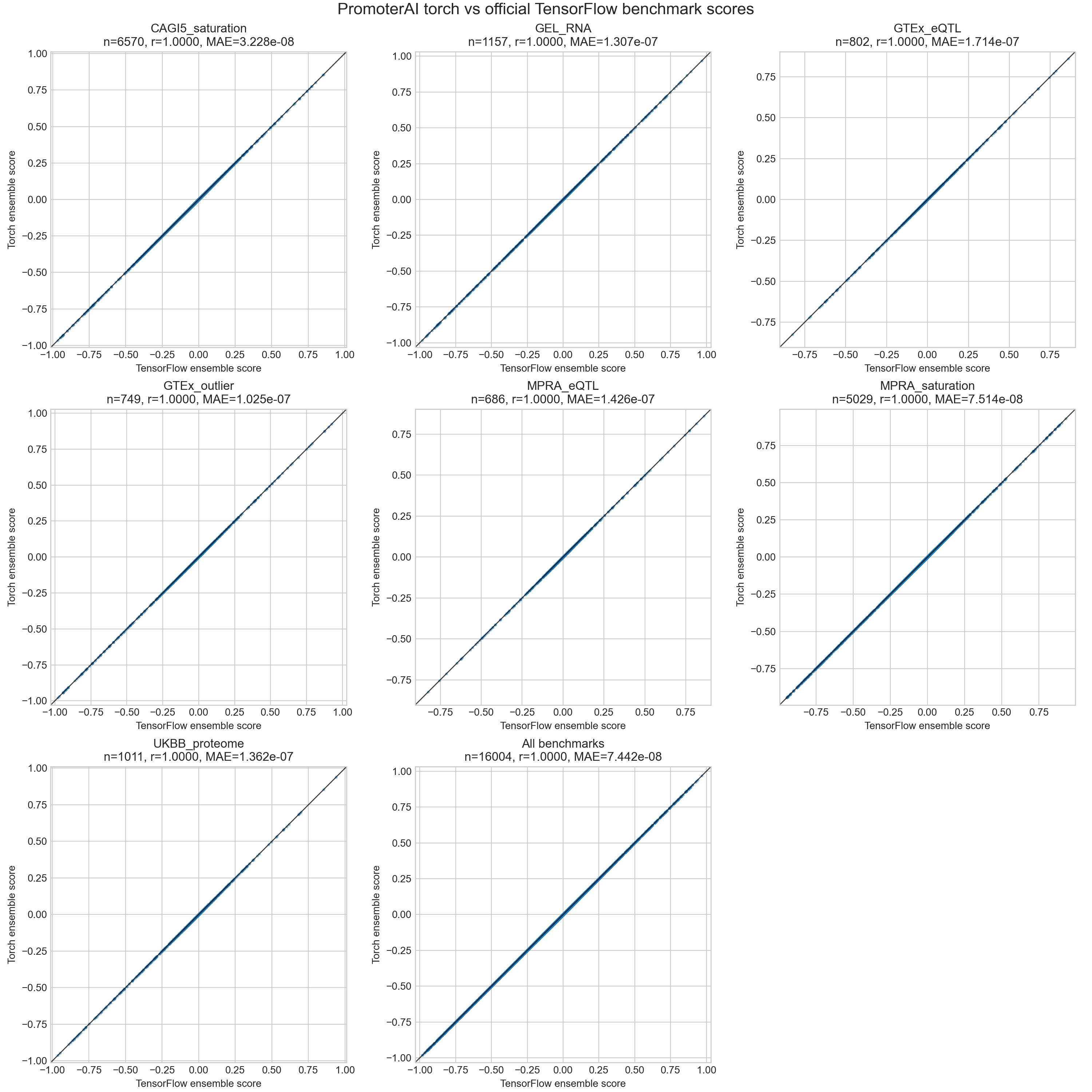
This port produces near-identical scores and regulatory track predictions to the original TensorFlow/Keras implementation, matching the published AUROCs. See docs/numerical-equivalence.md for benchmark reproduction steps, per-variant concordance results, and full-track comparison scripts.
Training models
Fine-tuning or training from scratch using the built-in scripts requires the
train extra described in Install (with an optional wandb extra
for wandb.ai integration. See docs/training.md for data
preprocessing, training from scratch, fine-tuning on variants, and multi-GPU usage.
Development
See CONTRIBUTING.md for setting up a local development environment and running the test suite.
Reference
Jaganathan, Ersaro, Novakovsky et al. Science (2025) Predicting expression-altering promoter mutations with deep learning. doi:10.1126/science.ads7373
He, Kundaje. Genomics x AI Blog (2026) promoterai-torch: a PyTorch port of Illumina's PromoterAI. doi:10.5281/zenodo.23038831
Original TF implementation: Illumina/PromoterAI
Citation metadata for this software is available in CITATION.cff.
1 maintainer

Metadata
1 maintainer
Release files for promoterai-torch 0.4.0
For a detailed explanation of source distributions (sdists) and built distributions (wheels), please see the package formats documentation.
Source distribution (sdist)
| File | Size | Uploaded | Provenance | Actions |
|---|---|---|---|---|
| promoterai_torch-0.4.0.tar.gz | 173.2 kB | With provenance | Details for promoterai_torch-0.4.0.tar.gz |
Built distribution (wheel)
| File | Interpreter | ABI | Platform | Actions Reset |
|---|---|---|---|---|
| promoterai_torch-0.4.0-py3-none-any.whl | Python 3 | none | any | Details for promoterai_torch-0.4.0-py3-none-any.whl |
Total release size: 244.6 kB
Release files / promoterai_torch-0.4.0.tar.gz
| Download URL | promoterai_torch-0.4.0.tar.gz |
|---|---|
| Size | 173.2 kB |
| Tags | Source |
|
SHA-256 checksum How to use checksums |
f56b666ee599006a2473becf80c7b38759a1826fcfe7f2be3c1ad5038f9a80cf
|
|
BLAKE2b-256 checksum How to use checksums |
491bfadbe29b07a6737bf58182dcc350aac4cd8592f3957755d54e0e210da280
|
| Upload date | |
|
Uploaded using Trusted Publishing? What is trusted publishing? |
Yes |
| Uploaded via |
twine/7.0.0 CPython/3.13.16
|
Provenance
Provenance describes where a file came from. On PyPI, provenance is shared via attestations, which provide a verifiable record of the build or publishing details. View details, limitations and caveats.


PyPI Publish Attestation
PyPI verified that this artifact, at this checksum, originated from the publisher listed below.
Signed by GitHub Actions, verified by PyPI on Nov 9, 2026.
Transparency logRelease files / promoterai_torch-0.4.0-py3-none-any.whl
| Download URL | promoterai_torch-0.4.0-py3-none-any.whl |
|---|---|
| Size | 71.4 kB |
| Tags | Python 3 |
|
SHA-256 checksum How to use checksums |
6da5367ffb4aee0a01bd2cdd1657b5481e60cddd75586d0c91993ecdda3a1fc3
|
|
BLAKE2b-256 checksum How to use checksums |
bb0ee96d82f3082417400860f3f8c4fd06d53e9a31e3dcbca036d810676a5077
|
| Upload date | |
|
Uploaded using Trusted Publishing? What is trusted publishing? |
Yes |
| Uploaded via |
twine/7.0.0 CPython/3.13.16
|
Provenance
Provenance describes where a file came from. On PyPI, provenance is shared via attestations, which provide a verifiable record of the build or publishing details. View details, limitations and caveats.
PyPI Publish Attestation
PyPI verified that this artifact, at this checksum, originated from the publisher listed below.
Signed by GitHub Actions, verified by PyPI on Nov 9, 2026.
Transparency logSecurity for promoterai-torch 0.4.0
Provenance
Provenance describes where a file came from. On PyPI, provenance is shared via attestations, which provide a verifiable record of the build or publishing details. View details, limitations and caveats.
Full provenance
Both files in this release have been uploaded with provenance metadata.
Attestation for promoterai_torch-0.4.0.tar.gz
PyPI Publish Attestation
PyPI verified that this artifact, at this checksum, originated from the publisher listed below.
Signed by GitHub Actions, verified by PyPI on Nov 9, 2026.
Transparency logA note on package security
PyPI is a repository for distributing packages, not a service for auditing them. While third-party security researchers and our staff do their best to detect and remove malicious packages, PyPI cannot guarantee the quality, security or suitability of any given package.
To learn more about protecting yourself from malicious actors, visit our package security documentation.














