
Binary Reader and Analysis Suite Software

Project description
BRASS (Binary Reader and Analysis Suite Software)
A simple and extensible C++/Python library for reading and analyzing binary particle output files.
Features
- C++ header-based binary file reader for particle data
- Plugin-style extensible analysis system (via registry macros)
- Optional Python bindings via
pybind11 - Histogramming utilities
- No external dependencies (except optionally
pybind11) - Devloped primarly for SMASH
Build Instructions
In repository
pip install pythonlib
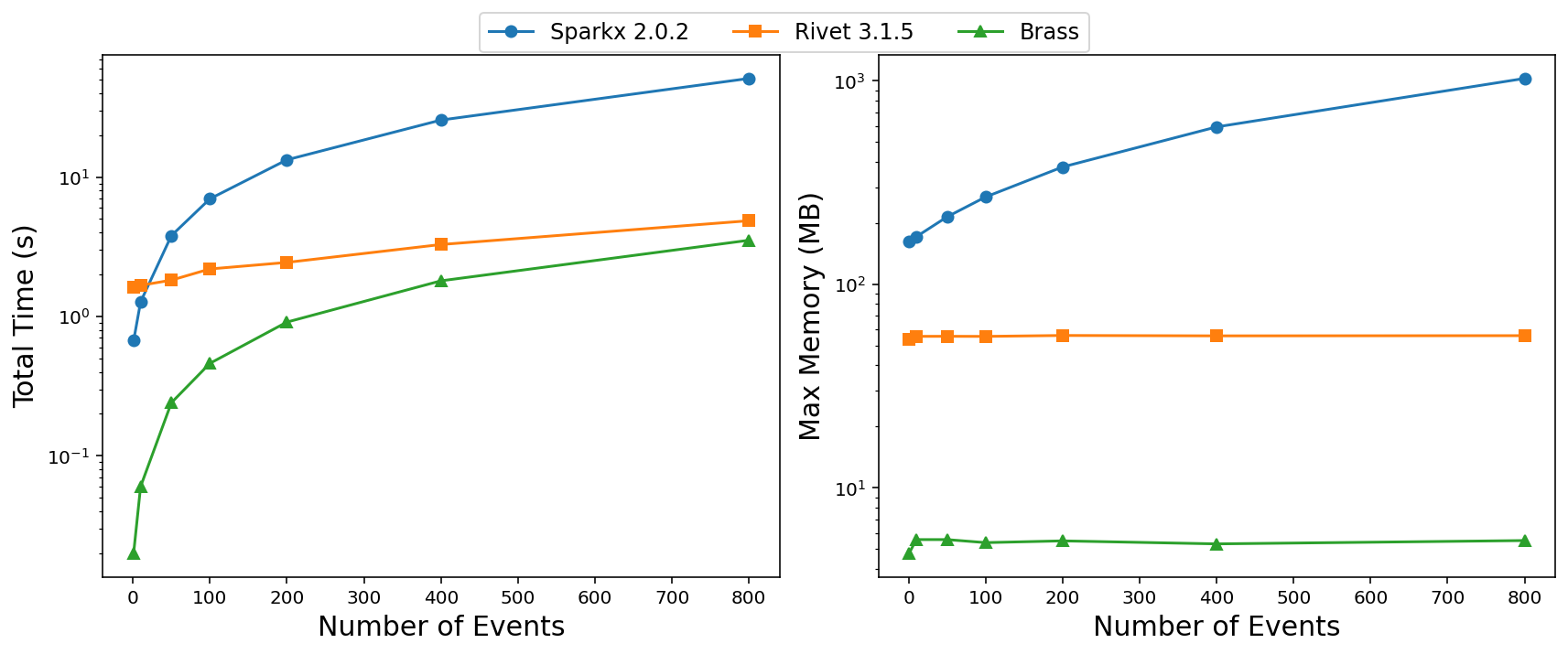
Performance
brass-analyze
Command-line tool for running registered analyses on multiple SMASH run directories.
Usage
brass-analyze [OPTIONS] OUTPUT_DIR ANALYSIS_NAME
- OUTPUT_DIR — top directory containing run subfolders (
out-*by default) - ANALYSIS_NAME — name of a registered analysis (see
--list-analyses)
Options
--list-analyses List registered analyses and exit.
--pattern PATTERN Glob for run folders (default: out-*).
--keys KEY1 KEY2 ... Dotted keys from config for labeling runs (last segment used as name). Example: --keys Modi.Collider.Sqrtsnn General.Nevents
--results-subdir DIR Subdirectory to store results (default: data).
--strict-quantities Fail if Quantities differ across runs (default: warn and use first).
-v, --verbose Print detailed information.
Writing Analyses
You can create a custom analysis by subclassing Analysis:
class MyAnalysis : public Analysis {
public:
    void analyze_particle_block(const ParticleBlock& block, const Accessor& accessor) override {
        // your logic here
    }
    void finalize() override {}
    void save(const std::string& path) override {}
};

REGISTER_ANALYSIS("my_analysis", MyAnalysis)
#include "analysis.h"
#include "analysisregister.h"
#include "histogram2d.h"
#include <cmath>
#include <vector>
#include <fstream>
#include <unordered_map>
#include <string>

class BulkObservables : public Analysis {
public:
    BulkObservables()
      : y_min(-4.0), y_max(4.0), y_bins(30),
        pt_min(0.0), pt_max(3.0), pt_bins(30),
        d2N_dpT_dy(pt_min, pt_max, pt_bins,
                   y_min, y_max, y_bins),
        n_events(0) {}

    Analysis& operator+=(const Analysis& other) override {
        auto const* o = dynamic_cast<const BulkObservables*>(&other);
        if (!o) throw std::runtime_error("merge mismatch");

        d2N_dpT_dy += o->d2N_dpT_dy;
        n_events   += o->n_events;

        for (auto const& [pdg, src] : o->per_pdg_) {
            auto& dst = obs_for(pdg);
            dst.d2N_dpT_dy += src.d2N_dpT_dy;
        }
        return *this;
    }

    void analyze_particle_block(const ParticleBlock& b, const Accessor& a) override {
        // event selection: needs at least one wounded nucleon
        bool has_wounded = false;
        for (size_t i = 0; i < b.npart; ++i) {
            int pdg = a.get_int("pdg", b, i);
            if ((pdg == 2212 || pdg == 2112) && a.get_int("ncoll", b, i) > 0) {
                has_wounded = true;
                break;
            }
        }
        if (!has_wounded) return;
        ++n_events;

        // fill spectra
        for (size_t i = 0; i < b.npart; ++i) {
            const int pdg   = a.get_int("pdg", b, i);
            const double E  = a.get_double("p0", b, i);
            const double pz = a.get_double("pz", b, i);
            const double px = a.get_double("px", b, i);
            const double py = a.get_double("py", b, i);

            if (E <= std::abs(pz)) continue;
            const double y  = 0.5 * std::log((E + pz) / (E - pz));
            const double pt = std::hypot(px, py);

            d2N_dpT_dy.fill(pt, y);

            auto& obs = obs_for(pdg);
            obs.d2N_dpT_dy.fill(pt, y);
        }
    }

    void finalize() override {
        if (n_events > 0) {
              d2N_dpT_dy.scale(1.0 / n_events);
              for (auto& [_, o] : per_pdg_) {
                 o.d2N_dpT_dy.scale(1.0 / n_events);
             }
         }
    }

    void save(const std::string& dir) override {
        YAML::Emitter out;
        out << YAML::BeginMap;

        out << YAML::Key << "merge_key"     << YAML::Value; to_yaml(out, keys);
        out << YAML::Key << "smash_version" << YAML::Value << YAML::DoubleQuoted << smash_version;
        out << YAML::Key << "n_events"      << YAML::Value << n_events;

        // totals
        out << YAML::Key << "d2N_dpT_dy"    << YAML::Value;
        to_yaml(out, "pt", "y", d2N_dpT_dy);

        // per-PDG spectra
        out << YAML::Key << "spectra" << YAML::Value << YAML::BeginMap;
        for (auto const& [pdg, o] : per_pdg_) {
            out << YAML::Key << std::to_string(pdg) << YAML::Value;
            to_yaml(out, "pt", "y", o.d2N_dpT_dy);
        }
        out << YAML::EndMap;

        out << YAML::EndMap;

        std::ofstream f(dir + "/bulk.yaml");
        f << out.c_str();
    }

private:
    struct Obs {
        Histogram2D d2N_dpT_dy;
        Obs(double pt_min, double pt_max, size_t pt_bins,
            double y_min, double y_max, size_t y_bins)
          : d2N_dpT_dy(pt_min, pt_max, pt_bins,
                       y_min, y_max, y_bins) {}
    };

    Obs& obs_for(int pdg) {
        auto [it, inserted] = per_pdg_.try_emplace(
            pdg, pt_min, pt_max, pt_bins, y_min, y_max, y_bins);
        return it->second;
    }

    double y_min, y_max, pt_min, pt_max;
    size_t y_bins, pt_bins;
    Histogram2D d2N_dpT_dy;
    int n_events;

    std::unordered_map<int, Obs> per_pdg_;
};

REGISTER_ANALYSIS("BulkObservables", BulkObservables);
How Analyses Work
Each analysis plugin in BRASS subclasses the Analysis interface and is responsible for processing particle blocks and storing results.
Merging by Metadata
When you run over multiple binary files, BRASS uses user-supplied metadata (like sqrt_s, projectile, target) to associate results with a merge key.
You define metadata like this:
YAML Output
Each analysis writes a human-readable YAML file named after the analysis, e.g., simple.yaml, which contains:
- The
smash_version - The
merge_keys - The
datablock with all computed quantities
Example output:
merge_key:
  sqrts: 17.3
  system: "PbPb"
smash_version: "SMASH-3.2-38-g5c9a7cbef"
n_events: 40
d2N_dpT_dy:
  pt_range: [0, 3]
  y_range: [-4, 4]
  pt_bins: 30
  y_bins: 30
  counts: ...
Python usage
from brass import BinaryReader, CollectorAccessor
import numpy as np
accessor = CollectorAccessor()
reader = BinaryReader("particles_binary.bin", ["pdg", "pz", "p0"], accessor)
reader.read()

pz = accessor.get_double_array("pz")
e  = accessor.get_double_array("p0")
pdg = accessor.get_int_array("pdg")

y = 0.5 * np.log((e + pz) / (e - pz))
Run analyses through Python
import os
import yaml
import brass as br

# --- point these to a few run directories you want to analyze ---
RUN_DIRS = [
    "runs/out-001",
    "runs/out-002",
]

def load_meta(yaml_path):
    with open(yaml_path, "r") as f:
        cfg = yaml.safe_load(f) or {}

    coll = (cfg.get("Modi", {}) or {}).get("Collider", {}) or {}
    proj = (coll.get("Projectile", {}) or {}).get("Particles", {}) or {}
    targ = (coll.get("Target", {}) or {}).get("Particles", {}) or {}

    Zp, Np = int(proj.get(2212, 0)), int(proj.get(2112, 0))
    Zt, Nt = int(targ.get(2212, 0)), int(targ.get(2112, 0))

    def sym(Z, N):
        # Just a couple of common cases; falls back to A=Z+N
        if   (Z, N) == (82, 126): return "Pb"
        if   (Z, N) == (1, 0):    return "p"
        return f"A{Z+N}"

    system = f"{sym(Zt, Nt)}{sym(Zp, Np)}"
    sqrts  = coll.get("Sqrtsnn", "unknown")
    return f"system={system},sqrts={sqrts}"

def main():
    file_and_meta = []
    used_quantities = None

    for d in RUN_DIRS:
        bin_path  = os.path.join(d, "particles_binary.bin")
        yaml_path = os.path.join(d, "config.yaml")
        if not (os.path.isfile(bin_path) and os.path.isfile(yaml_path)):
            print(f"[skip] Missing files in {d}")
            continue

        # Optional: read quantities once (if present). Otherwise, use [].
        with open(yaml_path, "r") as f:
            cfg = yaml.safe_load(f) or {}
        q = (((cfg.get("Output", {}) or {}).get("Particles", {}) or {})
             .get("Quantities", []) or [])
        q = [str(x) for x in q]

        if used_quantities is None:
            used_quantities = q
        elif used_quantities != q:
            print(f"[warn] Quantities differ in {yaml_path}; using the first set.")

        meta = load_meta(yaml_path)
        file_and_meta.append((bin_path, meta))

    if not file_and_meta:
        raise SystemExit("No valid runs found.")

    br.run_analysis(
        file_and_meta=file_and_meta,     # [(path_to_bin, "meta=..."), ...]
        analysis_name="my_analysis",     # label for outputs
        quantities=used_quantities or [],# [] if you don't care / not in YAML
        save_output=True,
        print_output=False,
        output_folder="results"          # will be created if missing
    )
    print("[done] brass analysis finished -> results/")

if __name__ == "__main__":
    main()


Download files
Download the file for your platform. If you're not sure which to choose, learn more about installing packages.
Source Distribution
Built Distribution
Filter files by name, interpreter, ABI, and platform.
If you're not sure about the file name format, learn more about wheel file names.
Copy a direct link to the current filters
File details
Details for the file pybrass-0.0.0.tar.gz.
File metadata
- Download URL: pybrass-0.0.0.tar.gz
- Upload date:
- Size: 1.1 MB
- Tags: Source
- Uploaded using Trusted Publishing? No
- Uploaded via: twine/6.2.0 CPython/3.12.7
File hashes
| Algorithm | Hash digest | |
|---|---|---|
| SHA256 |
3378e3aa81f2b24bb1c632d1e6e28d64fa4db8cc3e7c30a91cbc8dc355efd046
|
|
| MD5 |
e2aa1106f3b07103cdc42661ea3cd21e
|
|
| BLAKE2b-256 |
b7f887818a0a4e6bc0710c2058544e1d36cf33d78ada323408ba2dc8b654aa06
|
File details
Details for the file pybrass-0.0.0-cp312-cp312-macosx_14_0_arm64.whl.
File metadata
- Download URL: pybrass-0.0.0-cp312-cp312-macosx_14_0_arm64.whl
- Upload date:
- Size: 6.3 kB
- Tags: CPython 3.12, macOS 14.0+ ARM64
- Uploaded using Trusted Publishing? No
- Uploaded via: twine/6.2.0 CPython/3.12.7
File hashes
| Algorithm | Hash digest | |
|---|---|---|
| SHA256 |
8eba9678020bda463b88f67b31020704daef67ce2cd81d68407f859bf72059d7
|
|
| MD5 |
7f1b61387ee58b4f29950eab4e6e7746
|
|
| BLAKE2b-256 |
4c704a2f3e1ca68323a4b8736d73ff146ee8f78da911f219460d108a68d2b3a8
|






