
This release is a pre-release and may not be stable for production use.
pyscf-vscf
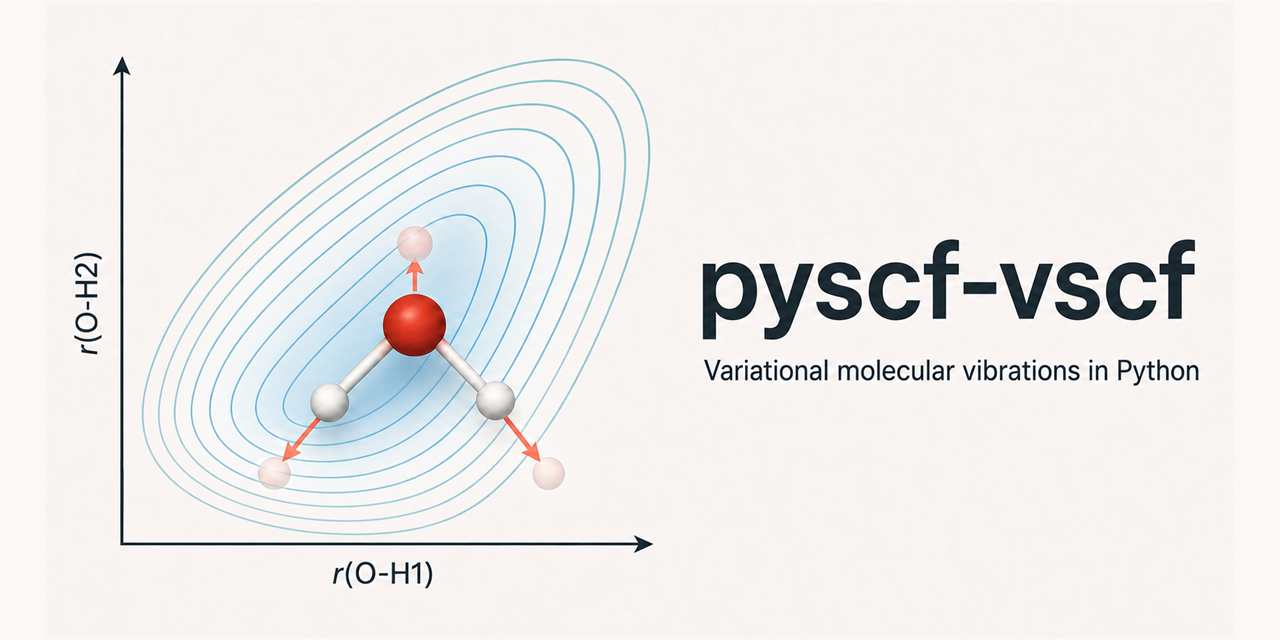
pyscf-vscf is a public-alpha package for PySCF-backed construction and
reduced-dimensional variational analysis of vibrational potential-energy and
dipole-moment surfaces.
The package now contains an actual state-specific VSCF solver for n-mode Hamiltonians with one-mode terms and explicit two-mode coupling corrections. It also provides 1D/2D sinc-DVR solvers, overlap-based 2D state assignment, harmonic and scan workflows, exact constrained normal-coordinate relaxation, and provenance-checked PES/DMS caches.
VCI is not implemented. The present VSCF is reduced-dimensional and uses rectilinear uniform DVR coordinates with diagonal one-mode kinetic operators. The package does not claim full-dimensional or general curvilinear VSCF/VCI.
Install
Install from PyPI:
pip install pyscf-vscf
The source project uses uv for development:
uv sync --extra dev
PySCF is the supported electronic-structure backend and is included in the standard installation. Electronic methods are specified using PySCF's native method syntax. Pure numerical modules and the VSCF solver avoid importing PySCF until an electronic-structure workflow is requested. On Windows, install and run the package under WSL because PySCF does not support native Windows installations.
Runnable VSCF Example
The wheel includes a deterministic coupled two-mode example that performs no electronic-structure calculations:
python -m pyscf_vscf.examples.vscf_two_mode
The main API is:
from pyscf_vscf import NModePotential, VSCFSettings, vscf_spectrum
NModePotential represents
H = sum_i [T_i + V_i(q_i)] + sum_{i<j} V_ij(q_i, q_j)
where each V_ij is a coupling correction rather than a complete two-mode
potential. Coordinates supplied to NModePotential must be in Angstrom.
The current VSCF implementation consumes a one-mode/two-mode PES through the
Python API. nmode_model_from_pair_surfaces assembles that representation from
overlapping complete pair surfaces, rejects inconsistent shared one-mode cuts,
and removes independent pair-energy offsets. PySCF does not yet generate an
arbitrary molecular n-mode PES or DMS automatically. VSCF transition
intensities and a VSCF command-line workflow are also not implemented.
Command Line
The geometry commands below are source-checkout examples; geom/ is repository
validation material and is not installed into the wheel:
pyscf-vscf --help
pyscf-vscf --version
pyscf-vscf --mmol geom/HDO.mmol --task harmonic
pyscf-vscf --mmol geom/H2O.mmol --task 1d --bond 0-1 --npts 41
The legacy pyscf_pme_pipeline.py remains in the source repository for
historical compatibility, but release support and API guarantees apply to the
package code under src/pyscf_vscf.
XYZ and MMOL files do not reliably preserve molecular charge and spin. Supply
--charge and --spin whenever a non-neutral or open-shell geometry is reused.
Scientific Conventions
- Transition dipoles are reported in Debye, never arbitrary units.
- Integrated cross sections are
integral sigma(omega) d omegainm^2/s. - Axis-projected values are for polarized light; vector-norm values use the
isotropic
1/3orientation average. - 2D state labels use phase-canonical wavefunction overlaps and expose unique labels, mixed-state signatures, participation ratios, dominant-manifold weights, and leading signed components.
- Schema-v2 caches fingerprint geometry, isotope masses, charge/spin, every electronic-structure setting, scan coordinates, runtime versions, and array checksums. Legacy caches fail closed in production loaders.
See the intensity conventions and validation guide.
Validation
uv run ruff check src tests scripts/validate_archived_grids.py \
  scripts/generate_nh3_three_mode.py scripts/expand_nh3_three_mode.py \
  scripts/validate_nh3_three_mode.py
uv run ruff format --check src tests scripts/validate_archived_grids.py \
  scripts/generate_nh3_three_mode.py scripts/expand_nh3_three_mode.py \
  scripts/validate_nh3_three_mode.py
uv run pytest -m "not pyscf" -q
uv run pytest -m pyscf -q
uv run python scripts/validate_archived_grids.py \
  --nmax 12 --output validation_data/convergence_report.json
uv run python scripts/validate_nh3_three_mode.py
The archived-grid analysis performs no electronic-structure recomputation. It reports state-matched spreads across grid density and coordinate-window variants for H2O, HDO, and D2O. It also compares the two assigned stretch fundamentals of each isotopologue against independent ORCA harmonic IR intensities. The six calculated intensities reproduce the independent scale and isotope/mode trend within 35.4% relative error. This is a computational cross-check, not an experimental or rovibrational validation.
On the same archived molecular surfaces and a matched separable kinetic model, state-specific VSCF is also compared with exact 2D DVR for both fundamentals and their combination state. This is a molecular solver benchmark, not an independent validation of the underlying PES or omitted kinetic couplings.
The separate NH3 archive exercises three local N-H coordinates and all three
pair surfaces. State-specific VSCF is compared with exact 3D DVR on the
identical 1MR/2MR Hamiltonian across a documented window-convergence sequence.
The fundamental, binary-combination, and triple-combination manifolds pass the
25 cm^-1 centroid-spread criterion; the first-overtone manifold is retained
as nonconverged. Across the final three variants, the maximum VSCF/exact
centroid error is 4.43 cm^-1. Reanalysis uses only the checked-in caches and
does not require PySCF.
1 maintainer

Metadata
1 maintainer
Release files for pyscf-vscf 0.1.0a6
For a detailed explanation of source distributions (sdists) and built distributions (wheels), please see the package formats documentation.
Source distribution (sdist)
| File | Size | Uploaded | |
|---|---|---|---|
| pyscf_vscf-0.1.0a6.tar.gz | 1.1 MB | Details |
Built distribution (wheel)
| File | Interpreter | ABI | Platform | Reset |
|---|---|---|---|---|
| pyscf_vscf-0.1.0a6-py3-none-any.whl | Python 3 | none | any | Details |
Total release size: 1.1 MB
Release files / pyscf_vscf-0.1.0a6.tar.gz
| Download URL | pyscf_vscf-0.1.0a6.tar.gz |
|---|---|
| Size | 1.1 MB |
| Tags | Source |
|
SHA-256 checksum How to use checksums |
e5974b7aba131b5dddac8179bab64170c4489b23e7187d24bdb3e1526d379c78
|
|
BLAKE2b-256 checksum How to use checksums |
8015114246804703f5b2f1314f4753fd3f219e106fbbddc1a3e6f086a160d6f6
|
| Upload date | |
|
Uploaded using Trusted Publishing? What is trusted publishing? |
Yes |
| Uploaded via |
twine/7.0.0 CPython/3.13.14
|
Provenance
Provenance describes where a file came from. On PyPI, provenance is shared via attestations, which provide a verifiable record of the build or publishing details. View details, limitations and caveats.


PyPI Publish Attestation
PyPI verified that this artifact, at this checksum, originated from the publisher listed below.
Signed by GitHub Actions, verified by PyPI on Aug 8, 2026.
Transparency logRelease files / pyscf_vscf-0.1.0a6-py3-none-any.whl
| Download URL | pyscf_vscf-0.1.0a6-py3-none-any.whl |
|---|---|
| Size | 68.1 kB |
| Tags | Python 3 |
|
SHA-256 checksum How to use checksums |
b831b5c269218dc7d59703190c9f799a17312839f297dd5d498a98546c634a2d
|
|
BLAKE2b-256 checksum How to use checksums |
db1a5dddb85ae50828457d2fa48519a86b9deac681c181d66be21c49cfcf6f34
|
| Upload date | |
|
Uploaded using Trusted Publishing? What is trusted publishing? |
Yes |
| Uploaded via |
twine/7.0.0 CPython/3.13.14
|
Provenance
Provenance describes where a file came from. On PyPI, provenance is shared via attestations, which provide a verifiable record of the build or publishing details. View details, limitations and caveats.
PyPI Publish Attestation
PyPI verified that this artifact, at this checksum, originated from the publisher listed below.
Signed by GitHub Actions, verified by PyPI on Aug 8, 2026.
Transparency log













