
pyscf-vscf
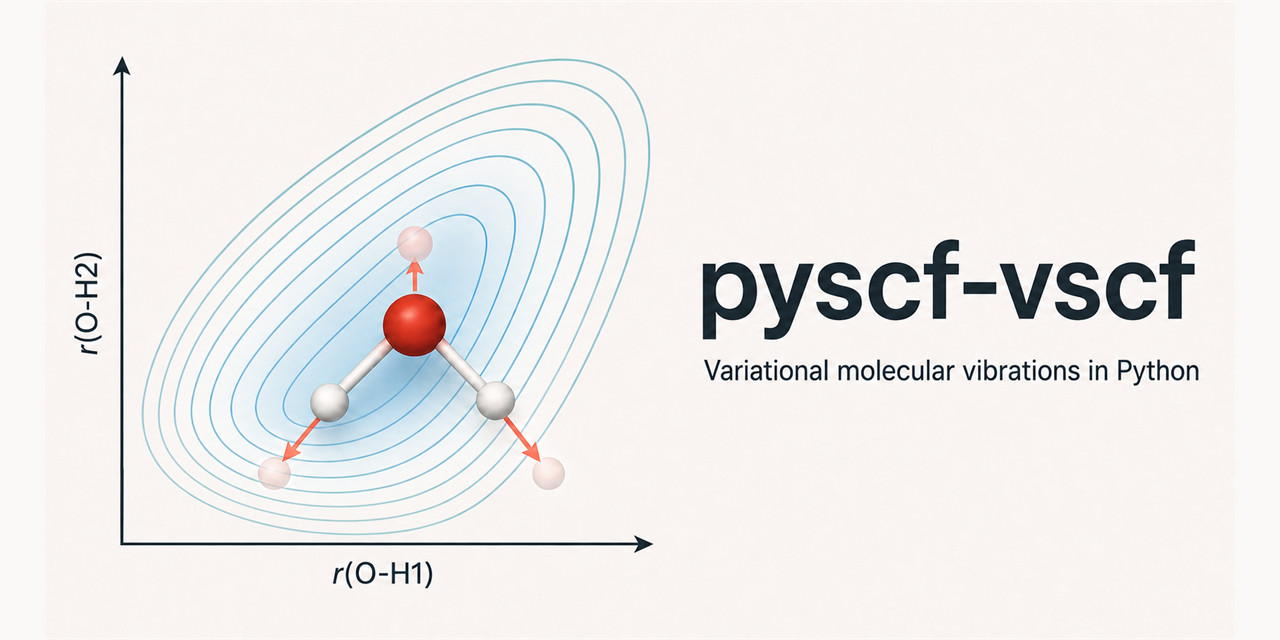
pyscf-vscf computes anharmonic vibrational spectra variationally, on
potential-energy and dipole-moment surfaces evaluated with
PySCF. It scans one or two bond stretches (or a normal
coordinate), solves the vibrational Schrodinger equation on that grid, and
reports assigned transition frequencies with absolute infrared intensities.
For more coordinates it offers vibrational self-consistent field (VSCF) and
configuration-interaction (VCI) solvers on fitted n-mode surfaces.
It is meant for researchers who need anharmonic frequencies and intensities of a few strongly anharmonic modes, such as X-H stretches, overtones, and isotopologues, beyond what harmonic analysis or second-order perturbation theory provide, and who want every step to be inspectable, cached, and reproducible from Python.
Install
pip install pyscf-vscf
PySCF and geomeTRIC are installed with the package. PySCF does not support native Windows, so Windows users should install under WSL. See the installation guide for development installs and thread settings.
Quickstart
Optimize a geometry, then compute the O-H stretch spectrum of water from a 41-point potential and dipole scan:
pyscf-vscf --xyz water.xyz --task opt --method b3lyp --basis cc-pvdz
pyscf-vscf --xyz water.pyscf_opt.xyz --task 1d --bond 0-1 \
    --rmin 0.65 --rmax 1.6 --npts 41 --vmax 3 \
    --method b3lyp --basis cc-pvdz --dump-grid oh.npz
v  nu/cm^-1   mu_axis/D   I_axis/(km/mol)   int_axis/(m^2/s)   orientation: polarized along bond axis
1   3644.8     2.6930e-02     1.9877e+01     6.2173e-11
2   7136.8     8.8836e-03     4.2354e+00     1.3248e-11
3  10481.3     2.0529e-03     3.3216e-01     1.0390e-12
Bonds are zero-based atom indices. The scan runs in parallel automatically;
this one takes about 15 s on an 8-core laptop. The grid is cached in
oh.npz, so further spectra need no electronic-structure calculations; the
cache supplies the method, basis, bond, and grid:
pyscf-vscf --xyz water.pyscf_opt.xyz --task 1d --reuse-grid oh.npz --intensity both
Check that the grid is wide enough. States that place more than 1e-5 of
their probability on the outermost grid points are marked with *; their
frequencies are not converged. On the default 0.75-1.25 A range the O-H
fundamental above is 76 cm^-1 too high, so always choose --rmin/--rmax
for your bond and confirm that the reported states do not change when the
range grows.
Run pyscf-vscf --help for every option. --json results.json also writes
machine-readable results.
Python
The same building blocks are available from Python. This VSCF example needs no electronic-structure calculation:
import numpy as np
from pyscf_vscf import NModePotential, vscf_spectrum

q1 = np.linspace(-0.35, 0.35, 31)
q2 = np.linspace(-0.30, 0.30, 29)
model = NModePotential(
    coordinates=(q1, q2),                       # angstrom
    masses_amu=(1.0, 1.5),
    one_mode_potentials_Eh=(0.08 * q1**2, 0.11 * q2**2),
    two_mode_couplings_Eh={(0, 1): 0.20 * q1[:, None] ** 2 * q2[None, :] ** 2},
)
spectrum = vscf_spectrum(model, max_quanta_per_mode=2, max_total_quanta=2)
for transition in spectrum.transitions:
    print(transition.quanta, round(transition.frequency_cm, 1))
python -m pyscf_vscf.examples.vscf_two_mode and
python -m pyscf_vscf.examples.nmode_vci run packaged examples. Scans from
Python accept your own energy/dipole evaluator, so other electronic-structure
programs can supply the surfaces.
What it computes
- 1D and 2D sinc-DVR spectra on frozen local-bond scans, rigid normal-coordinate scans, and exactly constrained relaxed normal-coordinate scans, with overlap-based state assignments.
- Absolute intensities for light polarized along a bond and for isotropic samples, in km/mol and as integrated cross sections.
- State-specific VSCF for n-mode Hamiltonians with one-mode potentials and two-mode couplings.
- Fitted 1MR/2MR and selected 3MR scalar and vector n-mode surfaces, VCI on
VSCF modals, and a complete triatomic Jacobi
J=0kinetic-energy operator. - Harmonic analysis and geometry optimization through PySCF and geomeTRIC.
- Checksummed PES/DMS caches whose identity is independent of isotope masses.
The package does not generate full-dimensional potential surfaces and does not implement a general curvilinear or rovibrational kinetic-energy operator. Reduced-dimensional results inherit the error of the omitted coordinates.
Stability
| Area | Modules | Status |
|---|---|---|
| Command line, scans, 1D/2D DVR spectra, caches | cli, workflows, variational, dvr, cache |
Stable; changes are announced in the changelog |
| VSCF on n-mode potentials | vscf |
Stable |
n-mode surfaces, triatomic J=0, VCI, transition moments, multilevel surfaces, correlated providers |
nmode, kinetic, vci, transition_moments, multilevel, backends.pyscf_correlated |
Evolving; may change between minor releases |
Documentation
- Grid caches and reuse
- Intensity conventions
- Advanced n-mode and VCI guide
- Correlated and finite-field providers
- Running the validations
- Changelog and roadmap
Validation
The test suite combines analytic numerical checks, small PySCF calculations, and archived H2O/HDO/D2O and NH3 molecular validations against exact DVR. These establish solver correctness and convergence on the stated reduced-dimensional Hamiltonians; they do not establish general spectroscopic accuracy.
Citing and contributing
If you use pyscf-vscf in research, cite it with the metadata in
CITATION.cff
(GitHub's "Cite this repository" button). Bug reports, questions, and
contributions are welcome; see
CONTRIBUTING.
License
The code is MIT-licensed. The archived validation data are licensed under
CC BY 4.0; see
DATA_LICENSE.md.
1 maintainer

Metadata
1 maintainer
Release files for pyscf-vscf 0.2.2
For a detailed explanation of source distributions (sdists) and built distributions (wheels), please see the package formats documentation.
Source distribution (sdist)
| File | Size | Uploaded | |
|---|---|---|---|
| pyscf_vscf-0.2.2.tar.gz | 1.2 MB | Details |
Built distribution (wheel)
| File | Interpreter | ABI | Platform | Reset |
|---|---|---|---|---|
| pyscf_vscf-0.2.2-py3-none-any.whl | Python 3 | none | any | Details |
Total release size: 1.3 MB
Release files / pyscf_vscf-0.2.2.tar.gz
| Download URL | pyscf_vscf-0.2.2.tar.gz |
|---|---|
| Size | 1.2 MB |
| Tags | Source |
|
SHA-256 checksum How to use checksums |
65b61df13b2617d43be5012ba859ef3d9386bf04096bc3cd785a807a6d186fe6
|
|
BLAKE2b-256 checksum How to use checksums |
e4acd79ee777de8d3213832179f7079aa3624f7b98156fd2780bd1aa5baa5205
|
| Upload date | |
|
Uploaded using Trusted Publishing? What is trusted publishing? |
Yes |
| Uploaded via |
twine/7.0.0 CPython/3.13.14
|
Provenance
Provenance describes where a file came from. On PyPI, provenance is shared via attestations, which provide a verifiable record of the build or publishing details. View details, limitations and caveats.


PyPI Publish Attestation
PyPI verified that this artifact, at this checksum, originated from the publisher listed below.
Signed by GitHub Actions, verified by PyPI on Oct 11, 2026.
Transparency logRelease files / pyscf_vscf-0.2.2-py3-none-any.whl
| Download URL | pyscf_vscf-0.2.2-py3-none-any.whl |
|---|---|
| Size | 156.4 kB |
| Tags | Python 3 |
|
SHA-256 checksum How to use checksums |
45c090c3679668ad4588c16daef346fcb2435242a4648226efe62a4639bc8a2e
|
|
BLAKE2b-256 checksum How to use checksums |
d8caf6c23cf2c1142ce2798addedc3da3d58f802352919e9c0436d1be133b868
|
| Upload date | |
|
Uploaded using Trusted Publishing? What is trusted publishing? |
Yes |
| Uploaded via |
twine/7.0.0 CPython/3.13.14
|
Provenance
Provenance describes where a file came from. On PyPI, provenance is shared via attestations, which provide a verifiable record of the build or publishing details. View details, limitations and caveats.
PyPI Publish Attestation
PyPI verified that this artifact, at this checksum, originated from the publisher listed below.
Signed by GitHub Actions, verified by PyPI on Oct 11, 2026.
Transparency log













