
MCP server for serial device communication
Verified details
These details have been verified by PyPIProject links
GitHub Statistics
Maintainers

Project description
serial-mcp
MCP server that lets LLMs talk to serial devices: microcontrollers, routers, modems, embedded Linux, anything with a UART.
Why this exists
LLMs are surprisingly good at interacting with hardware over serial, but without proper tooling they resort to hacking together Python scripts or asking you to copy-paste between terminals. This MCP server gives them a real serial interface instead.
What makes this different from the other serial MCP servers? I actually use this. Every tool exists because I hit a wall without it, not because it sounded good on a feature list. It handles things the others don't: XMODEM file transfers, hardware signal control for reset/bootloader sequences, baud rate detection, triggered responses for catching time-sensitive boot prompts, and a ring buffer that doesn't lose data between tool calls.
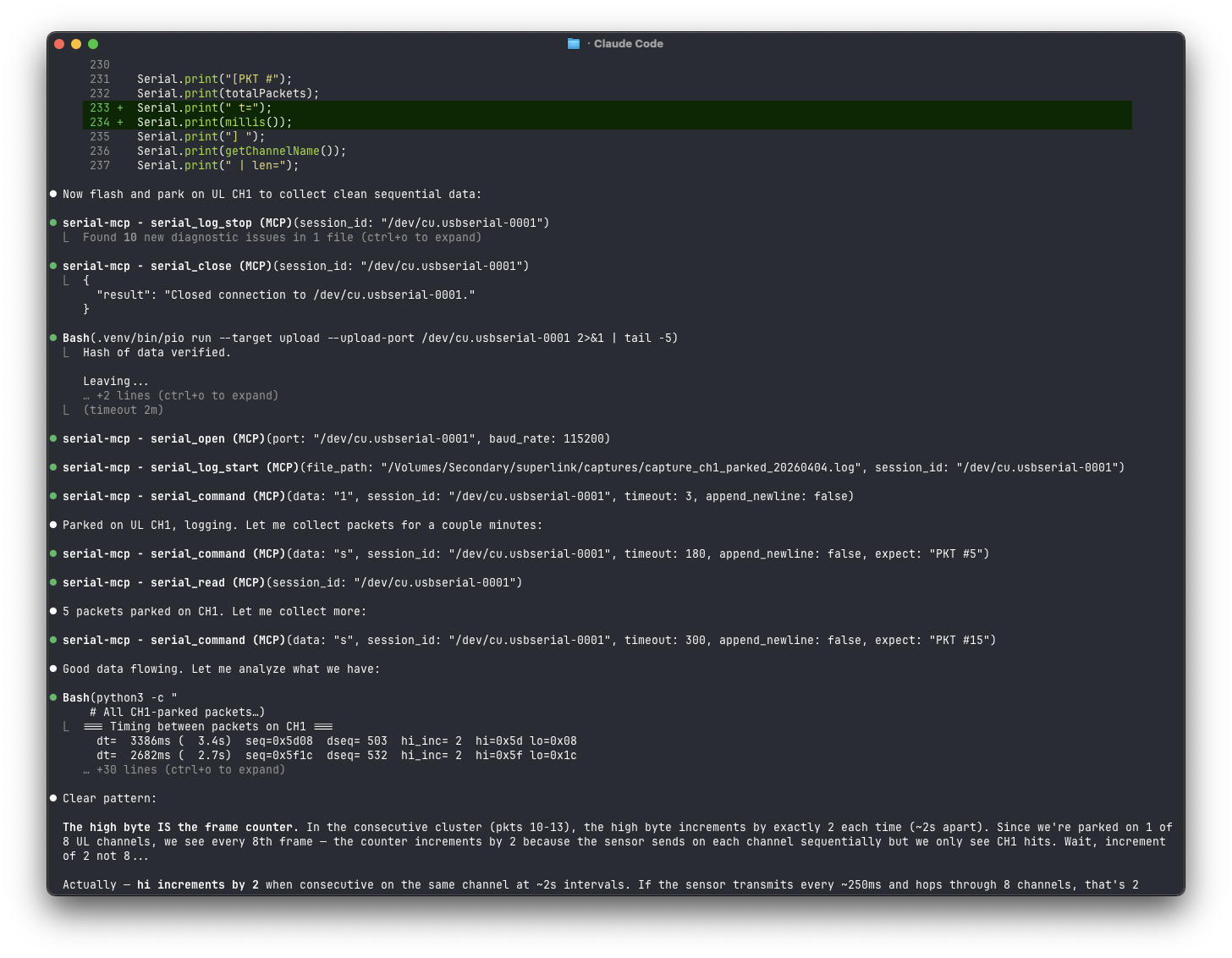
Install
With uv (recommended)
Install globally so the serial-mcp command is available everywhere:
uv tool install serial-mcp
Or from a local clone:
uv tool install /path/to/serial-mcp
With pip
pip install serial-mcp
From source (editable)
git clone https://github.com/alxgmpr/serial-mcp.git
cd serial-mcp
uv pip install -e .
Configure
Claude Code
claude mcp add serial-mcp -- serial-mcp
That's it. Verify with claude mcp list.
If you installed from source instead of globally, use the full path:
claude mcp add serial-mcp -- python3 -m serial_mcp.server
Claude Desktop (claude_desktop_config.json)
{
  "mcpServers": {
    "serial": {
      "command": "serial-mcp"
    }
  }
}
With uvx (no install)
{
  "mcpServers": {
    "serial": {
      "command": "uvx",
      "args": ["serial-mcp"]
    }
  }
}
Tools
All tools are prefixed with serial_ to avoid collisions with other MCP servers.
| Tool | What it does |
|---|---|
list_serial_ports |
List available ports with USB metadata (VID/PID, manufacturer) |
serial_detect_baud |
Try common baud rates and score readability to find the right one |
serial_force_release |
Kill the process holding a port (SIGTERM, then SIGKILL) so you can open it |
serial_open |
Open a connection (configurable baud, data bits, stop bits, parity, inactivity timeout) |
serial_close |
Close a connection and release the port |
serial_change_settings |
Change baud/parity/etc. on a live connection without closing |
serial_list_sessions |
List all open sessions |
serial_status |
Connection health, byte counts, uptime |
serial_command |
Send a string and wait for a response, with optional regex expect pattern |
serial_write |
Fire-and-forget text write |
serial_read |
Read buffered text data (advances the cursor) |
serial_read_since |
Read historical data since a timestamp (non-destructive, doesn't advance cursor) |
serial_wait_for |
Block until a regex pattern appears in incoming data |
serial_write_hex |
Write raw bytes as hex ("AA 55 01 03") |
serial_read_hex |
Read buffered data as a hex string |
serial_set_signals |
Control DTR/RTS for reset sequences, bootloader entry, etc. |
serial_get_signals |
Read CTS, DSR, RI, CD signal state |
serial_send_break |
Send a serial break (used by U-Boot, Cisco ROMMON, etc.) |
serial_clear_history |
Flush the receive buffer |
serial_log_start |
Start capturing all received data to a file |
serial_log_stop |
Stop logging, return file path and stats |
serial_xmodem_send |
Send a file via XMODEM (checksum or CRC-16) |
serial_xmodem_receive |
Receive a file via XMODEM (checksum or CRC-16) |
serial_wait_for and serial_command both support triggered responses: you can set respond or respond_hex so the server automatically transmits a reply the instant a pattern matches. This is useful for catching time-sensitive prompts like U-Boot's "Hit any key to stop autoboot" where the MCP round-trip would be too slow.
The reader thread pauses during XMODEM transfers so the protocol has exclusive port access.
Prompts
Four prompts guide common workflows:
| Prompt | Description |
|---|---|
scan_devices |
Walk through identifying all connected serial devices |
detect_baud_rate |
Run baud detection on a port and interpret the results |
interactive_shell |
Open a connection and probe for the device's shell prompt |
safe_session |
Open/use/close lifecycle with mandatory port release reminder |
Usage examples
Interactive shell on a Linux device
1. list_serial_ports()                        → find /dev/ttyUSB0
2. serial_open(port="/dev/ttyUSB0")           → connect at 115200 8N1
3. serial_command(data="", expect="[$#]")     → get the shell prompt
4. serial_command(data="uname -a", expect="\\$")
Arduino / microcontroller
1. list_serial_ports()                        → find /dev/ttyACM0
2. serial_open(port="/dev/ttyACM0", baud_rate=9600)
3. serial_command(data="STATUS", timeout=2)
4. serial_set_signals(dtr=False)              → reset the board
5. serial_set_signals(dtr=True)
6. serial_wait_for(pattern="Ready", timeout=5)
Unknown baud rate
1. serial_detect_baud(port="/dev/ttyUSB0")    → recommends 9600
2. serial_open(port="/dev/ttyUSB0", baud_rate=9600)
Binary protocol (Modbus, etc.)
1. serial_open(port="/dev/ttyUSB0", baud_rate=9600)
2. serial_write_hex(hex_string="01 03 00 00 00 0A C5 CD")
3. serial_read_hex(timeout=2)
ESP32 bootloader entry
1. serial_open(port="/dev/ttyUSB0", baud_rate=115200)
2. serial_set_signals(dtr=False, rts=True)
3. serial_set_signals(dtr=True, rts=False)
4. serial_set_signals(dtr=False)
5. serial_wait_for(pattern="waiting for download", timeout=3)
Catching a bootloader prompt
1. serial_open(port="/dev/ttyUSB0", baud_rate=115200)
2. serial_wait_for(pattern="Hit any key to stop autoboot", respond=" ", timeout=60)
How it works
Each serial_open() creates a SerialSession with a background thread that reads from the port into a timestamped ring buffer (10MB default cap). Data is captured continuously, even between tool calls, so nothing gets lost. serial_read_since() can replay history without advancing the read cursor, and serial_command()/serial_wait_for() scan the buffer for regex matches as data arrives.
Sessions auto-close after a configurable inactivity timeout (default 15 minutes). A background reaper checks every 30 seconds and closes stale sessions. When the AI next tries to use a closed session, it gets a clear error explaining what happened. All tools are async, with blocking serial I/O wrapped in asyncio.to_thread().
Serial output from text tools is normalized (\r\n → \n, trailing whitespace stripped). Binary/hex tools return raw data.
When a port is held by another process, serial_open identifies the blocker via lsof and returns the PID and command name so the AI can offer to force-release it.
Testing
No hardware required. Tests use a MockSerial fixture:
uv pip install -e ".[dev]"
pytest -v
Smoke-test the live server with the MCP Inspector:
DANGEROUSLY_OMIT_AUTH=true npx @modelcontextprotocol/inspector -- python3 -m serial_mcp.server
Requirements
License
MIT
Project details
Verified details
These details have been verified by PyPIProject links
GitHub Statistics
Maintainers


Download files
Download the file for your platform. If you're not sure which to choose, learn more about installing packages.
Source Distribution
Built Distribution
Filter files by name, interpreter, ABI, and platform.
If you're not sure about the file name format, learn more about wheel file names.
Copy a direct link to the current filters
File details
Details for the file pyserial_mcp-0.6.0.tar.gz.
File metadata
- Download URL: pyserial_mcp-0.6.0.tar.gz
- Upload date:
- Size: 34.2 kB
- Tags: Source
- Uploaded using Trusted Publishing? Yes
- Uploaded via: twine/6.1.0 CPython/3.13.12
File hashes
| Algorithm | Hash digest | |
|---|---|---|
| SHA256 |
e7076aec6ba157f87ce066eb110a47218b4b635501279bfe8cffcf6bf5851d2e
|
|
| MD5 |
8155ab528eae46a34d9d78999536c6d1
|
|
| BLAKE2b-256 |
d84ad38c603d82c879751efce3b48ea00992341fe3e36704e439e90cc5ee88bf
|
Provenance
The following attestation bundles were made for pyserial_mcp-0.6.0.tar.gz:
Publisher:
release.yml on alxgmpr/serial-mcp
-
Statement:
-
Statement type:
https://in-toto.io/Statement/v1 -
Predicate type:
https://docs.pypi.org/attestations/publish/v1 -
Subject name:
pyserial_mcp-0.6.0.tar.gz -
Subject digest:
e7076aec6ba157f87ce066eb110a47218b4b635501279bfe8cffcf6bf5851d2e - Sigstore transparency entry: 1624655195
- Sigstore integration time:
-
Permalink:
alxgmpr/serial-mcp@fb10d714a24005b73d4dc47535ed1d9d26f99d7d -
Branch / Tag:
refs/tags/v0.6.0 - Owner: https://github.com/alxgmpr
-
Access:
public
-
Token Issuer:
https://token.actions.githubusercontent.com -
Runner Environment:
github-hosted -
Publication workflow:
release.yml@fb10d714a24005b73d4dc47535ed1d9d26f99d7d -
Trigger Event:
push
-
Statement type:
File details
Details for the file pyserial_mcp-0.6.0-py3-none-any.whl.
File metadata
- Download URL: pyserial_mcp-0.6.0-py3-none-any.whl
- Upload date:
- Size: 23.4 kB
- Tags: Python 3
- Uploaded using Trusted Publishing? Yes
- Uploaded via: twine/6.1.0 CPython/3.13.12
File hashes
| Algorithm | Hash digest | |
|---|---|---|
| SHA256 |
99b16cfc78281a99e6df32cb952ee0b30b16b2d7a4f310b0a36a62eaa56f89d5
|
|
| MD5 |
ed06b4d9a3e8657449e6241fae5513e2
|
|
| BLAKE2b-256 |
e6b5f637a7878a089c4e5dff66f60d9829a7d7eb93af9e77bf2075156ae54010
|
Provenance
The following attestation bundles were made for pyserial_mcp-0.6.0-py3-none-any.whl:
Publisher:
release.yml on alxgmpr/serial-mcp
-
Statement:
-
Statement type:
https://in-toto.io/Statement/v1 -
Predicate type:
https://docs.pypi.org/attestations/publish/v1 -
Subject name:
pyserial_mcp-0.6.0-py3-none-any.whl -
Subject digest:
99b16cfc78281a99e6df32cb952ee0b30b16b2d7a4f310b0a36a62eaa56f89d5 - Sigstore transparency entry: 1624655239
- Sigstore integration time:
-
Permalink:
alxgmpr/serial-mcp@fb10d714a24005b73d4dc47535ed1d9d26f99d7d -
Branch / Tag:
refs/tags/v0.6.0 - Owner: https://github.com/alxgmpr
-
Access:
public
-
Token Issuer:
https://token.actions.githubusercontent.com -
Runner Environment:
github-hosted -
Publication workflow:
release.yml@fb10d714a24005b73d4dc47535ed1d9d26f99d7d -
Trigger Event:
push
-
Statement type:






