
docs |
|
|---|---|
tests |
      |
package |
|



A py.test fixture for benchmarking code. It will group the tests into rounds that are calibrated to the chosen timer. See: calibration.
Free software: BSD license
Installation
pip install pytest-benchmark
Usage
This plugin provides a benchmark fixture. This fixture is a callable object that will benchmark any function passed to it.
Example:
def something(duration=0.000001):
    # Code to be measured
    return time.sleep(duration)

def test_my_stuff(benchmark):
    # benchmark something
    result = benchmark(something)

    # Extra code, to verify that the run completed correctly.
    # Note: this code is not measured.
    assert result is None
You can also pass extra arguments:
def test_my_stuff(benchmark):
    # benchmark something
    result = benchmark(something, 0.02)
If you need to do some wrapping (like special setup), you can use it as a decorator around a wrapper function:
def test_my_stuff(benchmark):
    @benchmark
    def result():
        # Code to be measured
        return something(0.0002)

    # Extra code, to verify that the run completed correctly.
    # Note: this code is not measured.
    assert result is None
py.test command-line options:
- --benchmark-min-time=BENCHMARK_MIN_TIME
Minimum time per round. Default: 25.00us
- --benchmark-max-time=BENCHMARK_MAX_TIME
Maximum time to spend in a benchmark. Default: 1.00s
- --benchmark-min-rounds=BENCHMARK_MIN_ROUNDS
Minimum rounds, even if total time would exceed –max-time. Default: 5
- --benchmark-sort=BENCHMARK_SORT
Column to sort on. Can be one of: ‘min’, ‘max’, ‘mean’ or ‘stddev’. Default: min
- --benchmark-timer=BENCHMARK_TIMER
Timer to use when measuring time. Default: time.perf_counter
- --benchmark-warmup
Runs the benchmarks two times. Discards data from the first run.
- --benchmark-warmup-iterations=BENCHMARK_WARMUP_ITERATIONS
Max number of iterations to run in the warmup phase. Default: 100000
- --benchmark-verbose
Dump diagnostic and progress information.
- --benchmark-disable-gc
Disable GC during benchmarks.
- --benchmark-skip
Skip running any benchmarks.
- --benchmark-only
Only run benchmarks.
Setting per-test options:
@pytest.mark.benchmark(
    group="group-name",
    min_time=0.1,
    max_time=0.5,
    min_rounds=5,
    timer=time.time,
    disable_gc=True,
    warmup=False
)
def test_my_stuff(benchmark):
    @benchmark
    def result():
        # Code to be measured
        return time.sleep(0.000001)

    # Extra code, to verify that the run
    # completed correctly.
    # Note: this code is not measured.
    assert result is None
Glossary
- Iteration
A single run of your benchmarked function.
- Round
A set of iterations. The size of a round is computed in the calibration phase.
Stats are computed with rounds, not with iterations. The duration for a round is an average of all the iterations in that round.
See: calibration for an explanation of why it’s like this.
Features
Calibration
pytest-benchmark will run your function multiple times between measurements. A round`is that set of runs done between measurements. This is quite similar to the builtin ``timeit` module but it’s more robust.
The problem with measuring single runs appears when you have very fast code. To illustrate:
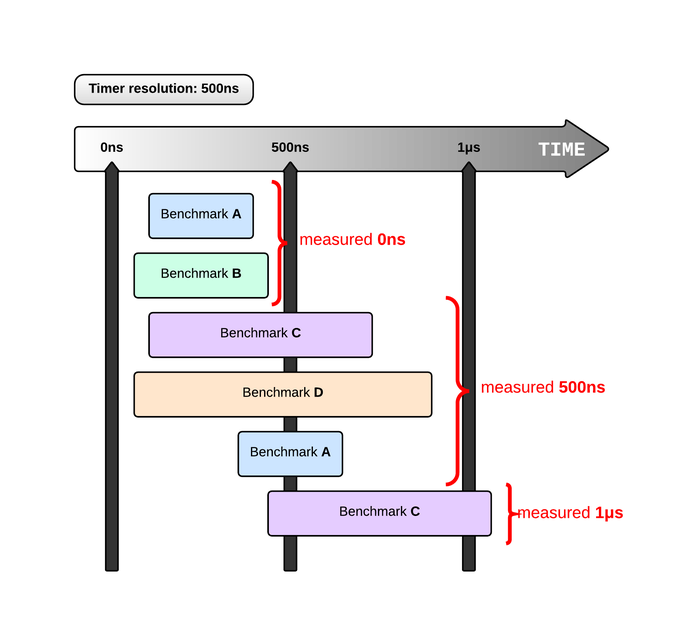
In other words, a round is a set of runs that are averaged together, those resulting numbers are then used to compute the result tables. The default settings will try to keep the round small enough (so that you get to see variance), but not too small, because then you have the timer calibration issues illustrated above (your test function is faster than or as fast as the resolution of the timer).
Patch utilities
Suppose you want to benchmark an internal function from a class:
class Foo(object):
    def __init__(self, arg=0.01):
        self.arg = arg

    def run(self):
        self.internal(self.arg)

    def internal(self, duration):
        time.sleep(duration)
With the benchmark fixture this is quite hard to test if you don’t control the Foo code or it has very complicated construction.
For this there’s an experimental benchmark_weave fixture that can patch stuff using aspectlib (make sure you pip install apectlib or pip install pytest-benchmark[aspect]):
def test_foo(benchmark_weave):
    with benchmark_weave(Foo.internal, lazy=True):
        f = Foo()
        f.run()
Documentation
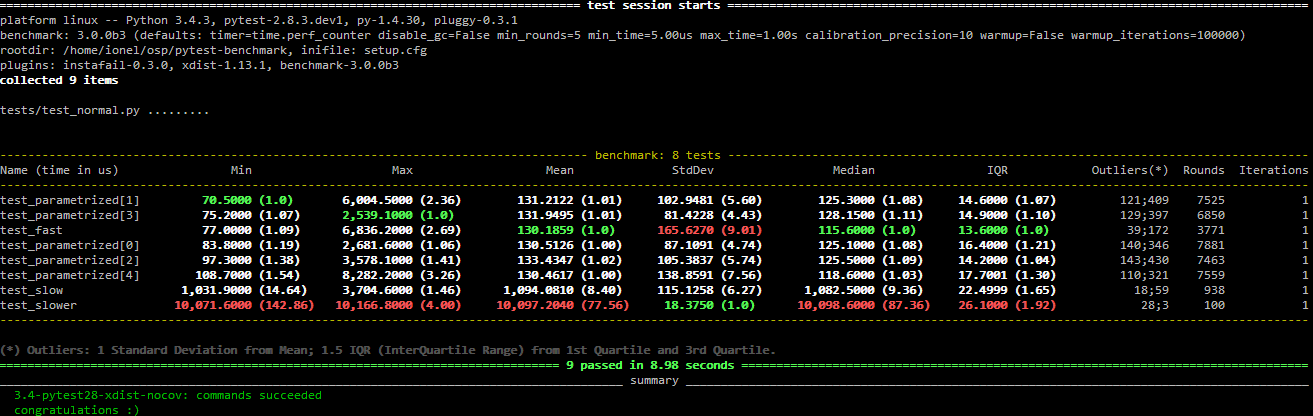
Obligatory screenshot
Development
To run the all tests run:
tox
Credits
Timing code and ideas taken from: https://bitbucket.org/haypo/misc/src/tip/python/benchmark.py
Changelog
2.5.0 (2015-06-20)
Improved test suite a bit (not using cram anymore).
Improved help text on the --benchmark-warmup option.
Made warmup_iterations available as a marker argument (eg: @pytest.mark.benchmark(warmup_iterations=1234)).
Fixed --benchmark-verbose’s printouts to work properly with output capturing.
Changed how warmup iterations are computed (now number of total iterations is used, instead of just the rounds).
Fixed a bug where calibration would run forever.
Disabled red/green coloring (it was kinda random) when there’s a single test in the results table.
2.4.1 (2015-03-16)
Fix regression, plugin was raising ValueError: no option named 'dist' when xdist wasn’t installed.
2.4.0 (2015-03-12)
Add a benchmark_weave experimental fixture.
Fix internal failures when xdist plugin is active.
Automatically disable benchmarks if xdist is active.
2.3.0 (2014-12-27)
Moved the warmup in the calibration phase. Solves issues with benchmarking on PyPy.
Added a --benchmark-warmup-iterations option to fine-tune that.
2.2.0 (2014-12-26)
Make the default rounds smaller (so that variance is more accurate).
Show the defaults in the --help section.
2.1.0 (2014-12-20)
Simplify the calibration code so that the round is smaller.
Add diagnostic output for calibration code (--benchmark-verbose).
2.0.0 (2014-12-19)
Replace the context-manager based API with a simple callback interface.
Implement timer calibration for precise measurements.
1.0.0 (2014-12-15)
Use a precise default timer for PyPy.
? (?)
Readme and styling fixes (contributed by Marc Abramowitz)
Lots of wild changes.
1 maintainer

Release files for pytest-benchmark 2.5.0
For a detailed explanation of source distributions (sdists) and built distributions (wheels), please see the package formats documentation.
Source distribution (sdist)
| File | Size | Uploaded | |
|---|---|---|---|
| pytest-benchmark-2.5.0.tar.gz | 97.2 kB | Details |
Built distribution (wheel)
| File | Interpreter | ABI | Platform | Reset |
|---|---|---|---|---|
| pytest_benchmark-2.5.0-py2.py3-none-any.whl | Python 2, Python 3 | none | any | Details |
Total release size: 118.7 kB
Release files / pytest-benchmark-2.5.0.tar.gz
| Download URL | pytest-benchmark-2.5.0.tar.gz |
|---|---|
| Size | 97.2 kB |
| Tags | Source |
|
SHA-256 checksum How to use checksums |
fb0e3e2d2e174e504b98785313ab1afb734ac8740c9efdeb5395acdf903da7c7
|
|
BLAKE2b-256 checksum How to use checksums |
5af2e1ba1863822345e3044900bf32dc78c90dd169b282f7819c85c210d30f2a
|
| Upload date | |
|
Uploaded using Trusted Publishing? What is trusted publishing? |
No |
Release files / pytest_benchmark-2.5.0-py2.py3-none-any.whl
| Download URL | pytest_benchmark-2.5.0-py2.py3-none-any.whl |
|---|---|
| Size | 21.5 kB |
| Tags | Python 2 Python 3 |
|
SHA-256 checksum How to use checksums |
938bb7e7c9d4207f757d4d9c87432feeb4edfebdbe0ff4d1cf844f49fa5b0c70
|
|
BLAKE2b-256 checksum How to use checksums |
a6afe28c98156ee01b1f178f2be0a1acab8e936ef0db5448682ce78e2abe7d2b
|
| Upload date | |
|
Uploaded using Trusted Publishing? What is trusted publishing? |
No |














