
"A lightweight open-source Python library for exact view-factor computations on polygonal meshes"

Project description
PyViewFactor

pyViewFactoris a lightweight open-source Python library for exact view-factor computations on polygonal meshes. It provides robust tools for:
- geometric visibility analysis,
- obstruction detection,
- accurate view factor computation.
Full documentation available at arep-dev.gitlab.io/pyViewFactor.
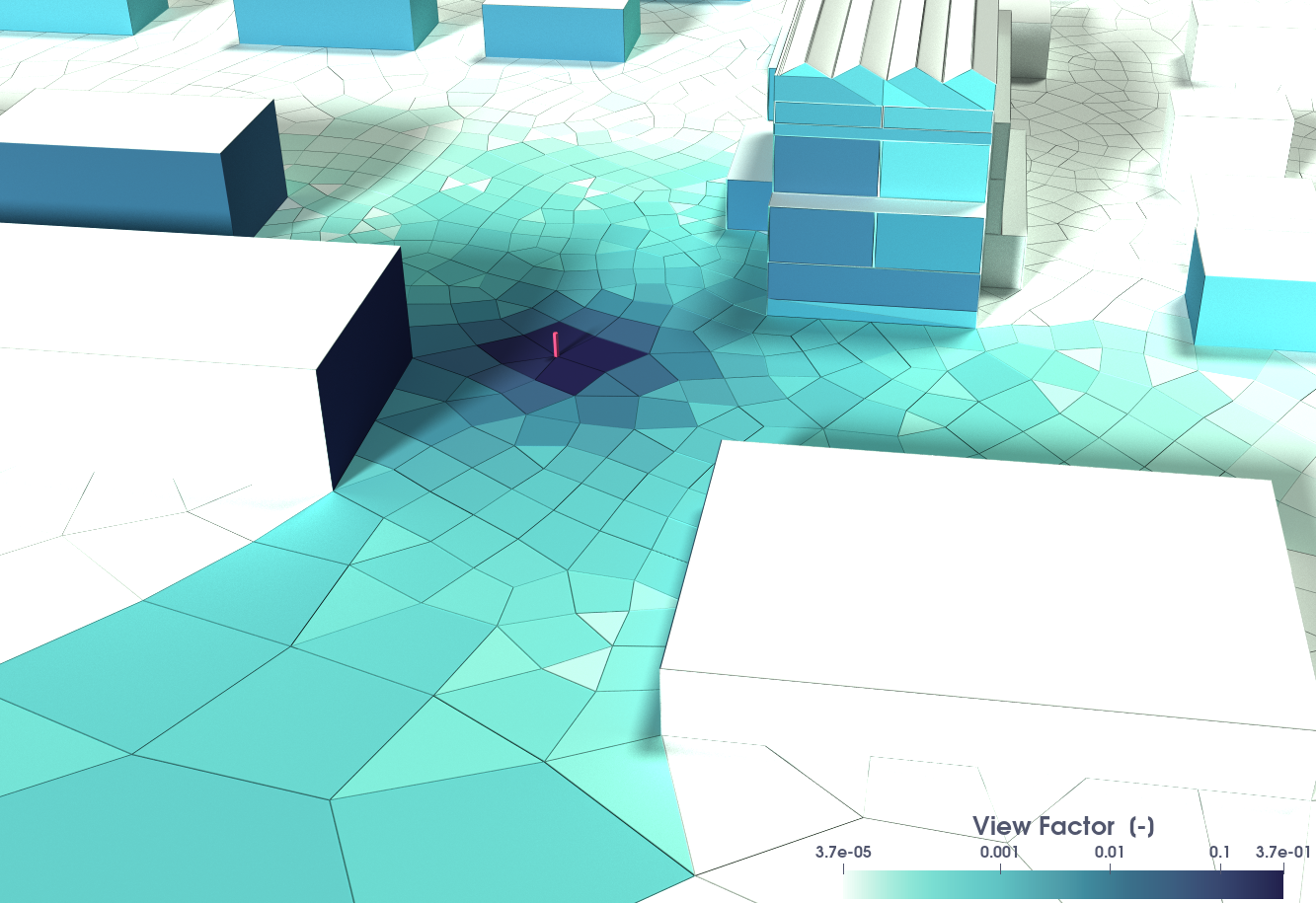







Features
- This library enables the computation of radiation view factors between planar polygons using an accurate double‐contour integration method described in (Mazumder and Ravishankar 2012) with insights from (Schmid 2016).
- It uses the handy
Pyvistapackage to deal with geometry imports (*.stl,*.vtk,*.obj, ...), geometry creations, and some other mesh functionalities under the hood. - It enables:
- 🔺 View factor computation between planar polygons via the SA-30 semi-analytic kernel — handles touching and coplanar faces analytically, no epsilon shift
- 👁️ Visibility checks based on face orientation
- 🚧 Obstruction detection using Möller–Trumbore ray-triangle intersection, BVH-accelerated (O(log N) per ray)
- ⚙️ Strict / non-strict modes for robustness control
- ⚡ Full N×N view-factor matrix with Numba
prangeparallelism (~33× faster than v1.0) - 📦 Built on
numpy,scipy,pyvista,numba
Installation
pyViewFactor can be installed from PyPi
using pip on Python >= 3.10:
pip install pyviewfactor
You can also visit PyPi or Gitlab to download the sources.
Requirements:
numpy==1.26.4
pyvista==0.45
scipy==1.11.4
numba==0.61.2
tqdm==4.65.0
The code will probably work with lower versions of the required packages, however this has not been tested.
[!NOTE]
numbais optional but strongly recommended. Without it, all kernels fall back to sequential pure-Python with identical results — no need to pin an older version.
Quick Start
Suppose we want to compute the radiation view factor between a triangle and a rectangle facing each other:
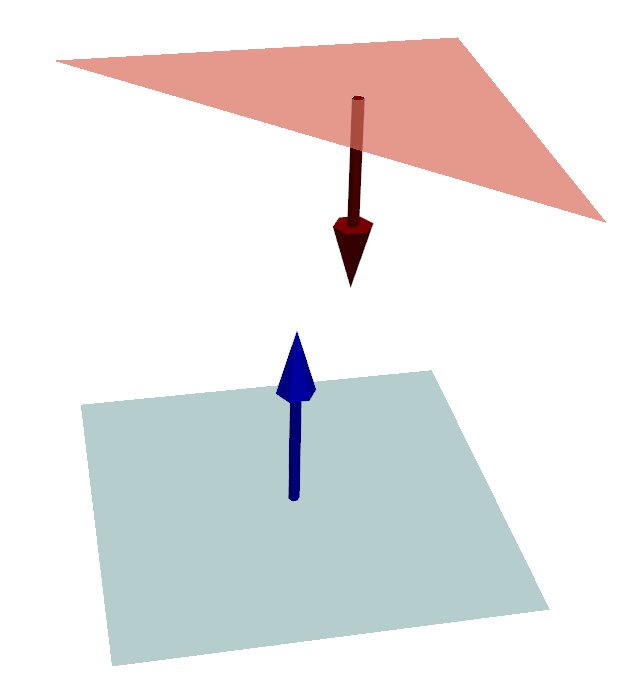
You are few lines of code away from your first view factor computation:
import pyvista as pv
import pyviewfactor as pvf

# Create a rectangle and a triangle facing each other
pointa1 = [0.0, 0.0, 0.0]
pointb1 = [1.0, 0.0, 0.0]
pointc1 = [0.0, 1.0, 0.0]
rectangle = pv.Rectangle([pointa1, pointb1, pointc1])

pointa2 = [0.0, 0.0, 1.0]
pointb2 = [0.0, 1.0, 1.0]
pointc2 = [1.0, 1.0, 1.0]
triangle = pv.Triangle([pointa2, pointb2, pointc2])

if pvf.get_visibility(rectangle, triangle)[0]:
    F = pvf.compute_viewfactor(triangle, rectangle)
    print("VF from rectangle to triangle :", F)
else:
    print("Not facing each other")

pl = pv.Plotter()
pl.add_mesh(rectangle, color="lightblue", opacity=0.7)
pl.add_mesh(triangle, color="salmon", opacity=0.7)

# compute and glyph normals for mesh1
n1 = rectangle.compute_normals(cell_normals=True, point_normals=False)
arrows1 = n1.glyph(orient="Normals", factor=0.1)
pl.add_mesh(arrows1, color="blue")
# similarly for mesh2
n2 = triangle.compute_normals(cell_normals=True, point_normals=False)
arrows2 = n2.glyph(orient="Normals", factor=0.1)
pl.add_mesh(arrows2, color="darkred")

pl.show()
You want to import your own geometry from a different format?
(*.dat, *.idf, *.stl, ...)
Check pyvista's documentation on how to generate a PolyData facet from points.
Documentation
For detailed explanations and advanced usage, see:
https://arep-dev.gitlab.io/pyViewFactor/
The documentation includes:
- Theory: view factor integral, SA-30 semi-analytic kernel, BVH obstruction engine,
- Implementation: architecture, visibility & obstruction semantics, performance guide,
- Extended examples with analytical validations.
Citation & Acknowledgments
- Main contributors:
- Mateusz BOGDAN,
- Edouard WALTHER.
- Acknowledgment: The authors would like to acknowledge M. Alecian for his initial work on the quadrature code and M. Chapon for her contribution to the code validation.
There is even a conference paper, showing analytical validations.
So if you use pyViewFactor in your work, please cite:
[!IMPORTANT] Citation: Mateusz BOGDAN, Edouard WALTHER, Marc ALECIAN and Mina CHAPON. Calcul des facteurs de forme entre polygones - Application à la thermique urbaine et aux études de confort. IBPSA France 2022, Châlons-en-Champagne.
Bibtex entry:
@inproceedings{pyViewFactor22bogdan,
  author       = "Mateusz BOGDAN and Edouard WALTHER and Marc ALECIAN and Mina CHAPON",
  title        = "Calcul des facteurs de forme entre polygones - Application à la thermique urbaine et aux études de confort",
  year         = "2022",
  organization = "IBPSA France",
  venue        = "Châlons-en-Champagne, France"
  note         = "IBPSA France 2022",
}
License
MIT License - Copyright (c) AREP 2025
Release history Release notifications | RSS feed


Download files
Download the file for your platform. If you're not sure which to choose, learn more about installing packages.
Source Distribution
Built Distribution
Filter files by name, interpreter, ABI, and platform.
If you're not sure about the file name format, learn more about wheel file names.
Copy a direct link to the current filters
File details
Details for the file pyviewfactor-1.1.0.tar.gz.
File metadata
- Download URL: pyviewfactor-1.1.0.tar.gz
- Upload date:
- Size: 35.4 kB
- Tags: Source
- Uploaded using Trusted Publishing? No
- Uploaded via: twine/6.2.0 CPython/3.11.15
File hashes
| Algorithm | Hash digest | |
|---|---|---|
| SHA256 |
fc00f7f89aa4418366bf28b113c1fbe9551eebdd270361b0fc7cc62aef8973d1
|
|
| MD5 |
a3315b1079105655ce7b5afaca35624c
|
|
| BLAKE2b-256 |
be7babaac1a2cf0cda13ffec9285443cf501e13384933ab78be594edbe96b39b
|
File details
Details for the file pyviewfactor-1.1.0-py3-none-any.whl.
File metadata
- Download URL: pyviewfactor-1.1.0-py3-none-any.whl
- Upload date:
- Size: 38.3 kB
- Tags: Python 3
- Uploaded using Trusted Publishing? No
- Uploaded via: twine/6.2.0 CPython/3.11.15
File hashes
| Algorithm | Hash digest | |
|---|---|---|
| SHA256 |
26730c72b912207b360f74038a22f6a7b7efc59348019515ab58340358d5db92
|
|
| MD5 |
3d60ee4105b83dd66229c336f6509fcd
|
|
| BLAKE2b-256 |
fa2be072bb410c83cca6304dd0bcbded6329d7a83fb174b370fd950b6f16bcf7
|






