
Simple Python HTTP Exec Server

Project description





pywebexec
Simple Python HTTP(S) API/Web Server Command Launcher and Terminal sharing
- build a Restfull API/swagger-ui powered application in no time exposing simple commands/parameters.
- create a toolbox with batch management/parallel execution of commands
- share a terminal in one command
Install
$ pip install pywebexec
Quick start
- share terminal
- start http server and spawn a new terminal shared on 0.0.0.0 port 8080 (defaults)
- exiting terminal stops server/share
$ pywebexec shareterm
- serve executables
- put in a directory the scripts/commands/links to commands you want to expose
- start http server serving current directory executables listening on 0.0.0.0 port 8080
$ pywebexec -d <dir>
- Launch commands with params/view live output/Status using browser
- Share your terminal output using
pywebexec -d <dir> term
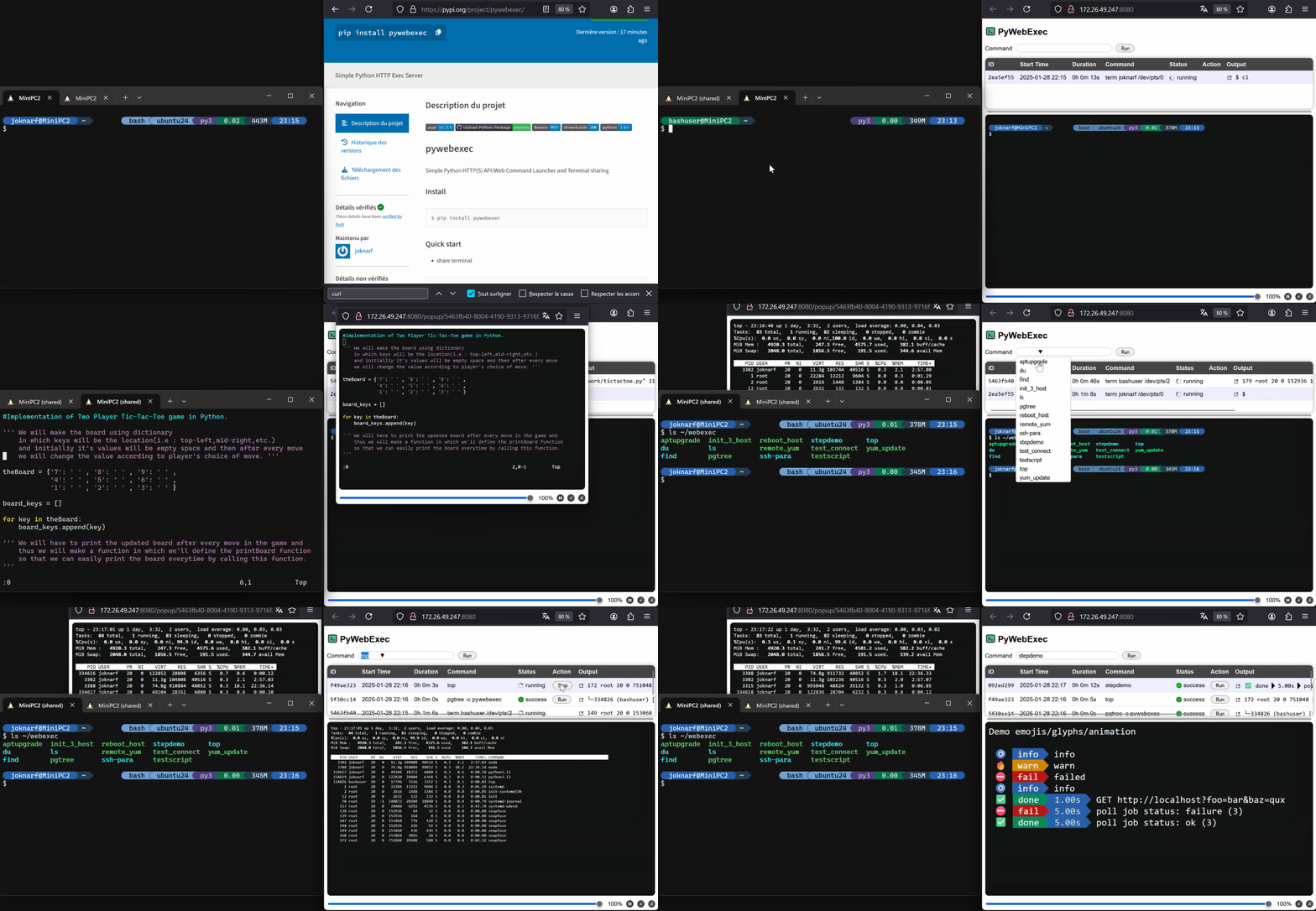
all commands output / statuses are available in the executables directory in subdirectory .web_status
features
- Serve executables in a directory
- full API driven with dynamic swagger UI
- Launch commands with params from web browser or API call
- multiple share terminal output
- Follow live output
- Replay terminal history
- Stop command
- Relaunch command
- HTTPS support
- HTTPS self-signed certificate generator
- Basic Auth
- LDAP(S) password check/group member
- Safe url token generation
- Can be started as a daemon (POSIX)
- Uses gunicorn to serve http/https
- Linux/MacOS compatible
- Markdown help for commands
- YAML schema for commands parameters
- Batch/parallel command execution
Customize server
$ pywebexec --dir ~/myscripts --listen 0.0.0.0 --port 8080 --title myscripts
$ pywebexec -d ~/myscripts -l 0.0.0.0 -p 8080 -t myscripts
Sharing terminals
- start server and share tty in one command
$ pywebexec -d ~/webshare shareterm
- share tty with an already pywebexec server started
$ pywebexec -d ~/webshare term
if another user need to share his terminal, he need to have write permission on <dir>/.web_status directory.
Safe url token
- generate safe url, use the url to access the server
$ pywebexec -T
$ pywebexec --tokenurl
Starting server:
http://<host>:8080?token=jSTWiNgEVkddeEJ7I97x2ekOeaiXs2mErRSKNxm3DP0
http://x.x.x.x:8080?token=jSTWiNgEVkddeEJ7I97x2ekOeaiXs2mErRSKNxm3DP0
Basic auth
- single user/password
$ pywebexec --user myuser [--password mypass]
$ pywebexec -u myuser [-P mypass]
Generated password is given if no --pasword option
- ldap(s) password check / group member ldap server must accept memberOf attribute for group members
$ export PYWEBEXEC_LDAP_SERVER=ldaps://ldap.mydomain.com:389
$ export PYWEBEXEC_LDAP_BIND_DN="cn=read-only-admin,dc=example,dc=com"
$ export PYWEBEXEC_LDAP_BIND_PASSWORD="password"
$ export PYWEBEXEC_LDAP_BASE_DN="dc=example,dc=com"
$ export PYWEBEXEC_LDAP_USER_ID="uid" # sAMAccountName for AD
$ export PYWEBEXEC_LDAP_GROUPS="ou=mathematicians,dc=example,dc=com ou=scientists,dc=example,dc=com"
$ pywebexec
HTTPS server
- Generate auto-signed certificate and start https server
$ pywebexec --gencert
$ pywebexec --g
- Start https server using existing certificate
$ pywebexec --cert /pathto/host.cert --key /pathto/host.key
$ pywebexec -c /pathto/host.cert -k /pathto/host.key
Launch server as a daemon
$ pywebexec start
$ pywebexec status
$ pywebexec stop
- log of server are stored in directory
~/[.config/].pywebexec/pywebexec_<listen>:<port>.log
Launch command through API
$ curl http://myhost:8080/commands/myscript -H 'Content-Type: application/json' -X POST -d '{"params":["param1", ...]}'
$ curl http://myhost:8080/commands/<command_id>
$ curl http://myhost:8080/commands/<command_id>/output -H "Accept: text/plain"
Add markdown help to commands
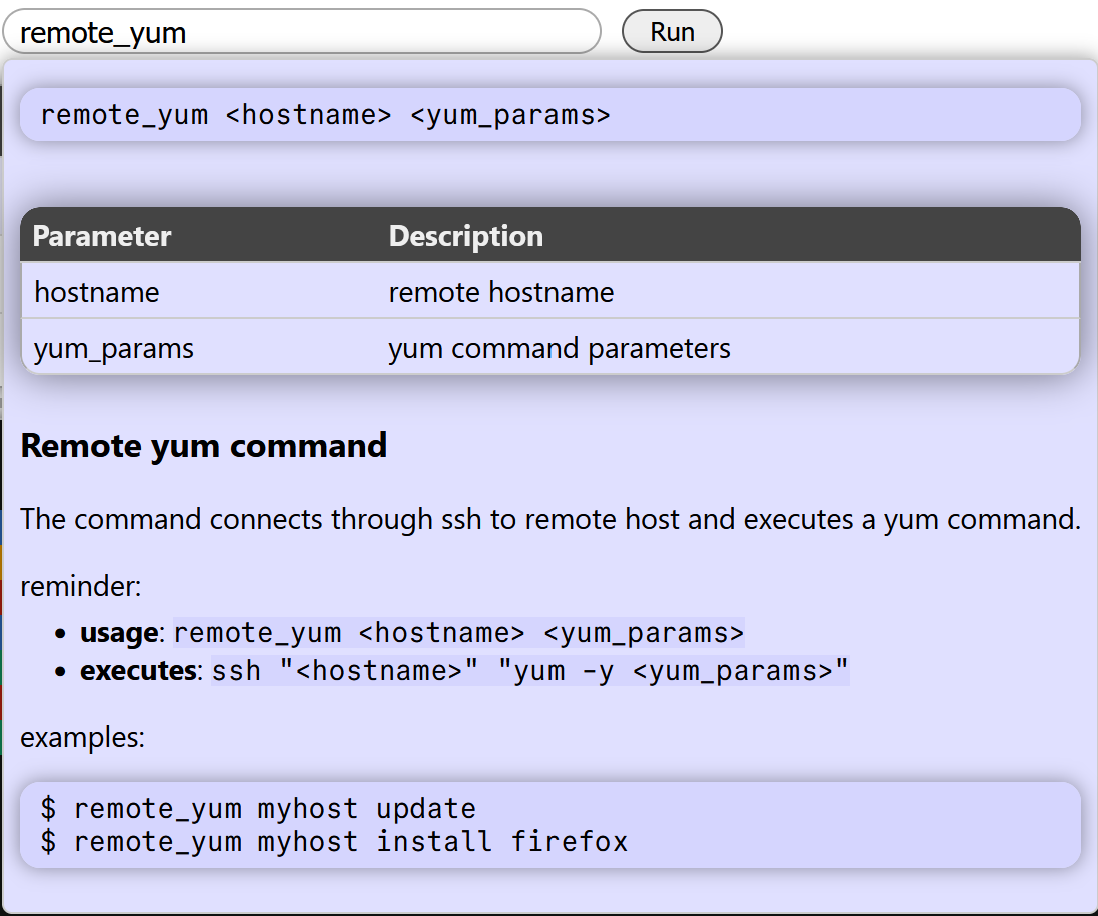
For each exposed command, you can add a help message by creating a file named <command>.help in the same directory as the command. The help message must be written in markdown.
The help message is displayed:
- in the web interface as tooltip when focused on param input field,
- in the response when calling the API
/executables - in the swagger-ui in the
/commands/<command>route.
Add schema to commands
For each exposed command, you can add a schema by creating a file named <command>.schema.yaml in the same directory as the command. The schema must be written in yaml format.
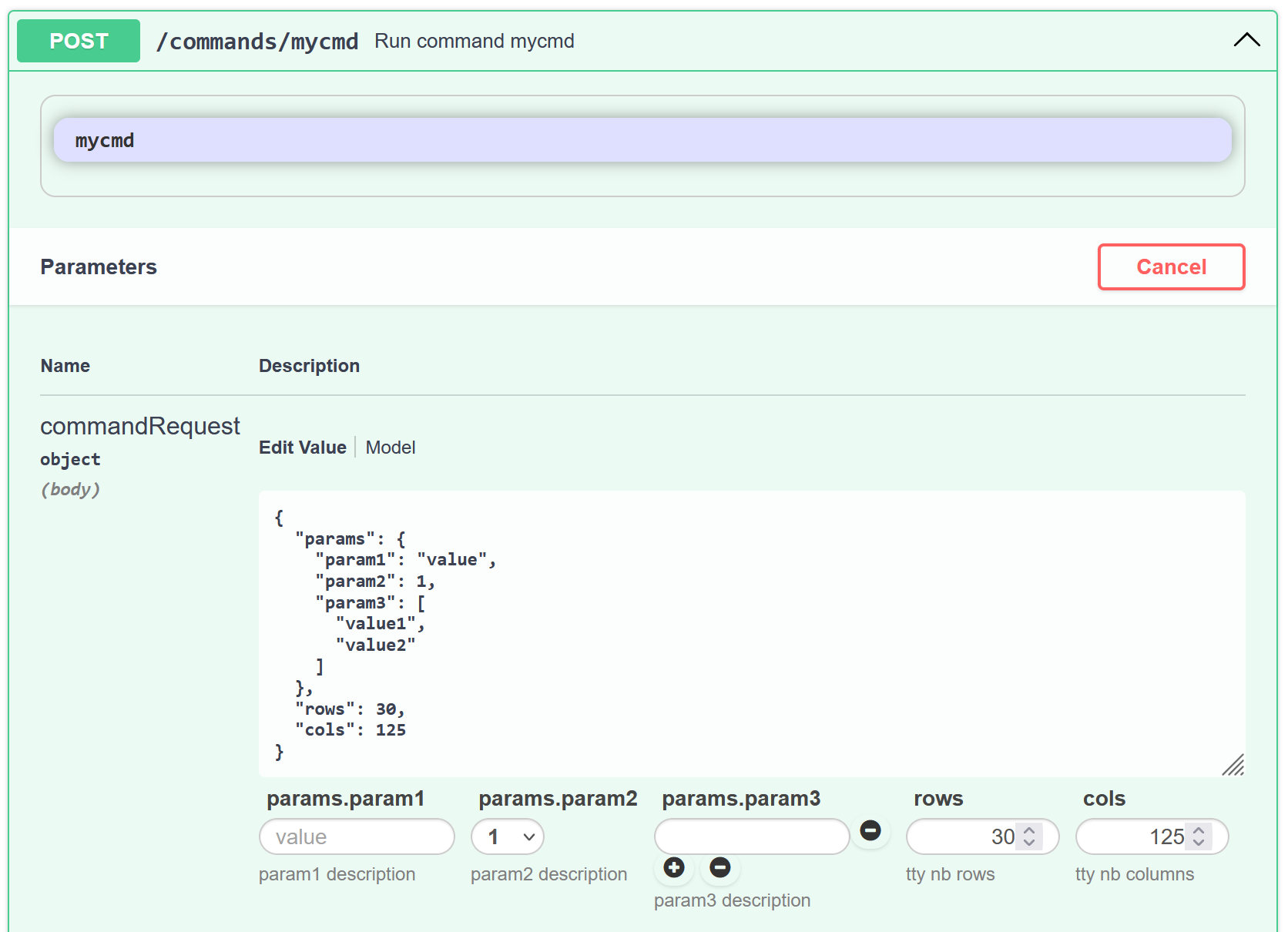
The schema is used to generate a form in the web interface and in the swagger-ui in the /commands/<command> route.
The schema is also used to validate the input parameters when calling the API /commands/<command>.
The schema must be written in the openapi schema format.
type: object
properties:
  param1:
    type: string
    description: "param1 description"
    example: "value"
  param2:
    type: integer
    description: "param2 description"
    enum: [1, 2, 3]
  param3:
    type: array
    items:
      type: string
    description: "param3 description"
    example: ["value1", "value2"]
required:
  - param1
  - param2
The payload will be converted to command line arguments when calling the command.
command --param1 value --param2 1 --param3 value1 value2
- On the web inferface, and swagger-ui the form will be generated from the schema.
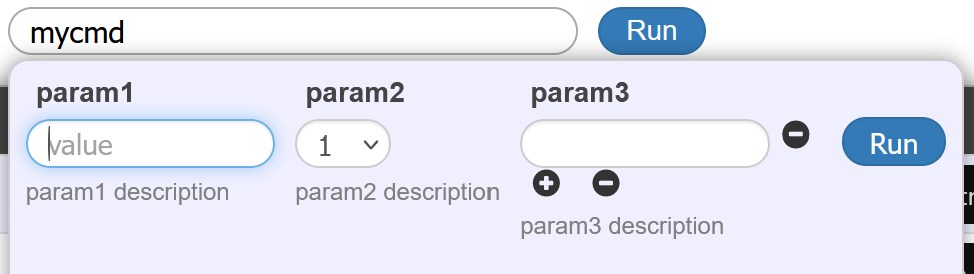
When using schema, the command can now be launched with:
$ curl -X POST http://<srv>/commands/<cmd> -H "Content-Type: application/json" -d '{"param1": "value", "param2": 1, "param3": ["value1", "value2"]}'
Schema options
The schema options are used to customize the command line arguments generation, just add a schema_options section to the schema.
schema_options:
  separator_params: {"*": " ", "param2": "="}}"=" # --param2=value (default is " ")
  noprefix_params: ["param1", "param2"] # omit --param prefix, use "*" to omit all
  convert_params: {"param1": "param2"} # convert param1 to param2
Batch commands/parallel execution
Integration of run-para to enable batch execution of commands:
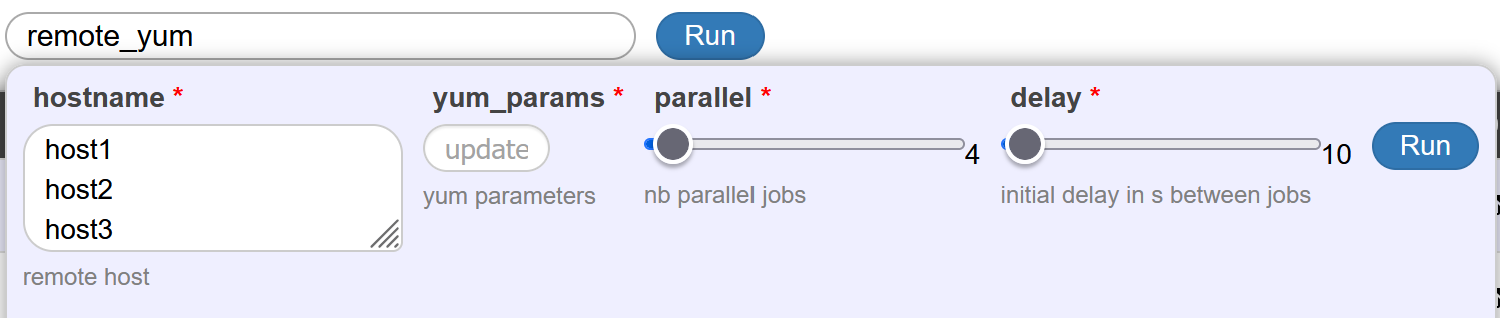
- In
schema_optionsaddingbatch_paramwill enable batch mode for the command, the command will be executed for each value in thebatch_paramlist. - The
batch_paramis the name of the parameter that will be used to pass the different values for the parameter. - The
batch_paramtype will be transformed to textarea to provide list to use as parameter for the command. - The range parameters
parallelanddelayis added to the command parameters to control the execution of the batch commands (nb jobs in parallel and initial delay between jobs).
Swagger UI
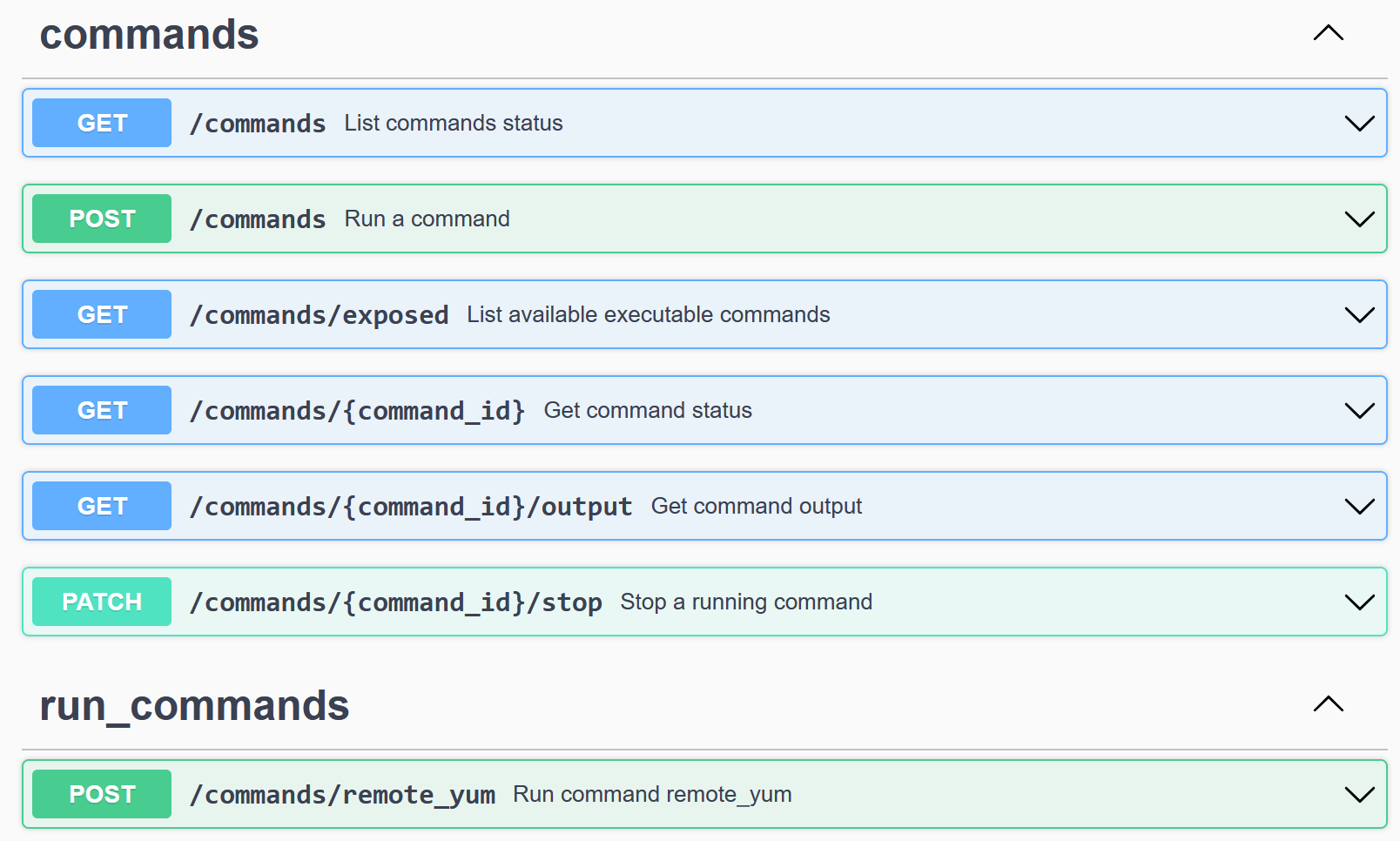
A custom swagger UI is available at http[s]://<srv>/v0/documentation with enhanced markdown rendering and form generation for body parameters.
API reference
| method | route | params/payload | returns |
|---|---|---|---|
| GET | /commands/exposed | commands: [ { command: str, help: str }, ] |
|
| GET | /commands | commands: [ { command_id: uuid command: str start_time: isotime end_time: isotime status: str exit_code: int last_output_line: str }, ] |
|
| GET | /commands/{id} | command_id: uuid command: str params: array[str] start_time: isotime end_time: isotime status: str exit_code: int last_output_line: str |
|
| GET | /commands/{id}/output | offset: int | output: str status: str links: { next: str } |
| GET | /commands/{id}/output_raw | offset: int | output: stream raw output until end of command curl -Ns http://srv/commands/{id}/output_raw |
| POST | /commands | command: str params: array[str] rows: int cols: int |
command_id: uuid message: str |
| POST | /commands/{cmd} | params: array[str] rows: int cols: int |
command_id: uuid message: str |
| PATCH | /commands/{id}/stop | message: str |
- to get command output as text (without ANSI codes/Control characters) use:
/commands/{id}/outputwith header"Accept: text/plain"
Release history Release notifications | RSS feed


Download files
Download the file for your platform. If you're not sure which to choose, learn more about installing packages.
Source Distribution
Built Distribution
Filter files by name, interpreter, ABI, and platform.
If you're not sure about the file name format, learn more about wheel file names.
Copy a direct link to the current filters
File details
Details for the file pywebexec-2.4.18.tar.gz.
File metadata
- Download URL: pywebexec-2.4.18.tar.gz
- Upload date:
- Size: 3.1 MB
- Tags: Source
- Uploaded using Trusted Publishing? No
- Uploaded via: twine/6.1.0 CPython/3.9.22
File hashes
| Algorithm | Hash digest | |
|---|---|---|
| SHA256 |
1f4578849e3963c066b996517818b59c66d4217bf13cfc33abe51ada3c1e8aef
|
|
| MD5 |
b3734b5bd397fb058abec71c10bb8028
|
|
| BLAKE2b-256 |
68c6f630e9a89786e2ccb73ea49c450cce32023d5484e50225ec0bd1046ebe71
|
File details
Details for the file pywebexec-2.4.18-py3-none-any.whl.
File metadata
- Download URL: pywebexec-2.4.18-py3-none-any.whl
- Upload date:
- Size: 3.1 MB
- Tags: Python 3
- Uploaded using Trusted Publishing? No
- Uploaded via: twine/6.1.0 CPython/3.9.22
File hashes
| Algorithm | Hash digest | |
|---|---|---|
| SHA256 |
105f50912abd6ad610f3e1a3794da3ae6864e473baa2af0ce99b9f6474e84270
|
|
| MD5 |
117ad5df4e8d884e5bf9721ff0ead98d
|
|
| BLAKE2b-256 |
8eb717a44b574b9c703163edc475637b7bdc4615f3ddc9d559ac34bc1e32f378
|






