
Rapid-MLX — AI inference for Apple Silicon. Drop-in OpenAI API, 2-4x faster than Ollama.
Verified details
These details have been verified by PyPIProject links
GitHub Statistics
Maintainers

Project description
Rapid-MLX
The fastest way to run AI models on Apple Silicon.





Rapid-MLX is a local LLM inference engine for Macs. It speaks the OpenAI Chat / Responses / Embeddings APIs, so anything that talks to ChatGPT — Cursor, Claude Code, Aider, Codex CLI, LangChain, PydanticAI, your own scripts — just works against http://localhost:8000. No cloud, no API key, no per-token cost.
rapidmlx.com · Desktop app · Community benchmarks · Model mirror
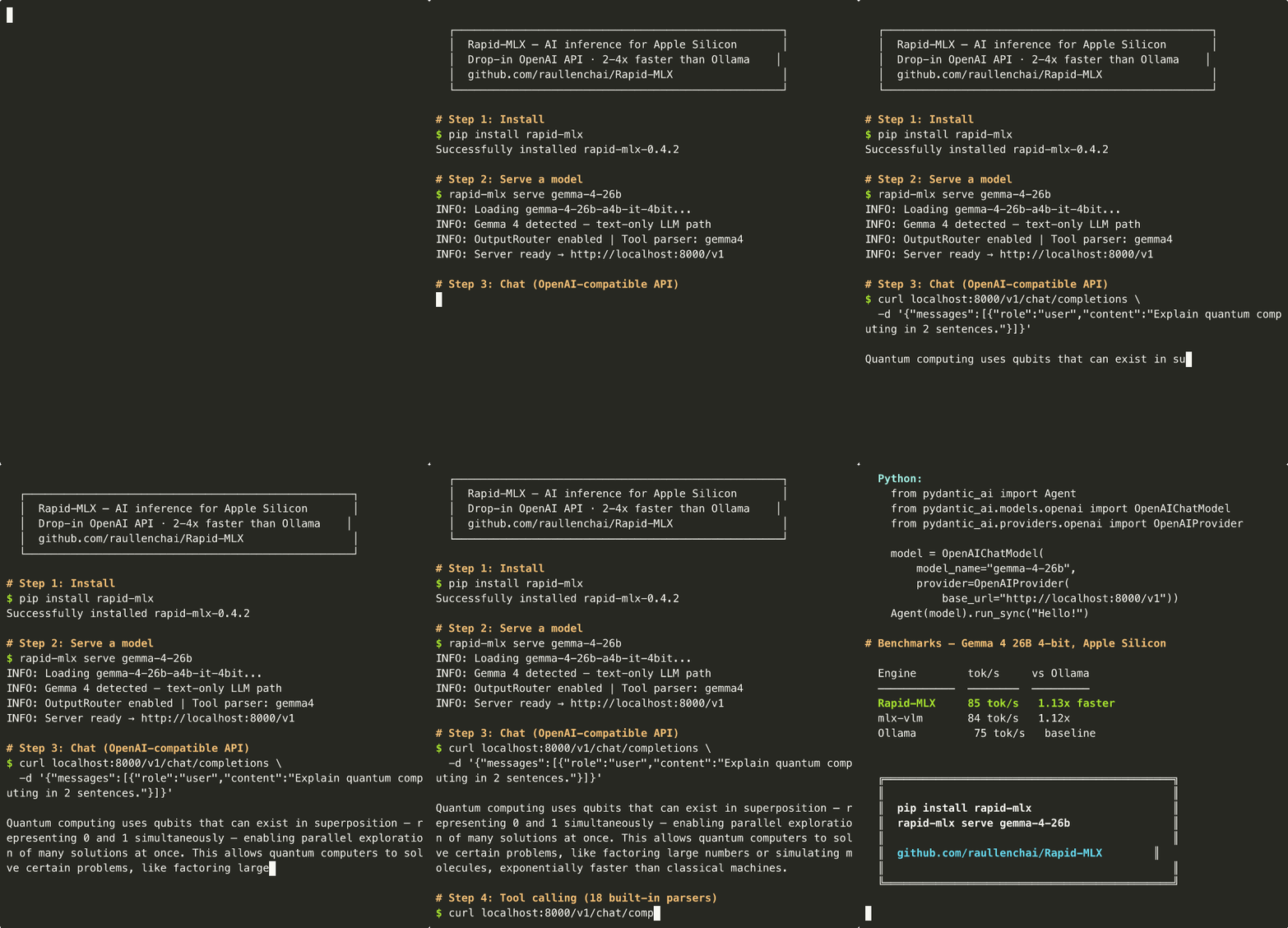
pip install → serve Gemma 4 → chat + tool calling → works with PydanticAI, LangChain, Aider, and more.
What runs on your Mac
| Your Mac | Model | Speed (tok/s) | What works | |
|---|---|---|---|---|
| 16 GB MacBook Air | Qwen3.5-4B | 147 tok/s | Chat, coding, tools | |
| 24 GB MacBook Pro | Qwen3.5-9B | 101 tok/s | Great all-rounder | |
| 32+ GB Mac Mini / Studio | Gemma 4 12B | 64 tok/s | Vision + tools | |
| 32+ GB Mac Mini / Studio | GPT-OSS 20B | 119 tok/s | Harmony-native, 100% tools | |
| 32+ GB Mac Mini / Studio | Qwen3.6-35B-A3B | 93 tok/s | 256 MoE experts, 262K context | |
| 48+ GB Mac Mini / Studio | Qwen3.5-35B-A3B 8bit | 80 tok/s | Best balance of smart + fast | |
| 96+ GB Mac Studio / Pro | Qwen3.5-122B | 57 tok/s¹ | Frontier-level intelligence | |
| 128+ GB Mac Studio Ultra | DeepSeek V4 Flash 158B-A13B | 31–56 tok/s¹ | Day-0 frontier MoE, 1M context |
Single-user end-to-end throughput (B=1: one request at a time, 256 max output tokens, output_tokens / wall-clock incl. first-token latency), median of 3 rounds. chat_template_kwargs.enable_thinking=False passed where the engine honours it. Tested on M3 Ultra 256 GB / rapid-mlx v0.6.83 (fused top-p sampler). ¹ carried over from 2026-04 bench — disk-constrained on this refresh. The full sizing table with HuggingFace links is in Choose Your Model.
New to local AI? Quick glossary
- tok/s (tokens per second) — roughly how many words the AI generates per second. Higher = faster.
- 4bit / 8bit — compression levels for models. 4bit uses less memory (recommended); 8bit is higher quality.
- TTFT (Time To First Token) — how long before the AI starts responding.
- Tool calling — the AI can call functions in your code. Used by Cursor, Claude Code, and coding assistants.
- OpenAI-compatible — Rapid-MLX speaks the same HTTP API as ChatGPT, so any app that works with ChatGPT can work with Rapid-MLX by pointing at
http://localhost:8000/v1. - Ollama / llama.cpp — other popular local-AI runtimes. The only apples-to-apples row in our benchmark is GPT-OSS 20B (identical weights both sides) — Rapid-MLX runs it 2.3× faster than Ollama under B=4 concurrent load. On the Qwen3 closest-tag rows (Qwen3.5/3.6 DeltaNet isn't on llama.cpp yet) Rapid-MLX leads 1.7–2.4×. The Gemma 4 row ties Ollama's Gemma 3 (different architectures, 1.0×). Against
mlx-lm serve(same MLX weights) Rapid-MLX is 1.2–1.5× faster. Full caveats in Benchmarks.
Quick Start
1. Install (pick one):
# uv (recommended — one command, isolated env, auto-manages Python)
uv tool install rapid-mlx@latest
# Don't have uv yet? curl -LsSf https://astral.sh/uv/install.sh | sh

# Or one-liner with auto-setup (installs Python if needed)
curl -fsSL https://raullenchai.github.io/Rapid-MLX/install.sh | bash

# Homebrew (Mac-native — needs tap + trust before install on Homebrew 4.x)
brew tap raullenchai/rapid-mlx
brew trust raullenchai/rapid-mlx
brew install rapid-mlx

# pip (requires Python 3.10+ — macOS ships 3.9, so install Python first if needed)
pip install rapid-mlx
Upgrade later: uv tool upgrade rapid-mlx / brew upgrade rapid-mlx / pip install -U rapid-mlx.
2. Chat with a model right now:
rapid-mlx chat
Defaults to qwen3.5-4b-4bit. First run downloads the model (~2.5 GB) — you'll see a progress bar. Drops you into a REPL when it's ready. Type /help for slash commands, /exit to quit. Pass --think to surface chain-of-thought, --no-think to skip it for faster replies.
3. Or serve it for use from other apps:
rapid-mlx serve qwen3.5-4b-4bit
Starts an OpenAI-compatible HTTP server. Wait for Ready: http://localhost:8000/v1, then point Cursor, Claude Code, Aider, LangChain, the OpenAI SDK — anything — at http://localhost:8000/v1.
curl http://localhost:8000/v1/chat/completions \
  -H "Content-Type: application/json" \
  -d '{"model":"default","messages":[{"role":"user","content":"Say hello"}]}'
from openai import OpenAI
client = OpenAI(base_url="http://localhost:8000/v1", api_key="not-needed")
print(client.chat.completions.create(
    model="default",
    messages=[{"role": "user", "content": "Say hello"}],
).choices[0].message.content)
Vision/multimodal models (Gemma 4, Qwen-VL) need extras:
pip install 'rapid-mlx[vision]'. Text-only install is ~460 MB; vision adds ~322 MB. See Optional Extras.
"No matching distribution" from pip? Your Python is too old. Run
python3 --version— if it says 3.9, runbrew install python@3.12thenpython3.12 -m pip install rapid-mlx.
Refusing to load formula ... from untrusted tap? Homebrew 4.x requires third-party taps to be explicitly trusted before install. Runbrew trust raullenchai/rapid-mlx(per-machine, persists across upgrades) then retrybrew install rapid-mlx.
brew installstalls onTapping homebrew/core? Brew 5.x's install sandbox can't auto-taphomebrew/coremid-install. Pre-tap it once, then retry:brew tap homebrew/core --force # ~1.3 GB, one-time brew tap raullenchai/rapid-mlx brew trust raullenchai/rapid-mlx brew install rapid-mlx
Not into the terminal? Rapid-MLX Desktop bundles the same engine inside a one-click Mac app — drag to Applications, pick a model, chat. The CLI here is still the source of truth for serving and scripting; the desktop app is the friendlier on-ramp.
Why Rapid-MLX
If you're comparing against Ollama, LM Studio, mlx-lm serve, or llama.cpp:
- Fastest on Apple Silicon, measured. Under concurrent load (B=4), Rapid-MLX is 2.3× faster than Ollama on the apples-to-apples GPT-OSS 20B row (identical weights both sides), leads by 1.7–2.4× across the Qwen3.5 / Qwen3.6 closest-tag Ollama rows, and runs 1.2–1.5× faster than
mlx-lm serveon shared MLX weights. Full table in Benchmarks. - Drop-in OpenAI / Anthropic API. Same
/v1/chat/completionsand/v1/responsesas OpenAI, plus/v1/messagesfor the Anthropic SDK and Claude Code. No client-side adapter required. - Tool calling that actually works under 4-bit quantization. 17 parser formats with automatic recovery — when a quantized model emits a malformed tool call as text, Rapid-MLX detects it and rebuilds the structured
tool_callsobject instead of failing silently. Verified end-to-end against Cursor, Codex CLI, Claude Code, Aider, LangChain, PydanticAI, smolagents. - Prompt cache, even on hybrid RNN models, sharable across tenants. Standard transformers get radix-tree prefix cache — N clients hitting the same 2k-token system prompt converge on the same trie node (O(prefix_len) lookup vs. O(log N + LCP_scan) on hash caches). Hybrid models (Qwen3.5 DeltaNet) get RNN state snapshots restored in ~0.1 ms instead of re-running hundreds of tokens through the recurrent layers. 2–5× faster TTFT on every architecture, always on.
- Long-prompt prefill acceleration. PFlash scores 32K+ prompts and only prefills the sink + recent tail + query-relevant middle — 3.87–8.5× faster cold-start TTFT with full needle-in-a-haystack recall. Default-on for verified aliases;
--pflash alwaysforces it for any model. - TurboQuant K8V4 KV codec, default-on for verified MoE. 9 Qwen3.5/3.6 hero aliases ship with K8V4 (K 8-bit + V 4-bit after Walsh-Hadamard + Lloyd-Max) turned on — codec compresses KV to ~1/2.4 (~58% savings), lossless across the verified matrix. Set
--kv-cache-turboquant noneto force off. - Day-0 frontier models. DeepSeek V4 Flash 158B-A13B, Qwen3.6 with 262K context, DiffusionGemma 26B (non-autoregressive), Gemma 4 vision — all behind the same Chat Completions API.
Use Cases
The same rapid-mlx binary covers four very different workflows. Pick the one closest to what you want to do:
1. Chat in the terminal
rapid-mlx chat qwen3.5-9b-4bit
A streaming REPL with slash commands (/help, /system, /save, /clear). No second process needed. Use --think / --no-think to control chain-of-thought. Aliased as rapid-mlx run for Ollama muscle memory.
2. OpenAI-compatible server for your apps
rapid-mlx serve qwen3.5-9b-4bit
Point Cursor, Continue.dev, Open WebUI, LibreChat, the OpenAI Python SDK, LangChain, PydanticAI, smolagents at http://localhost:8000/v1. Tool calling, streaming, reasoning separation, structured JSON output, and embeddings are all on the standard endpoints. See Connect Your Client for one-shot configs.
3. Agent backends: Codex CLI, Claude Code, Aider, OpenCode
Rapid-MLX is the backend — pair it with an open-source agent CLI for the full Claude Code-like experience.
rapid-mlx serve qwen3.6-27b-8bit          # or any tool-capable alias
rapid-mlx agents codex --setup            # writes ~/.codex/config.toml
codex                                      # now talks to your local model
- Codex CLI (OpenAI's official Rust agent, 0.136.0+) hits
/v1/responses. Verified end-to-end on Qwen3.5-9B / Qwen3.6-27B for chat, file read/write, shell, multi-step, and source analysis. Release gate G7b probes the codex-shape SSE on every tag. (guide) - Claude Code hits
/v1/messages(Anthropic SDK).ANTHROPIC_BASE_URL=http://localhost:8000 claude. - Aider / OpenCode / OpenClaude / Goose / Hermes / Claw Code —
rapid-mlx agents <name> --setupwrites the right config file.
4. Benchmark your hardware and contribute to the community
rapid-mlx bench qwen3.5-9b-4bit --submit
Runs the standardized B=1 community benchmark (greedy, 128 + 512 token buckets, 5 rounds each), shows you the JSON payload, asks for consent, and opens the PR via gh if you have it (or prints a compare-page URL if you don't). Submitted rows land in community-benchmarks/submissions/ and show up on rapidmlx.com once merged. Your bench helps everyone else pick the right model for their Mac.
Bonus: share a public URL
rapid-mlx share qwen3.6-27b-8bit
Tunnels your local server through rapidserver.quicksilverpro.io over a WebSocket. Prints a public OpenAI-compatible endpoint plus a bearer key — point any chat UI or OpenAI SDK at it. Bearer auth, CORS allowlist, and a 120 RPM rate-limit are wired automatically; closing the terminal tears the tunnel down. The default chat surface is our hosted Big-AGI fork (tool calling, personas, voice — no signup); any OpenAI-compatible client also works. Pick a 27B-class model or larger for a usable share experience.
Connect Your Client
Tested integrations
Agent harnesses (auto-setup with rapid-mlx agents <name> --setup):
| Harness | Type | Notes |
|---|---|---|
| Codex CLI | Agent | OpenAI's official Rust agent — /v1/responses shim, verified end-to-end against codex 0.136.0 (guide) |
| Claude Code | Agent | Anthropic SDK via /v1/messages — ANTHROPIC_BASE_URL=http://localhost:8000 claude |
| Aider | Agent | CLI edit-and-commit, architect mode (test) |
| OpenCode | TUI Agent | Claude Code-like terminal UX, OpenAI-compat provider |
| Hermes Agent | Agent | 62 tools, multi-turn (test) |
| Goose | Agent | Ollama provider via OLLAMA_HOST |
| OpenClaude | Agent | Anthropic SDK, CLAUDE_CODE_USE_OPENAI=1 (test) |
| Claw Code | Agent | OpenAI & Anthropic endpoints |
| PydanticAI | Framework | Typed agents, structured output (test) |
| LangChain | Framework | ChatOpenAI, tools, streaming (test) |
| smolagents | Framework | CodeAgent + ToolCallingAgent (test) |
UI / IDE clients:
| Client | Status | Setup |
|---|---|---|
| Cursor | Compatible | Settings → OpenAI Base URL |
| Continue.dev | Compatible | VS Code / JetBrains extension |
| LibreChat | Tested | Docker (test) |
| Open WebUI | Tested | Docker (test) |
| Any OpenAI-compatible app | Compatible | Point at http://localhost:8000/v1 |
Quick setup snippets
Cursor — Settings → Models → Add Model:
OpenAI API Base:  http://localhost:8000/v1
API Key:          not-needed
Model name:       default          (or qwen3.5-9b-4bit — either works)
Cursor's agent/composer mode uses tool calls automatically — Rapid-MLX handles them natively with Qwen3.5 models, no extra flags needed.
Codex CLI — rapid-mlx agents codex --setup writes ~/.codex/config.toml for you. Or by hand:
model = "default"
model_provider = "rapid-mlx"

[model_providers.rapid-mlx]
name = "Rapid-MLX (local)"
base_url = "http://localhost:8000/v1"
# If rapid-mlx was started with --api-key, add env_key = "RAPID_MLX_API_KEY"
# and `export RAPID_MLX_API_KEY=...`. Don't use api_key = "..." — Codex
# CLI's --strict-config rejects inline literals.
Then codex (or codex exec '<query>') routes through /v1/responses. See the Codex CLI guide.
Claude Code:
ANTHROPIC_BASE_URL=http://localhost:8000 ANTHROPIC_API_KEY=not-needed claude
Aider:
aider --openai-api-base http://localhost:8000/v1 --openai-api-key not-needed
Goose:
GOOSE_PROVIDER=ollama OLLAMA_HOST=http://localhost:8000 \
GOOSE_MODEL=default goose run --text "hello"
More client setup snippets (Continue.dev, OpenCode, LibreChat, Open WebUI, Hermes, PydanticAI, smolagents, Anthropic SDK)
Continue.dev (~/.continue/config.yaml):
models:
  - name: rapid-mlx
    provider: openai
    model: default
    apiBase: http://localhost:8000/v1
    apiKey: not-needed
OpenCode (opencode.json in your project root):
{
  "provider": {
    "openai": {
      "api": "http://localhost:8000/v1",
      "models": {
        "default": {
          "name": "rapid-mlx local",
          "limit": { "context": 32768, "output": 8192 }
        }
      },
      "options": { "apiKey": "not-needed" }
    }
  }
}
Open WebUI (Docker one-liner):
docker run -d -p 3000:8080 \
  --add-host=host.docker.internal:host-gateway \
  -e ENABLE_OLLAMA_API=False \
  -e OPENAI_API_BASE_URL=http://host.docker.internal:8000/v1 \
  -e OPENAI_API_KEY=not-needed \
  -v open-webui:/app/backend/data \
  --name open-webui \
  ghcr.io/open-webui/open-webui:main
LibreChat (librechat.yaml, under endpoints.custom):
- name: "Rapid-MLX"
  apiKey: "rapid-mlx"
  baseURL: "http://localhost:8000/v1/"
  models:
    default: ["default"]
    fetch: true
  titleConvo: true
  titleModel: "current_model"
  modelDisplayLabel: "Rapid-MLX"
Hermes Agent (~/.hermes/config.yaml):
model:
  provider: "custom"
  default: "default"
  base_url: "http://localhost:8000/v1"
  context_length: 32768
OpenClaude:
CLAUDE_CODE_USE_OPENAI=1 OPENAI_BASE_URL=http://localhost:8000/v1 \
OPENAI_API_KEY=not-needed OPENAI_MODEL=default openclaude -p "hello"
Claw Code:
export OPENAI_BASE_URL=http://localhost:8000/v1
export OPENAI_API_KEY=not-needed
claw --model "openai/default" prompt "summarize this repo"
PydanticAI (pip install pydantic-ai):
from pydantic_ai import Agent
from pydantic_ai.models.openai import OpenAIChatModel
from pydantic_ai.providers.openai import OpenAIProvider

model = OpenAIChatModel(
    model_name="default",
    provider=OpenAIProvider(
        base_url="http://localhost:8000/v1",
        api_key="not-needed",
    ),
)
print(Agent(model).run_sync("What is 2+2?").output)
smolagents (pip install smolagents):
from smolagents import CodeAgent, OpenAIServerModel

model = OpenAIServerModel(
    model_id="default",
    api_base="http://localhost:8000/v1",
    api_key="not-needed",
)
CodeAgent(tools=[], model=model).run("What is 5 multiplied by 7?")
Anthropic SDK (pip install anthropic):
from anthropic import Anthropic
client = Anthropic(base_url="http://localhost:8000", api_key="not-needed")

message = client.messages.create(
    model="default",
    max_tokens=1024,
    messages=[{"role": "user", "content": "Say hello"}],
)
print(message.content[0].text)
Model-Harness Index (MHI)
MHI measures how well a model works with a specific agent harness. It combines three dimensions:
| Dimension | Weight | What it measures | Source |
|---|---|---|---|
| Tool Calling | 50% | Can the model+harness execute function calls correctly? | rapid-mlx agents --test |
| HumanEval | 30% | Can the model generate correct code? | HumanEval (10 tasks) |
| MMLU | 20% | Does the harness degrade base knowledge? | tinyMMLU (10 tasks) |
MHI = 0.50 × ToolCalling + 0.30 × HumanEval + 0.20 × MMLU (scale 0-100)
| Model | Best MHI | Best Harness | Tool Calling |
|---|---|---|---|
| Qwopus 27B | 92 | Hermes / PydanticAI / LangChain / smolagents | 100% |
| Qwen3.5 27B | 82 | Hermes / PydanticAI / LangChain | 100% |
| Llama 3.3 70B | 83 | smolagents (text-based) | 100% |
| Nemotron Nano 30B | 59 | PydanticAI / LangChain | 91–93% |
| Gemma 4 26B | 62 | Hermes / smolagents | 100% |
Run rapid-mlx agents to list supported agents and python3 scripts/mhi_eval.py to compute MHI on your own setup.
Command Reference
| Command | What it does |
|---|---|
rapid-mlx chat [model] |
Interactive chat REPL (alias: rapid-mlx run) |
rapid-mlx serve <model> |
Start an OpenAI-compatible HTTP server |
rapid-mlx share <model> |
Same as serve, but tunneled to a public URL |
rapid-mlx agents [name] |
List agent integrations; --setup / --test per integration |
rapid-mlx bench <model> |
Throughput benchmark; --submit runs the standardized B=1 community bench and opens a PR |
rapid-mlx models |
List all aliases (--cached shows only locally-downloaded ones; ls is a top-level alias) |
rapid-mlx pull <model> |
Download a model to the HF cache without starting a server |
rapid-mlx rm <model> |
Remove a cached model |
rapid-mlx ps |
List running rapid-mlx servers |
rapid-mlx info <model> |
Show the per-model profile (parsers, hybrid / MoE flags, DFlash eligibility) |
rapid-mlx doctor |
Self-diagnostic — Metal, imports, CLI, inference pipeline |
rapid-mlx upgrade |
Detect install method (brew / pip / install.sh) and upgrade |
rapid-mlx telemetry <status|enable|disable|preview|reset> |
Manage anonymous usage telemetry (off by default; see Telemetry) |
rapid-mlx version |
Print the installed version |
Every subcommand supports --help. Tab completion is wired automatically via argcomplete — see shell completion if it doesn't fire.
Choose Your Model
What fits my Mac?
The model has to fit in your Mac's RAM. If your Mac slows down or Activity Monitor shows red memory pressure, pick a smaller model from the table below.
| Your Mac | Best Model | RAM Used | Speed (B=1) | Quality |
|---|---|---|---|---|
| 16 GB MacBook Air/Pro | Qwen3.5-4B 4bit | 2.4 GB | 147 tok/s | Good for chat and simple tasks |
| 24 GB MacBook Pro | Qwen3.5-9B 4bit | 5.1 GB | 101 tok/s | Great all-rounder |
| 32 GB Mac Mini / Studio | Qwen3.5-27B 4bit | 15.3 GB | 37 tok/s | Solid coding model |
| 32 GB Mac Mini / Studio | Gemma 4 12B 4bit | 7 GB | 64 tok/s | Vision-capable + tool calling |
| 32 GB Mac Mini / Studio | GPT-OSS 20B MXFP4 | 11 GB | 119 tok/s | Harmony-native, 100% tools |
| 32 GB Mac Mini / Studio | Qwen3.6-35B-A3B 4bit | 20 GB | 93 tok/s | 256 MoE experts, 262K context |
| 36 GB MacBook Pro M3/M4 Pro | Qwen3.5-27B 4bit | 15.3 GB | 37 tok/s | Same as 32 GB — extra headroom for long contexts |
| 48 GB Mac Mini / Studio | Qwen3.5-35B-A3B 8bit | 37 GB | 80 tok/s | Sweet spot — smart + fast |
| 64 GB Mac Mini / Studio | Qwen3.5-35B-A3B 8bit | 37 GB | 80 tok/s | Same model, more room for KV cache |
| 96 GB Mac Studio / Pro | Qwen3.5-122B mxfp4 | 65 GB | 57 tok/s¹ | Best model, fits comfortably |
| 128 GB Mac Studio / Pro | DeepSeek V4 Flash 2-bit DQ | 91 GB | 56 tok/s¹ | 158B-A13B frontier MoE, day-0 (chat only) |
| 192 GB Mac Studio / Pro | Qwen3.5-122B 8bit | 130 GB | 44 tok/s¹ | Maximum quality |
| 256 GB Mac Studio Ultra | DeepSeek V4 Flash 8-bit | 136 GB | 31 tok/s¹ | 158B-A13B frontier MoE, 1M context (chat only) |
Speed = single-user end-to-end throughput (B=1: one request, 256 max output tokens, output_tokens / wall-clock including first-token latency), median of 3 rounds. rapid-mlx v0.6.83 (fused top-p sampler) on M3 Ultra 256 GB, 2026-06-09. ¹ Carried over from prior bench (disk-constrained on this refresh).
Not getting the speed in the table? Most likely the model is reasoning before answering — add
--no-thinkto skip chain-of-thought. See Troubleshooting.
4bit vs 8bit: 4bit models are compressed to use less memory (recommended for most users). 8bit models are higher quality but need more RAM. "mxfp4" is a high-quality 4-bit format.
Alias naming convention
Every alias follows the same template:
<family>-<version>-<params>-<modality?>-<technique?>-<quant>
| Segment | Meaning | Examples |
|---|---|---|
| family | Model family | gemma, qwen, llama, mistral, deepseek, phi |
| version | Major version | -4, 3.5, 3.6, -r1, -v4-flash |
| params | Parameter count (MoE includes active count) | 12b, 27b, 35b-a3b (35B total / 3B active) |
| modality (optional) | Non-text variants | -vl (vision), -coder (code) |
| technique (optional) | Training-time modifier | -qat (Quantization-Aware Training), -distill, -thinking |
| quant (mandatory) | Quantization tier | -4bit, -8bit, -mxfp4, -qat-8bit, … |
The quantization suffix is mandatory on every alias — qwen3.5-4b-4bit not qwen3.5-4b. This mirrors LM Studio's …-MLX-4bit HuggingFace convention so you never guess the bit width. -qat is a technique suffix, not a quant — it stacks before the quant (so a QAT-trained Gemma 4 12B in 4-bit is gemma-4-12b-qat-4bit).
| Quant suffix | Meaning |
|---|---|
-4bit |
Standard MLX 4-bit (most common) |
-8bit |
Standard MLX 8-bit (higher quality, ~2× RAM) |
-2bit, -3bit, -6bit |
Other bit widths |
-mxfp4 |
Microscaling FP4 (high-quality 4-bit) |
-mxfp4-q8 |
MXFP4 weights + Q8 head (GPT-OSS style) |
-dwq |
Dynamic Weight Quantization (mlx-community) |
-ud |
Unsloth Dynamic (mixed-precision per-layer) |
-unpacked |
Original FP16 / BF16 weights, no quantization |
Full model lineup
128+ explicit aliases across 30+ families ship today (rapid-mlx models), including audio (13 TTS + 13 STT) and embedding aliases. rapid-mlx info <alias> shows the per-alias profile — parser, hybrid / MoE flags, K8V4 eligibility, DFlash / MTP eligibility.
Text families at a glance
| Family | Aliases | Notable |
|---|---|---|
| Qwen3.5 | qwen3.5-4b-4bit, -4b-8bit, -9b-4bit, -9b-8bit, -9b-6bit, -27b-4bit, -27b-6bit, -27b-8bit, -35b-4bit, -35b-6bit, -35b-8bit, -122b-mxfp4, -122b-8bit |
DeltaNet hybrid; 27b-8bit DFlash-eligible; K8V4-verified: -9b-4bit, -9b-8bit, -27b-4bit, -27b-8bit, -35b-6bit |
| Qwen3.6 | qwen3.6-27b-4bit, -27b-8bit, -27b-ud, -35b-4bit, -35b-6bit, -35b-8bit, -35b-dwq, -35b-ud |
262K ctx, 256 MoE experts; 27b-8bit DFlash-eligible; K8V4-verified: -35b-4bit, -35b-6bit, -35b-8bit, -35b-dwq |
| Qwen3 | qwen3-0.6b-8bit, -4b-8bit, -8b-8bit, qwen3-coder-4bit, qwen3-coder-30b-4bit, qwen3-vl-4b-4bit, -8b-4bit, -30b-4bit |
Coding + vision |
| Qwopus | qwopus-9b-4bit, qwopus-27b-4bit, qwopus-27b-8bit |
92 MHI on tool calling |
| DeepSeek | deepseek-r1-8b-4bit, -32b-4bit, deepseek-coder-v2-lite-16b-4bit, deepseek-v4-flash-2bit, -4bit, -8bit |
R1 reasoning + V4 Flash 158B-A13B day-0 |
| Gemma | gemma-3n-e4b-4bit, gemma-4-12b-4bit, -12b-8bit, -12b-qat-4bit, -12b-qat-8bit, -26b-4bit, -26b-qat-4bit, -31b-4bit, -31b-8bit, -31b-qat-4bit, -31b-qat-8bit, gemma3-1b-4bit, -12b-4bit, -27b-4bit |
Vision-capable; QAT variants |
| Llama / Hermes | llama3-1b-4bit, -3b-4bit, llama-3.1-8b-4bit, -8b-8bit, hermes3-8b-4bit, hermes4-70b-4bit |
|
| GLM | glm4.5-air-4bit, glm4.7-9b-4bit |
|
| GPT-OSS | gpt-oss-20b-mxfp4-q8 |
Harmony native |
| MiniMax / Kimi | minimax-m2.5-4bit, minimax-m2.7-mxfp4, kimi-48b-4bit, kimi-k2.5-3bit |
|
| Mistral / Devstral | mistral-24b-4bit, devstral-24b-4bit, devstral-v2-24b-4bit, ministral-3b-4bit |
|
| Phi / Granite / Nemotron / Bonsai / SmolLM | phi-4-14b-4bit, phi-4-mini-4bit, smollm3-3b-4bit, nemotron-30b-4bit, bonsai-1.7b-unpacked, -4b-unpacked, -8b-unpacked, granite4-tiny-4bit |
|
| Text-Diffusion | diffusion-gemma-26b-4bit, diffusion-gemma-26b-8bit |
Non-autoregressive (block denoising); same /v1/chat/completions API |
| Tmax / VibeThinker / Nanbeige / Holo3.1 / Bonsai / SmolLM / EmbeddingGemma / UI | tmax-9b-4bit, tmax-27b-4bit, vibethinker-*, nanbeige4.1-*, holo3.1-a3b-*, ui-*, embeddinggemma-* |
Community aliases (MLX-first-mover, agentic, GUI, embeddings) |
TurboQuant K8V4 KV codec is default-on for 9 verified Qwen3.5/3.6 MoE aliases (see Features); DFlash and MTP speculative drafters are opt-in per alias (rapid-mlx info <alias> shows what's eligible).
Copy-paste serve commands
# 16 GB — lightweight, fast
rapid-mlx serve qwen3.5-4b-4bit --port 8000

# 24 GB — best small model
rapid-mlx serve qwen3.5-9b-4bit --port 8000

# 32 GB — Gemma 4 12B (vision-capable, 64 tok/s)
rapid-mlx serve gemma-4-12b-4bit --port 8000

# 32 GB — GPT-OSS 20B (harmony-native, 100% tool calling, 119 tok/s)
rapid-mlx serve gpt-oss-20b-mxfp4-q8 --port 8000

# 32+ GB — Qwen 3.6 35B-A3B (256 experts, 262K context, 93 tok/s)
rapid-mlx serve qwen3.6-35b-4bit --port 8000

# 48+ GB — sweet spot (Qwen3.5-35B-A3B 8bit, 80 tok/s)
rapid-mlx serve qwen3.5-35b-8bit --prefill-step-size 8192 --port 8000

# 96+ GB — frontier (Qwen3.5-122B mxfp4)
rapid-mlx serve qwen3.5-122b-mxfp4 --prefill-step-size 8192 --port 8000

# Coding agent — fast MoE
rapid-mlx serve qwen3-coder-4bit --prefill-step-size 8192 --port 8000

# Vision — image understanding (needs [vision] extras)
rapid-mlx serve qwen3-vl-4b-4bit --mllm --port 8000

# Text-diffusion — DiffusionGemma 26B-A4B (block denoising, needs [vision] for mlx-vlm 0.6.3+)
rapid-mlx serve diffusion-gemma-26b-4bit --port 8000
Vision deps: Install into the same environment where rapid-mlx lives:
pipusers:pip install 'rapid-mlx[vision]'(in the same venv)install.shusers:~/.rapid-mlx/bin/pip install 'rapid-mlx[vision]'brewusers:$(brew --prefix)/opt/rapid-mlx/libexec/bin/pip install 'rapid-mlx[vision]'
Parser auto-detection & manual overrides
Parsers are auto-detected from the model name — you don't need to specify --tool-call-parser or --reasoning-parser for supported families. Explicit flags always override auto-detection.
| Model Family | --tool-call-parser |
--reasoning-parser |
Notes |
|---|---|---|---|
| Qwen3.5 (all sizes) | hermes |
qwen3 |
Recommended — 100% tool calling |
| Qwen3.6 | qwen3_coder_xml |
qwen3 |
XML tool format, 262K context |
| Qwen3-Coder-Next | hermes |
(none) | Fast coding, non-thinking mode |
| DeepSeek R1-0528 / V3.1 | deepseek_v31 |
deepseek_r1 |
Dedicated V3.1 parser |
| DeepSeek R1 (older) | deepseek |
deepseek_r1 |
With reasoning |
| DeepSeek V3 / V2.5 | deepseek |
(none) | No reasoning parser |
| GLM-4.7 | glm47 |
(none) | 100% tool calling |
| MiniMax-M2.5 | minimax |
minimax |
XML tool format |
| GPT-OSS | harmony |
harmony |
Native format |
| Kimi-Linear | kimi |
(none) | Kimi tool format |
| Llama 3.x | llama |
(none) | JSON tool format |
| Mistral / Devstral | hermes |
(none) | Hermes-compatible |
| Gemma | hermes |
(none) | Hermes-compatible |
| Phi-3/4 | hermes |
(none) | Hermes-compatible |
All 17 parsers include automatic recovery — if a quantized model outputs broken tool calls as text, they're auto-converted back to structured format.
Text-Diffusion (DiffusionGemma 26B-A4B)
DiffusionGemma is a non-autoregressive language model — instead of emitting one token at a time, it denoises whole blocks of tokens in parallel via a diffusion process. Rapid-MLX wraps it behind the standard OpenAI Chat Completions API.
pip install 'rapid-mlx[vision]'       # mlx-vlm 0.6.3+ provides the diffusion runtime
rapid-mlx serve diffusion-gemma-26b-4bit --port 8000
B=1 single-user benchmark (M3 Ultra 256 GB, mlx-community/diffusiongemma-26B-A4B-it-4bit, median of 3 runs + 1 warmup):
max_tokens |
TTFT | E2E | Aggregate tok/s |
|---|---|---|---|
| 64 | 1.47s | 1.47s | 43 |
| 256 | 6.00s | 6.00s | 43 |
| 1024 | 5.71s | 19.58s | 37 |
Diffusion models emit tokens in whole denoising blocks, so the conventional decode_tok/s = tokens / (e2e − ttft) metric isn't meaningful here (ttft ≈ e2e for short outputs). The table reports aggregate throughput — tokens / total_wall_time — i.e. how many tokens actually land in the chat window per second. Throughput climbs with output length because the per-step denoising cost amortizes across more emitted tokens.
Reproduce: python3.12 scripts/bench_diffusion_gemma.py --port 8000.
Benchmarks
Tested on Mac Studio M3 Ultra (256 GB), 2026-06-06. Workload is B=4 sustained concurrent streaming (four parallel chat requests, 256 max output tokens each), median of 3 measured rounds after one warmup discard. Engines were swapped sequentially with an 8 s Metal cooldown so contention never crossed engine boundaries.
chat_template_kwargs.enable_thinking=False is passed to all engines that honour it (rapid-mlx, mlx-lm, mlx-vlm). Ollama 0.24 ignores that hook for Qwen3 and keeps streaming reasoning chunks — those decode at the same model rate as content tokens, so we count them, and the Qwen3 Ollama numbers reflect chain-of-thought-on throughput in practice. Token counts come from the streaming usage chunk (authoritative), not from counting SSE frames.
Versions: rapid-mlx v0.6.80, mlx-lm 0.31.3, Ollama 0.24.0 (latest stable).
Aggregate throughput = sum of output tokens across all four streams ÷ wall-clock seconds — the metric that matters for a server fronting multiple users or a TUI firing parallel sub-agents. Per-user decode is roughly aggregate ÷ 4 on a true batching engine; on Ollama 0.24 (no in-flight batching) the four streams effectively serialize.
| Model (rapid-mlx alias) | rapid-mlx (B=4) | mlx-lm serve | Ollama tag (closest) | Ollama (B=4) | vs mlx-lm | vs Ollama |
|---|---|---|---|---|---|---|
| Qwen3.5-4B | 261 tok/s | 173 | qwen3:4b¹ |
120 | 1.51x | 2.18x |
| Qwen3.5-9B | 180 tok/s | 136 | qwen3:8b¹ |
84 | 1.32x | 2.14x |
| Qwen3.5-27B | 66 tok/s | 55 | qwen3:32b² |
27 | 1.20x | 2.43x |
| Gemma 4 12B | 55 tok/s | crash³ | gemma3:12b⁴ |
56 | — | 1.00x |
| GPT-OSS 20B | 221 tok/s | 162 | gpt-oss:20b ✅ |
97 | 1.36x | 2.29x |
| Qwen3.6-35B-A3B (4-bit) | 176 tok/s | 129 | qwen3:30b-a3b⁵ |
87 | 1.37x | 2.02x |
| Qwen3.5-35B-A3B (8-bit) | 151 tok/s | 112 | qwen3:30b-a3b⁵ |
87 | 1.35x | 1.74x |
✅ Direct apples-to-apples: identical weights both sides.
¹ Ollama Qwen3 base, not Qwen3.5 — DeltaNet hybrid arch isn't on llama.cpp yet. ² Closest dense Qwen3; Unsloth Qwen3.6-27B GGUF fails to load on Ollama 0.24. ³ mlx-lm 0.31.3 has no Gemma 4 loader (it lives in mlx-vlm). ⁴ Gemma 4 not yet on llama.cpp — Gemma 3 is the closest. ⁵ Closest MoE A3B available; Qwen3.5/3.6-35B-A3B don't have a llama.cpp build yet.
Reproduce the throughput table:
python3.12 scripts/bench_readme_refresh.py \
  --models qwen3.5-4b-4bit,qwen3.5-9b-4bit,qwen3.5-27b-4bit,gemma-4-12b-4bit,gpt-oss-20b-mxfp4-q8,qwen3.6-35b-4bit,qwen3.5-35b-8bit \
  --engines rapid-mlx,mlx-lm,ollama
Raw JSON per round + per-stream tok/s land in reports/benchmarks/readme-refresh/. Want to add your hardware? Run rapid-mlx bench <alias> --submit — it opens a PR for you and your numbers show up on rapidmlx.com.
TTFT — Prompt Cache Advantage
Prompt cache keeps multi-turn conversations fast. For standard transformers, KV cache trimming gives sub-100ms TTFT. For hybrid RNN models (Qwen3.5 DeltaNet), we use state snapshots — the first technique to bring prompt cache to non-trimmable architectures on MLX.
Numbers below were last verified 2026-04 — the prefix-cache code path has not changed since.
Pure KV cache (transformers):
| Model | Rapid-MLX (cached) | mlx-lm serve | Speedup |
|---|---|---|---|
| Kimi-Linear-48B | 0.08s | — | — |
| Llama 3.2 3B | 0.10s | — | — |
| Hermes-3-Llama 8B | 0.10s | 0.18s | 1.8x |
| Phi-4 Mini 14B | 0.13s | 0.15s | 1.2x |
| Devstral-Small-2 24B | 0.13s | 0.38s | 2.9x |
| Mistral Small 24B | 0.13s | 0.38s | 2.9x |
| GLM-4.7-Flash 9B | 0.13s | 0.23s | 1.8x |
| GLM-4.5-Air | 0.14s | 0.47s | 3.4x |
| Qwen3-Coder-Next 80B | 0.16s | 0.27s | 1.7x |
| GPT-OSS 20B | 0.16s | 0.27s | 1.7x |
| Qwen3.5-9B | 0.22s | 0.26s | 1.2x |
| Gemma 4 E4B | 0.25s | — (day-0) | — |
| Gemma 4 26B-A4B | 0.25s | — (day-0) | — |
| Gemma 4 31B | 0.34s | 0.57s (mlx-vlm bf16) | 1.7x |
DeltaNet state snapshots (hybrid RNN + attention):
Qwen3.5 uses Gated DeltaNet (75% RNN) + full attention (25% KV). Other engines recreate the entire cache from scratch every request — we snapshot the RNN state at the system prompt boundary, restoring in ~0.1ms instead of re-running hundreds of tokens through the recurrent layers.
| Model | Cold TTFT | Snapshot TTFT | Speedup |
|---|---|---|---|
| Qwen3-Coder-Next 6bit (48L) | 0.66s | 0.16s | 4.3x |
| Qwen3.5-35B-A3B 8bit (40L) | 0.49s | 0.19s | 2.6x |
| Qwen3.5-27B 4bit (40L) | 0.58s | 0.27s | 2.1x |
| Qwen3.5-9B 4bit (40L) | 0.27s | 0.22s | 1.2x |
| Qwen3.5-4B 4bit (32L) | 0.24s | 0.16s | 1.5x |
Capability comparison vs other Apple-Silicon runtimes
| Feature | Rapid-MLX | oMLX | Ollama | llama.cpp | mlx-lm serve |
|---|---|---|---|---|---|
| Tool calling | 100% (Qwen/GLM/GPT-OSS/Kimi) | N/A | 100% (Qwen) | 80% (Phi-4) | N/A |
| Tool call recovery | 100% | N/A | 100% | 100% | N/A |
| Tool injection fallback | Yes | No | No | No | No |
| Think-tag leak | 0% | N/A | 0% | 0% | N/A |
| Prompt cache | KV + DeltaNet | No | No | No | No |
| Vision | Yes | Yes | Yes | No | No |
| Audio (STT/TTS) | Yes | No | No | No | No |
| 17 tool parsers | Yes | No | No | No | No |
| Cloud routing | Yes | No | No | No | No |
| Streaming | Yes | Yes | Yes | Yes | Yes |
| OpenAI API | Yes | Yes | Yes | Yes | Yes |
Optimization techniques per model
| Technique | What it does | Models |
|---|---|---|
| Radix prefix cache | O(prefix_len) trie lookup + copy-on-write nodes for multi-tenant shared system prompts | All transformer models (default --prefix-cache-index radix) |
| DeltaNet state snapshots | Deep-copy RNN state at prefix boundary, restore in ~0.1 ms | Qwen3.5 (4B, 9B, 27B, 35B, 122B), Qwen3-Coder-Next |
| Hybrid cache sync | Keep trimmable KV + non-trimmable RNN layers in sync | Qwen3.5 (Gated DeltaNet + attention) |
| PFlash sparse prefill | Score long prompt, prefill only sink + tail + relevant middle | Default-on for verified aliases; --pflash always |
| Tool logits bias | Jump-forward decoding — bias logits toward structured tokens | All models with --enable-tool-logits-bias |
| Auto tool recovery | Detect broken text-format tool calls, convert to structured | All 17 parser formats (incl. Gemma 4) |
| TurboQuant K8V4 codec | K 8-bit + V 4-bit after Walsh-Hadamard + Lloyd-Max (~1/2.4 compression, lossless across verified matrix) | Default-on for 9 verified Qwen3.5/3.6 aliases; --kv-cache-turboquant k8v4|v4|none |
| KV cache quantization | Quantize prefix cache entries to reduce memory | All models with --kv-cache-quantization |
| DFlash speculative decoding | Block-diffusion drafter, parallel draft + verify (single-user) | qwen3.5-27b-8bit, qwen3.6-27b-8bit with --enable-dflash |
| MTP speculative decoding | Multi-token prediction head shipped with the model | MTP-trained checkpoints with --enable-mtp |
| SuffixDecoding | Drafter-free, statistical n-gram lookup speculative decoding | All BatchedEngine models with --suffix-decoding |
| Prefill chunking | Configurable step size for large-prompt throughput | All models |
| Cloud routing | Offload high-token requests to cloud LLM when local is slow | All models with --cloud-model |
Eval benchmarks (20 models, 4 suites)
Tool calling (30 scenarios), coding (HumanEval+), reasoning (MATH-500), general knowledge (MMLU-Pro). Top models:
| Model | Decode (B=1) | Tools | Code | Reason | General | Avg |
|---|---|---|---|---|---|---|
| Qwen3.5-122B 8bit | 44 t/s¹ | 87% | 90% | 90% | 90% | 89% |
| Qwen3.5-35B 8bit | 59 t/s | 90% | 90% | 80% | 80% | 85% |
| Qwen3-Coder-Next 4bit | 74 t/s¹ | 90% | 90% | 70% | 70% | 80% |
| Qwen3.5-27B 4bit | 33 t/s | 83% | 90% | 50% | 80% | 76% |
| Qwen3.5-9B 4bit | 100 t/s | 83% | 70% | 60% | 70% | 71% |
Decode = single-user end-to-end throughput refreshed 2026-06-06 against rapid-mlx v0.6.80. ¹ Carried over from the 2026-04 bench (not re-measured this round).
Run your own: bash evals/run_all_models.sh runs the full quality suite (tool calling, coding, reasoning, general) across every alias and emits a fresh evals/SCORECARD.md.
Features
| Feature | What it does |
|---|---|
| Tool calling | OpenAI-compatible, 17 parser formats, automatic recovery when quantized models break (4-bit Qwen, Gemma, Llama, etc.). |
| Reasoning separation | Models with chain-of-thought (Qwen3, DeepSeek-R1, MiniMax, GPT-OSS) emit reasoning in a separate reasoning_content field, cleanly streamed alongside content. Casual chat + tool-call requests auto-disable thinking for lower TTFT (0.8.x+). |
| Radix prefix cache | Multi-tenant shared system prompts converge on the same radix node — O(prefix_len) lookup vs. O(log N + LCP_scan) on hash-keyed caches. Default index is radix; --prefix-cache-index hash for regressions. Always on; disable with --disable-prefix-cache. |
| RNN prompt cache | For hybrid models (Qwen3.5 DeltaNet), RNN state snapshots restore non-trimmable layers in ~0.1 ms instead of re-running the recurrent stack. 2–5× faster TTFT vs. mlx-lm on the DeltaNet aliases. |
| PFlash prefill acceleration | Sparse prefill on 32K+ prompts (attention sink + recent tail + query-relevant middle) — 3.87–8.5× TTFT on cold long prompts with full needle-in-a-haystack recall. Default-on for verified aliases; --pflash always forces it. |
| TurboQuant K8V4 KV codec | K is 8-bit + V is 4-bit after Walsh-Hadamard rotation + Lloyd-Max quantization — compresses KV to ~1/2.4 (~58% savings), lossless across the verified matrix. Default-on for 9 verified Qwen3.5/3.6 aliases (see below); --kv-cache-turboquant none to force off. |
| Smart cloud routing | Large-context requests auto-route to a cloud LLM (--cloud-model openai/gpt-5 --cloud-threshold 20000) when local prefill would be slow. |
| Multimodal | Vision, audio (STT/TTS with bundled Silero VAD silence pre-trim), video understanding, text embeddings — all through the standard OpenAI endpoints. |
| Speculative decoding | DFlash (block-diffusion drafter, --enable-dflash), MTP (multi-token prediction head, --enable-mtp), SuffixDecoding (drafter-free n-gram, --suffix-decoding). Opt-in per alias — see below. |
| Structured output, logprobs, continuous batching, KV quantization | Standard, no flags or with one flag each. |
| 3300+ tests | Across reasoning, tool parsing, streaming, agent harnesses, and engine integration. |
K8V4 default-on aliases (9 as of 0.9.9): qwen3.5-9b-4bit, qwen3.5-9b-8bit, qwen3.5-27b-4bit, qwen3.5-27b-8bit, qwen3.5-35b-6bit, qwen3.6-35b-4bit, qwen3.6-35b-6bit, qwen3.6-35b-8bit, qwen3.6-35b-dwq. Radix prefix cache is independent and saves additional bytes proportional to inter-request prefix overlap — the two are orthogonal.
Speculative decoding — DFlash, MTP, SuffixDecoding
Three drafters ship in-tree. All are opt-in per alias — rapid-mlx info <alias> shows what's eligible on the model you're serving.
DFlash — block-diffusion drafter (via mlx-vlm), single-user path. Opt in with --enable-dflash; requires pip install 'rapid-mlx[dflash]'.
| Alias | Drafter | Avg speedup | Min / Max |
|---|---|---|---|
qwen3.6-27b-8bit |
z-lab/Qwen3.6-27B-DFlash |
1.49× | 1.06× / 2.07× |
qwen3.5-27b-8bit |
z-lab/Qwen3.5-27B-DFlash |
1.31× | 0.59× / 2.15× |
pip install 'rapid-mlx[dflash]'
rapid-mlx info qwen3.5-27b-8bit       # check per-gate eligibility
rapid-mlx serve qwen3.5-27b-8bit --enable-dflash
Workload sensitivity: coding / math / summarization typically see 1.5–2.7×; high-entropy creative writing and long-form chat can dip to 0.6–0.9× because the drafter's training distribution diverges from open-ended generation — a known spec-decode literature pattern (AdaEDL), not a bug. DFlash mode runs a dedicated single-user server (no batched kernel yet); tool calling, MCP, and embeddings aren't available in that mode — restart without --enable-dflash for those.
MTP (Multi-Token Prediction) — draft head baked into the model. Opt in with --enable-mtp on MTP-trained checkpoints. Auto-tune of --mtp-num-draft-tokens per workload is roadmapped for the 0.9.1x line.
SuffixDecoding — drafter-free, statistical n-gram lookup over the running suffix. Opt in with --suffix-decoding; works on any BatchedEngine alias.
Mutex: DFlash cannot combine with MTP or SuffixDecoding (single-user path). MTP and SuffixDecoding cannot combine with each other (both consume the drafter slot).
Server flags reference
You don't need any flags to get started — the defaults work for most setups. These are for advanced tuning.
Core
| Flag | Description | Default |
|---|---|---|
<model> |
HuggingFace model name, local path, or alias (positional arg) | (required) |
--host |
Host to bind to (loopback-only by default; pass 0.0.0.0 to expose on LAN) |
127.0.0.1 |
--port |
Port to bind to | 8000 |
--max-tokens |
Default max tokens for generation | 32768 |
Tool calling & reasoning
| Flag | Description | Default |
|---|---|---|
--tool-call-parser |
Parser: hermes, minimax, qwen, llama, deepseek, etc. |
(auto-detected) |
--reasoning-parser |
Parser: qwen3, deepseek_r1, minimax, gpt_oss, harmony, glm4, gemma4 |
(auto-detected) |
--no-thinking / --no-think |
Disable reasoning even if auto-detected; faster, no <think> traces |
off |
--enable-tool-logits-bias |
Jump-forward decoding for faster tool calls | off |
Performance
| Flag | Description | Default |
|---|---|---|
--prefill-step-size |
Tokens per prefill chunk | 2048 |
--kv-cache-turboquant |
TurboQuant KV-cache codec (k8v4 = K 8-bit + V 4-bit, ~1/2.4 compression; v4 = legacy V-only; none = off). Default-on for 9 verified Qwen3.5/3.6 aliases. |
auto (k8v4 on verified aliases, else off) |
--kv-cache-quantization |
Quantize prefix cache entries for memory savings | off |
--enable-prefix-cache / --disable-prefix-cache |
Cache common prefixes across requests | on |
--prefix-cache-index |
Prefix-cache lookup index: radix (default) or hash |
radix |
--pflash |
PFlash sparse prefill: auto / always / off |
auto (on for verified aliases) |
--enable-dflash |
DFlash speculative decoding (single-user; qwen3.5-27b-8bit / qwen3.6-27b-8bit) |
off |
--suffix-decoding |
Drafter-free n-gram speculative decoding (BatchedEngine path) | off |
--enable-mtp |
MTP head speculative decoding (requires MTP-trained model) | off |
--gpu-memory-utilization |
Fraction of device memory to use (0.0-1.0) | 0.90 |
Cloud routing
| Flag | Description | Default |
|---|---|---|
--cloud-model |
litellm model string (e.g. openai/gpt-5) |
(disabled) |
--cloud-threshold |
New token threshold to trigger cloud routing | 20000 |
Security & other
| Flag | Description | Default |
|---|---|---|
--api-key |
API key for authentication | (no auth) |
--rate-limit |
Requests per minute per client | (unlimited) |
--timeout |
Request timeout in seconds | 1800 |
--mllm / --no-mllm |
Force / disable multimodal (vision) mode | auto-detect |
--force-openai-harmony-streaming |
Force the openai-harmony streaming router on (debug-only) | auto-detect |
--no-openai-harmony-streaming |
Disable the openai-harmony streaming router; fall back to the legacy state machine | auto-detect |
--mcp-config |
MCP configuration file for tool integration | (none) |
--embedding-model |
Pre-load embedding model at startup | (none) |
Optional Extras
The base pip install rapid-mlx is ~460 MB and covers all text-only models. Vision, audio, and other features ship as opt-in extras:
| Extra | Install | Adds | What it unlocks |
|---|---|---|---|
vision |
pip install 'rapid-mlx[vision]' |
~322 MB | Gemma 4, Qwen-VL, DiffusionGemma, video understanding (mlx-vlm + opencv + torch) |
audio |
pip install 'rapid-mlx[audio]' |
~600 MB | 26 TTS/STT aliases (Kokoro, Chatterbox, VibeVoice, VoxCPM, Dia, Whisper, Parakeet) via /v1/audio/speech and /v1/audio/transcriptions; bundles Silero VAD for silence pre-trim (guards Whisper against silence hallucination) |
embeddings |
pip install 'rapid-mlx[embeddings]' |
~50 MB | /v1/embeddings endpoint (mlx-embeddings) |
chat |
pip install 'rapid-mlx[chat]' |
~150 MB | Built-in Gradio chat UI |
guided |
pip install 'rapid-mlx[guided]' |
~80 MB | Schema-constrained JSON generation (outlines) |
dflash |
pip install 'rapid-mlx[dflash]' |
~50 MB | DFlash speculative decoding runtime (text-only, no torch) |
all |
pip install 'rapid-mlx[all]' |
~1.1 GB | Vision + audio + chat + embeddings |
If you installed via Homebrew, install extras into the brew-managed Python so the rapid-mlx binary picks them up:
$(brew --prefix)/opt/rapid-mlx/libexec/bin/pip install 'rapid-mlx[vision]' # or [audio], [embeddings], ...
(A separate venv-local pip install 'rapid-mlx[vision]' also works, but only affects the rapid-mlx inside that venv — the brew-installed binary keeps its own libexec Python.)
Troubleshooting
Run the built-in self-diagnostic (works from pip install, no dev tools needed):
rapid-mlx doctor
Rapid-MLX Doctor
============================================================
  [metal] OK        # Apple Silicon Metal GPU available
  [imports] OK      # Core modules import cleanly
  [cli] OK          # CLI commands respond
  [model_load] OK   # Inference pipeline works
Result: PASS
Common gotchas:
- Getting much lower tok/s than the speed table? Most often the model is reasoning before answering. Qwen3.5 and Qwen3.6 default to thinking-on, which doubles the work. Add
--no-thinktochatorserveto skip chain-of-thought. (This is the cause of the most common bug report — see issue #567.) - Out of memory or very slow (<5 tok/s). Model too big for your RAM. Check What fits my Mac? and pick a smaller quant (4-bit) or smaller model.
- Empty responses. Remove
--reasoning-parserfor non-thinking models. - Tool calls coming through as plain text. Set the right
--tool-call-parserfor your model, or rely on auto-detection. Even without it, Rapid-MLX auto-recovers most cases. - Slow first response. Two causes: (1) Qwen3.5/3.6 think before answering — add
--no-think; (2) cold prefill on long prompts — add--prefill-step-size 8192. Subsequent turns hit prompt cache and are 10–30× faster. - "parameters not found in model" warnings at startup. Normal for VLMs — vision weights are auto-skipped.
Shell completion
Tab completion works automatically when installed via Homebrew. For pip / install.sh, activate it once:
# zsh / bash
eval "$(register-python-argcomplete rapid-mlx)"

# Or system-wide:
activate-global-python-argcomplete
Telemetry
Rapid-MLX can send anonymous usage data to help us prioritise the right models and catch regressions. It is off by default and never starts collecting without your explicit opt-in.
What we collect (only if you opt in)
- Subcommand names (
serve/chat/agents/bench/doctor) - Model alias names (
qwen3.5-9b-4bit) or canonical HF repo IDs (mlx-community/...) — local paths are redacted to<local> - Bucketed counts: prompt/completion tokens, TTFT, tokens/sec — never exact values
- Error categories + a hash fingerprint of the failure site (exception class name + per-frame
file:function:linenoonly — never the message text or absolute paths) - OS, arch, Apple chip name, RAM (rounded to GB), Python major.minor
What we never collect
- Prompts, completions, tool-call arguments, file contents, or any user-generated text
- Local file paths, working directory, or model paths beyond their HF repo ID
- IPs or hostnames (Phase 2 routes through a Cloudflare Worker that strips IPs before forwarding; Phase 1 ships no transport at all)
- API keys, environment variable values, auth headers
- Stack trace messages or argument values
Manage it
rapid-mlx telemetry status     # show current state and why
rapid-mlx telemetry preview    # print the exact JSON payload that would be sent
rapid-mlx telemetry enable     # opt in
rapid-mlx telemetry disable    # opt out
rapid-mlx telemetry reset      # delete consent + client-id files (re-prompts on next run)
Force-disable in scripts / CI
Either of these always wins, regardless of stored consent:
RAPID_MLX_TELEMETRY=0 rapid-mlx serve qwen3.5-9b-4bit
rapid-mlx --no-telemetry serve qwen3.5-9b-4bit
There is intentionally no env-var equivalent for force-on — opting in must be an explicit one-time rapid-mlx telemetry enable. CI agents will never silently contribute. Code lives in vllm_mlx/telemetry/; tracking issue #236.
Development
git clone https://github.com/raullenchai/Rapid-MLX.git
cd Rapid-MLX
pip install -e ".[dev]"
Test commands:
| Command | What | Time | Needs server? |
|---|---|---|---|
make lint |
ruff lint | ~10s | No |
make test |
pytest unit suite (3300+ tests) | ~30s | No |
make smoke |
lint + unit | ~1 min | No |
make stress |
8-scenario stress test | ~5 min | Yes |
make soak |
10-min agent soak test | 10 min | Yes |
make check |
1-model regression harness (auto starts server) | ~10 min | auto |
make full |
3 models + 12 agent profiles | ~1 hr | auto |
For stress/soak, start a server first:
rapid-mlx serve qwen3.5-4b-4bit
# In another terminal:
make stress
Or use the script directly for more options: python scripts/dev_test.py {smoke,stress,full}.
Architecture overview
vllm_mlx/
  server.py              # App factory + model loading + CLI entry
  config/                # ServerConfig singleton
  service/
    helpers.py           # Shared request helpers
    postprocessor.py     # Streaming pipeline (100% test coverage)
  routes/
    chat.py              # /v1/chat/completions
    completions.py       # /v1/completions
    responses.py         # /v1/responses (Codex CLI)
    anthropic.py         # /v1/messages (Anthropic API)
    health.py, models.py, embeddings.py, audio.py, mcp_routes.py
  engine/                # BatchedEngine (continuous batching)
  reasoning/             # 7 reasoning parsers (Qwen3, DeepSeek, MiniMax, ...)
  tool_parsers/          # 17 tool call parsers
  speculative/           # DFlash, SuffixDecoding, MTP drafters
  agents/                # 12 agent profiles (YAML)
  runtime/               # Model registry, cache persistence
  doctor/                # User self-diagnostic
scripts/                 # Dev-only (NOT shipped with pip)
tests/                   # pytest unit tests (3300+)
harness/                 # Regression baselines + thresholds
Roadmap
| Technique | Expected Gain | Status |
|---|---|---|
| DFlash — block-diffusion drafter, single-user | 1.3–2× decode (workload-dependent) | Shipping, opt-in (--enable-dflash, [dflash] extra; qwen3.5-27b-8bit, qwen3.6-27b-8bit) |
| SuffixDecoding — drafter-free n-gram speculative | 1.1–1.5× decode | Shipping (--suffix-decoding, per-model tier sweep ongoing) |
| MTP — Multi-Token Prediction head | 1.4–1.7× decode | Shipping, opt-in (--enable-mtp, MTP-trained checkpoints); per-workload auto-tune of --mtp-num-draft-tokens landing in the 0.9.1x line |
| EAGLE-3 — feature-level draft on Metal | 3–6.5× decode | Not started |
| ReDrafter — Apple's RNN draft head | 1.4–1.5× decode | Not started |
See ROADMAP.md for the full backlog.
Contributing
We welcome contributions of all sizes! See CONTRIBUTING.md for setup and guidelines.
Easy first contributions (no model download needed):
- Add a model alias — map a short name to a HuggingFace model ID
- Request model support — tell us which model you want
Testing contributions (needs a Mac with Apple Silicon):
- Share your hardware's benchmark numbers — one command:
rapid-mlx bench qwen3.5-9b-4bit --submit
Runs the standardized B=1 bench (greedy, 128 + 512 token buckets, 5 rounds each), shows you the JSON payload, asks for consent, and opens the PR for you viagh. If you don't havegh, it prints the JSON path + a deep-link to GitHub's compare page so you can open the PR in your browser. Submitted rows land in community-benchmarks/submissions/ and show up on https://rapidmlx.com once merged. - Test with your favorite AI client (Cursor, Aider, LangChain, etc.)
- Report a bug
Contributors

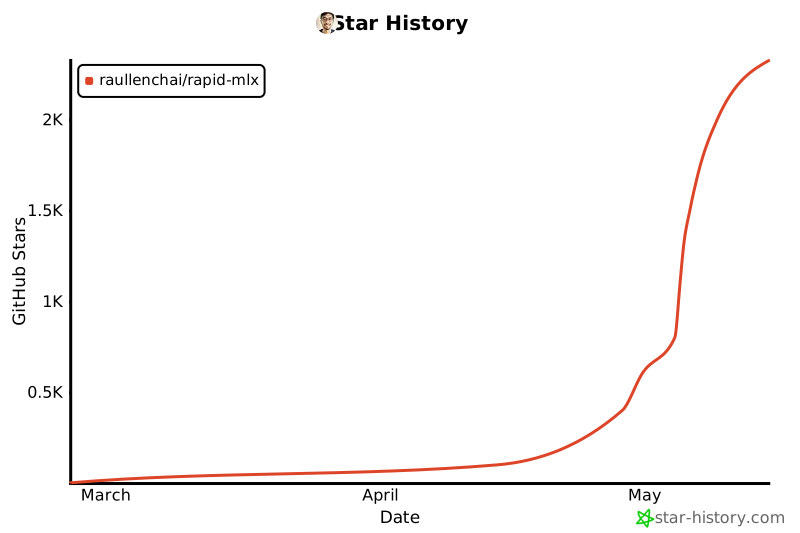
Star History
License
Apache 2.0 — see LICENSE.
Project details
Verified details
These details have been verified by PyPIProject links
GitHub Statistics
Maintainers
Release history Release notifications | RSS feed


Download files
Download the file for your platform. If you're not sure which to choose, learn more about installing packages.
Source Distribution
Built Distribution
Filter files by name, interpreter, ABI, and platform.
If you're not sure about the file name format, learn more about wheel file names.
Copy a direct link to the current filters
File details
Details for the file rapid_mlx-0.9.12.tar.gz.
File metadata
- Download URL: rapid_mlx-0.9.12.tar.gz
- Upload date:
- Size: 3.7 MB
- Tags: Source
- Uploaded using Trusted Publishing? Yes
- Uploaded via: twine/6.1.0 CPython/3.13.12
File hashes
| Algorithm | Hash digest | |
|---|---|---|
| SHA256 |
310ef026538217df792c30f6638a4665a58f45d274e2d13b64174a5fa9ae5c80
|
|
| MD5 |
0e8dc1fcbfe289f4f69c6ea10d91a4d7
|
|
| BLAKE2b-256 |
f72b2dcc8e17a0fb5625e4abd7cf110b536475a0b792d649f5ef8026d08f85d6
|
Provenance
The following attestation bundles were made for rapid_mlx-0.9.12.tar.gz:
Publisher:
publish.yml on raullenchai/Rapid-MLX
-
Statement:
-
Statement type:
https://in-toto.io/Statement/v1 -
Predicate type:
https://docs.pypi.org/attestations/publish/v1 -
Subject name:
rapid_mlx-0.9.12.tar.gz -
Subject digest:
310ef026538217df792c30f6638a4665a58f45d274e2d13b64174a5fa9ae5c80 - Sigstore transparency entry: 2055605916
- Sigstore integration time:
-
Permalink:
raullenchai/Rapid-MLX@82ab6d2453a574b50201ff64c15cd602d96b0e20 -
Branch / Tag:
refs/tags/v0.9.12 - Owner: https://github.com/raullenchai
-
Access:
public
-
Token Issuer:
https://token.actions.githubusercontent.com -
Runner Environment:
github-hosted -
Publication workflow:
publish.yml@82ab6d2453a574b50201ff64c15cd602d96b0e20 -
Trigger Event:
release
-
Statement type:
File details
Details for the file rapid_mlx-0.9.12-py3-none-any.whl.
File metadata
- Download URL: rapid_mlx-0.9.12-py3-none-any.whl
- Upload date:
- Size: 1.9 MB
- Tags: Python 3
- Uploaded using Trusted Publishing? Yes
- Uploaded via: twine/6.1.0 CPython/3.13.12
File hashes
| Algorithm | Hash digest | |
|---|---|---|
| SHA256 |
9fe35760ea5c465920c90288700b514fedce602777f95dc3dc04d36ceec104b1
|
|
| MD5 |
431860ff2ff2a78f7260f0a598ad2bdd
|
|
| BLAKE2b-256 |
c4cecbf7179589e857e4653c7f8267dd8bb83c4233e3b559e7f064573fce9c5f
|
Provenance
The following attestation bundles were made for rapid_mlx-0.9.12-py3-none-any.whl:
Publisher:
publish.yml on raullenchai/Rapid-MLX
-
Statement:
-
Statement type:
https://in-toto.io/Statement/v1 -
Predicate type:
https://docs.pypi.org/attestations/publish/v1 -
Subject name:
rapid_mlx-0.9.12-py3-none-any.whl -
Subject digest:
9fe35760ea5c465920c90288700b514fedce602777f95dc3dc04d36ceec104b1 - Sigstore transparency entry: 2055606349
- Sigstore integration time:
-
Permalink:
raullenchai/Rapid-MLX@82ab6d2453a574b50201ff64c15cd602d96b0e20 -
Branch / Tag:
refs/tags/v0.9.12 - Owner: https://github.com/raullenchai
-
Access:
public
-
Token Issuer:
https://token.actions.githubusercontent.com -
Runner Environment:
github-hosted -
Publication workflow:
publish.yml@82ab6d2453a574b50201ff64c15cd602d96b0e20 -
Trigger Event:
release
-
Statement type:






