<span align=”center”>
- <pre>
<a href=”https://requests.readthedocs.io/”><img src=”https://raw.githubusercontent.com/psf/requests/master/ext/requests-logo.png” align=”center” /></a>
<div align=”left”> <p></p> <code> Python 3.7.4 (default, Sep 7 2019, 18:27:02)</code> <code> >>> <strong>import requests</strong></code> <code> >>> r = requests.get(’https://api.github.com/repos/psf/requests’)</code> <code> >>> r.json()[“description”]</code> <code> ‘A simple, yet elegant HTTP library.’</code> </div>
- <p>
This software has been designed for you, with much joy, by <a href=”https://kennethreitz.org/”>Kenneth Reitz</a> & is protected by The <a href=”https://www.python.org/psf/”>Python Software Foundation</a>.
</p>
</pre>
</span>
<p> </p><p> </p>
<p align=”center”><strong>Requests</strong> is an elegant and simple HTTP library for Python, built with ♥.</p>
<p> </p>
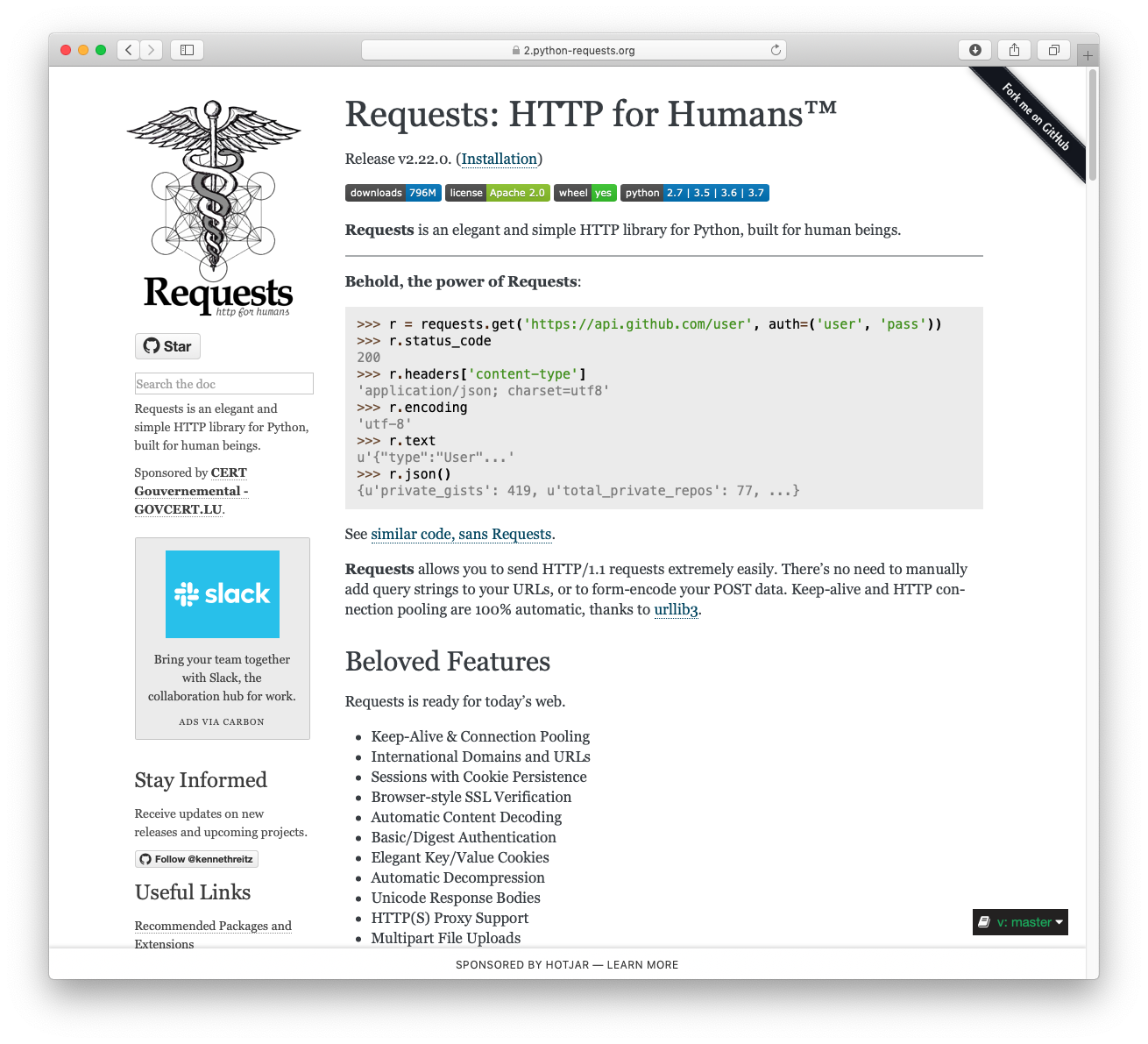
`python >>> import requests >>> r = requests.get('https://api.github.com/user', auth=('user', 'pass')) >>> r.status_code 200 >>> r.headers['content-type'] 'application/json; charset=utf8' >>> r.encoding 'utf-8' >>> r.text '{"type":"User"...' >>> r.json() {'disk_usage': 368627, 'private_gists': 484, ...} `
<p> </p>
Requests allows you to send HTTP/1.1 requests extremely easily. There’s no need to manually add query strings to your URLs, or to form-encode your PUT & POST data — but nowadays, just use the json method!
Requests is one of the most downloaded Python package today, pulling in around 14M downloads / week— according to GitHub, Requests is currently [depended upon](https://github.com/psf/requests/network/dependents?package_id=UGFja2FnZS01NzA4OTExNg%3D%3D) by 500,000+ repositories. You may certainly put your trust in this code.
<p> </p> <p align=”center”><a href=”https://pepy.tech/project/requests” rel=”nofollow”><img src=”https://camo.githubusercontent.com/e1dedc9f5ce5cd6b6c699f33d2e812daadcf3645/68747470733a2f2f706570792e746563682f62616467652f7265717565737473” alt=”Downloads” data-canonical-src=”https://pepy.tech/badge/requests” style=”max-width:100%;”></a> <a href=”https://pypi.org/project/requests/” rel=”nofollow”><img src=”https://camo.githubusercontent.com/6d78aeec0a9a1cfe147ad064bfb99069e298e29b/68747470733a2f2f696d672e736869656c64732e696f2f707970692f707976657273696f6e732f72657175657374732e737667” alt=”image” data-canonical-src=”https://img.shields.io/pypi/pyversions/requests.svg” style=”max-width:100%;”></a> <a href=”https://github.com/psf/requests/graphs/contributors”><img src=”https://camo.githubusercontent.com/a70ea15870b38bba9203b969f6a6b7e7845fbb8a/68747470733a2f2f696d672e736869656c64732e696f2f6769746875622f636f6e7472696275746f72732f7073662f72657175657374732e737667” alt=”image” data-canonical-src=”https://img.shields.io/github/contributors/psf/requests.svg” style=”max-width:100%;”></a></p>
<p> </p>
<h2 align=”center”>Supported Features & Best–Practices</h2>
Requests is ready for the demands of building robust and reliable HTTP–speak applications, for the needs of today.
- <pre class=”test”>
International Domains and URLs + Keep-Alive & Connection Pooling
Sessions with Cookie Persistence + Browser-style SSL Verification
Basic & Digest Authentication + Familiar dict–like Cookies
Automatic Decompression of Content + Automatic Content Decoding
Automatic Connection Pooling + Unicode Response Bodies<super>*</super>
Multi-part File Uploads + SOCKS Proxy Support
Connection Timeouts + Streaming Downloads
Automatic honoring of .netrc + Chunked HTTP Requests
&, of course, rock–solid stability!
</pre>
</div>
- <p align=”center”>
✨ 🍰 ✨
</p>
<p> </p>
Requests Module Installation
The recommended way to install the requests module is to simply use [pipenv](https://pipenv.kennethreitz.org) (or pip, of course):
`console $ pipenv install requests Adding requests to Pipfile's [packages]… ✔ Installation Succeeded … `
Requests officially supports Python 2.7 & 3.5+.
## P.S. — Documentation is available at [requests.readthedocs.io](https://requests.readthedocs.io/en/latest/).
- <p align=”center”>
<a href=”https://requests.readthedocs.io/”><img src=”https://raw.githubusercontent.com/psf/requests/master/ext/ss.png” align=”center” /></a>
</p>
<p> </p>
- <p align=”center”>
<a href=”https://kennethreitz.org/”><img src=”https://raw.githubusercontent.com/psf/requests/master/ext/kr.png” align=”center” /></a>
</p>
<p> </p>
- <p align=”center”>
<a href=”https://www.python.org/psf/”><img src=”https://raw.githubusercontent.com/psf/requests/master/ext/psf.png” align=”center” /></a>
</p>
3 maintainers


Metadata
3 maintainers
Release files for requests 2.24.0
For a detailed explanation of source distributions (sdists) and built distributions (wheels), please see the package formats documentation.
Source distribution (sdist)
| File | Size | Uploaded | Provenance | Actions |
|---|---|---|---|---|
| requests-2.24.0.tar.gz | 115.1 kB | Without provenance | Details for requests-2.24.0.tar.gz |
Built distribution (wheel)
| File | Interpreter | ABI | Platform | Actions Reset |
|---|---|---|---|---|
| requests-2.24.0-py2.py3-none-any.whl | Python 3, Python 2 | none | any | Details for requests-2.24.0-py2.py3-none-any.whl |
Total release size: 176.9 kB
Release files / requests-2.24.0.tar.gz
| Download URL | requests-2.24.0.tar.gz |
|---|---|
| Size | 115.1 kB |
| Tags | Source |
|
SHA-256 checksum How to use checksums |
b3559a131db72c33ee969480840fff4bb6dd111de7dd27c8ee1f820f4f00231b
|
|
BLAKE2b-256 checksum How to use checksums |
da67672b422d9daf07365259958912ba533a0ecab839d4084c487a5fe9a5405f
|
| Upload date | |
|
Uploaded using Trusted Publishing? What is trusted publishing? |
No |
| Uploaded via |
twine/1.13.0 pkginfo/1.5.0.1 requests/2.24.0 setuptools/41.0.1 requests-toolbelt/0.9.1 tqdm/4.32.1 CPython/2.7.13
|
Release files / requests-2.24.0-py2.py3-none-any.whl
| Download URL | requests-2.24.0-py2.py3-none-any.whl |
|---|---|
| Size | 61.8 kB |
| Tags | Python 2 Python 3 |
|
SHA-256 checksum How to use checksums |
fe75cc94a9443b9246fc7049224f75604b113c36acb93f87b80ed42c44cbb898
|
|
BLAKE2b-256 checksum How to use checksums |
451e0c169c6a5381e241ba7404532c16a21d86ab872c9bed8bdcd4c423954103
|
| Upload date | |
|
Uploaded using Trusted Publishing? What is trusted publishing? |
No |
| Uploaded via |
twine/1.13.0 pkginfo/1.5.0.1 requests/2.24.0 setuptools/41.0.1 requests-toolbelt/0.9.1 tqdm/4.32.1 CPython/2.7.13
|
Security for requests 2.24.0
Provenance
Provenance describes where a file came from. On PyPI, provenance is shared via attestations, which provide a verifiable record of the build or publishing details. View details, limitations and caveats.
No provenance found
None of the files in this release were uploaded with provenance metadata.
A note on package security
PyPI is a repository for distributing packages, not a service for auditing them. While third-party security researchers and our staff do their best to detect and remove malicious packages, PyPI cannot guarantee the quality, security or suitability of any given package.
To learn more about protecting yourself from malicious actors, visit our package security documentation.