


Discovering governing equations from data




Documentation · Examples · Algorithms · API reference
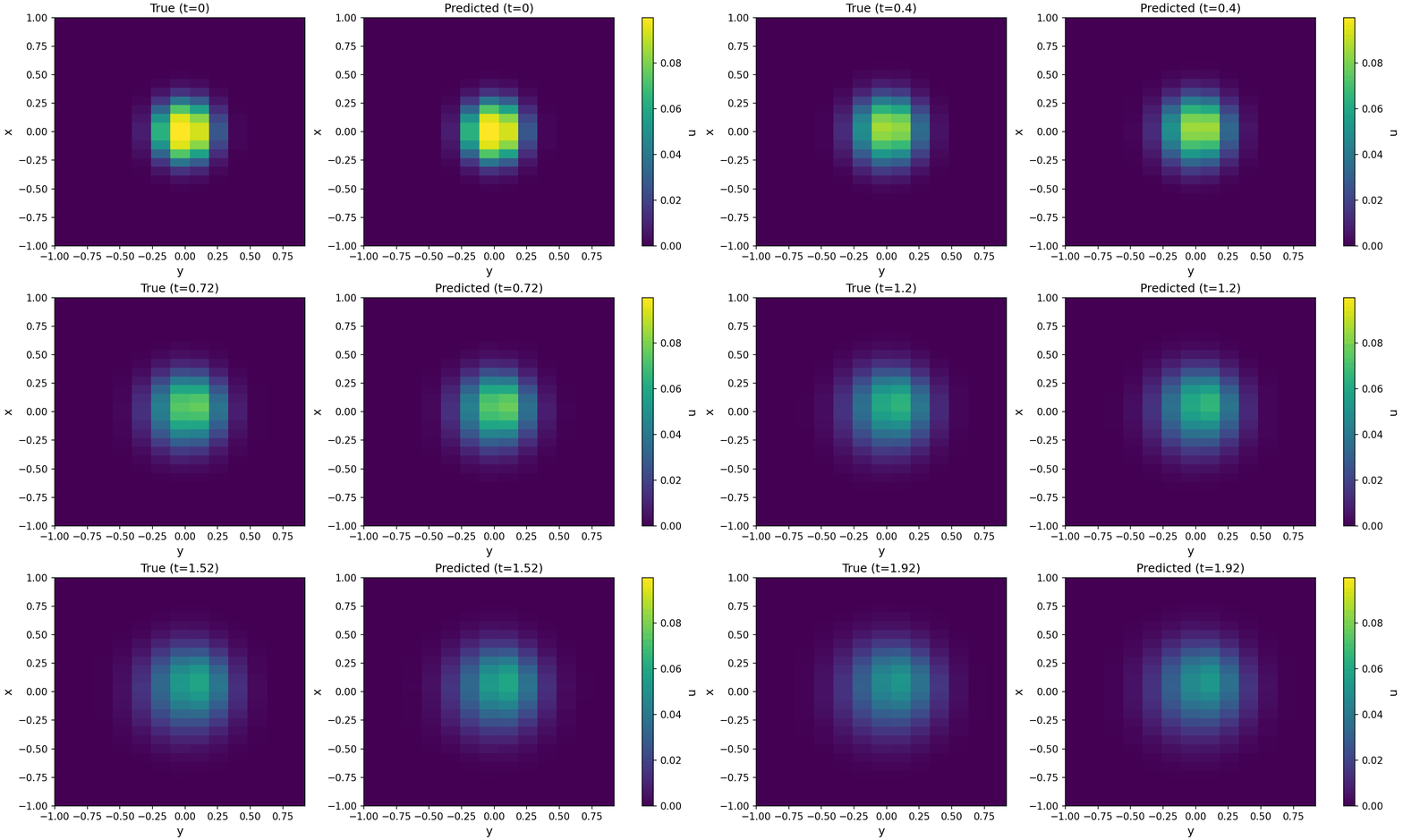
2D Burgers (u_t = -u·u_x - u·u_y + 0.01·∇²u): the field's true evolution beside the PDE integrated forward through the platform.
Regenerate with examples/14_field_animation_2d.py.
KD discovers the governing partial differential equation from data: give it a
field sampled on a spatiotemporal grid, get back a symbolic PDE. The same
Model.fit also takes a plain feature table and returns a scalar expression
y = f(X). Five in-house algorithms (SGA, DLGA, DISCOVER, EqGPT, LLM4ED) and
two external baselines (PySR, PySINDy) run behind one kd.Model API, sharing a
single dataset interface, term evaluator, and HTML report.
Install
Requires Python >= 3.11. With uv, one install
works on every machine: --torch-backend=auto picks the PyTorch build that
matches the hardware (CUDA when a driver is present, CPU otherwise).
uv venv
uv pip install sail-kd --torch-backend=auto
With plain pip, pip install sail-kd pulls PyTorch from PyPI, which on Linux is the
CUDA build (about 4 GB with its NVIDIA libraries). On a machine without a GPU,
install the CPU build first; pip install sail-kd then keeps it:
pip install torch --index-url https://download.pytorch.org/whl/cpu
pip install sail-kd
Model(algorithm="pysr") needs the PySR extra, whose first import downloads a
Julia runtime: uv pip install "sail-kd[pysr]". For a development checkout,
git clone https://github.com/Scientific-Artificial-Intelligence-Lab/kd.git && cd kd && uv sync.
The experimental controller is available through the agent extra:
uv pip install "sail-kd[agent]" --torch-backend=auto
kd-agent setup
kd-agent run --data sample.npz "Find the equation governing this data."
Setup saves an OpenAI-compatible or Anthropic endpoint, model and API key.
Each run writes a Markdown report in its workspace. kd-agent --help works
with a base install; running the controller requires the extra. For PySR
searches through the controller, install sail-kd[agent,pysr].
Quick start
import kd

# The bundled Burgers benchmark: a 256 × 201 field on an (x, t) grid.
dataset = kd.load_burgers()

model = kd.Model(algorithm="sga", generations=5, seed=0)
model.fit(dataset)

print(model.best_expr_)    # u_t = -1*mul(u_x, u) + 0.1002*diff2_x(u)
print(model.best_score_)   # -28.78 (AIC, lower is better)
The printed expression is KD's canonical function-call notation (funcall IR):
mul(u_x, u) is $u,u_x$ and diff2_x(u) is $u_{xx}$, so five generations of
search recover
$$u_t = -u,u_x + 0.1002,u_{xx}$$
against a ground truth of $u_t = -u,u_x + 0.1,u_{xx}$. The same run narrated step by step, with the figures it produces, is Getting started.
Your own data enters through kd.load, which takes a catalog id or a file
path and reads the file on evidence rather than on a guess:
kd.inspect_file("1D_Burgers_Sols_Nu0.01.hdf5")           # every array: key, shape, dtype, range
dataset = kd.load("1D_Burgers_Sols_Nu0.01.hdf5", select={"sample": 0})   # a PDEBench file
dataset = kd.load("run.mat", coords={"x": "x", "t": "t"}, fields={"u": "usol"}, lhs="u_t")
A registered layout (PDEBench HDF5, the self-describing kd-npz convention)
builds the dataset by itself; otherwise you name the arrays with coords= /
fields=, or pass loader=, a function of your own. Arrays you already hold
go through kd.PDEDataset.from_arrays (see
Use your own data).
Tabular data
Model.fit also accepts a TabularDataset: a plain feature table, searched for
y = f(X) with no fields, no derivatives, and no term library. The example below
uses the bundled TLC-CC measurements, 74 chromatography conditions.
import kd

dataset = kd.load_tlc_cc(target="start")     # X = (R_F, r), y = V_S

model = kd.Model("discover", generations=100, seed=0,
                 batch_size=500, reward_alpha=0.005, max_length=15).fit(dataset)

for entry in model.result_.pareto_front():
    print(entry.complexity, entry.loss, entry.scale, entry.expression)
Tabular scoring is scale-free: a Pareto entry holds the raw candidate in
entry.expression and its fitted outer coefficient in entry.scale. At this
budget and seed the complexity-5 entry div(r, add(0.0737, R_F)) with scale
6.634 normalizes to $r/(0.151,R_F + 0.0111)$, against the published
$r/(0.147,R_F + 0.0114)$.
"discover" and "pysr" run in tabular mode. Both on the same table:
examples/12_symbolic_regression.py; the
worked comparison, with the Pareto fronts side by side, is
Column chromatography.
Algorithms
The five in-house algorithms are refactored re-implementations of methods
developed in this lab. Swap the algorithm= string to switch; all seven share
one dataset interface and one result object.
| Algorithm | algorithm= |
Origin | Approach |
|---|---|---|---|
| SGA | "sga" |
Chen et al. 2022 (SGA-PDE) | Genetic algorithm over symbolic expression trees |
| DLGA | "dlga" |
Xu et al. 2020 | Neural-network surrogate + genetic algorithm |
| DISCOVER | "discover" |
Du et al. 2024 | LSTM controller + policy gradient |
| EqGPT | "eqgpt" |
Xu et al. 2025 (EqGPT) | Pretrained generative GPT proposes candidate PDEs, then reward-guided fine-tuning |
| LLM4ED | "llm4ed" |
Du et al. 2024 (LLM4ED) | An LLM proposes candidate equations as text, scored by a sparse-regression reward |
| PySR | "pysr" |
external, Cranmer 2023 | Genetic programming over expression trees (pip install "sail-kd[pysr]") |
| PySINDy | "pysindy" |
external, de Silva et al. 2020 | Native STLSQ sparse regression over the KD term library |
Beyond field data, "discover" and "pysr" also run on a feature table (above),
and "sga" and "pysindy" also accept a sketch (below).
EqGPT needs its pretrained GPT weights, which are not vendored; see
examples/16_eqgpt.py for where to place them. LLM4ED
runs fully offline with an injected provider, or against any OpenAI-compatible
API (see examples/17_llm4ed.py).
Each algorithm's own settings go through the same call: any field of its config
carries as a keyword argument, so kd.Model(algorithm="pysindy", threshold=0.2, normalize_columns=True) and kd.Model(algorithm="dlga", pop_size=200, epsilon=1e-4) need no per-algorithm call form. An unknown name is rejected with
the accepted ones listed. kd.instrument_schemas() returns one row per
algorithm, its config fields with types and defaults plus the facade parameters
(generations, population, seed, ...), so a caller holding only JSON can
configure any algorithm without hardcoding names.
Datasets
Simulated PDE datasets
The simulated datasets come from this lab's PDE-discovery papers: SGA-PDE (Chen et al., Phys. Rev. Research 4, 023174, 2022), EqGPT (Xu et al., Nat Commun 16, 10255, 2025) and LLM4ED (Du et al., Phys. Fluids 36, 097121, 2024).
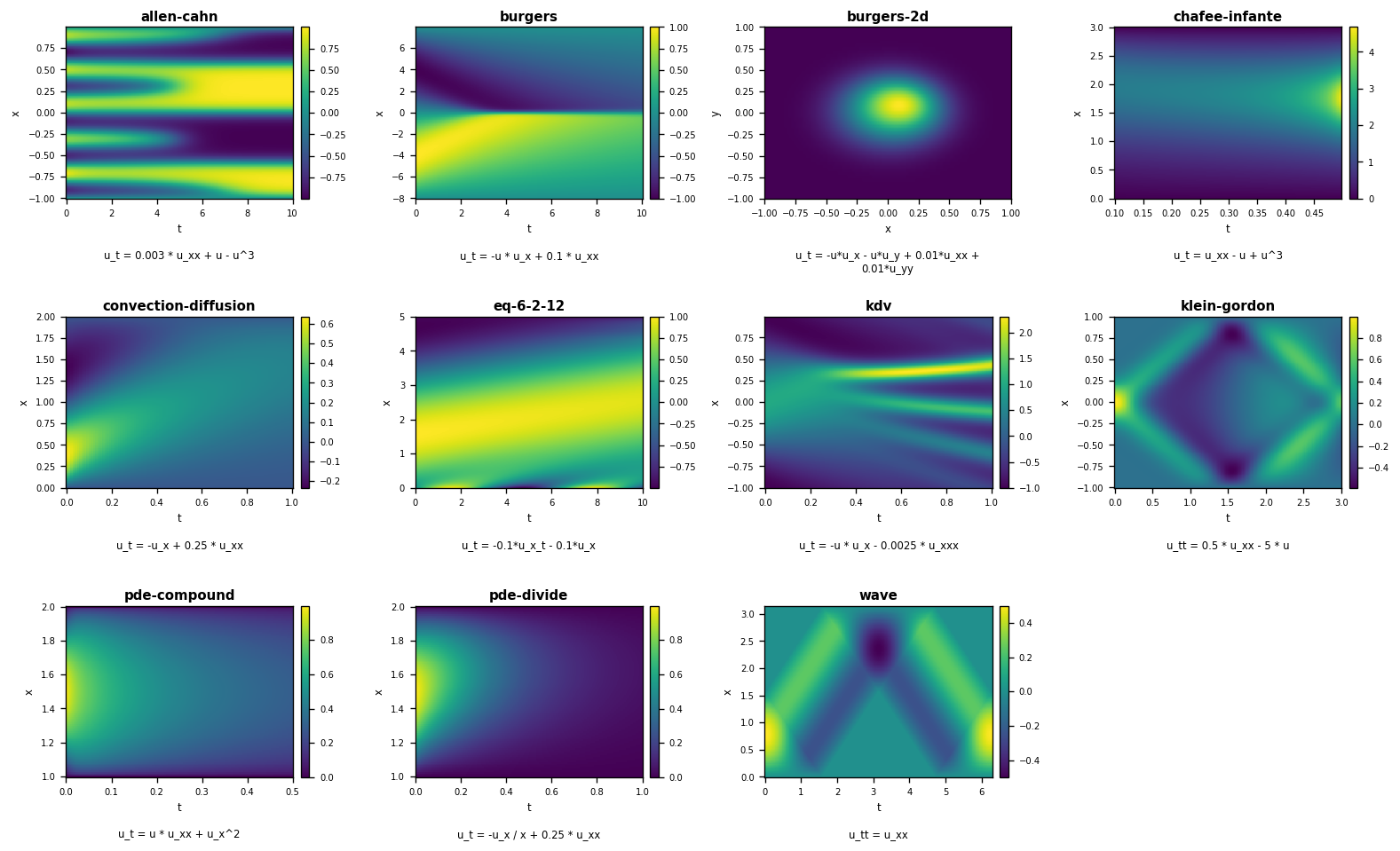
The catalog runs from Burgers and KdV to 2D Burgers, Klein-Gordon and the
Fisher family. Load any bundled dataset with kd.load("burgers") or
kd.load_burgers(), or browse the catalog programmatically with
kd.list_datasets() / kd.get_dataset(id); each entry carries its .source
and .license (see NOTICE).
kd.generate_burgers_data(), kd.generate_diffusion_data(), ... build
synthetic datasets on demand, and remote entries are fetched with
kd.load_from_hub(id).
Governing equation, grid and source for every entry: Bundled datasets.
Real-world experimental data
KD also bundles measured data, not only simulation:
| Dataset | Type | Measured quantity | Size | Reference |
|---|---|---|---|---|
wave-breaking |
wave-tank experiment (Imperial College London) | surface elevation η(t, x) of wave groups approaching breaking |
314,478 points (one of the paper's 12 experiments) | Xu et al., Nat Commun 16, 10255 (2025) |
tlc-cc |
automated chromatography experiment | column retention volumes V_S, V_E vs (R_F, r) |
2 tables × 74 conditions | Xu et al., Nat Commun 16, 832 (2025) |
wb = kd.load_wave_breaking()          # η(t, x): scattered wave-tank points
cc = kd.load_tlc_cc(target="start")   # X = (R_F, r), y = V_S
Wave breaking is surface elevation of focused wave groups approaching breaking,
reconstructed frame by frame from camera images in the wave-tank experiments of
the EqGPT paper, bundled as scattered (t, x, η) points. TLC-CC is
column-chromatography retention volumes measured on an automated platform (192
compounds, 4 g silica columns), aggregated to mean start and end retention
volumes over 74 (R_F, r) conditions, ready for KD's scalar
symbolic-regression entries. Experimental background, protocols and references
for both are in the papers and their Supplementary Information
(wave breaking,
TLC-CC).
Examples
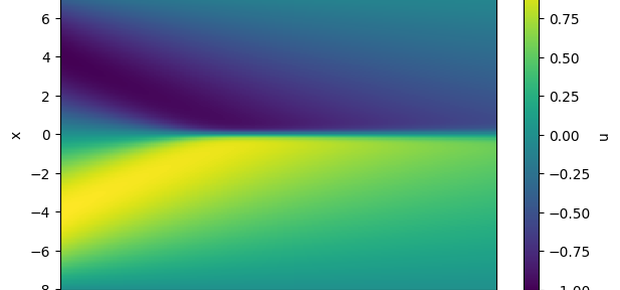 Getting started
Load a bundled benchmark, fit in one call, read the result. |
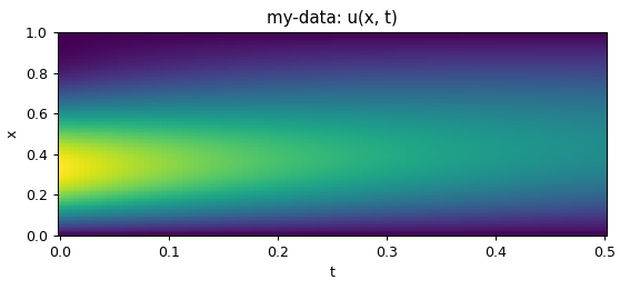 Use your own data
Two coordinate arrays and one field array, from NumPy to a fitted equation. |
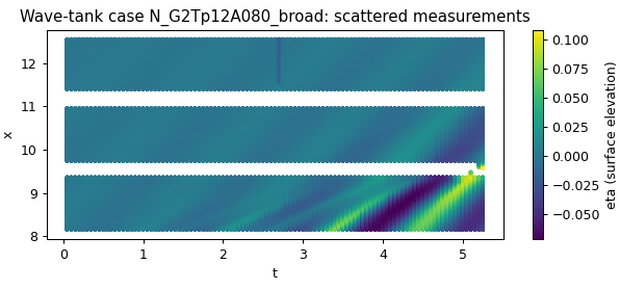 Breaking waves
The published EqGPT equation, reproduced on 12 wave-tank experiments. |
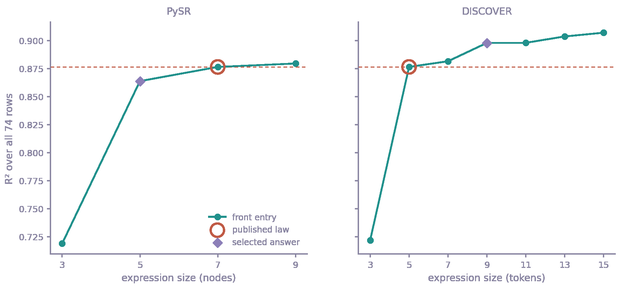 Column chromatography
Two algorithms on one 74-row table, both recovering the published formula. |
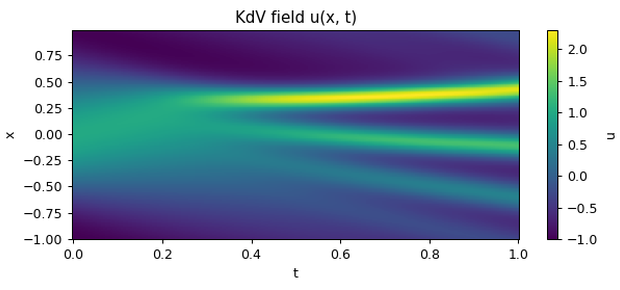 KdV walkthrough
A 200-generation SGA-PDE fit on the KdV benchmark, read term by term, with every figure and the report. |
Nineteen runnable scripts covering every algorithm are in
examples/, including
09_compare_algorithms.py, which runs the
algorithms on one dataset and ranks the discovered equations on a single NMSE
ruler.
Discovery with a sketch
A blind search starts from "any equation could be here". When part of the law is
already settled physics, fit(dataset, sketch=...) states that part and searches
only the rest. A pinned term is subtracted from the regression target before the
search and restored exactly in the solution, so the search cannot spend budget
rediscovering it. A hole declares how many terms may fill it and what shapes they
may take (derivative-order cap, allowed operators, fields, axes).
The exit is certified: outcome.solution is published only when the discovered
law satisfies every clause, and otherwise the run reports
outcome.best_candidate plus the clause that failed. "sga" and "pysindy"
accept sketches today; an algorithm that cannot honor a clause refuses the fit
with a ValueError naming that clause instead of searching wider than declared.
The full walkthrough, including how the two backends differ, is
examples/21_sketch_discovery.py (about 30
seconds).
More in KD
| Score candidate terms | Fit and score a term set directly, or classify one without fitting, with a per-term rejection report | examples/11 · API |
| Checkpoint and resume | Atomic search-state checkpoints during fit, plus a manifest.json ledger to pick a resume point from |
examples/10 · Guide |
| Batch experiments | A declarative algorithm × dataset plan, run into a sealed evidence store with environment fingerprints and consensus reports | examples/19 · Guide |
| HTML reports | Convergence, parity, residual maps, field comparisons, the equation in LaTeX, and each algorithm's own search diagnostics | examples/03 · Guide |
| Dataset preview | kd.preview(dataset) audits axes, spacing, field statistics and the left-hand side before a search |
Data requirements |
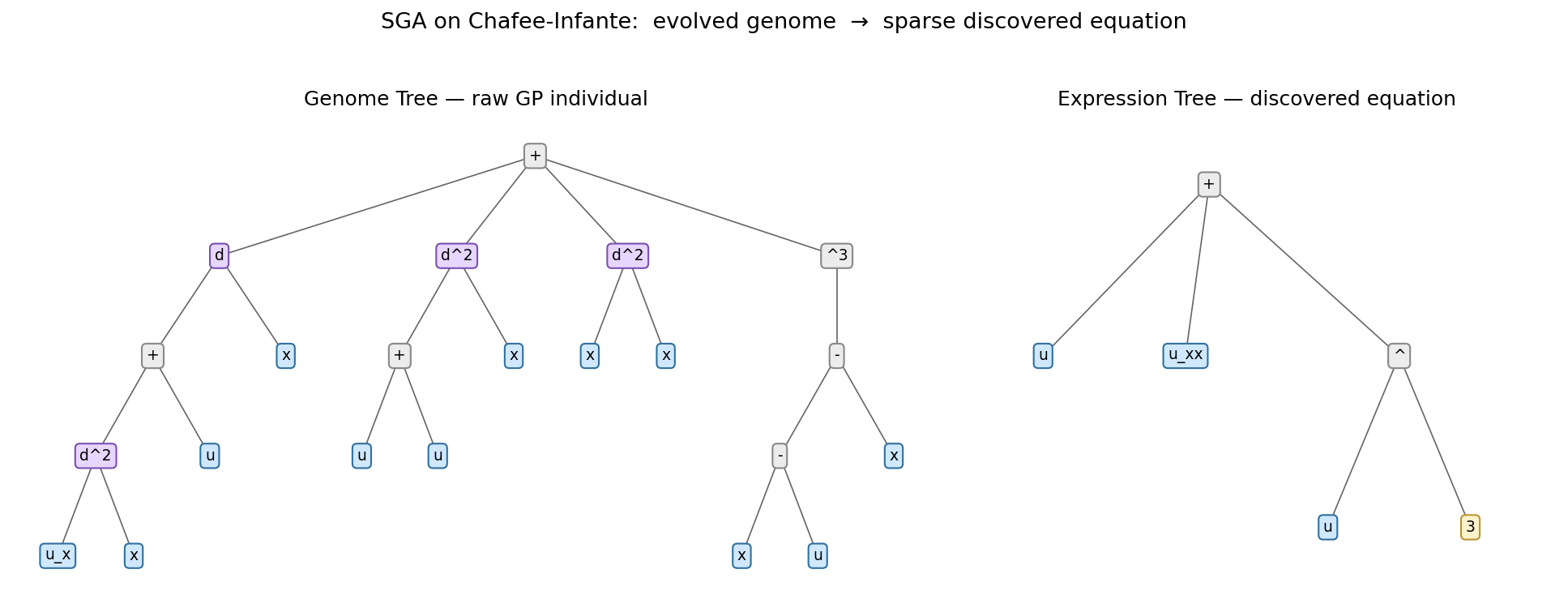
From the report, SGA on the bundled Chafee-Infante dataset. Left: the raw genome of the best evolved individual, still carrying redundant branches. Right: the discovered equation after sparse selection, operators and derivatives only.
Origins and acknowledgements
The SGA, DLGA, DISCOVER, EqGPT, and LLM4ED algorithms are refactored re-implementations of methods developed in this lab; credit for the methods belongs to the original works:
- SGA-PDE: Chen et al., SGA-PDE;
also the source of several bundled datasets (see
NOTICE) - DLGA: Xu et al. 2020
- DISCOVER: Du et al., DISCOVER
- EqGPT: Xu et al., EqGPT,
Nat Commun 16, 10255 (2025); also the source of several bundled
datasets, including the wave-breaking experiments (see
NOTICE) - LLM4ED: Du et al., LLM4ED, Phys. Fluids 36, 097121 (2024)
KD also builds on PySR and PySINDy (optional external baselines), SymPy, and PyTorch.
License
Apache-2.0. Copyright 2026 Mao, Hao and the Scientific Artificial Intelligence Lab.
1 maintainer

Download files
Download the file for your platform. If you're not sure which to choose, learn more about installing packages.
Source Distribution
Built Distribution
Filter files by name, interpreter, ABI, and platform.
If you're not sure about the file name format, learn more about wheel file names.
Copy a direct link to the current filters
File details
Details for the file sail_kd-0.8.0.tar.gz.
File metadata
- Download URL: sail_kd-0.8.0.tar.gz
- Upload date:
- Size: 20.2 MB
- Tags: Source
- Uploaded using Trusted Publishing? No
- Uploaded via:
uv/0.11.8 {"installer":{"name":"uv","version":"0.11.8","subcommand":["publish"]},"python":null,"implementation":{"name":null,"version":null},"distro":{"name":"Ubuntu","version":"24.04","id":"noble","libc":null},"system":{"name":null,"release":null},"cpu":null,"openssl_version":null,"setuptools_version":null,"rustc_version":null,"ci":null}
File hashes
| Algorithm | Hash digest | |
|---|---|---|
| SHA256 |
c86e4cc56aa234f135b2d5350dbbd939ddd145e016b1198c4bf2c0f316be7981
|
|
| MD5 |
3e1f0b83058b033077be6ec57a183258
|
|
| BLAKE2b-256 |
ef98eca6e7cb5a228d47e7ea188fa1c6b435a8278e6b7d3f3f5b8383c0e6c8ac
|
File details
Details for the file sail_kd-0.8.0-py3-none-any.whl.
File metadata
- Download URL: sail_kd-0.8.0-py3-none-any.whl
- Upload date:
- Size: 20.3 MB
- Tags: Python 3
- Uploaded using Trusted Publishing? No
- Uploaded via:
uv/0.11.8 {"installer":{"name":"uv","version":"0.11.8","subcommand":["publish"]},"python":null,"implementation":{"name":null,"version":null},"distro":{"name":"Ubuntu","version":"24.04","id":"noble","libc":null},"system":{"name":null,"release":null},"cpu":null,"openssl_version":null,"setuptools_version":null,"rustc_version":null,"ci":null}
File hashes
| Algorithm | Hash digest | |
|---|---|---|
| SHA256 |
94c0f97b9d7475fcf9d30e4dec45fd5dce852c16f1bdd84bfaf17132f453b789
|
|
| MD5 |
8e4dc9f6beb842b6828fa22f40b9b323
|
|
| BLAKE2b-256 |
1f6dffd0d2d81770631874f1cd53769e55febaede3e5fe18e496d15ad9c70835
|













