
Per-entry-point navigable call-graph visualizations of Solidity repositories, for Web3 security auditors.
Verified details
These details have been verified by PyPIProject links
GitHub Statistics
Maintainers

Project description
SolFlow (Solidity Flow Navigator)

Read a contract the way it executes, not the way its files are organized.
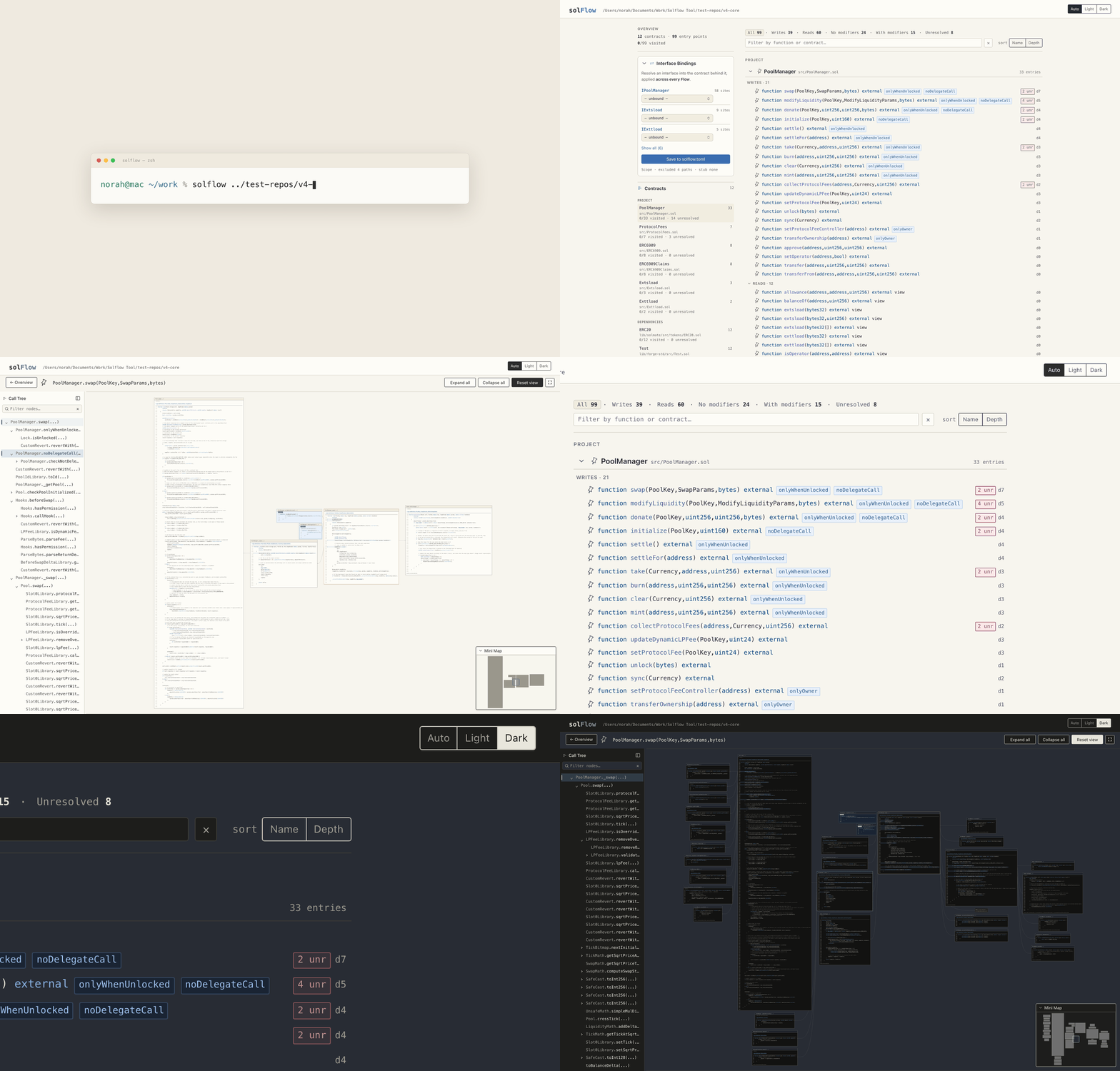
SolFlow compiles a Solidity repository, extracts call-graph facts with Slither, and serves one interactive call-flow visualization per external entry point. Every panel shows the function's real source. Built for smart contract auditing.
SolFlow on Morpho Blue: the entry-point index, the fully expanded liquidate flow, and the same flow zoomed to source level. Pausable stills are under Screenshots.
Why
The first job in any audit is reconstructing what actually happens when someone calls an entry point. The answer is scattered across base contracts, libraries, and modifiers in a dozen files. SolFlow lays it out as a graph you can read:
- One Flow per entry point. The index lists every externally callable function, grouped by contract and split into mutating vs read-only, with modifier badges, call-tree depth, and unresolved-target counts per entry: the whole audit surface on one page.
- Real source, not boxes. Every node renders the target function's actual code, syntax-highlighted and line-numbered. Click a call site and the callee expands beside it, the edge anchored to the exact line that makes the call.
- It never silently lies. When a call target can't be resolved statically (an interface with no bound implementation,
addr.call(...), computed-target Yul), the node is explicitly marked unresolved, with the reason. No guessing, no silent omissions. - Local and private. Analysis runs entirely on your machine and the server binds only to
127.0.0.1. Audit code is never uploaded anywhere.
SolFlow is not a vulnerability scanner. It emits no findings and makes no security claims. It shows you the code's shape so you can find the problems faster.
Install
Requires Python 3.11+ and a solc matching your target, via solc-select (Slither needs it to compile):
pipx install solflow
pipx install solc-select
solc-select install <version> && solc-select use <version>
For the latest development version instead: pipx install git+https://github.com/norah1499/solidity-flow-navigator.
To uninstall: pipx uninstall solflow removes the tool and all its bundled dependencies; SolFlow writes nothing outside its own install directory, so nothing else is left behind. solc-select and its downloaded compilers are a separate install, removable with pipx uninstall solc-select.
Use
solflow path/to/your/solidity/project
Point it at the repository root, where Slither can resolve dependencies. SolFlow compiles the project, binds 127.0.0.1:8080 (or the next free port), and prints the URL.
Compilation goes through crytic-compile, so any build system it detects should work (Foundry, Hardhat, Truffle, Brownie, plain solc); Foundry projects are what SolFlow is tested against. If anything goes wrong on the first run, see If the first run fails below.
Useful flags (run solflow --help for the full reference, grouped into Scope, Resolution, Rendering, and Server):
| Flag | What it does |
|---|---|
--expand-all |
Open every Flow fully expanded, for a bird's-eye view |
--exclude-path GLOB, --exclude-contract PATTERN |
Narrow which contracts produce Flows |
--inline-library NAME |
Recurse into a lib/<NAME>/ dependency instead of stubbing it |
--port N |
Bind a specific port |
If the first run fails
SolFlow is built on Slither and is contingent on it: anything Slither cannot compile and analyze, SolFlow cannot visualize. When that happens, SolFlow prints the underlying error verbatim and exits without producing anything. No partial Flows, by design: a half-compiled picture would silently mislead an audit. SolFlow never installs dependencies or modifies the target repository to make a build pass.
The rule of thumb: if the project does not build on its own in that directory, SolFlow will not build it either. The two most common first-run failures are environment issues, not tool bugs:
- solc version mismatch. The active
solcdoes not match the project's pragma. Fix:solc-select install <version> && solc-select use <version>. - Missing dependencies. The target was cloned fresh and its libraries were never fetched. Fix: run the project's own setup first (
forge install,npm install, or equivalent) and confirm the project's own build succeeds before pointing SolFlow at it.
If the project builds cleanly and Slither itself still fails on it (this happens on some large protocols), that is an upstream Slither limitation rather than a SolFlow defect; an issue is still welcome so it can be tracked.
Screenshots
Stills from the demo above (Morpho Blue)
The index lists every external entry point of the analyzed repository:

Opening an entry point renders its full call flow; every callee panel shows the real source:


Contributing
Issues and pull requests are welcome. Before opening a PR, make sure these pass:
pytest
black --check .
ruff check
License
AGPL-3.0, and not a free choice: SolFlow builds on Slither and crytic-compile, both AGPL-3.0, so the combined work inherits their license. In practice this is the same license situation as Slither itself, which most auditors already run daily. SolFlow executes entirely on your machine and never transmits the code it analyzes, so using it on client or NDA work is no different from using Slither on that work. The license's network clause applies only if you host a SolFlow instance for others; in that case you must offer them the source, and the index footer links back here for exactly that purpose.
Project details
Verified details
These details have been verified by PyPIProject links
GitHub Statistics
Maintainers
Release history Release notifications | RSS feed


Download files
Download the file for your platform. If you're not sure which to choose, learn more about installing packages.
Source Distribution
Built Distribution
Filter files by name, interpreter, ABI, and platform.
If you're not sure about the file name format, learn more about wheel file names.
Copy a direct link to the current filters
File details
Details for the file solflow-0.13.1.tar.gz.
File metadata
- Download URL: solflow-0.13.1.tar.gz
- Upload date:
- Size: 217.0 kB
- Tags: Source
- Uploaded using Trusted Publishing? Yes
- Uploaded via: twine/6.1.0 CPython/3.13.12
File hashes
| Algorithm | Hash digest | |
|---|---|---|
| SHA256 |
63f17551d9851538695a3cf405b9b0c3f65e6cc163aa2c87f23d09bf70fe69e1
|
|
| MD5 |
43658f4b317cad71e67dfc453f6b6791
|
|
| BLAKE2b-256 |
84cc2f22e87dfc935224ce4ce1b42772724edaba4812400de01b548e7bab6fca
|
Provenance
The following attestation bundles were made for solflow-0.13.1.tar.gz:
Publisher:
release.yml on norah1499/solidity-flow-navigator
-
Statement:
-
Statement type:
https://in-toto.io/Statement/v1 -
Predicate type:
https://docs.pypi.org/attestations/publish/v1 -
Subject name:
solflow-0.13.1.tar.gz -
Subject digest:
63f17551d9851538695a3cf405b9b0c3f65e6cc163aa2c87f23d09bf70fe69e1 - Sigstore transparency entry: 1799309927
- Sigstore integration time:
-
Permalink:
norah1499/solidity-flow-navigator@f89f94fc3761f3063ca22b45d1a1b958d16bf836 -
Branch / Tag:
refs/tags/v0.13.1 - Owner: https://github.com/norah1499
-
Access:
public
-
Token Issuer:
https://token.actions.githubusercontent.com -
Runner Environment:
github-hosted -
Publication workflow:
release.yml@f89f94fc3761f3063ca22b45d1a1b958d16bf836 -
Trigger Event:
release
-
Statement type:
File details
Details for the file solflow-0.13.1-py3-none-any.whl.
File metadata
- Download URL: solflow-0.13.1-py3-none-any.whl
- Upload date:
- Size: 223.0 kB
- Tags: Python 3
- Uploaded using Trusted Publishing? Yes
- Uploaded via: twine/6.1.0 CPython/3.13.12
File hashes
| Algorithm | Hash digest | |
|---|---|---|
| SHA256 |
6879e7bf14f45d70fb72fd3a5c7d43e5bbdba914593d3376c8c26bd1aa2c1d1b
|
|
| MD5 |
3d37c6cfafacd2f2d35f886ecd3a673b
|
|
| BLAKE2b-256 |
138c5c1726fa97560c218c729316f607b522b95335c11bcdae8513f60f914c1a
|
Provenance
The following attestation bundles were made for solflow-0.13.1-py3-none-any.whl:
Publisher:
release.yml on norah1499/solidity-flow-navigator
-
Statement:
-
Statement type:
https://in-toto.io/Statement/v1 -
Predicate type:
https://docs.pypi.org/attestations/publish/v1 -
Subject name:
solflow-0.13.1-py3-none-any.whl -
Subject digest:
6879e7bf14f45d70fb72fd3a5c7d43e5bbdba914593d3376c8c26bd1aa2c1d1b - Sigstore transparency entry: 1799310079
- Sigstore integration time:
-
Permalink:
norah1499/solidity-flow-navigator@f89f94fc3761f3063ca22b45d1a1b958d16bf836 -
Branch / Tag:
refs/tags/v0.13.1 - Owner: https://github.com/norah1499
-
Access:
public
-
Token Issuer:
https://token.actions.githubusercontent.com -
Runner Environment:
github-hosted -
Publication workflow:
release.yml@f89f94fc3761f3063ca22b45d1a1b958d16bf836 -
Trigger Event:
release
-
Statement type:






