
SPGCI Python Library
Python Client for the S&P Global Commodity Insights API.
Looking for more examples? Check out our Notebook Gallery.
Installation
Requires Python >= 3.9.0.
pip install spgci
Getting Started

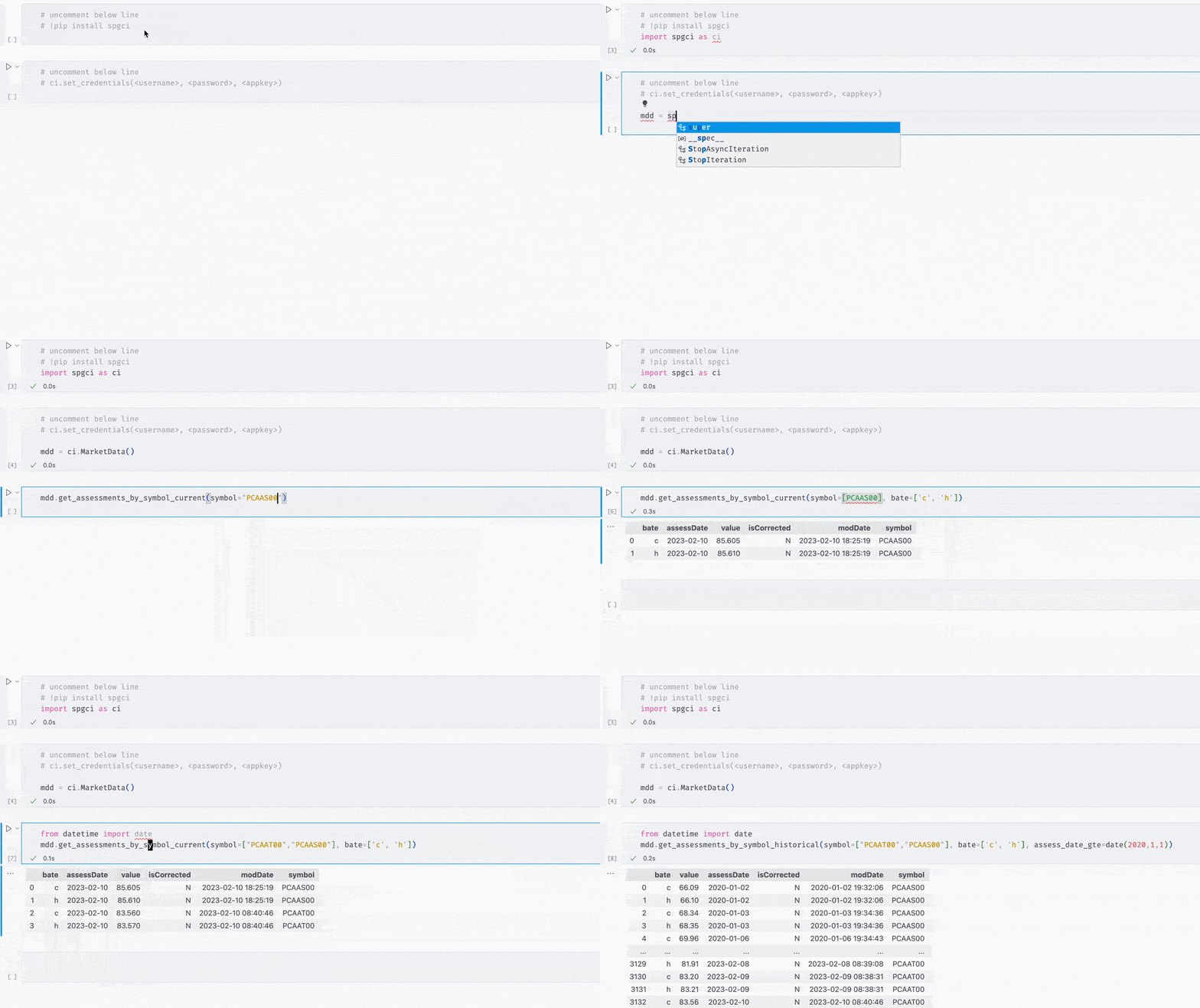
    import spgci as ci

    ci.set_credentials(<username>, <password>)
    mdd = ci.MarketData()

    symbols = ["PCAAS00", "PCAAT00"]
    mdd.get_assessments_by_symbol_current(symbol=symbols)
Alternatively, you can set your credentials via Environment Variables and omit the set_credentials call:
| Environment Variable | Description |
|---|---|
| SPGCI_USERNAME | Your Username |
| SPGCI_PASSWORD | Your Password |
Features
- Automatically generates token prior to making request.
- Returns data as a pandas DataFrame (set
raw=Falseto get the rawrequest.responseobject). - Can auto-paginate response and concatenates into a single DataFrame (set
paginate=Trueto enable). - Sets datatype for
dateanddatetimefields in DataFrame. - Composes nicely with native python/pandas types. Arguments support
listsandpd.Serieswhich are automatically converted into filter expressions.
Datasets Supported
Market Data
import spgci as ci

mdd = ci.MarketData()

mdd.get_symbols(commodity="Crude oil")
# DataFrame of symbols with commodity = "Crude oil".

mdd.get_symbol(subscribed only=True)
# DataFrame of all Market Data Categories you are subscribed to.

mdd.get_assessments_by_mdc_current(mdc="ET")
# DataFrame of current assessments for all symbols in the Market Data Category "ET".

mdd.get_assessments_by_mdc_historical(mdc="ET")
# DataFrame of historical assessments for all symbols in the Market Data Category "ET"

mdd.get_mdcs()
# DataFrame for Market Data Categories (MDCs) available

mdd.get_assessments_by_symbol_current(symbol="PMABQ00")
# DataFrame for symbol assements for the current latest date

mdd.get_assessments_by_symbol_historical(symbol="PMABQ00")
# DataFrame for symbol assements for historical data from the earliest date possible
Forward Curves
import spgci as ci

fc = ci.ForwardCurves()

fc.get_curves(
    commodity=["Benzene", "Crude oil"],
    derivative_maturity_frequency="Month"
    )
# DataFrame of all curves with commodity in ("Benzene", "Crude Oil") and have a Monthly frequency.

fc.get_assessments(curve_code=["CN003", "CN006"])
# DataFrame of the latest assessments for all symbols in the curves ("CN003", "CN006").
Energy Price Forecast
import spgci as ci

epf = ci.EnergyPriceForecast()

epf.get_prices_shortterm(symbol="PCAAS00", month=[10, 11, 12])
# DataFrame of monthly forecasts for the symbol "PCAAS00" in the last 3 months of the year.

epf.get_prices_longterm(year=[2020, 2021], sector="Energy Transition", delivery_region="Europe")
# DataFrame of the annual forecasts for the years in ("2020", "2021"), where the sector is "Energy Transition" and the delivery region is "Europe".
EWindow Market Data
import spgci as ci
from datetime import date

ewmd = ci.EWindowMarketData()

ewmd.get_markets()
# DataFrame of Markets.

d = date(2023,2,13)
ewmd.get_botes(market=["EU BFOE", "US MidWest"], order_time=d)
# DataFrame of all BOTes in the markets ("EU BFOE", "US MidWest") on Feb 13, 2023.
World Oil Supply
import spgci as ci

wos = ci.WorldOilSupply()

countries = wos.get_reference_data(type=wos.RefTypes.Countries)
# DataFrame of all countries.

wos.get_ownership(country=countries['countryName'][:3], year=2040)
# DataFrame of Ownership for the first three countries from the countries endpoint and year "2040".
World Refinery Database
import spgci as ci

wrd = ci.WorldRefineryData()

wrd.get_yields(year=2020, owner="BP")
# DataFrame of yields for the year "2020" where "BP" is the refinery owner.

ref = wrd.get_reference_data(type=wrd.RefTypes.Refineries)
# DataFrame of all refineries.

az = ref[ref['Name'].str.contains("Al-Zour")]
wrd.get_runs(refinery_id=az["Id"])
# DataFrame of runs for the refineries with "Al-Zour" in the name.

wrd.get_outages(refinery_id=245)
# DataFrame of outages for refineryId 245.
Insights
import spgci as ci
import datetime

ni = ci.Insights()
two_weeks_ago = today - datetime.timedelta(days=14)

ni.get_stories(q="Suez", content_type=ni.ContentType.MarketCommentary)
# DataFrame of articles related to "Suez" where the content type is "Market Commentary".

ni.get_subscriber_notes(q="Naptha")
# DataFrame of all subscriber notes related to "Naptha".

ni.get_heards(q="Steel", content_type=ni.HeardsContentType.Heard, geography=['Europe', 'Middle East'], strip_html=True)
# DataFrame of all Heards related to "Steel" where the geography is in ("Europe", "Middle East") with HTML Tags removed from the headline and body.

ni.get_content(id="169b5f45-04e4-43f2-b83b-ecc16f96be55")
# DataFrame to see more content details in an article ID

ni.get_spotlights(updated_date_gte=two_weeks_ago)
# DataFrame for spotlights articles from two weeks ago to today

ni.get_spotlights(updated_date_gte=two_weeks_ago,strip_html=True)
# DataFrame for spotlights articles from two weeks ago to today, with HTML tags stripped

ni.get_content(id="02ed2748-1262-45e1-ad97-9629e29e0274",download=True)
# Download file from get_content endpoint, e.g. pdf file

ni.get_content(id="02ed2748-1262-45e1-ad97-9629e29e0274", download="my_report.pdf")
# Report name can be specified when downloading, otherwise the file will be named using the content ID
Global Oil Demand
import spgci as ci

od = ci.GlobalOilDemand()

od.get_demand(country="Cambodia", product=["Naphtha", "Ethane"])
# DataFrame of forecast monthly demand for ("Naphtha", "Ethane") for Cambodia.

products = od.get_reference_data(type=od.RefTypes.Products)
# DataFrame of all "products" covered by Global Oil Demand dataset.

od.get_demand(product=products["productName"][:3], year_gte=2023)
# DataFrame of forecast monthly demand for the first 3 products in the previous DataFrame and the year >= 2023.

od.get_demand_archive(scenario_id=150, country="Norway")
# DataFrame of an archived (March 2023) forecast of monthly oil demand for Norway.
Global Integrated Energy Model
import spgci as ci

giem = ci.GlobalIntegratedEnergyModel()

giem.get_demand(country="Cambodia", product=["Naphtha", "Ethane"])
# DataFrame of energy demand for ("Naphtha", "Ethane") for Cambodia.

giem.get_demand_archive(scenario_id=559, country="Cambodia", product=["Naphtha", "Ethane"])
# DataFrame of an archived demand data of giem for Cambodia.

giem.get_reference_data(type=giem.RefTypes.Products)
# DataFrame of all "products" covered by Global Oil Demand dataset.
Refining Margins & Crude Arbitrage
import spgci as ci

af = ci.Arbflow()

af.get_margins_catalog(location_id = 34, crude_symbol="AAQZB00")
# DataFrame of refining margins catalog for ("AAQZB00") for Location Id 34.

af.get_margins_data(margin_id=229, margin_date='2023-08-16')
# DataFrame of refining margins data of arbflow for '2023-08-16'.

af.get_arbitrage(margin_id=[220,330], base_margin_id=1514, frequency_id=2)
# DataFrame of arbitrage data with frequencyId = 2 (Monthly).

af.get_reference_data(type=af.RefTypes.Locations)
# DataFrame of all "locations" covered by Refining Margins & Crude Arbitrage dataset.
LNG Global Analytics
import spgci as ci

lng = ci.LNGGlobalAnalytics()

lng.get_tenders(country_name="United States", paginate=True)
# DataFrame of tenders with country = 'United States'.

lng.get_tenders(contract_type="FOB", contract_option="Sell")
# DataFrame of tenders with ContractType = "FOB" and ContractOption = "Sell".

lng.get_liquefaction_projects()
# DataFrame of liquefaction projects.

lng.get_outages(liquefaction_project_name="ADNOC LNG")
# DataFrame of all LNG outages tied to the liquefaction project "ADNOC LNG".

lng.get_netbacks(date_gt="2024-01-01", import_geography="Brazil")
# DataFrame of all LNG Netbacks where import geography is 'Brazil' since Jan 1, 2024.

lng.get_supply_forecast_current(export_market="Indonesia")
# DataFrame of the current supply forecast for Indonesia

lng.get_demand_forecast_history(import_market="Japan", month="2024-12-01")
# DataFrame of all historical forecasts (one per month) of the LNG demand for Japan in December 2024.

lng.get_cargo_trips(trade_route="Suez Canal", date_loaded_gte="2024-01-01")
# DataFrame of trips through the Suez Canaal that loaded since 2024.

lng.get_cargo_events_partial_reexport()
# DataFrame of partial re-exports (a fraction of the delivered LNG is re-exported during transportation)

lng.get_assets_contracts_offtake_contracts(assumed_destination="Japan")
# DataFrame of offtake contracts headed to 'Japan'

lng.get_assets_contracts_liquefaction_trains(train_status=["Existing","Under Construction"])
# DataFrame of liquefaction trains which are either 'Existing' or 'Under Construction'

lng.get_gas_demand(market=["United States", "Mexico"], period_type="Monthly")
# DataFrame of gas demand for the different categories in the U.S. and Mexico on a monthly basis.

lng.get_power_generation(
    market=["India", "Pakistan", "Bangladesh"],
    source="Power Generation By Fuel",
    period_type="Monthly",
    paginate=True,
)
# DataFrame of power generation for India, Pakistan, Bangladesh by fuel type on a monthly basis.

lng.get_demand_forecast_short_term_current(import_market="France",month_gte="2025-01-01")
# DataFrame of short term demand forecast for import market of France starting January 1st 2025

lng.get_supply_forecast_short_term_current(export_market="Canada",month_gte="2025-01-01")
# DataFrame of short term supply forecast for export market of Canada starting January 1st 2025

lng.get_events_trade_route(trade_route="Cape of Good Hope", vessel_direction="Westbound")
# DataFrame for events recording key information, e.g Westbound vessels passing throught the Cape of Good Hope

lng.get_events_diversion(diversion_location="Indian Ocean")
# DataFrame for events of diversion, e.g. in the Indian Ocean
Crude Analytics
import spgci as ci

ca = ci.CrudeAnalytics()

ca.get_country_scores(status="Current")
# DataFrame of latest scores for all countries.

ca.get_country_scores(country="United States")
# DataFrame of all (historical and current) scores for country = "United States".

ca.get_country_total_scores()
# DataFrame of aggregated scores, supply and capacity per date.
Weather
import spgci as ci

w = ci.Weather()

w.get_forecast(city="Boston")
# DataFrame of forecasts for Boston

w.get_forecast(market="United States", weather_date_gte="2024-01-01", weather_date_lte="2024-01-31")
# DateFrame of forecasts in the United States in January 2024.

w.get_actual(market="Hong Kong", paginate=True)
# DataFrame of actual weather in Hong Kong, paginate=True to get full history.
Structured Heards
import spgci as ci

sh = ci.StructuredHeards()

sh.get_markets()
# DataFrame of the list of markets that have structured heards.

sh.get_heards(market="Americas crude oil", heard_type="trade")
# DateFrame of heards in the Americas crude oil market that are of type 'trade'.
Chemicals Analysis and Forecasts
import spgci as ci

chem = ci.Chemicals()

chem.get_unique_values(dataset="production", columns=["commodity"])
# See the unique values for each field per dataset. Useful for finding out the exact values to fitler on for fields like commodity, region, etc..

chem.get_capacity_events(
    event_begin_date_gt="2023-01-01", country="China", event_type=["expand", "startup"]
)
# DataFrame of capacity events in plants in China, that are either "expand" or "startup" since 2023-01-01

chem.get_capacity_to_consume(is_active=[True, False], commodity="Polybutadiene rubber")
# DateFrame of capacities to consume. Setting `is_active` to [True, False] allows you to include records that were corrected or removed which is useful for Point-In-Time analysis.

chem.get_short_term_prices(commodity="Acetone", delivery_region="US Gulf Coast")
# DataFrame of short-term (monthly) price forecasts for Acetone delivered to the US Gulf Coast.

chem.get_outages(
    start_date_gte="2023-01-01",
    capacity_gte=500,
    alert_status=['Confirmed']
)
# DataFrame of chemical plant outages since Jan 1, 2023 where the capacity impacted is >= 500 and the status is `Confirmed`.
European Gas Analytics
import spgci as ci

egp = ci.EUGasAnalytics()

egp.get_daily_flow_point_selection(
    from_country="Norway",
    gas_day_gte="2024-10-01",
    gas_day_lte="2024-10-31",
    uom="MCM",
    direction="Net",
)
# DataFrame of all net flows out of Norway in October 2024 in Million Cubic Meters.


df = egp.get_overview_hub_balance(
    gas_day_gte="2024-10-01",
    gas_day_lte="2024-10-31",
    average_type="Daily value",
    hub="PEG",
    uom="MCM",
)
df.pivot_table(
    index=["hubFlowType", "hubSubFlowType"],
    columns="dayMonthOrdinal",
    values="quantity",
)
# DataFrame of hub balances for October 2024 for PEG in Million Cubic Meters
# Pivot Table shows this grouped by FlowType (demand, supply, storage, etc...) and +/- N Days.

egp.get_daily_country_overview(country="Netherlands", uom="MCM", gas_day_gte="2025-05-01", gas_day_lte="2025-05-31")
# DataFrame of the daily supply and demand of a specified country
Oil and NGL Analytics
import spgci as ci

rp = ci.OilNGLAnalytics()

rp.get_arbflow_arbitrage(from_region="Persian Gulf", to_region="Japan")
# DataFrame of arbitrage opportunities for commodities from the Persian Gulf to Japan by concept, commodity and date.

rp.get_arbflow_arbitrage(commodity="Jet Fuel", concept="incentive")
# DataFrame of arbitrage opportunities for Jet Fuel using the `incentive` concept.

rp.get_refinery_runs_latest(outlook_horizon="Short-Term", region="Latin America", report_for_date='2026-04-01')
# DataFrame of forecast monthly runs per country in Latin America for April 2026 for the most recent forecast.

rp.get_oil_inventory(
    commodity="Naphtha",
    outlook_horizon="Short-Term",
    geography="Amsterdam, Rotterdam and Antwerp",
    frequency='Monthly',
)
# DataFrame of oil inventory for ARA for Naptha, including the latest and historical forecasts.
Integrated Energy Scenarios
import spgci as ci

ies = ci.IntegratedEnergyScenarios()

ies.get_gdp(country="United States", scenario="Inflections 2024", year=2030)
# DataFrame of GDP forecasts for 2030, using the Inflections 2024 scenario, in both Nominal and Real and a PPP basis and not.

ies.get_unique_values(dataset="gdp", columns="scenario")
# DataFrame of unique values for `scenario` in the `get_gdp` method.
Agri and Food
import spgci as ci

agri = ci.AgriAndFood()

agri.get_cost_of_production(commodity="wheat",geography="India", year=2025)
# DataFrame of the cost of production of wheat in India for the year 2025.

agri.get_unique_values(dataset="cost-of-production", columns="commodity")
# DataFrame of unique values for `commodity` in the `get_cost_of_production` method.

agri.get_price_purchase_forecast(commodity="corn", reporting_region="United States", currency="USD",report_for_date_gte="2023-01-01", report_for_date_lte="2024-12-31")
# DataFrame of the price purchase forecast for corn in the United States in USD for the period from January 1, 2023 to December 31, 2024.
Americas Gas (Gaslytics)
import spgci as ci

ag = ci.AmericasGas()

ag.get_pipeline_flows(date_frequency="Monthly", subregion="New England", meter_type_primary="Power")
# DataFrame of monthly pipeline flows for Power as a primary meter type in New England

ag.get_modeled_demand_actual(flow_date="2025-07-07")
# DataFrame of actual modeled demand for a specific date

ag.get_outlook_marketbalances_prices(
    date_frequency="Summer",
    domain="Canada",
    category="LNG exports",
    vintage_type="Long Term Outlook",
    vintage="2025.01"
)
# DataFrame of market balances and prices outlook for Canadian LNG exports for the 2025 Long Term Outlook

ag.get_unique_values("outlook-marketbalances-prices", "region")
# DataFrame the unique values in a dataset and column, e.g. the regions available in outlook market balances prices dataset

ag.get_tariff_rate_data(pipeline_name="Northern Border",rate_frequency="Unit Rate",rate_name="Firm Transporta")
# DataFrame for tariff rate data in Northern Border, specifying for unit rate frequency and Firm Transporta

ag.get_pipeline_profiles_data(pipeline_id=18)
# DataFrame for pipeline profiles data filtered by ID number

ag.get_reference_data_geography(state="Alberta")
# DataFrame for reference data by on geography/state

ag.get_market_balances_data(flow_date_gte="2025-10-14")
# DataFrame for market balances data on flow date
1 maintainer

Metadata
1 maintainer
Release files for spgci 0.0.114
For a detailed explanation of source distributions (sdists) and built distributions (wheels), please see the package formats documentation.
Source distribution (sdist)
| File | Size | Uploaded | Provenance | Actions |
|---|---|---|---|---|
| spgci-0.0.114.tar.gz | 259.8 kB | Without provenance | Details for spgci-0.0.114.tar.gz |
Built distribution (wheel)
| File | Interpreter | ABI | Platform | Actions Reset |
|---|---|---|---|---|
| spgci-0.0.114-py3-none-any.whl | Python 3 | none | any | Details for spgci-0.0.114-py3-none-any.whl |
Total release size: 552.6 kB
Release files / spgci-0.0.114.tar.gz
| Download URL | spgci-0.0.114.tar.gz |
|---|---|
| Size | 259.8 kB |
| Tags | Source |
|
SHA-256 checksum How to use checksums |
30d39cf32204ce860678bcaefa04f2ab28e8a00ce3cf43821835fd634fe49585
|
|
BLAKE2b-256 checksum How to use checksums |
c0600e88a5ecf35cca4fb16953c7b58765196a2b2ca3a41ed8ae995d9a10c726
|
| Upload date | |
|
Uploaded using Trusted Publishing? What is trusted publishing? |
No |
| Uploaded via |
poetry/2.1.1 CPython/3.12.9 Darwin/25.6.0
|
Release files / spgci-0.0.114-py3-none-any.whl
| Download URL | spgci-0.0.114-py3-none-any.whl |
|---|---|
| Size | 292.8 kB |
| Tags | Python 3 |
|
SHA-256 checksum How to use checksums |
937093be6e678da253a3ddeddff3101d7d2eae5a78e5d92b11378ec0cab75aee
|
|
BLAKE2b-256 checksum How to use checksums |
783f2c07ea9a1f710aeb9c594648d8ed0fd7c805434f27b0724514dd86d3d6a1
|
| Upload date | |
|
Uploaded using Trusted Publishing? What is trusted publishing? |
No |
| Uploaded via |
poetry/2.1.1 CPython/3.12.9 Darwin/25.6.0
|
Security for spgci 0.0.114
Provenance
Provenance describes where a file came from. On PyPI, provenance is shared via attestations, which provide a verifiable record of the build or publishing details. View details, limitations and caveats.
No provenance found
None of the files in this release were uploaded with provenance metadata.
A note on package security
PyPI is a repository for distributing packages, not a service for auditing them. While third-party security researchers and our staff do their best to detect and remove malicious packages, PyPI cannot guarantee the quality, security or suitability of any given package.
To learn more about protecting yourself from malicious actors, visit our package security documentation.














