
Squeeze Kernel Covariance Estimator



A streaming covariance estimator for panels of financial returns whose entire public surface is one number — the decay lam of the anchor correlation timescale. Every other quantity is derived from it, fixed by a structural argument, or computed online from the estimator's own state. An O(Kn²) state update per day, positive semi-definite by construction, missing values handled natively, no tuning, no refits. Only dependency: NumPy.
from squeeze_kernel import SqueezeKernel

sk = SqueezeKernel(lam=0.996)        # the entire public surface
for r_t in returns:                  # NaN marks missing assets
    sk.update(r_t)
cov = sk.covariance()
Reference: Kende (2026), The Squeeze Kernel Covariance Estimator — SSRN abstract 6455918. The 3.x estimator is described in the paper's September 2026 revision, The Squeeze Kernel Covariance Estimator: A Diagonal-Congruence Flow in Per-Asset Trading Time.
Why
Markets do not keep calendar time. Following Mandelbrot, the estimator treats a panel as a collection of partially coupled markets, each advancing on its own activity-driven clock — and reads those clocks from the panel's own correlation structure, so a hot cluster (say precious metals and FX) advances its correlation state while an idle one (agriculture) does not, without anyone identifying a cluster. On those clocks it runs a single recursion that:
- is PSD at every step, structurally — the correlation state evolves by a diagonal-congruence flow (a congruence plus a rank-one term); no eigenvalue clipping, no nearest-PSD repair, and no factorisation anywhere in the state update. (The adaptive mixture is the one exception: it reads the gradient of the blend's own log score, which costs one Cholesky factorisation of the blend and a positive-definiteness check of each timescale's block per day. Switch it off on
SqueezeKernelEstimatorand the estimator is pureO(Kn²).) - learns in market time and forgets in calendar time — observations enter with a saturating, self-studentising weight (no day counts more than one unit of trading time); memory decays at fixed per-day rates on a geometric ladder of three timescales
(lam⁴, lam, lam^¼). Pairs accrue covariance at the geometric mean of their two clock increments, which is the most positive semi-definiteness allows and exactly the Cauchy–Schwarz bound on how far two assets' clocks can overlap. In closed form, each timescale's correlation is that of an exponentially weighted Gram matrix of the clock-weighted returns√w·z: daysenters the pair(i, j)with weight√(w_i,s·w_j,s)(market time) and is discounted bylam_k^(t−s)(calendar time). That makes it the natural-gradient step of the Gaussian log score, taken as a chord in calendar time on clock-weighted data; the geodesic along the same gradient would be an unbounded time change; - uses each day's magnitude once — the day's Mahalanobis norm under the estimator's own forecast,
m = r'Σ⁻¹r, sets the clock and is then removed from the observation: the innovation carries the weightω = n/m, the posterior mean of the inverse trading-time increment under a scale-free prior (Tyler's weight; the Student-t score-driven weight is the same posterior mean under an inverse-gamma prior). A day's direction moves the state; its size only says how much trading time it carried. One dot product from the factorisation the mixture already performs, no constant; - regularises itself — each timescale's shrinkage intensity is computed from two online statistics, the concentration
n/ν(dimension per unit trading time) and the de-noised fraction of correlation dispersion the target explains; the target is the Hadamard square of the running correlation, which is exactly the correlation matrix of the squared returns (cluster-respecting, PSD by the Schur product theorem, and sign-blind by construction — the signs are carried by the unshrunk term). The intensity rule is the prior of a learned split: each timescale's shrunk correlation is a pool of its raw correlation, its equicorrelation level and its Hadamard square, whose weights are pulled toward the rule's(1−α, α(1−α), α²)by a fixed share and corrected online by the blend gradient; - adapts its memory to regime breaks, in both stages — the timescale mix moves by an exponentiated-gradient step on the blend's own log score (not on any single timescale's, which would select rather than blend): each weight follows the Fisher–Rao inner product of its timescale with the day's natural gradient, at a temperature calibrated so that uninformative evidence leaves the mix within a factor e of its prior; the marginal variance is tracked on its own three-rung ladder, two octaves below the correlation ladder, and pooled panel-wide by the same rule on saturated evidence, so one spike day cannot hand a stale rung weeks of weight. Nothing in either mixture is fitted: the ladders are derived from
lam, the evidence memory is the fastest rung's, and the temperature is the null's; - ingests missing values natively — listings, delistings, halts enter as
NaN; - is cheap, with no solver —
O(Kn²)state work plusK + 1Cholesky factorisations a day, no iterative optimisation anywhere; a thirty-year daily pass at n = 300 takes about two minutes single-threaded (the mixture's factorisation also certifies the spectral floor of the scored blend inactive on almost every day, and supplies the observation weight for one dot product). CM-IEWMA as released by its authors takes 11–41 times as long on the same panels, most of it a daily convex programme that is infeasible on up to 19% of days at n = 300; DCC and DCC-NL are cheaper still.
Evidence. On thirty years of S&P 500 constituents against a ten-method field, every baseline fitted on a tuning block (EWMA, DCC, DCC-NL, Ledoit–Wolf, OAS, nonlinear shrinkage, RMT filtering, Gerber, IEWMA, CM-IEWMA), it leads at every universe size from 50 to 300 and is the sole member of the 90% model confidence set at every size. Frozen on data to 2021, it leads the best baseline on 2022–2026 by 1.7, 3.7, 11.1 and 19.2 NLL per day at n = 50, 100, 200 and 300. On twenty-four pre-registered universes of small and mid caps sealed before any scoring (two draws of twelve) it is first on every one against a field fitted to each universe, by 13 to 18 NLL per day at n = 300; the second draw was sealed for the observation weight, which improved the estimator on eleven of the twelve, by 0.6 to 1.8 NLL per day at n ≥ 200. Carried zero-shot to a diversified panel of 121 futures across eight asset classes it beats the five baselines that run there, calibrated on that panel's own history, by 11.3 to 121 NLL per day out-of-time (the weight costs 0.5 per day on that block, its one trade-off); on the public FF49 industry panel of Johansson et al. it has the lowest regret on their own metric. The ranking holds under the Student-t and density-power scores.
See the difference
A passive strategy any allocator would recognize: long-only minimum-variance over 300 liquid US stocks, scaled to a 15% volatility target, rebalanced monthly, 5 bps costs. Two runs on identical data; the only difference is the covariance matrix. The Squeeze Kernel arm runs SqueezeKernel(lam=0.996) — nothing tuned on this panel.
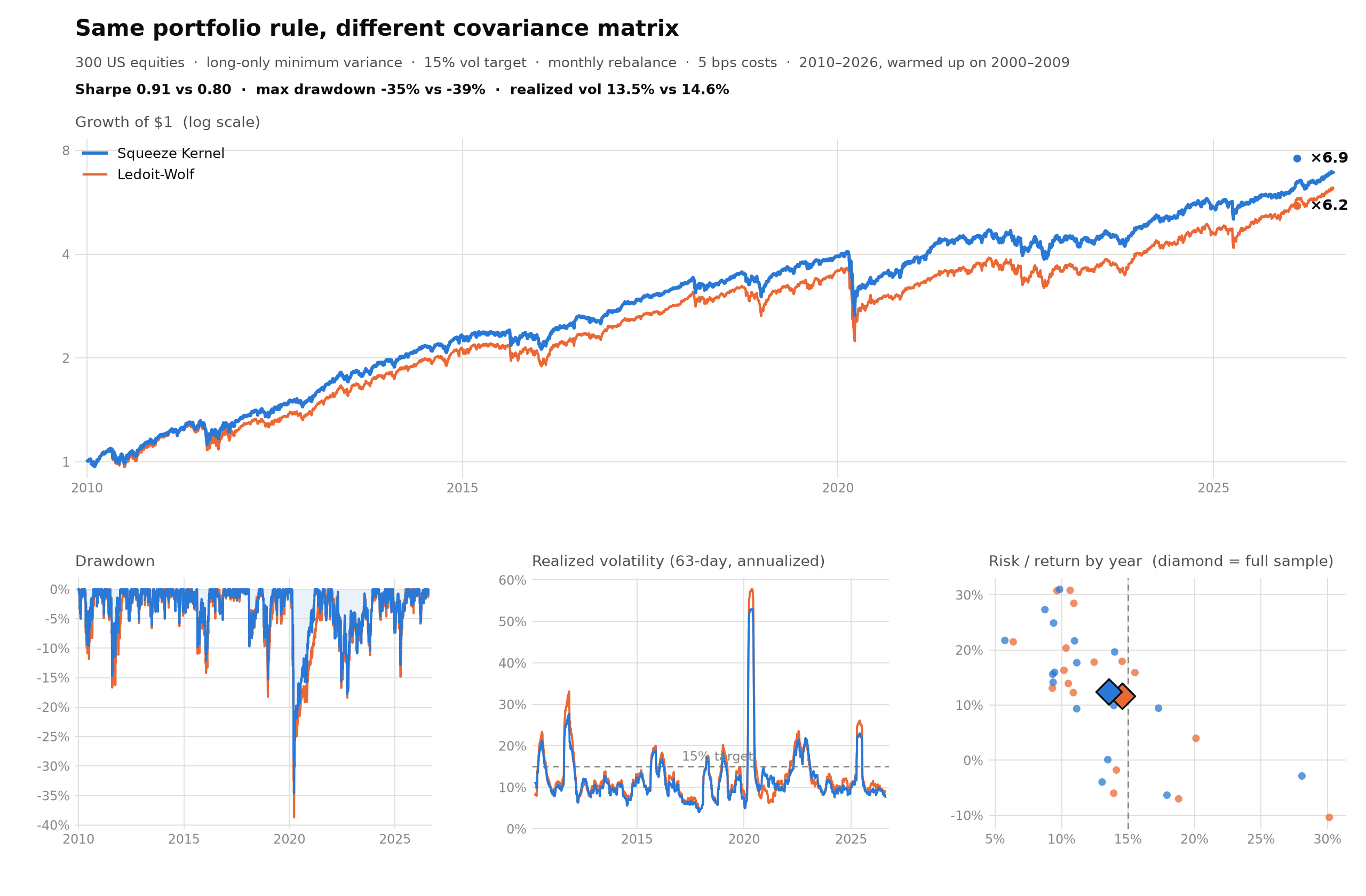
| Method | CAGR | Vol | Sharpe | MaxDD | Calmar | Vol-target RMSE |
|---|---|---|---|---|---|---|
| Squeeze Kernel (default) | 12.5% | 13.6% | 0.92 | -34.5% | 0.36 | 7.05% |
| Ledoit-Wolf (252d) | 11.7% | 14.6% | 0.80 | -38.7% | 0.30 | 7.51% |
Reproduce from the repo alone (the 300-stock panel ships as a parquet; survivorship and provenance are documented in the script):
pip install squeeze-kernel pandas pyarrow scikit-learn matplotlib
python examples/vol_targeted_portfolio.py    # ~2 minutes
Installation
pip install squeeze-kernel          # NumPy only
pip install "squeeze-kernel[full]"  # + SciPy (faster Cholesky factorisations for the mixture)
Quickstart
import numpy as np
from squeeze_kernel import SqueezeKernel, estimate_squeeze_cov

returns = np.random.default_rng(42).normal(0.0, 0.01, size=(500, 30))

sk = SqueezeKernel()                 # lam=0.996 (anchor half-life ~173 days)
for r_t in returns:
    w = sk.update(r_t)               # returns the day's kernel weight
cov, corr = sk.covariance(), sk.correlation()
sk.state()                           # kernel scale, per-timescale effective sizes, mixture tilt

# batch mode: full panel in, covariance path out
cov_path, corr_path, weights = estimate_squeeze_cov(returns, with_weights=True)
Missing values: pass NaN (or mask= on update). Newly listed, delisted or halted assets need no imputation and no complete-case subsetting.
Units: pass returns in decimal units (0.01 = 1%). The numerical floors are absolute (ε = 1e-8 in squared-return units), so percent-unit returns give a different path. A panel whose first day carries many exact-zero returns starts with a transient that the slow timescale remembers; start a day later.
What derives from lam
| quantity | value |
|---|---|
| timescale ladder | decays (lam⁴, lam, lam^¼) — half-lives (h/4, h, 4h), h = -1/log2(lam) |
| kernel scale | state: κ_t = ⅓ · EWMA(activity) at the anchor rate |
| shrinkage intensity | per timescale, α = min(1,c) · g̃²/(g̃² + (1−g̃)²·max(0, 1/c − 1)) from the online concentration c = n/ν and target-fit g̃ |
| timescale weights | prior ∝ √h, moved by exponentiated gradient on the blend log score at the null temperature, fast-rung memory |
| shrinkage split | per timescale, a learned pool of the raw correlation, its equicorrelation level and its Hadamard square; prior (1−α, α(1−α), α²), moved by the blend gradient |
| observation weight | state: ω_t = n_t/m_t, the day's observed count over its Mahalanobis distance under yesterday's forecast, from the mixture's own factorisation |
| volatility memory | ladder (h/16, h/4, h), pooled panel-wide by the same rule on tanh-saturated evidence, uniform prior |
| structural constants | K=3, b=4, θ=½, κ-scale ⅓, Schur power 2, intensity exponent 2 — each bracketed by ablation in the paper |
| fitted constants | lam itself (0.996, chosen on data to 2021); nothing else is fitted |
from squeeze_kernel import CONSTANTS exposes the structural constants for research. The published v1 estimator (all its knobs) remains available as SqueezeKernelEstimator / SqueezeKernel.v1(...); every mechanism since 2.0 is also an estimator-level switch for ablation. See MIGRATION.md.
How it works
One daily update: variance on a three-rung ladder per asset, pooled by panel-wide self-adapting weights → standardised surprise → per-asset clock increments from the Schur-square-weighted neighbourhood mean of squared surprises → diagonal-congruence update of each timescale's correlation state on those clocks, the day's outer product scaled by n/m → per-timescale shrinkage as a learned pool of the raw correlation, its equicorrelation level and its Hadamard square, with the self-tuning intensity rule as the prior and the blend gradient as the correction → blend across timescales, moved by the gradient of the blend's own log score → covariance. The paper gives the derivations (the natural-gradient and Gram-matrix forms of the flow, the Fisher–Rao form of the mixture), the guarantees (PSD, conditioning floor, exact reductions to the published special cases), and the full evaluation.
Development
uv sync --extra full --extra dev
uv run python -m pytest        # test suite
uv run python -m ruff check .  # lint
uv run mypy                      # strict type check (src/squeeze_kernel)
uv build                       # build sdist + wheel
Citation
@article{kende2026squeeze,
  title  = {The Squeeze Kernel Covariance Estimator: Dual-Timescale Tracking with Adaptive Shrinkage},
  author = {Kende, Robert},
  year   = {2026},
  note   = {Available at SSRN: \url{https://ssrn.com/abstract=6455918}}
}
See also CITATION.cff.
License
MIT
1 maintainer

Metadata
1 maintainer
Release files for squeeze-kernel 3.2.0
For a detailed explanation of source distributions (sdists) and built distributions (wheels), please see the package formats documentation.
Source distribution (sdist)
| File | Size | Uploaded | Provenance | Actions |
|---|---|---|---|---|
| squeeze_kernel-3.2.0.tar.gz | 25.0 kB | With provenance | Details for squeeze_kernel-3.2.0.tar.gz |
Built distribution (wheel)
| File | Interpreter | ABI | Platform | Actions Reset |
|---|---|---|---|---|
| squeeze_kernel-3.2.0-py3-none-any.whl | Python 3 | none | any | Details for squeeze_kernel-3.2.0-py3-none-any.whl |
Total release size: 52.5 kB
Release files / squeeze_kernel-3.2.0.tar.gz
| Download URL | squeeze_kernel-3.2.0.tar.gz |
|---|---|
| Size | 25.0 kB |
| Tags | Source |
|
SHA-256 checksum How to use checksums |
330d092f486c784ae1825629dfe5e5431a714fbe84529978ba6e5771e9d89259
|
|
BLAKE2b-256 checksum How to use checksums |
4f424eb4acfb0862c17d7088ab413a0a5948c39764252eb70eaa79506a66388a
|
| Upload date | |
|
Uploaded using Trusted Publishing? What is trusted publishing? |
Yes |
| Uploaded via |
twine/7.0.0 CPython/3.13.14
|
Provenance
Provenance describes where a file came from. On PyPI, provenance is shared via attestations, which provide a verifiable record of the build or publishing details. View details, limitations and caveats.


PyPI Publish Attestation
PyPI verified that this artifact, at this checksum, originated from the publisher listed below.
Signed by GitHub Actions, verified by PyPI on Sep 29, 2026.
Transparency logRelease files / squeeze_kernel-3.2.0-py3-none-any.whl
| Download URL | squeeze_kernel-3.2.0-py3-none-any.whl |
|---|---|
| Size | 27.5 kB |
| Tags | Python 3 |
|
SHA-256 checksum How to use checksums |
f1b8d7dc4f6b676bd320c616b41b5f4313e80eee9c0339baf6886a2bc7047e72
|
|
BLAKE2b-256 checksum How to use checksums |
d6aa9581ddeee6628230e793ea76c886eb24d8813a3ee5f9d980c6c8063a1ebb
|
| Upload date | |
|
Uploaded using Trusted Publishing? What is trusted publishing? |
Yes |
| Uploaded via |
twine/7.0.0 CPython/3.13.14
|
Provenance
Provenance describes where a file came from. On PyPI, provenance is shared via attestations, which provide a verifiable record of the build or publishing details. View details, limitations and caveats.
PyPI Publish Attestation
PyPI verified that this artifact, at this checksum, originated from the publisher listed below.
Signed by GitHub Actions, verified by PyPI on Sep 29, 2026.
Transparency logSecurity for squeeze-kernel 3.2.0
Provenance
Provenance describes where a file came from. On PyPI, provenance is shared via attestations, which provide a verifiable record of the build or publishing details. View details, limitations and caveats.
Full provenance
Both files in this release have been uploaded with provenance metadata.
Attestation for squeeze_kernel-3.2.0.tar.gz
PyPI Publish Attestation
PyPI verified that this artifact, at this checksum, originated from the publisher listed below.
Signed by GitHub Actions, verified by PyPI on Sep 29, 2026.
Transparency logA note on package security
PyPI is a repository for distributing packages, not a service for auditing them. While third-party security researchers and our staff do their best to detect and remove malicious packages, PyPI cannot guarantee the quality, security or suitability of any given package.
To learn more about protecting yourself from malicious actors, visit our package security documentation.














