








Squidpy - Spatial Single Cell Analysis in Python
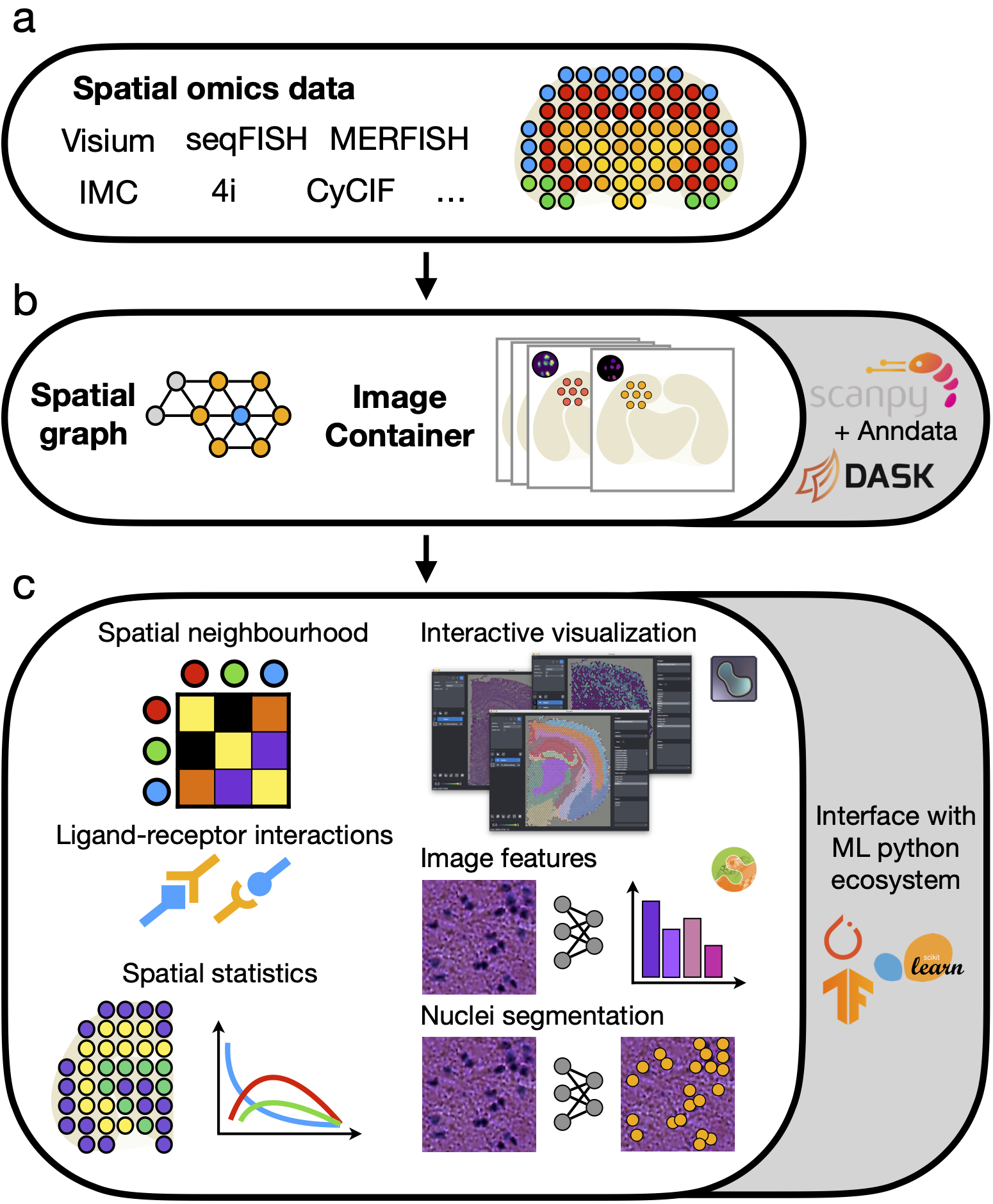
Squidpy is the scverse toolkit for scalable analysis and visualization of spatial molecular data. It builds on scanpy and anndata, providing streamlined APIs for feature extraction, spatial statistics, and interactive exploration of tissue sections together with microscopy images.
Documentation
Head over to the documentation for installation instructions, tutorials, how-to guides, and reference material.
Installation
We recommend running Squidpy on a recent Linux or macOS system with Python ≥3.12, but it also works on Windows via WSL.
Install from PyPI with:
pip install squidpy
or from conda-forge:
conda install -c conda-forge squidpy
Interactive visualization
For interactive visualization with napari, please use napari-spatialdata. The original napari plugin from Squidpy has been deprecated and replaced by napari-spatialdata, which offers improved functionality and support for the SpatialData ecosystem.
Key capabilities
- Build and analyze spatial neighbor graphs directly from Visium, Slide-seq, Xenium, and other spatial omics assays.
- Compute spatial statistics for cell types and genes, including neighborhood enrichment, co-occurrence, and Moran's I.
- Efficiently store, featurize, and visualize high-resolution tissue microscopy images via scikit-image.
- Explore annotated datasets interactively with napari-spatialdata.
Contributing
Contributions are welcome! Please read the contributing guide for instructions on setting up your environment, running tests, and submitting pull requests.
Citation
If you use Squidpy in your research, cite the original publication:
@article{palla:22,
    author = {Palla, Giovanni and Spitzer, Hannah and Klein, Michal and Fischer, David and Schaar, Anna Christina
              and Kuemmerle, Louis Benedikt and Rybakov, Sergei and Ibarra, Ignacio L. and Holmberg, Olle
              and Virshup, Isaac and Lotfollahi, Mohammad and Richter, Sabrina and Theis, Fabian J.},
    title = {Squidpy: a scalable framework for spatial omics analysis},
    journal = {Nature Methods},
    year = {2022},
    month = {Feb},
    volume = {19},
    number = {2},
    pages = {171--178},
    issn = {1548-7105},
    doi = {10.1038/s41592-021-01358-2},
}
Squidpy is part of the scverse® project (website, governance) and is fiscally sponsored by NumFOCUS. Please consider making a tax-deductible donation to help the project pay for developer time, professional services, travel, workshops, and a variety of other needs.

1 maintainer

Metadata
1 maintainer
Release files for squidpy 1.8.3
For a detailed explanation of source distributions (sdists) and built distributions (wheels), please see the package formats documentation.
Source distribution (sdist)
| File | Size | Uploaded | |
|---|---|---|---|
| squidpy-1.8.3.tar.gz | 6.1 MB | Details |
Built distribution (wheel)
| File | Interpreter | ABI | Platform | Reset |
|---|---|---|---|---|
| squidpy-1.8.3-py3-none-any.whl | Python 3 | none | any | Details |
Total release size: 6.4 MB
Release files / squidpy-1.8.3.tar.gz
| Download URL | squidpy-1.8.3.tar.gz |
|---|---|
| Size | 6.1 MB |
| Tags | Source |
|
SHA-256 checksum How to use checksums |
66d90f47193707a872de0e700645f57ddd5c5bcb60c5b64b5a58648043231ede
|
|
BLAKE2b-256 checksum How to use checksums |
a7d8e635e473e4a7605bfcb7ff5f0e5ee977beadde7c388d147e002cd7b86a85
|
| Upload date | |
|
Uploaded using Trusted Publishing? What is trusted publishing? |
Yes |
| Uploaded via |
twine/6.1.0 CPython/3.13.12
|
Provenance
Provenance describes where a file came from. On PyPI, provenance is shared via attestations, which provide a verifiable record of the build or publishing details. View details, limitations and caveats.


PyPI Publish Attestation
PyPI verified that this artifact, at this checksum, originated from the publisher listed below.
Signed by GitHub Actions, verified by PyPI on Jun 29, 2026.
Transparency logRelease files / squidpy-1.8.3-py3-none-any.whl
| Download URL | squidpy-1.8.3-py3-none-any.whl |
|---|---|
| Size | 280.5 kB |
| Tags | Python 3 |
|
SHA-256 checksum How to use checksums |
05fd5da00db697e6d0dbb91ff543ff5b27d0046666ce5a7348548076b3310efc
|
|
BLAKE2b-256 checksum How to use checksums |
2b5c3c5e524ee2aa8acdd05b298dd285ef7abbbdb3333b15e29738d34e0372bc
|
| Upload date | |
|
Uploaded using Trusted Publishing? What is trusted publishing? |
Yes |
| Uploaded via |
twine/6.1.0 CPython/3.13.12
|
Provenance
Provenance describes where a file came from. On PyPI, provenance is shared via attestations, which provide a verifiable record of the build or publishing details. View details, limitations and caveats.
PyPI Publish Attestation
PyPI verified that this artifact, at this checksum, originated from the publisher listed below.
Signed by GitHub Actions, verified by PyPI on Jun 29, 2026.
Transparency log













