
Streamlit SeqViz
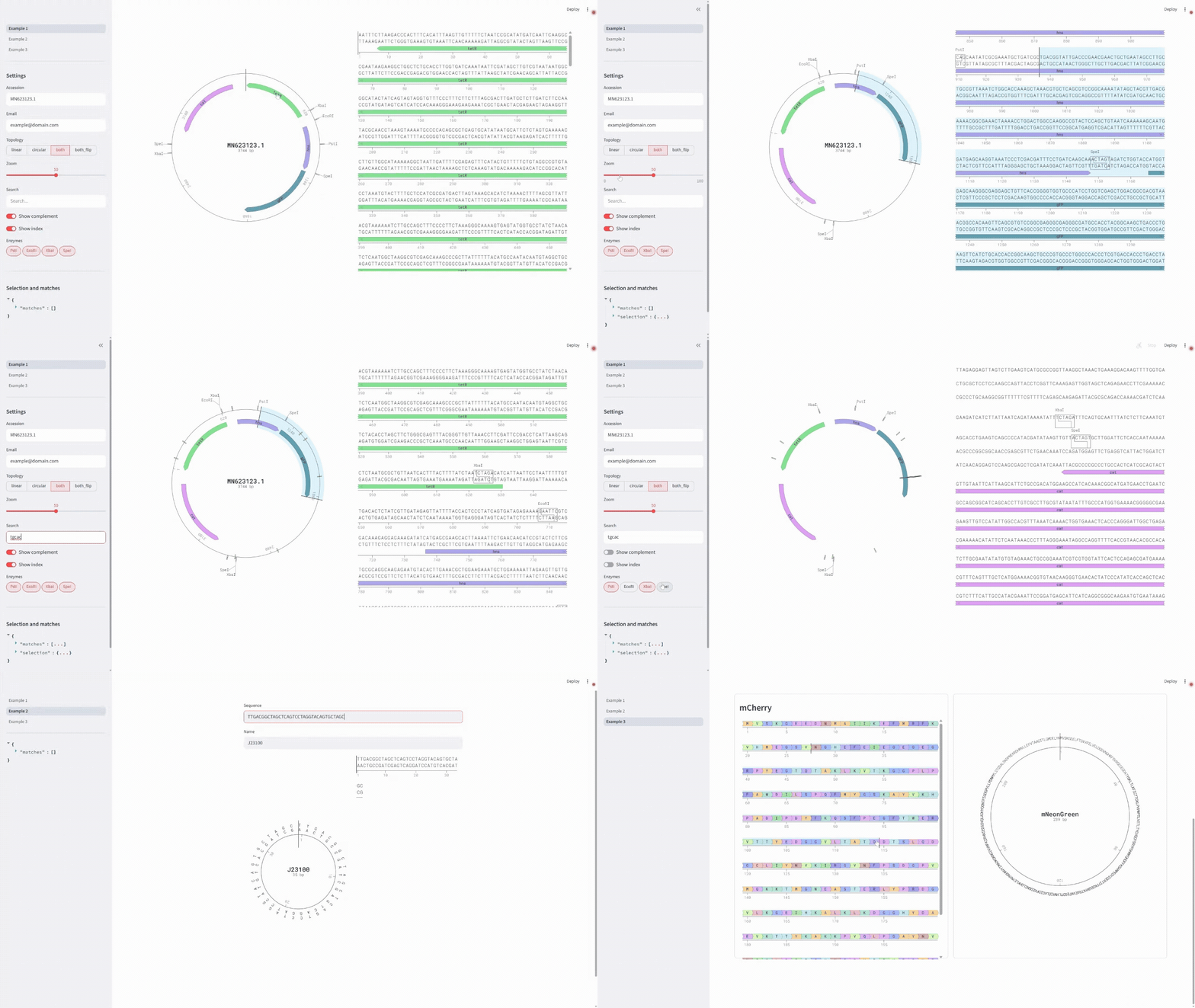
Streamlit SeqViz 🧬 brings the powerful SeqViz DNA/RNA/protein viewer to Streamlit. It allows you to visualize and explore biological sequences interactively inside your Streamlit apps with support for annotations, primers, restriction sites, translations, and more.
Demo

Installation
pip install st-seqviz
Usage
import streamlit as st

from st_seqviz import SeqViz

sv = SeqViz(
    seq="TTGACGGCTAGCTCAGTCCTAGGTACAGTGCTAGC",
    name="J23100",
    annotations=[
        {"name": "promoter", "start": 0, "end": 34, "direction": 1, "color": "blue"}
    ],
)

st.json(sv)
➡️ See the /demo folder for more complex examples (annotations, enzymes, translations, highlights, etc.).
API Reference
Parameters
| Name | Type | Default | Description |
|---|---|---|---|
seq |
str |
— | DNA, RNA, or amino acid sequence to render. |
viewer |
"linear", "circular", "both", "both_flip" |
"both" |
Viewer layout and orientation. |
name |
str |
"" |
Name of the sequence or plasmid. |
annotations |
list[dict] |
[] |
Sequence annotations (start, end, name, direction). |
primers |
list[dict] |
[] |
Primer regions (same structure as annotations). |
translations |
list[dict] |
[] |
Sequence ranges to translate and display as amino acids. |
enzymes |
list[str | dict] |
[] |
Restriction enzymes or custom recognition sites. |
highlights |
list[dict] |
[] |
Sequence ranges to visually highlight. |
zoom_linear |
int |
50 |
Linear viewer zoom level (0–100). |
colors |
list |
[] |
Custom color palette. |
bp_colors |
dict |
{} |
Map of base pairs (A/T/G/C or index) to colors. |
style |
dict |
{"height": "70vh", "width": "100%"} |
Custom CSS sizing and layout. |
search |
dict |
{} |
Predefined search query. |
show_complement |
bool |
True |
Display complement strand. |
rotate_on_scroll |
bool |
True |
Enable circular rotation on scroll. |
disable_external_fonts |
bool |
False |
Disable loading of external fonts. |
show_index |
bool |
True |
Show sequence index ticks. |
key |
str or None |
None |
Unique Streamlit key. |
Returns
A dict containing:
selection: the current selected sequence region (if any)search: the current search matches and metadata
1 maintainer

Metadata
1 maintainer
Release files for st-seqviz 0.1.7
For a detailed explanation of source distributions (sdists) and built distributions (wheels), please see the package formats documentation.
Source distribution (sdist)
| File | Size | Uploaded | Provenance | |
|---|---|---|---|---|
| st_seqviz-0.1.7.tar.gz | 161.4 kB | Without provenance | Details |
Built distribution (wheel)
| File | Interpreter | ABI | Platform | Reset |
|---|---|---|---|---|
| st_seqviz-0.1.7-py3-none-any.whl | Python 3 | none | any | Details |
Total release size: 323.3 kB
Release files / st_seqviz-0.1.7.tar.gz
| Download URL | st_seqviz-0.1.7.tar.gz |
|---|---|
| Size | 161.4 kB |
| Tags | Source |
|
SHA-256 checksum How to use checksums |
2c0683bd8145aa1b8ec48e2974bf44180674017eb5db91a1258e1addaa50e5b8
|
|
BLAKE2b-256 checksum How to use checksums |
ab7765aa6321d1ad6e9317ebf57ae0e839c2ee2f2743d3053f96e3db0bfd5a77
|
| Upload date | |
|
Uploaded using Trusted Publishing? What is trusted publishing? |
No |
| Uploaded via |
twine/6.2.0 CPython/3.14.4
|
Release files / st_seqviz-0.1.7-py3-none-any.whl
| Download URL | st_seqviz-0.1.7-py3-none-any.whl |
|---|---|
| Size | 161.9 kB |
| Tags | Python 3 |
|
SHA-256 checksum How to use checksums |
1c3da40dd05c6ea524abb4a3c7ed3d7605e19d0ff4af86b9eb0904208cea580a
|
|
BLAKE2b-256 checksum How to use checksums |
3b27cea3aa0af5128a96523fe8ad623292f48217125fe0a6ab9c1ed19e56117d
|
| Upload date | |
|
Uploaded using Trusted Publishing? What is trusted publishing? |
No |
| Uploaded via |
twine/6.2.0 CPython/3.14.4
|
Security for st-seqviz 0.1.7
Provenance
Provenance describes where a file came from. On PyPI, provenance is shared via attestations, which provide a verifiable record of the build or publishing details. View details, limitations and caveats.
No provenance found
None of the files in this release were uploaded with provenance metadata.
A note on package security
PyPI is a repository for distributing packages, not a service for auditing them. While third-party security researchers and our staff do their best to detect and remove malicious packages, PyPI cannot guarantee the quality, security or suitability of any given package.
To learn more about protecting yourself from malicious actors, visit our package security documentation.














