
surgite
Standup summaries from your git history — in the browser, in the terminal, or as a shareable link.




The web app gives your team a shared dashboard: per-user repos, per-user prompt settings, AI-written summaries, and shareable links to specific summary views. The CLI does the same for a local repo, no server needed. First-party auth, no third-party tracking.
Lean principles: ~17 Python source files, one binary, no SPA framework, no slowapi, no Celery, no Redis. Reads like a script.
Quickstart
Two paths. Pick one.
The web app — three commands, full team dashboard:
git clone https://github.com/nicoleman0/surgite.git
cd surgite
cp .env.example .env       # set BOOTSTRAP_OWNER_EMAIL=you@example.com
docker compose up -d
That builds the image from the checkout. To pull the published one instead of
building, uncomment APP_IMAGE=ghcr.io/nicoleman0/surgite:latest in .env.
On first start the app mints an admin invite and logs the token; redeem it
with uv run surgite --redeem-invite <token> --email you@example.com and
you're in. Full guide: docs/self-host.md.
One-off summary from a local repo — no database, no server:
pip install surgite         # or: uv tool install surgite
surgite /path/to/your/repo --since 7.days.ago
The PyPI wheel ships the surgite package — the CLI and the API code. The
web frontend and the alembic migrations are not in the wheel; the full
self-hosted stack installs from the repo or the Docker image (see
docs/self-host.md).
Add --summarize to get AI-written prose (set ANTHROPIC_API_KEY first).
Demo
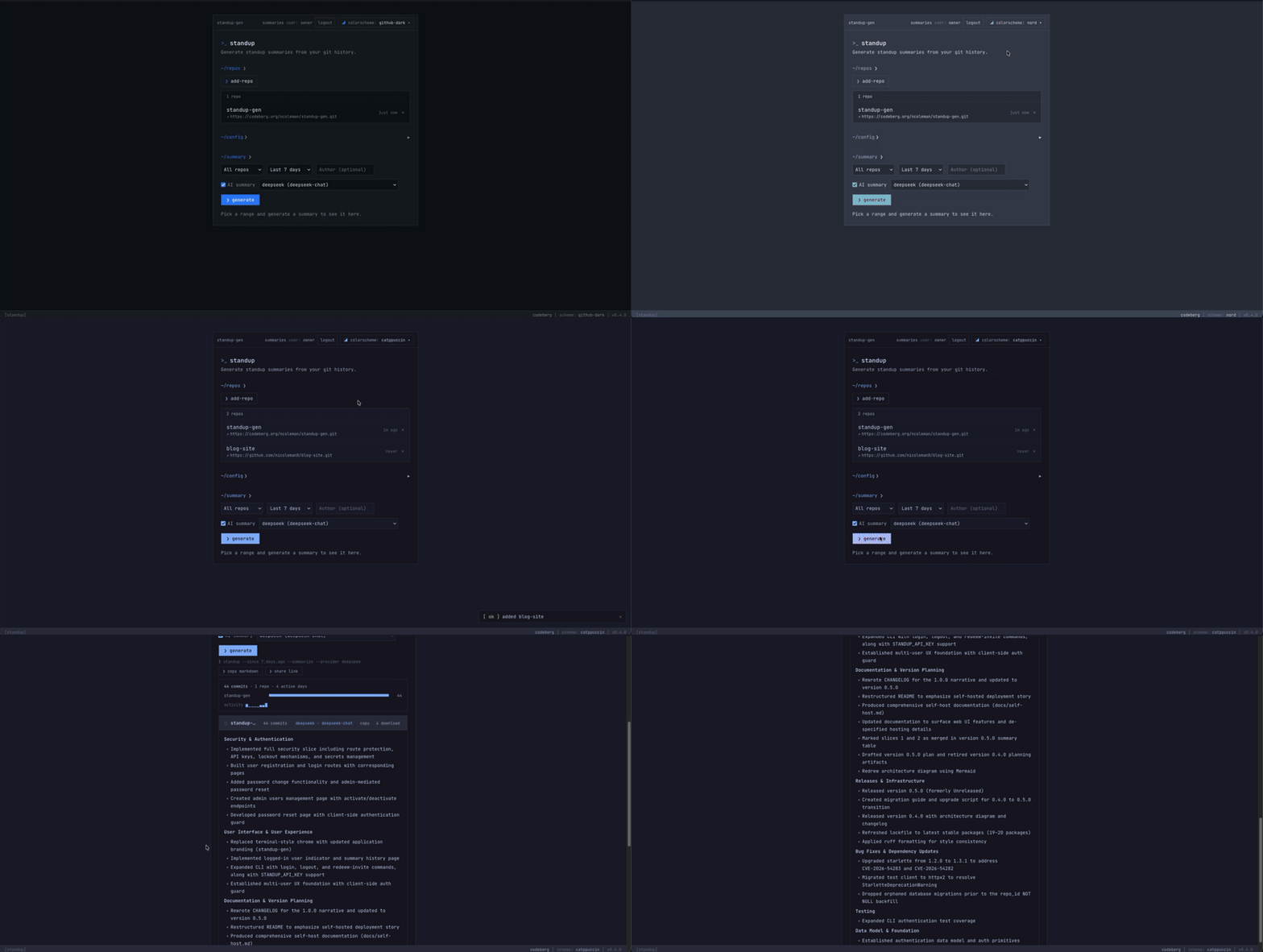
The dashboard, with terminal-aesthetic chrome, a sample repo's commit log,
and a streamed AI summary panel. See docs/self-host.md
for the deployment walkthrough.
What you get
- Web dashboard — per-user repos, prompt settings, summary history, share
links, admin user management (
/admin/users). Email + password login with__Host-session cookies. - CLI —
surgite /path/to/repofor a local one-off,surgite --registered <name>to pull from a running API,surgite --loginto authenticate,surgite --summarizefor AI-written prose. - Per-user provider keys — each user brings their own Anthropic / Groq / DeepSeek key. Fernet-encrypted at rest, never returned by the API.
- Self-hosted models — point
LOCAL_BASE_URLat any server speaking the OpenAI chat API (vLLM, Ollama, LM Studio, LiteLLM) to keep summaries on your own network.LLM_LOCAL_ONLY=1drops the hosted providers entirely. - Shareable summary links —
POST /summariesmints a/s/{slug}URL that re-runs a saved query in a read-only view. Owner-scoped in multi-user mode.
Why?
- Multi-user — email + password login, per-user repos and summaries, per-user provider keys. (The 0.5.0 headline.)
- Self-hostable — your data, your auth, your machine. No SaaS account, no vendor lock-in. Runs on a homelab box, a small VM, a Raspberry Pi, or a Kubernetes cluster — same code path.
- No telemetry — first-party auth, no analytics, no phone-home.
- Lean — FastAPI + Postgres + SvelteKit, the whole thing reads top-to-bottom.
Documentation
docs/self-host.md— end-to-end self-hosting guide (sizing, quickstart, TLS, backup, runbook).docs/security.md— the threat model and the security controls.docs/api-stability.md— the API stability policy: what we promise not to break, and how deprecation works.docs/security-support.md— supported versions, the vulnerability-response SLA, and the advisory process.docs/openapi.json— the snapshot-tested OpenAPI document; the machine-readable API contract.docs/migrations/0.4.0-to-0.5.0.md— upgrading a 0.4.0 install..env.example— every configuration variable, with defaults.CHANGELOG.md— release history.
Development
uv sync --group dev                 # install deps (incl. dev tools)
docker compose up -d db             # Postgres for local dev
uv run alembic upgrade head         # run migrations
uv run uvicorn surgite.api:app --reload
cd frontend && npm install && npm run dev
uv run pytest                       # tests
uv run ruff check . && uv run ruff format --check .   # lint + format
See AGENTS.md for the canonical dev quickstart and the
architecture overview.
Contributing
Contributions are welcome. The project is deliberately minimalist — see the
principles in AGENTS.md. Start with
CONTRIBUTING.md for dev setup and the PR workflow; please
also read CODE_OF_CONDUCT.md. For anything
security-sensitive, see SECURITY.md.
The canonical repository is on GitHub: https://github.com/nicoleman0/surgite.
License
MIT © 2026 Nick Coleman
1 maintainer

Metadata
1 maintainer
Release files for surgite 1.5.0
For a detailed explanation of source distributions (sdists) and built distributions (wheels), please see the package formats documentation.
Source distribution (sdist)
| File | Size | Uploaded | |
|---|---|---|---|
| surgite-1.5.0.tar.gz | 58.5 kB | Details |
Built distribution (wheel)
| File | Interpreter | ABI | Platform | Reset |
|---|---|---|---|---|
| surgite-1.5.0-py3-none-any.whl | Python 3 | none | any | Details |
Total release size: 124.6 kB
Release files / surgite-1.5.0.tar.gz
| Download URL | surgite-1.5.0.tar.gz |
|---|---|
| Size | 58.5 kB |
| Tags | Source |
|
SHA-256 checksum How to use checksums |
8f7f397cf9062790ebd05c080651c92471e734e1287a8695c02af96da0e93443
|
|
BLAKE2b-256 checksum How to use checksums |
05802cdff59558262a2cfe79171335e43f31884052cca4c22c07f87901c7af85
|
| Upload date | |
|
Uploaded using Trusted Publishing? What is trusted publishing? |
Yes |
| Uploaded via |
twine/7.0.0 CPython/3.13.14
|
Provenance
Provenance describes where a file came from. On PyPI, provenance is shared via attestations, which provide a verifiable record of the build or publishing details. View details, limitations and caveats.


PyPI Publish Attestation
PyPI verified that this artifact, at this checksum, originated from the publisher listed below.
Signed by GitHub Actions, verified by PyPI on Sep 8, 2026.
Transparency logRelease files / surgite-1.5.0-py3-none-any.whl
| Download URL | surgite-1.5.0-py3-none-any.whl |
|---|---|
| Size | 66.1 kB |
| Tags | Python 3 |
|
SHA-256 checksum How to use checksums |
8043f6d3baf537c5bce166653837fc69f38b4e916fe461f21a5ba1906fa52f99
|
|
BLAKE2b-256 checksum How to use checksums |
bb81ed7b50e52c7b9b6251ad96e6bb36d66283244b5754fd7a1edd6663fba42a
|
| Upload date | |
|
Uploaded using Trusted Publishing? What is trusted publishing? |
Yes |
| Uploaded via |
twine/7.0.0 CPython/3.13.14
|
Provenance
Provenance describes where a file came from. On PyPI, provenance is shared via attestations, which provide a verifiable record of the build or publishing details. View details, limitations and caveats.
PyPI Publish Attestation
PyPI verified that this artifact, at this checksum, originated from the publisher listed below.
Signed by GitHub Actions, verified by PyPI on Sep 8, 2026.
Transparency log













