
tex-mcp-web




Comment on your paper's PDF, and the coding agent that did the research fixes the LaTeX.
tex-mcp-web adds a review page for LaTeX papers to Claude Code and Codex. You open the page in a browser and comment on the PDF, and the agent edits the source. It runs on Windows, macOS and Linux.
Select words in the PDF, or draw a box over a figure or a table, and write what should change. Call agent sends all your comments at once. The agent edits the source, builds the PDF again and answers each comment. For a change of wording it shows the old and the new text, and you apply or reject it.
The agent is the session you already work in. It wrote the code and ran the experiments, so it answers from that work, and nothing is copied into another tool.
Quick start
-
Paste this into Claude Code or Codex, and restart the agent when it is done:
Install tex-mcp-web by following https://raw.githubusercontent.com/MiiKiyoshi/tex-mcp-web/main/INSTALL.mdThe agent says what it will install and installs once you agree.
-
Say
do tex initin the session where you work. The agent finds the paper in the folder and saves the settings once you agree. If the paper is on Overleaf, give the agent the project's link, and the page brings the files in. -
Open the address the agent gives, comment on the PDF, and press Call agent.
You need Python 3.10 or newer and a LaTeX installation with latexmk. The agent checks both
and asks before it installs anything.
The page is served from your own machine and answers only to it. Your comments are kept in the paper's folder. The page contacts three places: Overleaf when you connect it, the translation program when you set one, and the package index once a day for a newer release.
Work with co-authors on Overleaf
do tex init asks for the project's link, and Connect Overleaf on the page takes the same
link. The page asks once for your Overleaf sign-in cookie. Your co-authors' comments then
appear on the page. Under each comment you talk with the agent in
private, and the agent drafts the reply. Only the reply you send appears on Overleaf.
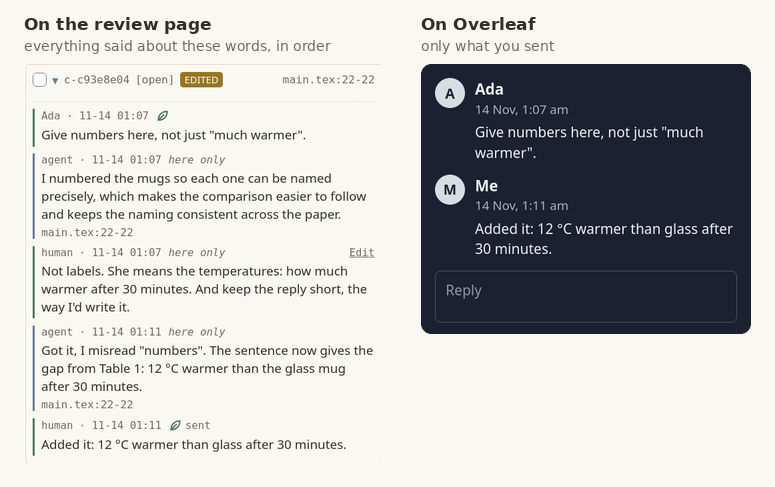
The agent also turns a rough note into a new comment for your co-authors. Edits they suggest on Overleaf are accepted or rejected here. A search finds one comment by its writer, its file and its date. Working with Overleaf shows each of these, and how the files stay in sync with Overleaf.
Read the paper in your language
The page shows each paragraph in your language under the PDF. A click on a translated paragraph opens its lines in the source, and the paragraph you edit stays highlighted. You choose the program that translates, so you choose the model and the cost. Translation describes the setup.
More
- Page limit. The agent sees where the text ends and how many lines are left, so it can shorten the paper to fit and check the result. Problems describes the list.
- Writing rules. The agent reads your rules from a file before it edits, in every paper
that names the file. Configuration describes
guidelineandreferences. - Keyboard. Every step works without the mouse, and the editor has Vim keys. Comment keys lists them.
- Tablet and phone. The page works by touch. Opening the page from another device also covers an agent that runs on a server.
- Settings.
do tex initsaves them in.tex-mcp-web.yaml. Configuration describes every field.
⭐ If this helps your writing, please give it a star. It helps others find the project.
See also
html-mcp-web reviews an AI agent's HTML slides or reports the same way, and exports finished slides as an editable PowerPoint deck.
Acknowledgements
tex-mcp-web is a hard fork of queelius/scholia at commit e6c7454 (version 0.6.1) and has been developed independently since then under the MIT license; see LICENSE. The PDF viewer is EmbedPDF with its PDFium WebAssembly engine, whose notices are in tex_mcp_web/static/embedpdf/LICENSE and tex_mcp_web/static/embedpdf/LICENSE.pdfium. The bundled viewer differs from the release only in its zoom gesture, which is described in Reviewing in detail. Syntax highlighting and completion in the source editor use Ace Editor builds 1.44.0 under the BSD-3-Clause license, and its notice is in tex_mcp_web/static/ace/LICENSE.
1 maintainer

Metadata
1 maintainer
Release files for tex-mcp-web 0.12.0
For a detailed explanation of source distributions (sdists) and built distributions (wheels), please see the package formats documentation.
Source distribution (sdist)
| File | Size | Uploaded | Provenance | Actions |
|---|---|---|---|---|
| tex_mcp_web-0.12.0.tar.gz | 3.3 MB | With provenance | Details for tex_mcp_web-0.12.0.tar.gz |
Built distribution (wheel)
| File | Interpreter | ABI | Platform | Actions Reset |
|---|---|---|---|---|
| tex_mcp_web-0.12.0-py3-none-any.whl | Python 3 | none | any | Details for tex_mcp_web-0.12.0-py3-none-any.whl |
Total release size: 6.3 MB
Release files / tex_mcp_web-0.12.0.tar.gz
| Download URL | tex_mcp_web-0.12.0.tar.gz |
|---|---|
| Size | 3.3 MB |
| Tags | Source |
|
SHA-256 checksum How to use checksums |
64ae90bad7b174faa28a31d68c82f782229350a228652716553044a1e8fc00b2
|
|
BLAKE2b-256 checksum How to use checksums |
64f73f42bc974d90920fc6e09717251e89bfdd4f8ee93b5358eac9ada3de3ec1
|
| Upload date | |
|
Uploaded using Trusted Publishing? What is trusted publishing? |
Yes |
| Uploaded via |
twine/7.0.0 CPython/3.13.16
|
Provenance
Provenance describes where a file came from. On PyPI, provenance is shared via attestations, which provide a verifiable record of the build or publishing details. View details, limitations and caveats.


PyPI Publish Attestation
PyPI verified that this artifact, at this checksum, originated from the publisher listed below.
Signed by GitHub Actions, verified by PyPI on Nov 21, 2026.
Transparency logRelease files / tex_mcp_web-0.12.0-py3-none-any.whl
| Download URL | tex_mcp_web-0.12.0-py3-none-any.whl |
|---|---|
| Size | 3.0 MB |
| Tags | Python 3 |
|
SHA-256 checksum How to use checksums |
8efc6984869db37968d112ecc989ca841dad3d0fd3c843bb84bc633644e3a3ec
|
|
BLAKE2b-256 checksum How to use checksums |
beef8a8d1f654d9d71d70d5ef187ef3836d1183b7254f7511287815cec14dedb
|
| Upload date | |
|
Uploaded using Trusted Publishing? What is trusted publishing? |
Yes |
| Uploaded via |
twine/7.0.0 CPython/3.13.16
|
Provenance
Provenance describes where a file came from. On PyPI, provenance is shared via attestations, which provide a verifiable record of the build or publishing details. View details, limitations and caveats.
PyPI Publish Attestation
PyPI verified that this artifact, at this checksum, originated from the publisher listed below.
Signed by GitHub Actions, verified by PyPI on Nov 21, 2026.
Transparency logSecurity for tex-mcp-web 0.12.0
Provenance
Provenance describes where a file came from. On PyPI, provenance is shared via attestations, which provide a verifiable record of the build or publishing details. View details, limitations and caveats.
Full provenance
Both files in this release have been uploaded with provenance metadata.
Attestation for tex_mcp_web-0.12.0.tar.gz
PyPI Publish Attestation
PyPI verified that this artifact, at this checksum, originated from the publisher listed below.
Signed by GitHub Actions, verified by PyPI on Nov 21, 2026.
Transparency logA note on package security
PyPI is a repository for distributing packages, not a service for auditing them. While third-party security researchers and our staff do their best to detect and remove malicious packages, PyPI cannot guarantee the quality, security or suitability of any given package.
To learn more about protecting yourself from malicious actors, visit our package security documentation.














