
A lightweight framework for running functions concurrently across multiple threads while maintaining a defined execution order.

Project description


threaded-order
A lightweight Python framework for running functions concurrently across multiple threads while maintaining defined execution order. It lets you declare dependencies between tasks—so some run only after others complete—without complex orchestration code.
Ideal for dependency-aware test execution, build pipelines, and automation workflows that benefit from controlled concurrency.
Key Features
- Concurrent task execution using Python threads
- Dependency graph automatically determines order
- Simple registration and decorator API
- Shared thread-safe state: tasks can opt in to receive a shared state dict and read/write values across dependent tasks
- Automatic result capture: each task’s return value is stored under
state['results'][task_name] - Thread-safe logging, callbacks, and run summary
- Graceful shutdown on interrupt
threaded-orderCLI for loading modules, seeding state, and running functions using threaded-order’s dependency-aware scheduler- Shared state support with a built-in lock for safe cross-thread mutation.
Installation
pip install threaded-order
API Overview
class Scheduler(
    workers=None, # maximum number of worker threads that can run tasks concurrently.
    state=None, # optional shared dictionary passed to tasks marked with with_state=True
    store_results=True, # automatically save task return values into state["results"]
    clear_results_on_start=True, # wipe state["results"] at the start of each run
    setup_logging=False, # enable built-in logging configuration for scheduler and worker threads.
    add_stream_handler=True, # attach a stream handler to the logger when logging is enabled.
    verbose=False # enable extra scheduler and task-level debug logging
)
Runs registered callables across multiple threads while respecting declared dependencies.
Core Methods
| Method | Description |
|---|---|
register(obj, name, after=None, with_state=False) |
Register a callable for execution. after defines dependencies by name, specify if function is to receive the shared state. |
dregister(after=None, with_state=False) |
Decorator variant of register() for inline task definitions. |
start() |
Start execution, respecting dependencies. Returns a summary dictionary. |
dmark(after=None, with_state=False) |
Decorator that marks a function for deferred registration by the scheduler, allowing you to declare dependencies (after) and whether the function should receive the shared state (with_state). |
Callbacks
All are optional and run on the scheduler thread (never worker threads).
| Callback | When Fired | Signature |
|---|---|---|
on_task_start(fn) |
Before a task starts | (name) |
on_task_run(fn) |
When tasks starts running on a thread | (name, thread) |
on_task_done(fn) |
After a task finishes | (name, ok) |
on_scheduler_start(fn) |
Before scheduler starts running tasks | (meta) |
on_scheduler_done(fn) |
After all tasks complete | (summary) |
Shared state _state_lock
The scheduler exposes a shared re-entrant lock in state['_state_lock']. Use this lock only when multiple tasks might write to the same key or mutate the same shared object. For more information refer to Shared State Guidelines
Interrupt Handling
Press Ctrl-C during execution to gracefully cancel outstanding work:
- Running tasks finish naturally or are marked as cancelled
- Remaining queued tasks are discarded
- Final summary reflects all results
CLI Overview
threaded-order provides a command-line runner. It loads a Python module, seeds initial state, discovers runnable functions, and executes them using threaded-order’s dependency-aware scheduler.
usage: threaded-order [-h] [--workers WORKERS] [--log] [--verbose] target

A threaded-order CLI for dependency-aware, parallel function execution.

positional arguments:
  target             Python file containing @dmark tasks, optionally with a test selector

options:
  -h, --help         show this help message and exit
  --workers WORKERS  Number of worker threads (default: Scheduler default)
  --log              enable logging output
  --verbose          enable verbose logging output
Run all functions in a module:
threaded-order path/to/module.py
This loads the module, calls optional setup_state function, discovers decorated functions, builds the dependency graph, and runs everything with threaded concurrency.
Run a single function:
threaded-order module.py::test_name
If the selected function normally depends on other tasks, threaded-order ignores those dependencies and runs it standalone. Seed any expected state through the module’s setup_state function.
Pass arbitrary key/value pairs to setup_state
Any argument of the form --key=value is added to the initial_state dictionary and passed to setup_state:
threaded-order module.py --env=dev --region=us-west
This allows your module to compute initial state based on CLI parameters.
Seed mocked results for single-test runs
For functions that depend on upstream results, you can bypass the dependency chain and supply mock values:
threaded-order module.py::test_b --result-test_a=mock_value
Examples
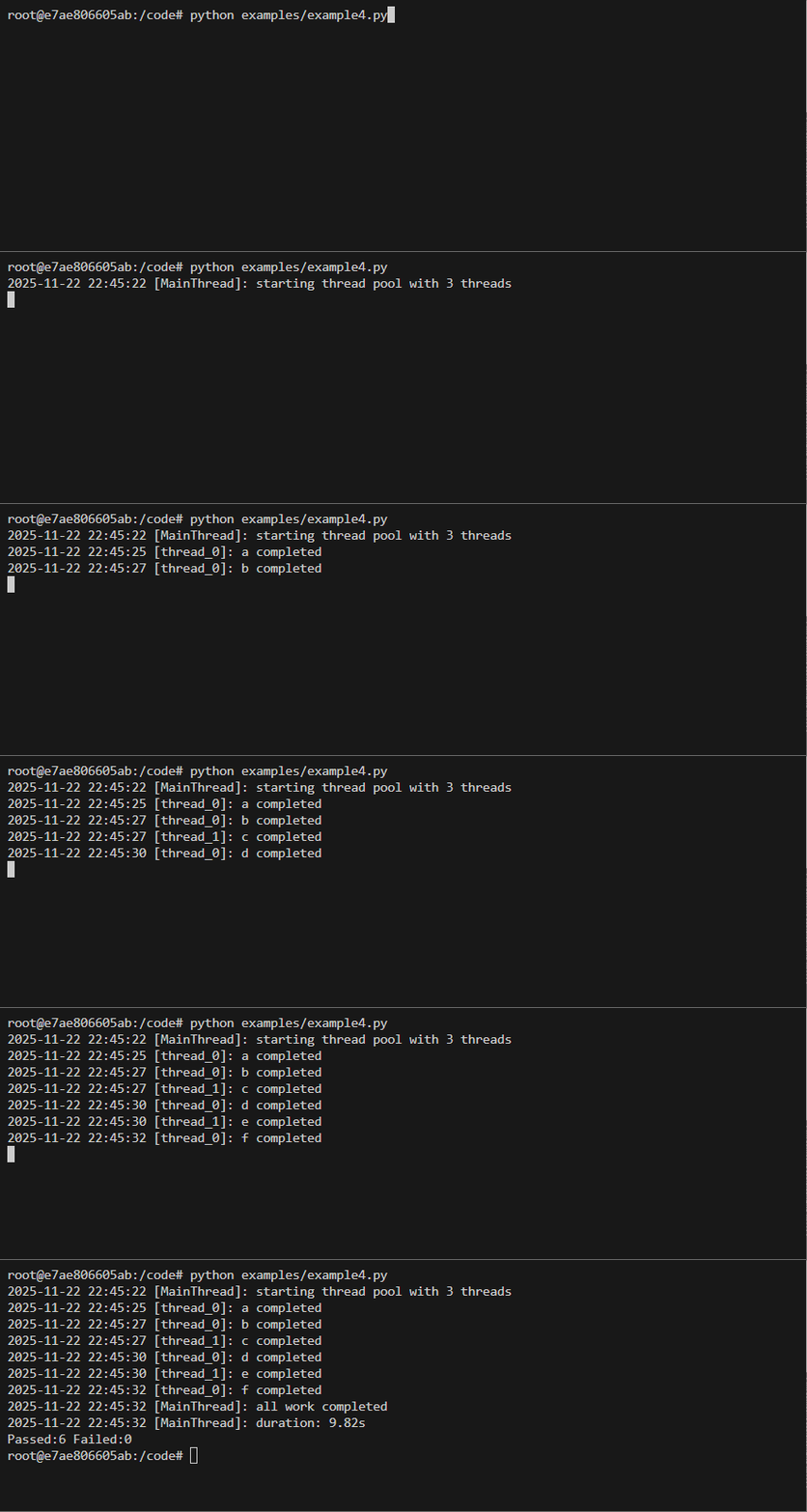
See examples in examples folder. To run examples, follow instructions below to build and run the Docker container then execute:
Simple Example
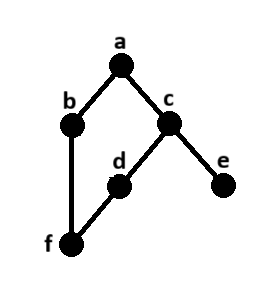
Code
from threaded_order import Scheduler, ThreadProxyLogger
import time
import random

s = Scheduler(workers=3, setup_logging=True)
logger = ThreadProxyLogger()

def run(name):
    time.sleep(random.uniform(.5, 3.5))
    logger.info(f'{name} completed')

@s.dregister()
def a(): run('a')

@s.dregister(after=['a'])
def b(): run('b')

@s.dregister(after=['a'])
def c(): run('c')

@s.dregister(after=['c'])
def d(): run('d')

@s.dregister(after=['c'])
def e(): run('e')

@s.dregister(after=['b', 'd'])
def f(): run('f')

if __name__ == '__main__':
    s.on_scheduler_done(lambda s: print(f"Passed:{len(s['passed'])} Failed:{len(s['failed'])}"))
    s.start()
Shared State Example
Code
import json
from time import sleep
from threaded_order import Scheduler

s = Scheduler(workers=3, state={})

@s.dregister(with_state=True)
def load(state):
    with state['_state_lock']:
        state['counter'] = state.get('counter', 0) + 1
    state["x"] = 10; return "loaded"

@s.dregister(with_state=True)
def behave(state):
    with state['_state_lock']:
        state['counter'] = state.get('counter', 0) + 1
    sleep(3); return "behaved"

@s.dregister(after=["load"], with_state=True)
def compute(state):
    with state['_state_lock']:
        state['counter'] = state.get('counter', 0) + 1
    state["x"] += 5; return state["x"]

s.start()
print(json.dumps(s.state, indent=2, default=str))
{
  "_state_lock": "<unlocked _thread.RLock object owner=0 count=0 at 0x7ac9632852c0>",
  "results": {
    "load": "loaded",
    "compute": 15,
    "behave": "behaved"
  },
  "counter": 3,
  "x": 15
}
ProgressBar Integration Example
Can be done by using the on_task_done callback. See example5

threaded-order Example
Code
import time
import random
from faker import Faker
from threaded_order import dmark, ThreadProxyLogger

logger = ThreadProxyLogger()

def setup_state(state):
    state.update({
        'faker': Faker()
    })

def run(name, state, deps=None, fail=False):
    with state['_state_lock']:
        last_name = state['faker'].last_name()
    sleep = random.uniform(.5, 3.5)
    logger.debug(f'{name} \"{last_name}\" running - sleeping {sleep:.2f}s')
    time.sleep(sleep)
    if fail:
        assert False, 'Intentional Failure'
    else:
        results = []
        for dep in (deps or []):
            dep_result = state['results'].get(dep, '--no-result--')
            results.append(f'{name}.{dep_result}')
        if not results:
            results.append(name)
        logger.info(f'{name} passed')
        return '|'.join(results)

@dmark(with_state=True)
def test_a(state): return run('test_a', state)

@dmark(with_state=True, after=['test_a'])
def test_b(state): return run('test_b', state, deps=['test_a'])

@dmark(with_state=True, after=['test_a'])
def test_c(state): return run('test_c', state, deps=['test_a'])

@dmark(with_state=True, after=['test_c'])
def test_d(state): return run('test_d', state, deps=['test_c'], fail=True)

@dmark(with_state=True, after=['test_c'])
def test_e(state): return run('test_e', state, deps=['test_c'])

@dmark(with_state=True, after=['test_b', 'test_d'])
def test_f(state): return run('test_f', state, deps=['test_b', 'test_d'])
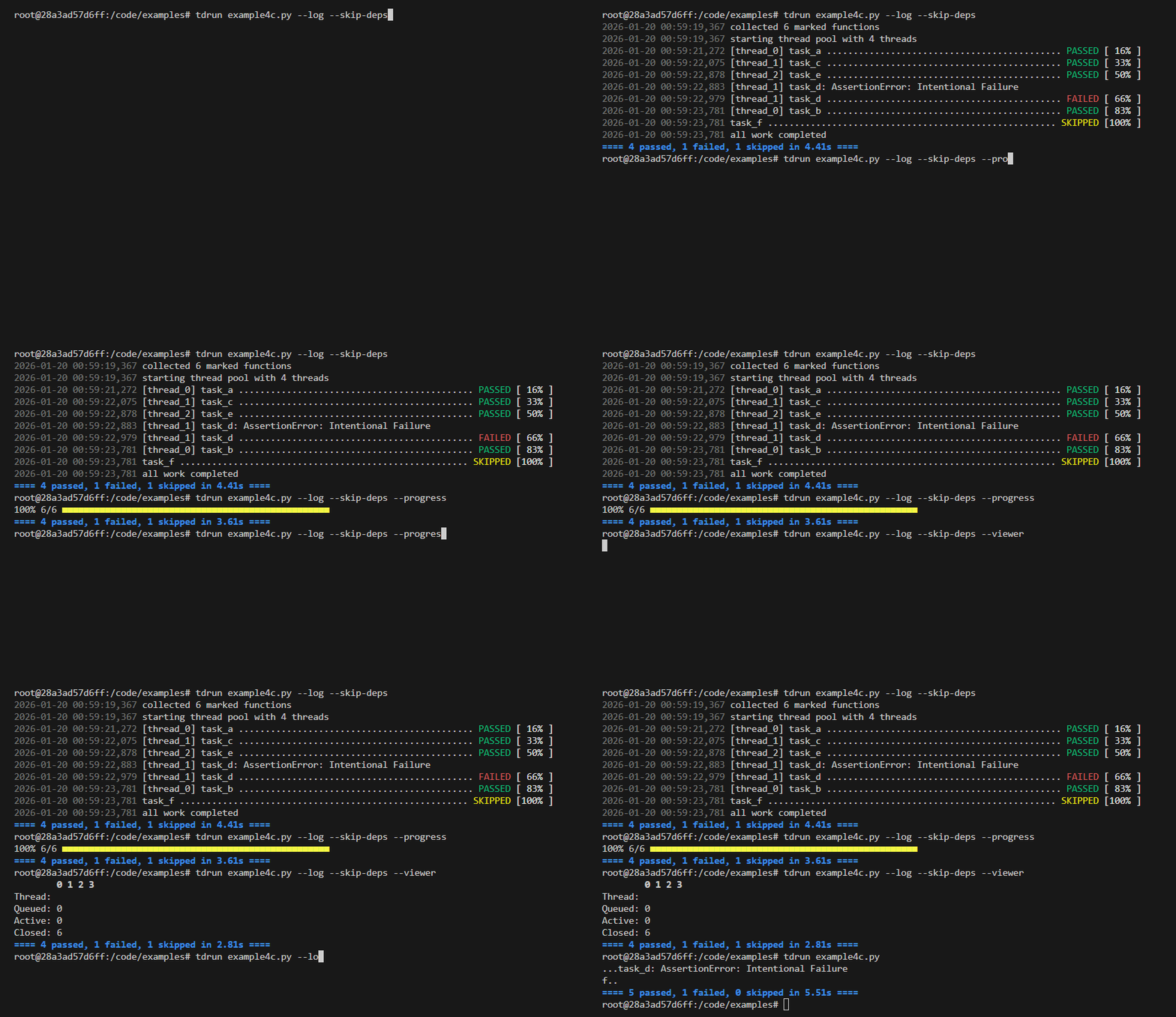
Development
Clone the repository and ensure the latest version of Docker is installed on your development server.
Build the Docker image:
docker image build \
-t threaded-order:latest .
Run the Docker container:
docker container run \
--rm \
-it \
-v $PWD:/code \
threaded-order:latest \
bash
Execute the dev pipeline:
make dev
Release history Release notifications | RSS feed


Download files
Download the file for your platform. If you're not sure which to choose, learn more about installing packages.
Source Distribution
Built Distribution
Filter files by name, interpreter, ABI, and platform.
If you're not sure about the file name format, learn more about wheel file names.
Copy a direct link to the current filters
File details
Details for the file threaded_order-1.3.8.tar.gz.
File metadata
- Download URL: threaded_order-1.3.8.tar.gz
- Upload date:
- Size: 20.5 kB
- Tags: Source
- Uploaded using Trusted Publishing? No
- Uploaded via: twine/6.2.0 CPython/3.12.12
File hashes
| Algorithm | Hash digest | |
|---|---|---|
| SHA256 |
df25ac70fca6649d51753c614b5886da71d57cc067c0bdef6a39ada16d389bab
|
|
| MD5 |
c17f5fddccb2ed6d166eb21e070e4da0
|
|
| BLAKE2b-256 |
d86c4a5dc0274ce3aa739bf3661bf74b15361ea4a37dd872200771ce33601a59
|
File details
Details for the file threaded_order-1.3.8-py3-none-any.whl.
File metadata
- Download URL: threaded_order-1.3.8-py3-none-any.whl
- Upload date:
- Size: 19.3 kB
- Tags: Python 3
- Uploaded using Trusted Publishing? No
- Uploaded via: twine/6.2.0 CPython/3.12.12
File hashes
| Algorithm | Hash digest | |
|---|---|---|
| SHA256 |
edb7b13f6b6c031c79b25f7d1c9f813cee195cd48f0c5d584dea9be5a1d37533
|
|
| MD5 |
51d4f6792c39a54247753fe10f50f507
|
|
| BLAKE2b-256 |
f48d6ec03c301d67b00b061337b04173d1408cbd08305673aaed13e3d37a6bac
|






