
ToolAtlas
The Knowledge Layer for MCP Tools



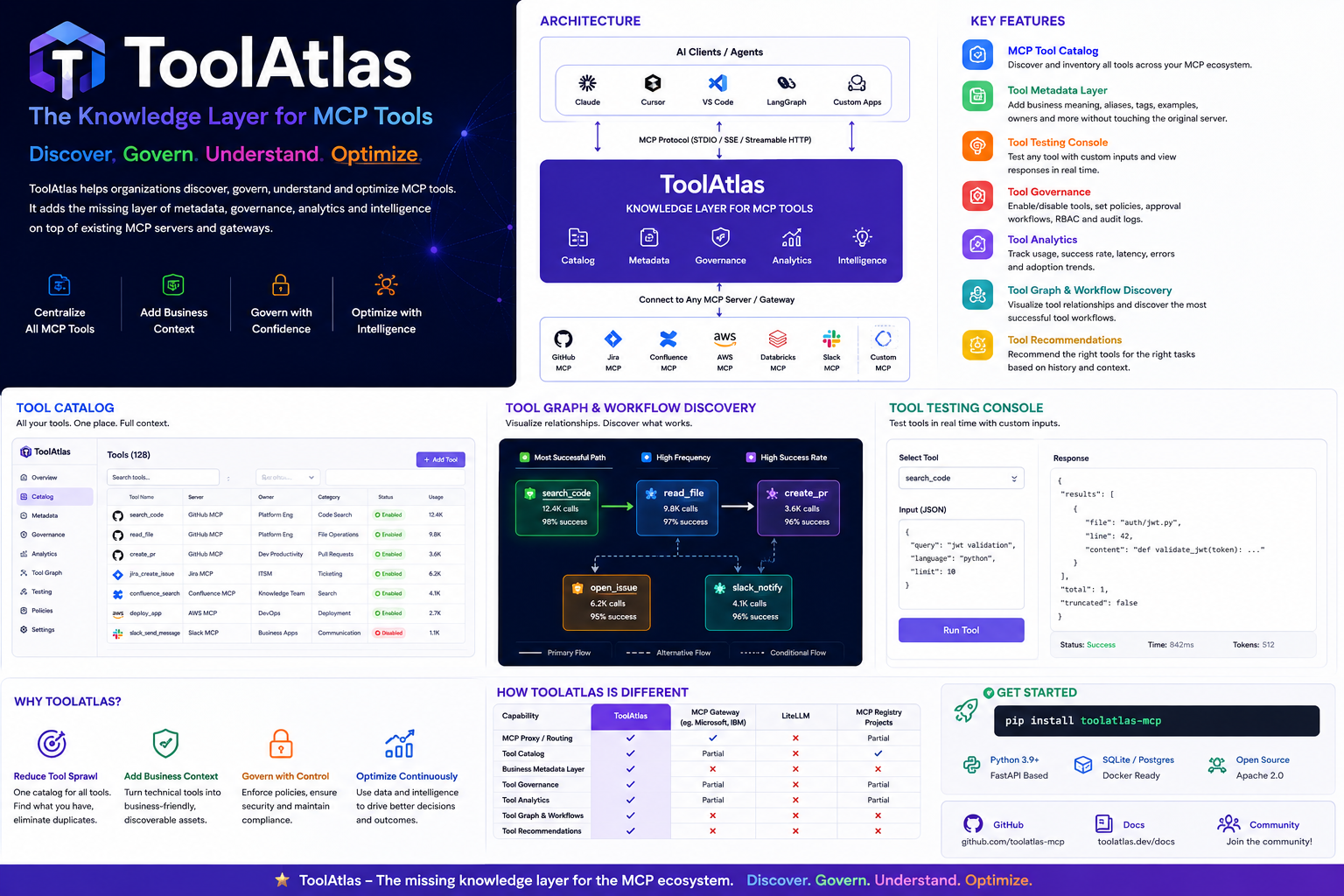
ToolAtlas helps organizations discover, govern, understand, and optimize MCP tools without modifying existing MCP servers.
pip install toolatlas-mcp
toolatlas start                  # defaults: port 8081, json storage
toolatlas start --port 9000 --storage sqlite --data-dir ./data
toolatlas start --storage postgres --database-url "postgresql+asyncpg://user:pass@localhost:5432/toolatlas"
Documentation
Full documentation is in the docs/ directory.
| Area | Documents |
|---|---|
| Plugin System | plugin-system.md, plugin-loading.md, plugin-hooks.md, plugin-examples.md, plugin-testing.md |
| Core System | proxy-engine.md, tool-graph.md, registry.md, architecture.md |
| API & CLI | api.md, cli.md, configuration.md |
| Operations | deploy-under-subpath.md, troubleshooting.md |
| Development | development.md, changelog.md |
| Examples | examples/ — runnable Python scripts |
Tip: Run
toolatlas docsfrom the CLI to find your local copy of the docs (shipped with the installed package).
Why ToolAtlas?
As MCP adoption grows, teams quickly accumulate hundreds of tools across GitHub, Jira, Confluence, AWS, Databricks, Slack, internal systems, and custom MCP servers. The challenge is no longer connecting tools — it's understanding them.
| Problem | How ToolAtlas Solves It |
|---|---|
| Tool Sprawl | Central catalog of every MCP tool — see what exists, what's used, what's duplicated, what's dangerous |
| Lack of Business Context | Add business descriptions, aliases, tags, domain categories, and glossary definitions — without modifying the original server |
| Governance | Per-proxy enable/disable, tool selection on server link, audit logging via call traces |
| Tool Intelligence | Usage analytics, success rates, latency tracking, top tools by usage |
ToolAtlas sits between AI clients and MCP servers — it's the control plane for your MCP ecosystem.
"LiteLLM manages models. ToolAtlas manages tools. "
Key Features
📋 MCP Tool Catalog
Central inventory of all MCP tools across all your servers — searchable, filterable, sortable from the web dashboard.
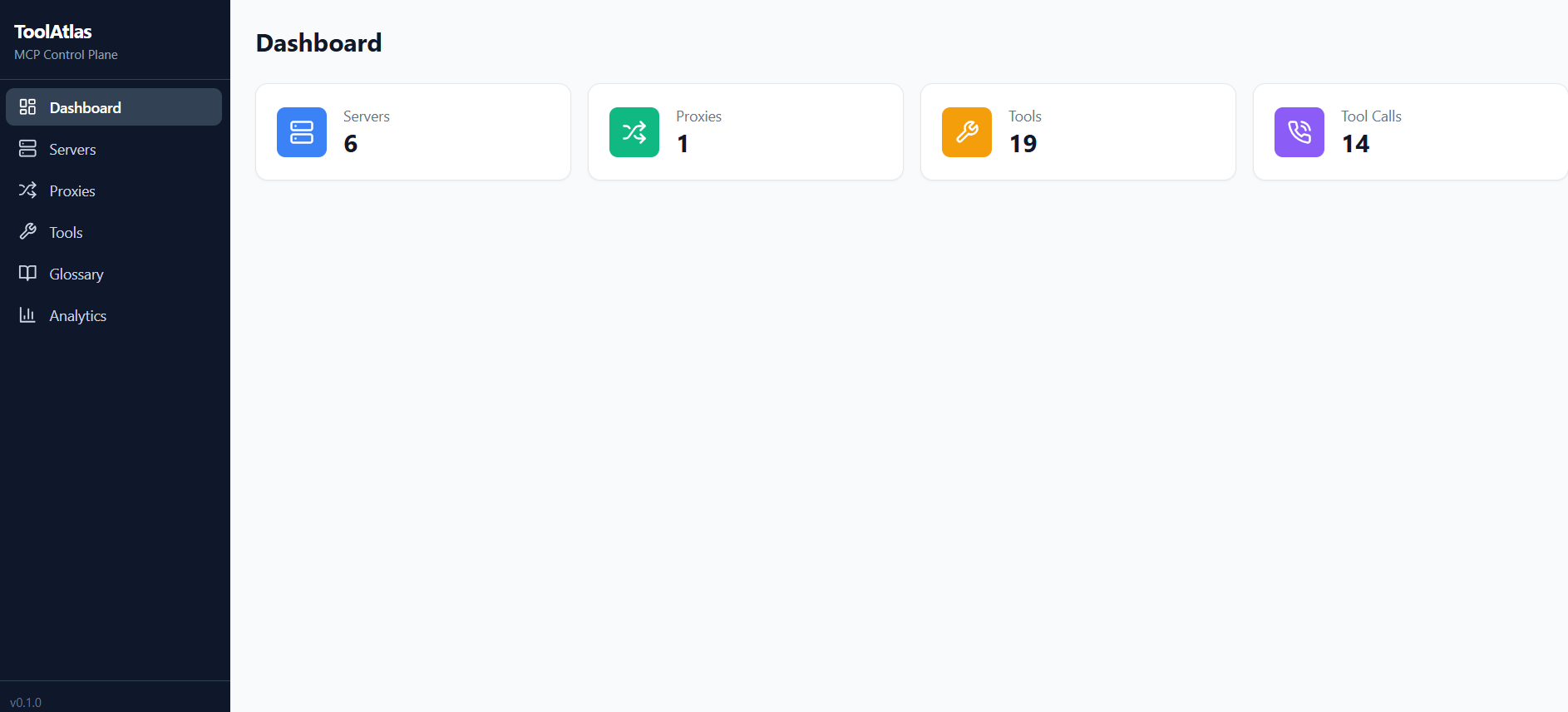
🗂️ Proxy Groups — Organize Tools by Team or Purpose
Create proxies (named groups) and assign MCP servers to each. Every proxy exposes a different toolset.
Proxy "dev"    → GitHub + GitLab     (for developers)
Proxy "pm"     → Jira + Confluence   (for project managers)
Proxy "devops" → AWS + PagerDuty     (for operations)
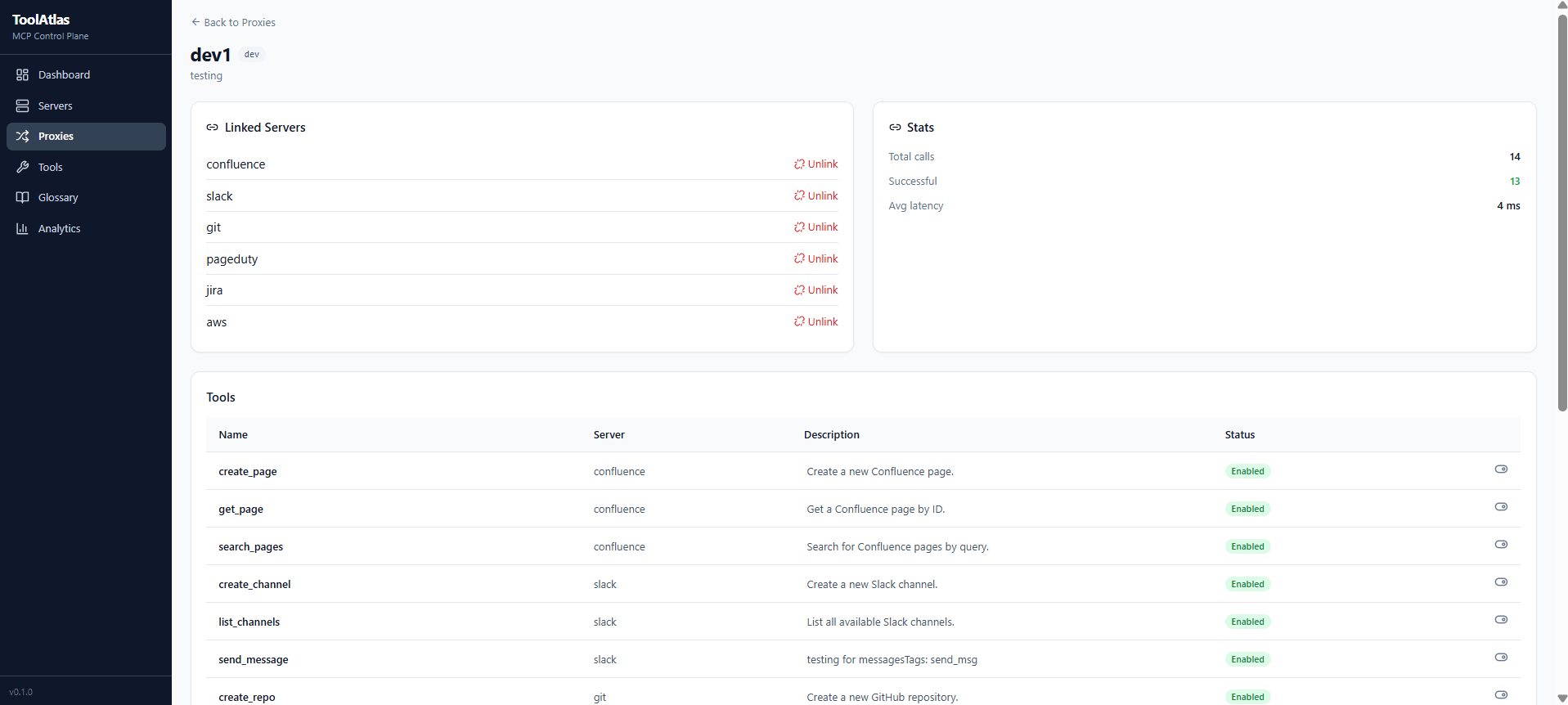
🛡️ Per-Tool Governance — Control What Each Proxy Exposes
Every tool can be independently configured per proxy:
| Control | What it does |
|---|---|
| Enable / Disable | Block dangerous tools (e.g. delete_repo) without touching the server |
| Custom Description | Rewrite the tool's description so AI agents understand it in context |
| Alias | Rename the tool per proxy |
| Tool Selection on Link | Pick exactly which tools to expose when linking a server — unselected tools auto-disable |
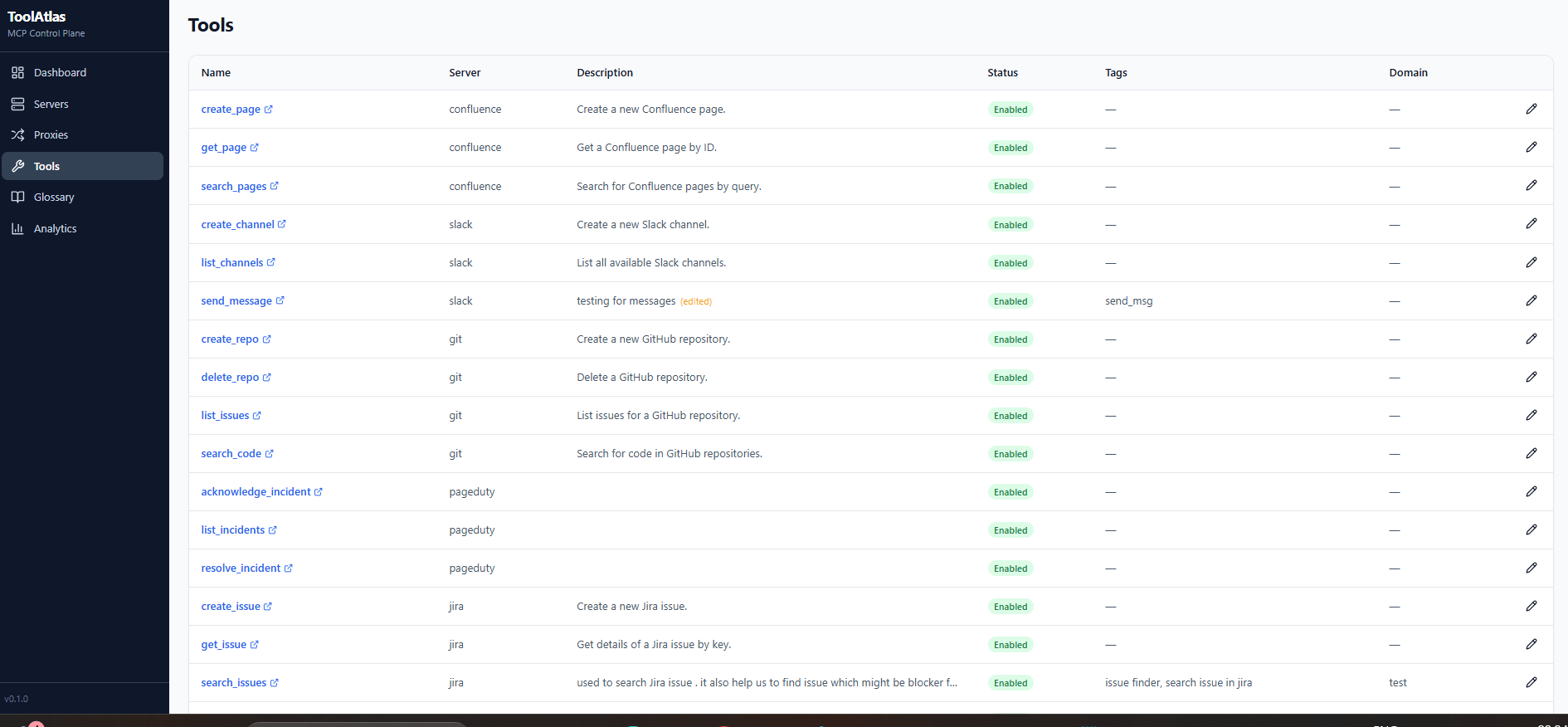
🏷️ Tool Enrichment — Make Tools Smarter
Every registry tool can be enriched with business context. The enriched description is what clients see when they call list_tools:
| Enrichment | Purpose | Example in client view |
|---|---|---|
| Custom Description | Override the original server description | Search for code in GitHub |
| Tags | Add searchable labels | Tags: git, code, search |
| Domain | Categorize by business area | Domain: development |
| Glossary Terms | Link one or more business concepts with definitions | Glossary: Search across all code repositories |
Client sees the full enriched description automatically:
{
  "name": "search_code",
  "description": "Search code in GitHub repositories\nTags: git, code\nDomain: development\nGlossary: Search code across all repositories",
  "inputSchema": { ... }
}
📊 Usage Analytics
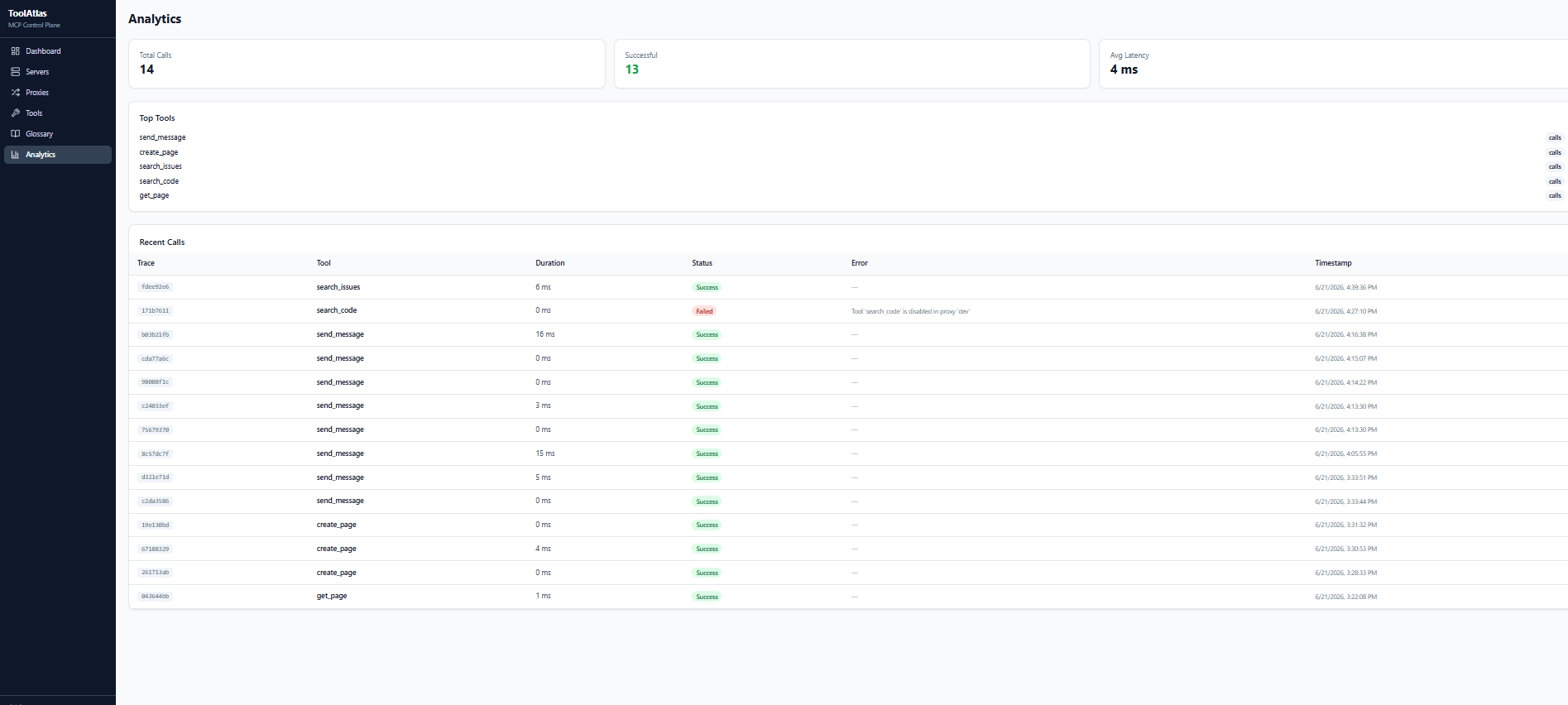
Every tool call is tracked — duration, success/failure, arguments. Dashboard shows top tools, latency trends, error rates, and per-call trace timelines.
🌐 Web Dashboard
Full SPA for managing everything visually — servers, proxies, tool settings, glossary, analytics.
🧪 Tool Testing Console
Test any tool directly from the UI — pass arguments via a dynamic form (auto-generated from the tool's input schema) and see the result in real time with duration tracking.
📂 Glossary with Domain Hierarchy
Organize glossary terms under domains (created first, then terms under them). Terms are grouped by domain in the UI. Assign multiple glossary terms to a single tool. Edit/delete domains and terms inline. Bulk import entire glossaries via JSON/CSV file upload with automatic domain creation.
🔍 Filters & Search
Every management page (Tools, Servers, Proxies, Glossary, Analytics) includes search bars and filter dropdowns for quick navigation.
🕸️ Tool Graph — Visualize Relationships & Execution Workflows
Explore how your MCP ecosystem connects. The Graph page offers three views:
- Call Flow — See the ordered sequence of tool calls within a single execution trace. Each call is a node; arrows show the execution order with timing labels. Click any trace in the side panel to visualize its flow as a directed acyclic graph.
- Relationships — Discover which tools are frequently called together. A force-directed graph shows co-occurrence strength via edge thickness and node size (call count). The side panel lists tool pairs ranked by co-occurrence count.
- Topology — The full infrastructure graph: proxies, servers, and their tools. Proxy-to-server edges are dashed; server-to-tool edges are solid. Color-coded by type (blue=proxy, green=server, amber=tool).
API endpoints:
| Endpoint | Returns |
|---|---|
GET /api/graph |
Full topology (proxies, servers, tools) |
GET /api/graph/proxy/{id} |
Topology scoped to a single proxy |
GET /api/graph/traces |
Recent execution traces with tool counts, duration, success rate |
GET /api/graph/trace/{id} |
Ordered call flow DAG for a specific trace |
GET /api/graph/co-occurrence |
Tool co-occurrence pairs with weights, filterable by proxy |
🔮 Planned Features
| Feature | Status |
|---|---|
| Tool Recommendations — Recommend the best tools for tasks based on usage patterns | Planned |
Architecture
┌─────────────────┐     ┌─────────────────────────────────────┐     ┌─────────────────┐
│  MCP Clients    │     │         ToolAtlas                    │     │  MCP Servers     │
│                 │     │                                     │     │                  │
│  Claude         │────▶│  Proxy "dev"     ── governance ──▶ │────▶│  GitHub MCP      │
│  Cursor         │────▶│  Proxy "pm"      ── governance ──▶ │────▶│  Jira MCP        │
│  Custom Agents  │────▶│  Proxy "devops"  ── governance ──▶ │────▶│  Slack MCP       │
│                 │     │                                     │     │  Confluence MCP  │
│                 │     │  ┌──────────────┐  ┌─────────────┐ │     │  AWS MCP         │
│                 │     │  │ Registry     │  │ Analytics   │ │     │  Custom MCP      │
│                 │     │  │ DB + API     │  │ Tracker     │ │     └─────────────────┘
│                 │     │  └──────────────┘  └─────────────┘ │
│                 │     │  ┌──────────────────────────────┐  │
│                 │     │  │  Web Dashboard (React SPA)   │  │
│                 │     │  └──────────────────────────────┘  │
│                 │     │  ┌──────────────────────────────┐  │
│                 │     │  │  CLI: toolatlas start/add    │  │
│                 │     │  └──────────────────────────────┘  │
│                 │     └─────────────────────────────────────┘
Clients speak MCP to ToolAtlas. ToolAtlas enforces governance, enriches tool descriptions, logs every call, and forwards to real MCP servers.
Installation
Prerequisites
- Python 3.10+ (download)
- pip (comes with Python)
Install from PyPI (recommended)
pip install toolatlas-mcp
PostgreSQL support (optional — requires asyncpg):
pip install "toolatlas-mcp[postgres]"
Verify it installed:
toolatlas --help
You should see the CLI help with start, server, proxy commands.
Install from source
git clone https://github.com/shashi3070/toolatlas-mcp
cd toolatlas-mcp

# Python package
pip install -e ".[dev]"

# Build the web UI
cd ui
npm install
npm run build
cd ..
Usage — Step by Step
1. Start the Server
toolatlas start
Output:
ToolAtlas starting on 127.0.0.1:8081
  Web UI: http://127.0.0.1:8081
  API:    http://127.0.0.1:8081/api/health
Open http://localhost:8081 in your browser to see the dashboard.
2. Add an MCP Server
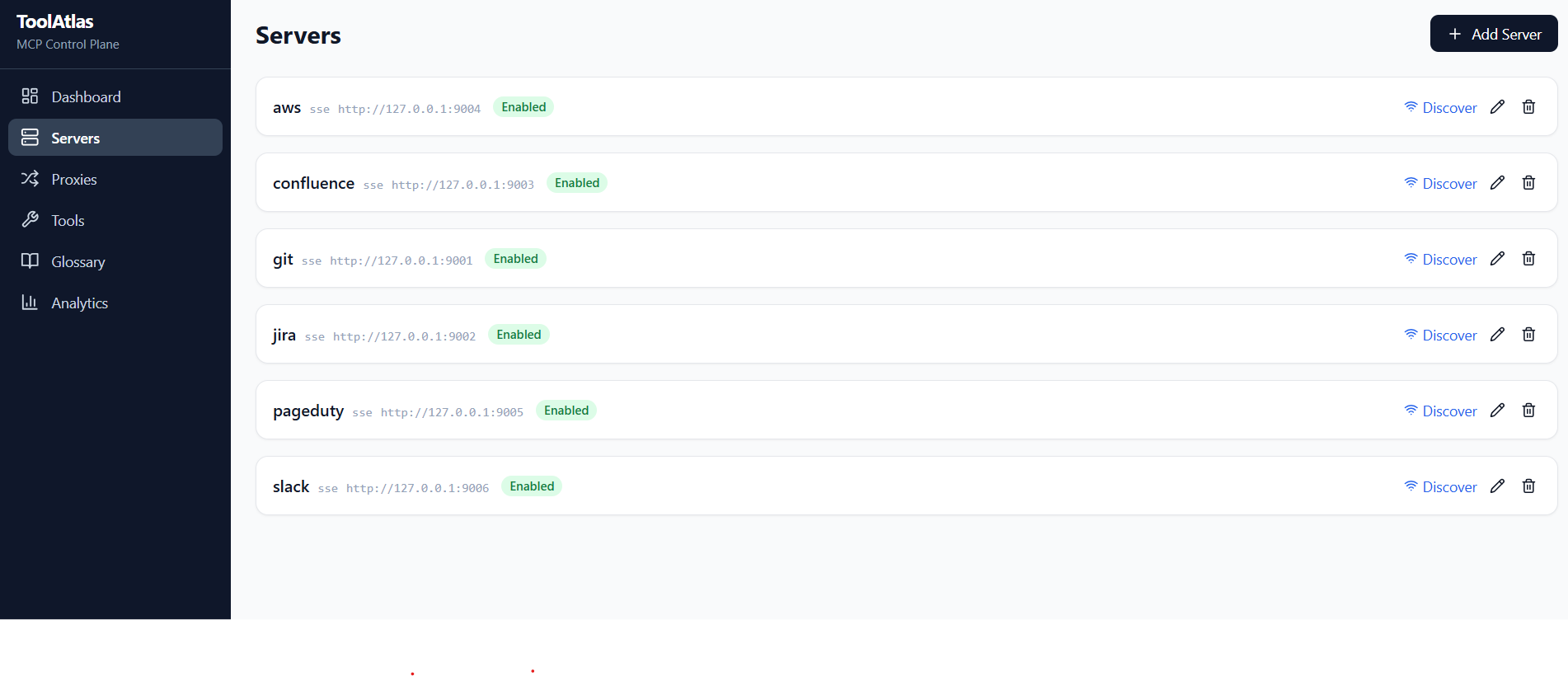
You can add servers via CLI or the web UI.
CLI — stdio server (e.g., npx-based):
toolatlas server add github \
  --transport stdio \
  --command "npx" \
  --args "-y" "@modelcontextprotocol/server-github"
CLI — SSE server (already running):
toolatlas server add my-api \
  --transport sse \
  --url "http://localhost:9001/sse"
Web UI: Go to Servers → Add Server, fill in the details.
3. Discover Tools
After adding a server, discover its tools:
# Via CLI (uses the API):
curl -X POST http://localhost:8080/api/servers/{server_id}/discover
Or click Discover & Save New on the Server detail page in the web UI.
4. Create a Proxy
Proxies organize tools into groups. Each proxy exposes a subset of your servers' tools.
# Create a proxy
toolatlas proxy add dev --description "Developer tools"

# Link servers to it
toolatlas proxy link dev github
toolatlas proxy link dev gitlab
List your proxies:
toolatlas proxy list
Tip: In the web UI, when linking a server you can select exactly which tools to expose — unselected tools are automatically disabled for that proxy. No need to manually toggle them afterwards.
5. Configure Tools Per Proxy
In the web UI, go to a Proxy detail page → Tools tab. For each tool:
- Toggle enabled/disabled — disable
delete_repofor the "dev" proxy - Set a custom description — e.g., "Search code in GitHub repos"
- Alias the tool — rename it for clarity
You can also select which tools to include at link time — click Link next to a server to open the tool picker modal.
6. Enrich Tool Metadata
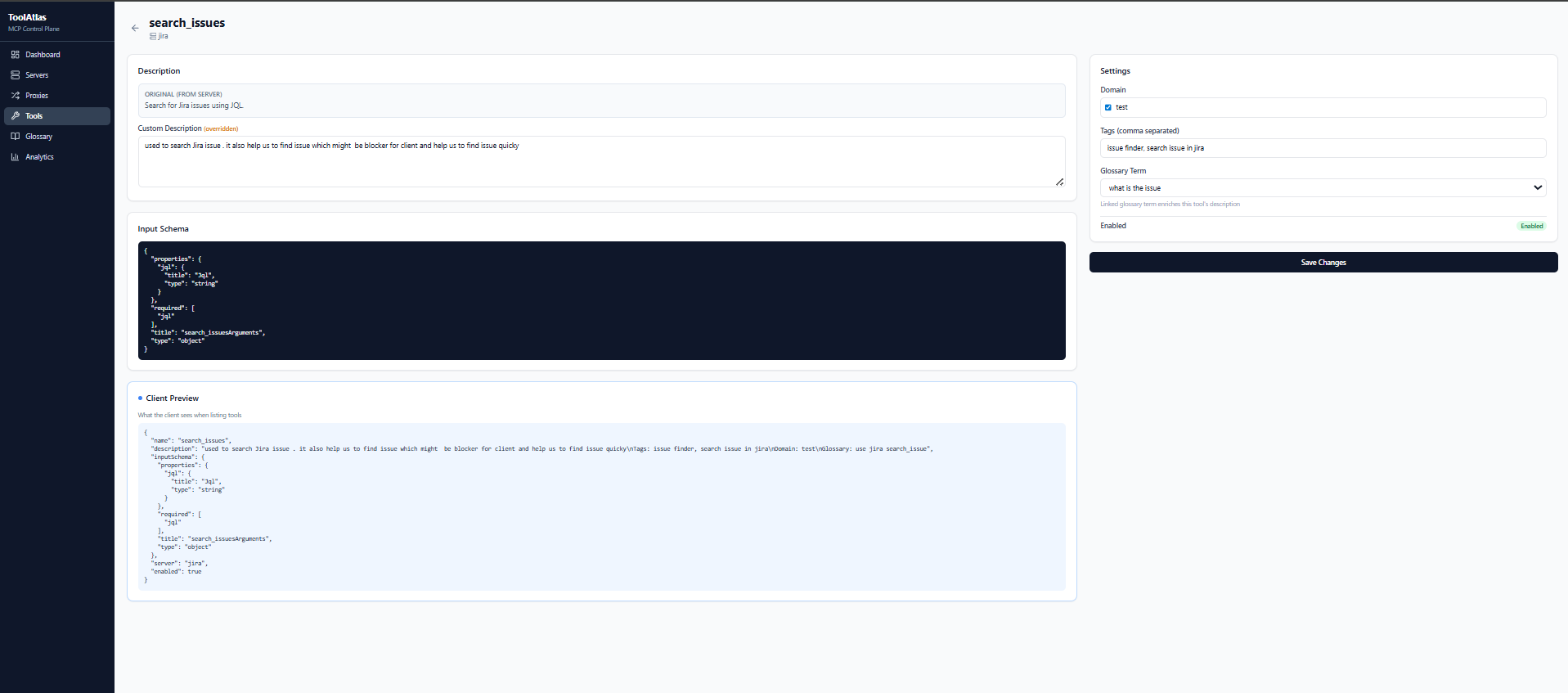
In the Tool detail page, you can add:
- Tags — comma-separated labels like
git, code, search - Domain — categorize the tool (e.g., "development", "security")
- Glossary Terms — link one or more business terms with definitions (multi-select, grouped by domain)
First create glossary domains and terms under the Glossary page, then assign them to tools from the tool detail page.
7. Connect Your AI Client
Configure your MCP client (Claude Desktop, Cursor, custom agent) to point to ToolAtlas. Replace dev with your proxy's slug name.
Claude Desktop (claude_desktop_config.json):
{
  "mcpServers": {
    "dev": {
      "type": "sse",
      "url": "http://localhost:8081/proxy/dev/sse"
    }
  }
}
Cursor / VS Code / any MCP client — same format; just register an SSE server with the URL above.
The proxy slug (dev, prod, etc.) is the name you gave when creating the proxy. Each proxy exposes a different toolset.
Advanced: Raw JSON-RPC (without SSE)
For scripting or testing without an MCP client library, use the message endpoint directly. Each call needs its own session_id (UUID).
import httpx, uuid

session_id = str(uuid.uuid4())
proxy_url = f"http://localhost:8081/proxy/dev/message/{session_id}"

# Initialize
httpx.post(proxy_url, json={
    "jsonrpc": "2.0", "id": 1, "method": "initialize",
    "params": {"protocolVersion": "2024-11-05", "capabilities": {}, "clientInfo": {"name": "test", "version": "1.0"}}
}).json()

# Notify initialized
httpx.post(proxy_url, json={
    "jsonrpc": "2.0", "method": "notifications/initialized"
}).json()

# List tools
httpx.post(proxy_url, json={
    "jsonrpc": "2.0", "id": 2, "method": "list_tools"
}).json()

# Call a tool
httpx.post(proxy_url, json={
    "jsonrpc": "2.0", "id": 3, "method": "call_tool",
    "params": {"name": "search_code", "arguments": {"query": "auth"}}
}).json()
8. View Analytics
Go to the Analytics page in the web UI to see:
- Total calls, success rate, average latency
- Top tools by usage
- Individual call traces with event timelines (proxy resolution → server call → response)
CLI Reference
| Command | Description |
|---|---|
toolatlas start |
Start the ToolAtlas server (defaults: port 8081, json storage) |
toolatlas start --port 9000 --host 0.0.0.0 |
Start on a different address |
toolatlas start --storage sqlite |
Use SQLite storage backend |
toolatlas start --storage postgres --database-url "postgresql+asyncpg://user:pass@host:5432/db" |
Use PostgreSQL storage backend |
toolatlas start --database-url "postgresql+asyncpg://..." |
Set database URL directly (any SQLAlchemy dialect) |
toolatlas start --data-dir ./my-data |
Custom data directory |
toolatlas start --reload |
Start with auto-reload (development) |
toolatlas start --base-path /toolatlas |
Start with reverse proxy base path prefix |
All flags: --port, --host, --storage (json/sqlite/postgres), --database-url, --data-dir, --base-path, --reload. Environment variables are still supported with TOOLATLAS_ prefix and take precedence over defaults. You can also use a .env file in the working directory to set any TOOLATLAS_* variable.
Storage
ToolAtlas supports three storage backends:
| Backend | Type | Best for |
|---|---|---|
| JSON File (default) | json |
Development, single-user, portable setups, git-versioned data |
| SQLite | sqlite |
Production, multi-user, analytics-heavy workloads (good for up to ~10 concurrent connections) |
| PostgreSQL | postgres |
Production, high-concurrency, many concurrent connections (no write-lock contention) |
Storage Backend Comparison
| Feature | JSON | SQLite | PostgreSQL |
|---|---|---|---|
| Dependencies | built-in | built-in | pip install toolatlas-mcp[postgres] |
| Concurrent reads | asyncio-lock serialized | WAL mode (reads don't block reads) | Full MVCC |
| Concurrent writes | asyncio-lock serialized | One writer at a time (WAL mode) | Many concurrent writers |
| Persistence | Single file | Single file | External server |
| Setup | None | None | Requires running PostgreSQL instance |
Tip: SQLite with WAL mode + batch commits (v1.13+) handles moderate concurrency well. Switch to PostgreSQL when you have many concurrent proxy instances or tool discovery calls happening at the same time.
PostgreSQL Connection Pooling (v2.0.0+)
When using PostgreSQL, ToolAtlas automatically configures:
AsyncAdaptedQueuePoolwithpool_size=10andmax_overflow=20— no new TCP connection per querycommand_timeout=10— proper asyncpg parameter (not the aiosqlitetimeout)- Early
asyncpgdetection — a clearRuntimeErroris raised at import ifasyncpgis missing
The data.json file is saved to the same data directory as the SQLite database.
v4.2.0 New Features
🎨 UI Customization
Customize the ToolAtlas dashboard to match your brand or preference:
- Top Tabs Layout — Switch from sidebar navigation to horizontal top tabs by setting
TOOLATLAS_TOP_TABS=true - Primary Color — Set a custom accent color via
TOOLATLAS_PRIMARY_COLOR(e.g.,#6832ba) - Embed Mode — Add
?embed=trueto the URL for iframe-friendly embedding (hides sidebar and header)
export TOOLATLAS_TOP_TABS=true
export TOOLATLAS_PRIMARY_COLOR="#6832ba"
🔐 Auth Header Support for MCP Servers
Add custom HTTP headers to MCP server connections — useful for API keys, bearer tokens, or any authentication scheme:
- Per-server headers configured via the UI or API
- Headers are passed through to
httpx.AsyncClientfor SSE/HTTP connections - Key-value editor in the Add/Edit Server form
{
  "Authorization": "Bearer sk-...",
  "X-API-Key": "your-api-key"
}
⚡ Performance Improvements
| Area | Improvement |
|---|---|
| N+1 Query Fixes | Bulk upsert_tools/delete_tools replaces per-tool loops — /discover: 1 bulk upsert vs 115 individual |
| Analytics | SQL GROUP BY aggregations instead of loading 10K+ records into Python |
| Tool Discovery | list_tools filter by server_ids — only fetch relevant tools |
| Deletes | ORM cascade deletes replaced with bulk DELETE + DB-level ON DELETE CASCADE |
| UI | AbortController cancels in-flight API requests on page navigation — no wasted requests or React warnings |
🧪 Playwright E2E Tests
5 new Playwright e2e tests verifying:
- No errors during rapid navigation
- Mid-request page changes
- Graph tab switching
- Proxy detail navigation
- Tool edit dialog
🐳 Docker Improvements
- Node 20
bookworm-slimbase for UI build stage - Auto-create PostgreSQL schema on startup
- Always install
asyncpgin Docker image TOOLATLAS_DATA_DIRbaked into image (/data)
v3.0 Advanced Features
🔌 Plugin System
ToolAtlas v4.0 ships with an advanced hook-based plugin architecture. Plugins can intercept and extend every major lifecycle event.
Built-in plugins:
| Plugin | Entry point | Enables via |
|---|---|---|
| Redis/Memory Cache | cache |
TOOLATLAS_PLUGINS=cache |
| Prometheus Metrics | metrics |
TOOLATLAS_PLUGINS=metrics |
Available hooks (all optional):
| Hook | Fires | Use case |
|---|---|---|
on_before_list_tools |
Before listing tools for a proxy | Abort or short-circuit tool listing |
on_after_list_tools |
After listing | Log results, inject extra tools |
on_tool_filter |
Before returning tool list | Hide sensitive tools per caller |
on_before_tool_call |
Before executing a tool | Validate arguments, authorize, rate limit |
on_after_tool_call |
After tool execution | Record results, metrics |
on_before_response_return |
Just before response sent to client | Redact, modify, or block the response |
on_before_cache_lookup |
Before cache read | Return cached data early |
on_after_cache_lookup |
After cache read | Track hit/miss stats |
on_cache_invalidated |
When cache is cleared | Propagate invalidation to Redis |
on_tool_added |
Registry sync discovers a new tool | Notify, index |
on_tool_updated |
Registry sync detects changes | Re-index |
on_tool_removed |
A tool is deleted from a server | Clean up |
on_server_connected |
A new MCP client connects | Tag connections |
Enable plugins:
# Via environment variable
export TOOLATLAS_PLUGINS="cache,metrics"

# Or via CLI
toolatlas start
Plugin discovery order:
- Entry points registered in
pyproject.tomlunder[project.entry-points."toolatlas.plugins"] - Directories listed in
TOOLATLAS_PLUGIN_DIRS - Module paths listed in
TOOLATLAS_PLUGINS
🛑 PluginAbortError — Block Requests from Plugins
Raise PluginAbortError in on_before_tool_call, on_before_list_tools, or on_before_response_return to abort the operation. ToolAtlas converts this to an MCP error (-32001) returned to the client.
from toolatlas_mcp.plugin import Plugin, PluginAbortError, PluginContext

class RateLimiterPlugin(Plugin):
    name = "rate_limiter"

    async def on_before_tool_call(self, ctx: PluginContext) -> None:
        if self._is_limited(ctx.tool_name):
            raise PluginAbortError(f"Rate limit exceeded for '{ctx.tool_name}'")
Normal exceptions (e.g. ValueError, RuntimeError) are caught, logged, and swallowed — they do not block the request. Only PluginAbortError propagates.
🎯 Plugin Priority Ordering
Set priority on your plugin class to control execution order. Lower values run first.
| Priority | Plugin Type | Example |
|---|---|---|
-100 |
Authentication | Validate API keys first |
-50 |
Authorization / Governance | ABAC, RBAC checks |
0 |
Observability (default) | MetricsPlugin, audit logger |
50 |
Rate Limiting | Check limits after auth |
100 |
Cache | CachePlugin (latest possible) |
class GovernancePlugin(Plugin):
    name = "governance"
    priority = -50  # runs before metrics
🧪 PluginContext Identity Fields
PluginContext now carries caller identity and routing context from the _meta protocol:
| Field | Source | Description |
|---|---|---|
client_id |
_meta.client_id |
Calling client (e.g. "chatbot-v3") |
user_id |
_meta.user_id |
Authenticated user |
org_id |
_meta.org_id |
Organization |
tenant_id |
_meta.tenant_id |
Tenant within org |
proxy_id |
Internal | Proxy that received the call |
proxy_name |
Internal | Proxy display name |
server_name |
Internal | Upstream MCP server name |
meta |
_meta (full dict) |
Raw metadata from request |
🔍 Tool Filter Hook
on_tool_filter lets plugins hide tools from the returned tool list. Useful for governance:
class GovernancePlugin(Plugin):
    name = "governance"
    priority = -50

    SENSITIVE_TOOLS = {"delete_repo", "admin_exec"}

    async def on_tool_filter(self, ctx: PluginContext, tools: list[dict]) -> list[dict]:
        return [t for t in tools if t["name"] not in self.SENSITIVE_TOOLS]
📝 Response Modification Hook
on_before_response_return fires just before the response is sent to the client. Plugins can modify or redact the result:
class DLPPlugin(Plugin):
    name = "dlp"

    async def on_before_response_return(self, ctx: PluginContext, result: dict) -> dict | None:
        # Redact sensitive fields
        for content in result.get("content", []):
            if isinstance(content, dict) and "text" in content:
                content["text"] = content["text"].replace("SECRET", "[REDACTED]")
        return result
📊 HTTP Endpoints from Plugins
Plugins can expose HTTP endpoints under /api/plugins/{name}/ via a router property:
from fastapi import APIRouter
from toolatlas_mcp.plugin import Plugin

class MyPlugin(Plugin):
    name = "my_plugin"

    @property
    def router(self) -> APIRouter | None:
        r = APIRouter(tags=["my_plugin"])
        @r.get("/status")
        async def status():
            return {"status": "ok"}
        return r
📘 Complete Example — Governance ABAC
See examples/plugins/governance_abac.py for a full ABAC governance plugin demonstrating PluginAbortError, PluginContext.org_id, on_tool_filter, and priority ordering.
Write a custom plugin:
from toolatlas_mcp.plugin import Plugin, PluginAbortError, PluginContext

class MyPlugin(Plugin):
    name = "my_plugin"
    priority = 0

    async def on_before_tool_call(self, ctx: PluginContext) -> None:
        # ctx.org_id, ctx.user_id, ctx.client_id available
        if not self._is_allowed(ctx):
            raise PluginAbortError("Not authorized")
Register via entry point in pyproject.toml:
[project.entry-points."toolatlas.plugins"]
my_plugin = "my_package.plugins:MyPlugin"
🗄️ Redis Cache (built-in plugin)
When the cache plugin is enabled, ToolAtlas uses a two-tier cache:
- Memory (in-process dict, shared across all proxies for the same server)
- Redis (optional, when
TOOLATLAS_REDIS_URLis set)
export TOOLATLAS_PLUGINS="cache"
export TOOLATLAS_REDIS_URL="redis://localhost:6379/0"
export TOOLATLAS_CACHE_TTL=300
Without Redis, the cache plugin operates in memory-only mode. If Redis is configured but unreachable, it falls back to memory automatically.
Cache keys are tools:{slug} with TTL equal to TOOLATLAS_CACHE_TTL. Each cache hit refreshes the TTL.
📊 Prometheus Metrics (built-in plugin)
When the metrics plugin is enabled, ToolAtlas exposes a /metrics endpoint at the API root:
export TOOLATLAS_PLUGINS="metrics"
curl http://localhost:8081/metrics
Exported metrics:
| Metric | Type | Labels |
|---|---|---|
toolatlas_calls_total |
Counter | proxy, tool, status |
toolatlas_call_duration_seconds |
Histogram | proxy, tool |
toolatlas_cache_hits_total |
Counter | proxy |
toolatlas_cache_misses_total |
Counter | proxy |
🔄 Background Registry Sync
Once enabled (built-in, no plugin needed), ToolAtlas periodically polls every connected MCP server for its current tool list. It:
- Fetches the remote tool list via the shared
ConnectionManager - Computes a SHA-256 hash of all tool definitions
- Compares against the stored hash on the
Serverrecord - If unchanged — skips DB writes entirely
- If changed — upserts new/updated tools, deletes removed ones, and auto-invalidates proxy caches
The sync runs every TOOLATLAS_REGISTRY_SYNC_INTERVAL seconds (default: 30). You can configure it:
export TOOLATLAS_REGISTRY_SYNC_INTERVAL=60
The sync only processes enabled servers. Disabled servers and connection failures are skipped gracefully with a warning log.
🔗 Shared ConnectionManager
All proxy engines now share a single ConnectionManager that maintains one MCPClient per server_id. Benefits:
- Fewer connections — 100 proxies all pointing to the same GitHub server share a single TCP connection
- Auto-reconnect — stale clients are detected and reconnected on next use
- Graceful shutdown —
connection_manager.close_all()cleanly closes all clients
No configuration needed — this is enabled automatically.
Configuration
Set via environment variables with TOOLATLAS_ prefix. A .env file in the working directory is also loaded automatically.
| Variable | Default | Description |
|---|---|---|
TOOLATLAS_HOST |
127.0.0.1 |
Bind address |
TOOLATLAS_PORT |
8081 |
HTTP port (auto-increments if in use) |
TOOLATLAS_DATABASE_URL |
sqlite+aiosqlite:///<data_dir>/toolatlas.db |
Database connection URL (any SQLAlchemy async dialect) |
TOOLATLAS_STORAGE_TYPE |
json |
Storage backend (json, sqlite, or postgres) |
TOOLATLAS_DATA_DIR |
~/.toolatlas (Unix) / %APPDATA%\ToolAtlas (Win) |
Data directory for databases and config |
TOOLATLAS_LOG_LEVEL |
INFO |
Log level (DEBUG, INFO, WARNING, ERROR) |
TOOLATLAS_BASE_PATH |
"" |
URL prefix when deployed behind a reverse proxy (e.g. /toolatlas) |
TOOLATLAS_REDIS_URL |
"" |
Redis URL for shared cache layer (e.g. redis://localhost:6379/0) |
TOOLATLAS_TOP_TABS |
false |
Use horizontal tab layout instead of sidebar |
TOOLATLAS_PRIMARY_COLOR |
#2563eb |
Primary accent color for the UI (hex) |
TOOLATLAS_CACHE_TTL |
300 |
Cache TTL in seconds for proxy tool listings |
TOOLATLAS_REGISTRY_SYNC_INTERVAL |
30 |
Background sync interval in seconds |
TOOLATLAS_PLUGINS |
[] |
Comma-separated list of plugin entry-point names or module paths to load |
TOOLATLAS_PLUGIN_DIRS |
[] |
Comma-separated list of directories to scan for plugin modules |
When starting interactively, you'll be prompted for the data directory and storage type if the environment variables aren't set. If you choose postgres, you'll be prompted for the connection details (host, port, database name, username, password). You can also provide a --database-url flag or TOOLATLAS_DATABASE_URL env var to skip prompts.
What's New in v4.0.0
| Area | Change | Impact |
|---|---|---|
| PluginAbortError | New exception that propagates through PluginManager.execute() — all other exceptions are still swallowed |
Authorization, rate limiting, and governance plugins now work correctly — they can block tool calls |
| Plugin Priority | Plugin.priority attribute (int, default 0, lower runs first) |
Governance runs before metrics runs before cache |
| PluginContext Identity | Added client_id, user_id, org_id, tenant_id, proxy_id, proxy_name, server_name, meta |
Plugins can now inspect who is calling and make authorization decisions |
on_tool_filter Hook |
Filters the tool list before returning to client | Hide sensitive tools from unauthorized callers |
on_before_response_return Hook |
Fires just before response is sent; can modify or block | DLP / redaction plugins |
| Plugin HTTP Routers | Plugin.router property auto-mounted at /api/plugins/{name}/ |
Expose custom endpoints from plugins |
on_before_list_tools in server.py |
Now called before cache check in the SSE handler | Auth plugins can block tool listing even on cache hit |
What's New in v3.0.0
| Area | Change | Impact |
|---|---|---|
| ConnectionManager | Shared MCPClient pool — one client per server_id reused across all proxies |
Eliminates redundant connections; auto-reconnects stale clients; reduces total TCP connections |
| Background Registry Sync | Periodic SHA-256 sync of all upstream servers (default 30s) | Tools auto-discover, update, and remove without manual discover; stale detection is continuous |
| Plugin Architecture | Hook-based plugin system with on_before_tool_call, on_after_tool_call, on_before_cache_lookup, on_tool_added/updated/removed |
Extend ToolAtlas without modifying core — built-in Cache + Metrics plugins included |
| Cache Plugin (built-in) | Memory→Redis two-tier cache with TTL jitter, warmup on startup, and stats | Redis as optional shared cache layer (TOOLATLAS_REDIS_URL); falls back to memory if unavailable |
| Metrics Plugin (built-in) | Prometheus-compatible counters for call count, latency, errors, cache hit ratio | /metrics endpoint for Prometheus scraping; no external dependencies beyond prometheus-client |
| TTL Jitter | Cache TTL randomly jittered by ±10% | Prevents thundering herd when multiple proxy TTLs expire simultaneously |
What's New in v2.0.0
| Area | Change | Impact |
|---|---|---|
| PostgreSQL | Dialect-aware connect_args, AsyncAdaptedQueuePool (pool=10, overflow=20), early asyncpg import check |
PostgreSQL now works reliably without crashes or per-query TCP overhead |
| Transaction safety | commit() wraps exceptions with rollback() — poisoned sessions are cleaned up |
Eliminates ResourceClosedError: This transaction is closed errors |
| Cache locking | list_tools cache miss uses double-checked locking under _engine_locks[slug] |
Prevents redundant list_tools flood when multiple domains' TTLs expire simultaneously |
| Batch commits | Proxy link-server tool disabling now uses auto_commit=False + single commit() |
130 toggles → 1 commit instead of 130 |
| Stale detection | Tool cache cleared immediately when any upstream client goes stale (not only when all are gone) | No stale tools returned after partial connection loss |
| Import hygiene | from sqlalchemy import JSON instead of sqlalchemy.dialects.sqlite.JSON |
Cleaner, semantically correct for all dialects |
The CLI automatically scans for a free port (8080→8280) if the default port is occupied.
Example:
export TOOLATLAS_HOST=0.0.0.0
export TOOLATLAS_PORT=9000
export TOOLATLAS_STORAGE_TYPE=json
export TOOLATLAS_DATA_DIR=./toolatlas-dev
toolatlas start
To use non-interactive mode (no prompts):
TOOLATLAS_DATA_DIR=/custom/path TOOLATLAS_STORAGE_TYPE=json toolatlas start
Using a .env file
Create a .env file in the directory where you run toolatlas start:
TOOLATLAS_STORAGE_TYPE=postgres
TOOLATLAS_DATABASE_URL=postgresql+asyncpg://user:pass@localhost:5432/toolatlas
TOOLATLAS_DATA_DIR=./toolatlas-dev
Then simply run toolatlas start — all values are picked up automatically.
Hosting ToolAtlas Inside an Existing Web Application
This guide explains how to embed ToolAtlas-MCP as a sub-app inside an existing Flask or FastAPI application under a URL prefix (e.g., /toolatlas/). No separate container or port is required.
Prerequisites
- An existing Python web application (Flask or FastAPI) running behind a reverse proxy (nginx, Apache, etc.)
- Python 3.10+
- pip access to install the
toolatlas-mcppackage
Installation
pip install toolatlas-mcp
This installs:
toolatlas-mcp— the core packageaiosqlite— SQLite async driver (needed even for JSON storage)rich,typer— CLI utilitiesfastapi,uvicorn— ASGI dependencies
For PostgreSQL, install with: pip install "toolatlas-mcp[postgres]"
Storage Configuration
ToolAtlas stores its data (servers, tools, proxies, etc.) in a JSON file by default. Set these environment variables to control storage:
export TOOLATLAS_STORAGE_TYPE=json            # "json" (default), "sqlite", or "postgres"
export TOOLATLAS_DATABASE_URL=...             # required for "postgres", e.g. "postgresql+asyncpg://user:pass@host:5432/toolatlas"
export TOOLATLAS_DATA_DIR=/data/toolatlas     # custom data path, default ~/.toolatlas
If not set, data lives at ~/.toolatlas/data.json.
Integration
Option A: FastAPI (mount as sub-app)
from fastapi import FastAPI
from toolatlas_mcp.api.app import create_app as create_toolatlas_app
from toolatlas_mcp.config import settings as toolatlas_settings
from toolatlas_mcp.db import init_db, close_db
from toolatlas_mcp.proxy.engine import close_all_engines

# Your existing FastAPI app
app = FastAPI()

# ... your existing routes ...

# Mount ToolAtlas under a prefix
toolatlas_settings.base_path = ""  # mount handles prefixing
toolatlas_app = create_toolatlas_app()
app.mount("/toolatlas", toolatlas_app)
Database lifecycle (add to your app's startup/shutdown):
from contextlib import asynccontextmanager
import os

@asynccontextmanager
async def lifespan(app: FastAPI):
    # Startup: ensure data dir exists
    data_dir = os.environ.get("TOOLATLAS_DATA_DIR", "/data/toolatlas")
    os.makedirs(data_dir, exist_ok=True)
    await init_db()
    yield
    # Shutdown
    close_all_engines()
    await close_db()

app = FastAPI(lifespan=lifespan)
Option B: Flask (WSGI sub-app)
Flask does not natively support ASGI sub-mounts. Use ASGI middleware or run ToolAtlas as a separate ASGI app behind the same reverse proxy on a different path.
Example using werkzeug middleware (limited):
from flask import Flask
from werkzeug.middleware.dispatcher import DispatcherMiddleware

app = Flask(__name__)

# ... your existing Flask app ...

# ToolAtlas needs ASGI — use a wrapper or run separately
Recommended for Flask: Run ToolAtlas as a separate uvicorn process behind the same nginx, routing /toolatlas/* to it. Or migrate your Flask app to FastAPI to get native sub-app mounting.
SPA Base URL Configuration
The ToolAtlas SPA reads the base path at runtime from window.__TOOLATLAS_BASE_PATH__, which is injected by the backend into the served index.html. Set TOOLATLAS_BASE_PATH (or use --base-path) to configure it:
# Environment variable
export TOOLATLAS_BASE_PATH=/toolatlas
toolatlas start

# Or CLI flag
toolatlas start --base-path /toolatlas
Both the Axios API client and React Router automatically use this value. No JS bundle patching is required.
Reverse Proxy (nginx)
Add a location block in your nginx config:
location /toolatlas/ {
    proxy_pass http://127.0.0.1:5100/;
    proxy_http_version 1.1;
    proxy_set_header Upgrade $http_upgrade;
    proxy_set_header Connection "upgrade";
    proxy_buffering off;
    proxy_cache off;
    proxy_set_header Host $host;
    proxy_set_header X-Real-IP $remote_addr;
    proxy_set_header X-Forwarded-For $proxy_add_x_forwarded_for;
    proxy_read_timeout 86400s;
}
Reload nginx:
nginx -s reload
Verifying the Deployment
# API health
curl http://localhost:5100/toolatlas/api/servers
curl http://localhost:5100/toolatlas/api/tools

# SPA
curl -o /dev/null -w '%{http_code}' http://localhost:5100/toolatlas/
# Expected: 200

# Open in browser
open http://localhost:5100/toolatlas/
Troubleshooting
| Symptom | Likely Cause | Fix |
|---|---|---|
| Blank page, no errors | React Router basename not configured | Set TOOLATLAS_BASE_PATH to match the reverse proxy prefix |
| API calls returning 404 | Axios baseURL not configured | Set TOOLATLAS_BASE_PATH to match the reverse proxy prefix |
| Data lost after restart | No persistent volume mounted | Set TOOLATLAS_DATA_DIR to a persisted path |
| SQLite file present even with JSON storage | ToolAtlas initializes both; safe to ignore or delete .db file after shutdown |
— |
Key Files
| File | Purpose |
|---|---|
~/.toolatlas/data.json |
Default JSON data file |
~/.toolatlas/toolatlas.db |
SQLite DB (created even in JSON mode, can be deleted) |
site-packages/toolatlas_mcp/ui/dist/index.html |
SPA entry point (base path injected at runtime, no patching needed) |
Notes
- ToolAtlas uses SQLAlchemy internally even for JSON storage. The
aiosqlitedependency is required regardless of storage backend. - The
data.jsonfile can grow large if many tool calls are recorded. Monitor its size if you enable call tracking. - ToolAtlas SPA is a single-page application. Ensure your reverse proxy serves
index.htmlfor all sub-paths under/toolatlas/if you need direct URL entry (FastAPI mount handles this automatically).
Client Examples
Python
import httpx, uuid

session_id = str(uuid.uuid4())
base = f"http://localhost:8081/proxy/dev/message/{session_id}"

# Initialize (required before any other call)
httpx.post(base, json={
    "jsonrpc": "2.0", "id": 1, "method": "initialize",
    "params": {"protocolVersion": "2024-11-05", "capabilities": {}, "clientInfo": {"name": "test", "version": "1.0"}}
}).json()

httpx.post(base, json={"jsonrpc": "2.0", "method": "notifications/initialized"}).json()

# List available tools
tools = httpx.post(base, json={
    "jsonrpc": "2.0", "id": 2, "method": "list_tools"
}).json()
print(tools)

# Call a tool
result = httpx.post(base, json={
    "jsonrpc": "2.0", "id": 3, "method": "call_tool",
    "params": {"name": "search_code", "arguments": {"query": "auth"}}
}).json()
print(result)
curl
SESSION_ID=$(uuidgen)

# Initialize
curl -s -X POST "http://localhost:8081/proxy/dev/message/$SESSION_ID" \
  -H "Content-Type: application/json" \
  -d '{"jsonrpc":"2.0","id":1,"method":"initialize","params":{"protocolVersion":"2024-11-05","capabilities":{},"clientInfo":{"name":"test","version":"1.0"}}}'

curl -s -X POST "http://localhost:8081/proxy/dev/message/$SESSION_ID" \
  -H "Content-Type: application/json" \
  -d '{"jsonrpc":"2.0","method":"notifications/initialized"}'

# List tools
curl -s -X POST "http://localhost:8081/proxy/dev/message/$SESSION_ID" \
  -H "Content-Type: application/json" \
  -d '{"jsonrpc":"2.0","id":2,"method":"list_tools"}'

# Call a tool
curl -s -X POST "http://localhost:8081/proxy/dev/message/$SESSION_ID" \
  -H "Content-Type: application/json" \
  -d '{"jsonrpc":"2.0","id":3,"method":"call_tool","params":{"name":"search_code","arguments":{"query":"auth"}}}'
Session Tracing (_meta Protocol)
ToolAtlas supports an _meta protocol for passing session context through the MCP proxy. This allows AI clients to correlate tool calls into traces, build span trees, and attach tenant/org context for governance.
Fields
| Field | Type | Description |
|---|---|---|
trace_id |
str (optional) |
Groups calls into a single trace. Auto-generated if omitted. |
span_id |
str (optional) |
Unique identifier for this call. Auto-generated via uuid4() if omitted. |
parent_span_id |
str (optional) |
Links this call as a child of a previous span, building a span tree. |
org_id |
str (optional) |
Organization identifier for multi-tenant deployments. |
tenant_id |
str (optional) |
Tenant identifier (pass-through; enforcement via plugins). |
user_id |
str (optional) |
End-user identifier who initiated the call. |
Usage
Pass _meta alongside tool arguments in call_tool:
import uuid

meta = {
    "trace_id": str(uuid.uuid4()),
    "span_id": str(uuid.uuid4()),
    "parent_span_id": previous_span_id,
    "org_id": "acme-corp",
    "tenant_id": "team-alpha",
}

result = await session.call_tool("search_code", {"query": "auth"}, _meta=meta)
- All calls sharing the same
trace_idare grouped in the Call Flow tab. - When
parent_span_idis set, edges follow the parent–child hierarchy (span tree). Without it, edges are chronological. - Tenant/org fields are stored on each call record and exposed via the API (
/api/analytics/calls?tenant_id=...).
See examples/client/python_client.py for a complete session tracing example.
Docker
Quick Start (SQLite/JSON Storage)
docker compose up --build
Opens ToolAtlas at http://localhost:8081 with JSON file storage persisted in a Docker volume.
PostgreSQL
docker compose -f docker-compose.postgres.yml up --build
Uses PostgreSQL 16 for production-grade storage, automatically initialized by ToolAtlas on startup.
Configuration
Set environment variables via the environment key in docker-compose.yml:
| Variable | Default | Description |
|---|---|---|
TOOLATLAS_HOST |
0.0.0.0 |
Bind address |
TOOLATLAS_PORT |
8081 |
HTTP port |
TOOLATLAS_STORAGE_TYPE |
json |
json or sqlite |
TOOLATLAS_DATABASE_URL |
sqlite+aiosqlite:////data/toolatlas.db |
Database URL |
TOOLATLAS_LOG_LEVEL |
INFO |
Log level |
TOOLATLAS_BASE_PATH |
`` | Sub-path for reverse proxy |
TOOLATLAS_PLUGINS |
`` | Comma-separated plugin list |
Volumes
toolatlas_data— persisted JSON storage and SQLite database (Docker-managed volume)postgres_data— persisted PostgreSQL data (when using postgres compose file)
Build from Source
docker build -t toolatlas-mcp .
docker run -p 8081:8081 -v toolatlas_data:/data toolatlas-mcp
Development
git clone https://github.com/shashi3070/toolatlas-mcp
cd toolatlas-mcp

# Python
pip install -e ".[dev]"

# UI
cd ui && npm install && npm run build && cd ..

# Tests
pytest

# Dev server (API only, UI served by Vite on port 5173)
toolatlas start --reload
# In another terminal:
cd ui && npm run dev
License
MIT © ToolAtlas contributors
1 maintainer

Metadata
1 maintainer
Release files for toolatlas-mcp 4.2.1
For a detailed explanation of source distributions (sdists) and built distributions (wheels), please see the package formats documentation.
Source distribution (sdist)
| File | Size | Uploaded | Provenance | |
|---|---|---|---|---|
| toolatlas_mcp-4.2.1.tar.gz | 2.4 MB | Without provenance | Details |
Built distribution (wheel)
| File | Interpreter | ABI | Platform | Reset |
|---|---|---|---|---|
| toolatlas_mcp-4.2.1-py3-none-any.whl | Python 3 | none | any | Details |
Total release size: 2.8 MB
Release files / toolatlas_mcp-4.2.1.tar.gz
| Download URL | toolatlas_mcp-4.2.1.tar.gz |
|---|---|
| Size | 2.4 MB |
| Tags | Source |
|
SHA-256 checksum How to use checksums |
587300b5e4be2b1a51d8fd121c9600596dd81b6835da136ec5df5cdd751ca70a
|
|
BLAKE2b-256 checksum How to use checksums |
e5f4560a4b20297cb66271de52e4f9be3ad399bab5166e127b978511e99236f5
|
| Upload date | |
|
Uploaded using Trusted Publishing? What is trusted publishing? |
No |
| Uploaded via |
twine/6.2.0 CPython/3.11.3
|
Release files / toolatlas_mcp-4.2.1-py3-none-any.whl
| Download URL | toolatlas_mcp-4.2.1-py3-none-any.whl |
|---|---|
| Size | 400.0 kB |
| Tags | Python 3 |
|
SHA-256 checksum How to use checksums |
7d33bf4fc64815806e40d0ae870b57230339e6fe1c719e18b9db96c5dc53af84
|
|
BLAKE2b-256 checksum How to use checksums |
073d04c0c9165745e9cd8cb868aab366460fc5b787a5a98eb129ae6534db7406
|
| Upload date | |
|
Uploaded using Trusted Publishing? What is trusted publishing? |
No |
| Uploaded via |
twine/6.2.0 CPython/3.11.3
|
Security for toolatlas-mcp 4.2.1
Provenance
Provenance describes where a file came from. On PyPI, provenance is shared via attestations, which provide a verifiable record of the build or publishing details. View details, limitations and caveats.
No provenance found
None of the files in this release were uploaded with provenance metadata.
A note on package security
PyPI is a repository for distributing packages, not a service for auditing them. While third-party security researchers and our staff do their best to detect and remove malicious packages, PyPI cannot guarantee the quality, security or suitability of any given package.
To learn more about protecting yourself from malicious actors, visit our package security documentation.














