
PyTorch Sparse Linear Algebra - Differentiable sparse solvers with CUDA support


Project description

torch-sla
PyTorch Sparse Linear Algebra - A differentiable sparse linear equation solver library with multiple backends.






📖 Introduction • 🔧 Installation • 📚 API Reference • 💡 Examples • 📊 Benchmarks
Features
- 🔥 Differentiable: Full gradient support through
torch.autograd - 🚀 Multiple Backends: SciPy, Eigen (CPU), CuPy, cuDSS, PyTorch-native (CUDA)
- 📦 Batched Operations: Support for batched sparse tensors
[..., M, N, ...] - 🎯 Property Detection: Auto-detect symmetry and positive definiteness
- ⚡ High Performance: Auto-selects best solver based on device, dtype, and problem size
- 🌐 Distributed: Domain decomposition with halo exchange (CFD/FEM style)
- 🔧 Easy to Use:
SparseTensorclass with solve, norm, eigs methods - 🧮 Nonlinear Solve: Adjoint-based Newton/Anderson solvers with implicit differentiation
Installation
# Basic installation
pip install torch-sla

# GPU users: choose one or both CUDA 12+ backends
pip install torch-sla[cupy]    # + CuPy backend
pip install torch-sla[cudss]   # + cuDSS backend (fastest direct solver on GPU)

# Full installation with all runtime backends (does not include dev/docs)
pip install torch-sla[all]

# From source (for development)
git clone https://github.com/walkerchi/torch-sla.git
cd torch-sla
pip install -e ".[dev]"     # development tools (pytest, black, isort, mypy)
pip install -e ".[docs]"    # documentation tools (sphinx, furo)
Note: The core install (
pip install torch-sla) pulls intorch,numpy,scipy, andninja— enough to run CPU solvers out of the box.torch-sla[all]additionally bundlespytest,nvmath-python, andcupy-cuda12x, but does not include[dev]or[docs]— install those separately if needed.
After installation, you can inspect which backends are available on your machine:
import torch_sla
torch_sla.show_backends()
Quick Start
Basic Solve
import torch
from torch_sla import SparseTensor

# Create sparse matrix from dense (for small matrices)
dense = torch.tensor([[4.0, -1.0,  0.0],
                      [-1.0, 4.0, -1.0],
                      [ 0.0, -1.0, 4.0]], dtype=torch.float64)
A = SparseTensor.from_dense(dense)

# Solve Ax = b
b = torch.tensor([1.0, 2.0, 3.0], dtype=torch.float64)
x = A.solve(b)

# Specify backend and method
x = A.solve(b, backend='scipy', method='lu')
CUDA Solve
# Move to CUDA
A_cuda = A.cuda()
b_cuda = b.cuda()

# Auto-selects cudss+cholesky (best for CUDA)
x = A_cuda.solve(b_cuda)

# Or explicitly specify
x = A_cuda.solve(b_cuda, backend='cudss', method='cholesky')

# For very large problems (DOF > 2M), use iterative
x = A_cuda.solve(b_cuda, backend='pytorch', method='cg')
Recommended Backends
Based on benchmarks on 2D Poisson equations (tested up to 400M DOF multi-GPU):
| Problem Size | CPU | CUDA | Notes |
|---|---|---|---|
| Small (< 100K DOF) | scipy+lu |
cudss+cholesky |
Direct solvers, machine precision |
| Medium (100K - 2M DOF) | scipy+lu |
cudss+cholesky |
cuDSS is fastest on GPU |
| Large (2M - 169M DOF) | N/A | pytorch+cg |
Iterative only, ~1e-6 precision |
| Very Large (> 169M DOF) | N/A | DSparseMatrix multi-GPU |
Multi-GPU domain decomposition |
Key Insights
- PyTorch CG+Jacobi scales to 169M+ DOF on single GPU with near-linear O(n^1.1) complexity
- Multi-GPU scales to 400M+ DOF with DSparseMatrix domain decomposition (3x H200)
- Direct solvers limited to ~2M DOF due to memory (O(n^1.5) fill-in)
- Use float64 for best convergence with iterative solvers
- Trade-off: Direct = machine precision (~1e-14), Iterative = ~1e-6 but 100x faster
Backends and Methods
Available Backends
| Backend | Device | Description | Recommended For |
|---|---|---|---|
scipy |
CPU | SciPy (LU/UMFPACK) | CPU default - fast + machine precision |
eigen |
CPU | Eigen C++ (CG, BiCGStab) | Alternative CPU iterative |
cupy |
CUDA | CuPy (LU, CG, GMRES) | GPU direct + iterative via cupyx.scipy |
cudss |
CUDA | NVIDIA cuDSS (LU, Cholesky, LDLT) | CUDA default - fastest direct |
pytorch |
CUDA | PyTorch-native (CG, BiCGStab) | Very large problems (> 2M DOF) |
Solver Methods
| Method | Backends | Best For | Precision |
|---|---|---|---|
lu |
scipy, cupy, cudss | General matrices (direct) | Machine precision |
cholesky |
cudss | SPD matrices (fastest) | Machine precision |
ldlt |
cudss | Symmetric matrices | Machine precision |
umfpack |
scipy | General matrices (requires scikit-umfpack) | Machine precision |
cg |
scipy, eigen, cupy, pytorch | SPD matrices (iterative) | ~1e-6 to 1e-7 |
bicgstab |
scipy, eigen, pytorch | General (iterative) | ~1e-6 to 1e-7 |
gmres |
scipy, cupy | General (iterative) | ~1e-6 to 1e-7 |
Batched Solve
Two batched solving modes are supported:
Batched matrices — same sparsity structure, different values per batch:
batch_size = 4
val_batch = val.unsqueeze(0).expand(batch_size, -1).clone()

# Create batched SparseTensor [B, M, N]
A = SparseTensor(val_batch, row, col, (batch_size, 3, 3))

b = torch.randn(batch_size, 3, dtype=torch.float64)
x = A.solve(b)  # Shape: [batch_size, 3]
Multiple right-hand sides — single matrix, multiple RHS columns (factorized once for direct solvers):
A = SparseTensor(val, row, col, (3, 3))
b = torch.randn(3, 5, dtype=torch.float64)  # 5 right-hand sides
x = A.solve(b)  # Shape: [3, 5]
Distributed Computing (DSparseMatrix)
For large-scale problems across multiple GPUs, use domain decomposition:
import torch.distributed as dist
from torch_sla.distributed import DSparseMatrix, partition_simple

# Initialize distributed (each process runs this)
dist.init_process_group(backend='nccl')  # or 'gloo' for CPU
rank = dist.get_rank()
world_size = dist.get_world_size()

# Each rank creates its local partition
A = DSparseMatrix.from_global(
    val, row, col, shape,
    num_partitions=world_size,
    my_partition=rank,
    partition_ids=partition_simple(n, world_size),
    device=f'cuda:{rank}'
)

# Distributed CG solve (default: distributed=True)
x_owned = A.solve(b_owned, atol=1e-10)

# Distributed LOBPCG eigenvalues
eigenvalues, eigenvectors_owned = A.eigsh(k=5)

# Local subdomain solve (no global communication)
x_local = A.solve(b_owned, distributed=False)
# Run with 4 GPUs
torchrun --standalone --nproc_per_node=4 your_script.py
Gradient Support
All operations support automatic differentiation:
val = val.requires_grad_(True)
b = b.requires_grad_(True)

x = A.solve(b)
loss = x.sum()
loss.backward()

print(val.grad)  # Gradient w.r.t. matrix values
print(b.grad)    # Gradient w.r.t. RHS
Gradient Support Summary
SparseTensor
| Operation | CPU | CUDA | Notes |
|---|---|---|---|
solve() |
✓ | ✓ | Adjoint method, O(1) graph nodes |
det() |
✓ | ✓ | Adjoint method, ∂det/∂A = det(A)·(A⁻¹)ᵀ |
eigsh() / eigs() |
✓ | ✓ | Adjoint method, O(1) graph nodes |
svd() |
✓ | ✓ | Power iteration, differentiable |
nonlinear_solve() |
✓ | ✓ | Adjoint, params only |
@ (A @ x, SpMV) |
✓ | ✓ | Standard autograd |
@ (A @ B, SpSpM) |
✓ | ✓ | Sparse gradients |
+, -, * |
✓ | ✓ | Element-wise ops |
T() (transpose) |
✓ | ✓ | View-like, gradients flow through |
norm(), sum(), mean() |
✓ | ✓ | Standard autograd |
to_dense() |
✓ | ✓ | Standard autograd |
DSparseTensor (Multi-GPU)
| Operation | CPU (Gloo) | CUDA (NCCL) | Notes |
|---|---|---|---|
matvec() |
✓ | ✓ | Halo exchange + local SpMV |
solve() |
✓ | ✓ | Distributed CG (default distributed=True) |
det() |
✓ | ✓ | Gathers all partitions, then computes (with warning) |
eigsh() |
✓ | ✓ | Distributed LOBPCG |
halo_exchange() |
✓ | ✓ | P2P communication with neighbors |
Communication per iteration:
solve(): Halo exchange + 2 all_reduceeigsh(): Halo exchange + O(k²) all_reduce
Note: DSparseMatrix uses true distributed algorithms that only require distributed matvec + global reductions. No data gather is needed for core operations.
Persistence (I/O)
Save and load sparse tensors using safetensors format:
from torch_sla import SparseTensor, DSparseTensor, DSparseMatrix
from torch_sla import load_sparse_as_partition, load_distributed_as_sparse

# Save SparseTensor
A = SparseTensor(val, row, col, shape)
A.save("matrix.safetensors")

# Load SparseTensor
A = SparseTensor.load("matrix.safetensors", device="cuda")

# Save as partitioned (for distributed loading)
A.save_distributed("matrix_dist", num_partitions=4)

# Each rank loads only its partition
rank = dist.get_rank()
partition = DSparseMatrix.load("matrix_dist", rank, world_size)

# Load partitioned data as single SparseTensor
A = load_distributed_as_sparse("matrix_dist")

# Load single file as partition (each rank reads full file, keeps its part)
partition = load_sparse_as_partition("matrix.safetensors", rank, world_size)
Cross-Format Conversion
| Save Format | Load as SparseTensor | Load as DSparseMatrix |
|---|---|---|
A.save("file.safetensors") |
SparseTensor.load("file") |
load_sparse_as_partition("file", rank, world_size) |
A.save_distributed("dir", n) |
load_distributed_as_sparse("dir") |
DSparseMatrix.load("dir", rank, world_size) |
D.save("dir") |
load_distributed_as_sparse("dir") |
DSparseTensor.load("dir") |
Nonlinear Solve (Adjoint Method)
Solve nonlinear equations F(u, A, θ) = 0 with automatic differentiation using the adjoint method:
from torch_sla import SparseTensor

# Create sparse matrix (e.g., FEM stiffness matrix)
A = SparseTensor(val, row, col, (n, n))

# Define nonlinear residual: A @ u + u² = f
def residual(u, A, f):
    return A @ u + u**2 - f

# Parameters with gradients
f = torch.randn(n, requires_grad=True)
u0 = torch.zeros(n)

# Solve with Newton-Raphson
u = A.nonlinear_solve(residual, u0, f, method='newton')

# Gradients flow via adjoint method
loss = u.sum()
loss.backward()
print(f.grad)  # ∂L/∂f via implicit differentiation
Methods:
newton: Newton-Raphson with line search (default, fast convergence)picard: Fixed-point iteration (simple, slow)anderson: Anderson acceleration (memory efficient)
Key Features:
- Memory-efficient adjoint method (no Jacobian storage)
- Jacobian-free Newton-Krylov via autograd
- Multiple parameters with mixed requires_grad
- Seamless integration with
SparseTensorclass
Matrix Operations
# Create sparse matrix from dense (for small matrices)
dense = torch.tensor([[4.0, -1.0,  0.0],
                      [-1.0, 4.0, -1.0],
                      [ 0.0, -1.0, 4.0]], dtype=torch.float64)
A = SparseTensor.from_dense(dense)

# Norms
norm = A.norm('fro')  # Frobenius norm

# Determinant (with gradient support)
det = A.det()  # ∂det/∂A = det(A)·(A⁻¹)ᵀ
# Note: CPU is faster for sparse matrices (CUDA uses dense conversion)
# For CUDA tensors: A_cuda.cpu().det() is ~3x faster than A_cuda.det()

# Eigenvalues
eigenvalues, eigenvectors = A.eigsh(k=6)

# SVD
U, S, Vt = A.svd(k=10)

# Matrix-vector product
y = A @ x

# LU factorization for repeated solves
lu = A.lu()
x = lu.solve(b)
Benchmark Results
2D Poisson equation (5-point stencil), NVIDIA H200 (140GB), float64:
Performance Comparison
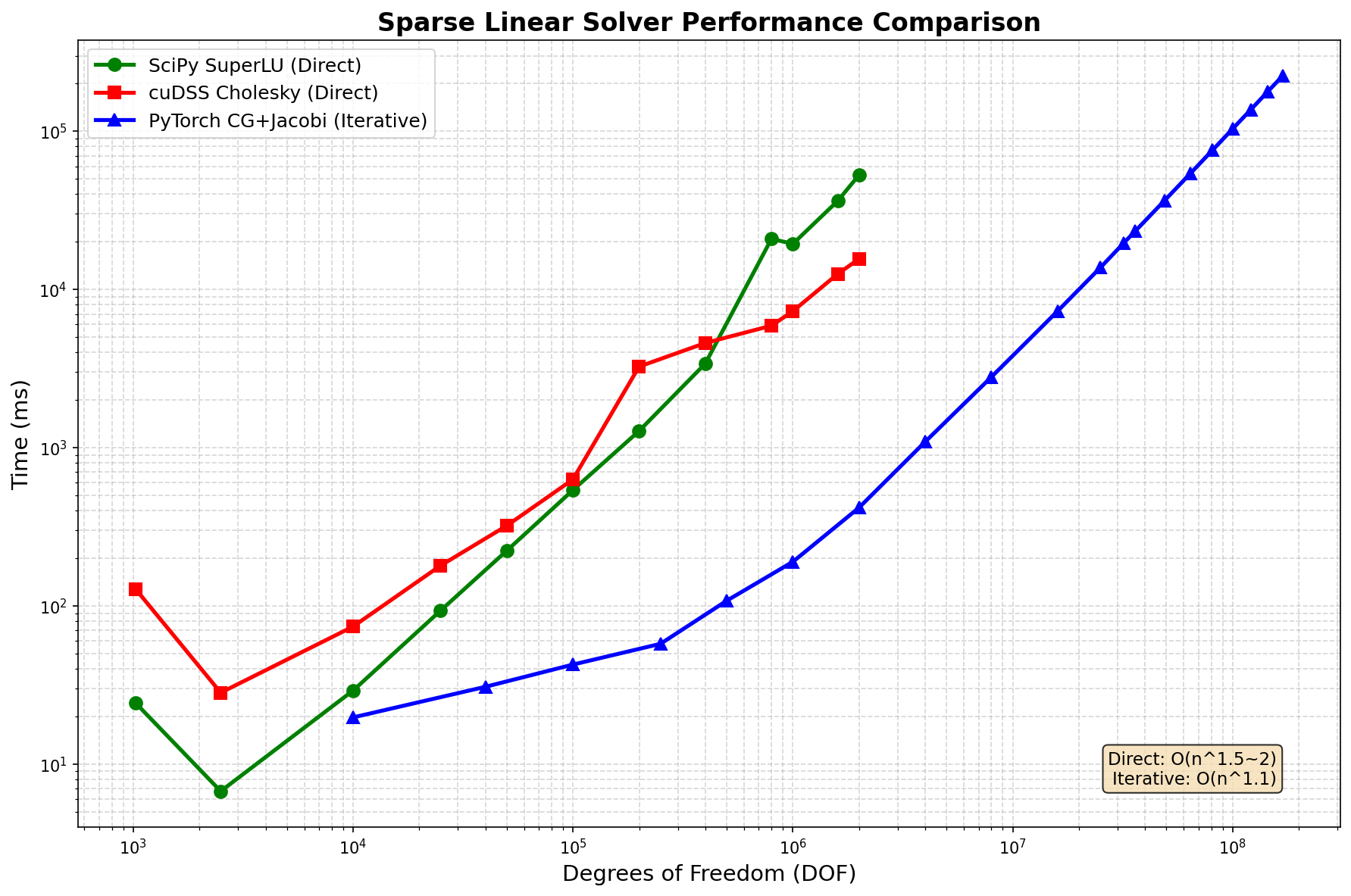
| DOF | SciPy LU | cuDSS Cholesky | PyTorch CG+Jacobi |
|---|---|---|---|
| 10K | 24ms | 128ms | 20ms |
| 100K | 29ms | 630ms | 43ms |
| 1M | 19.4s | 7.3s | 190ms |
| 2M | 52.9s | 15.6s | 418ms |
| 16M | - | - | 7.3s |
| 81M | - | - | 75.9s |
| 169M | - | - | 224s |
Memory Usage
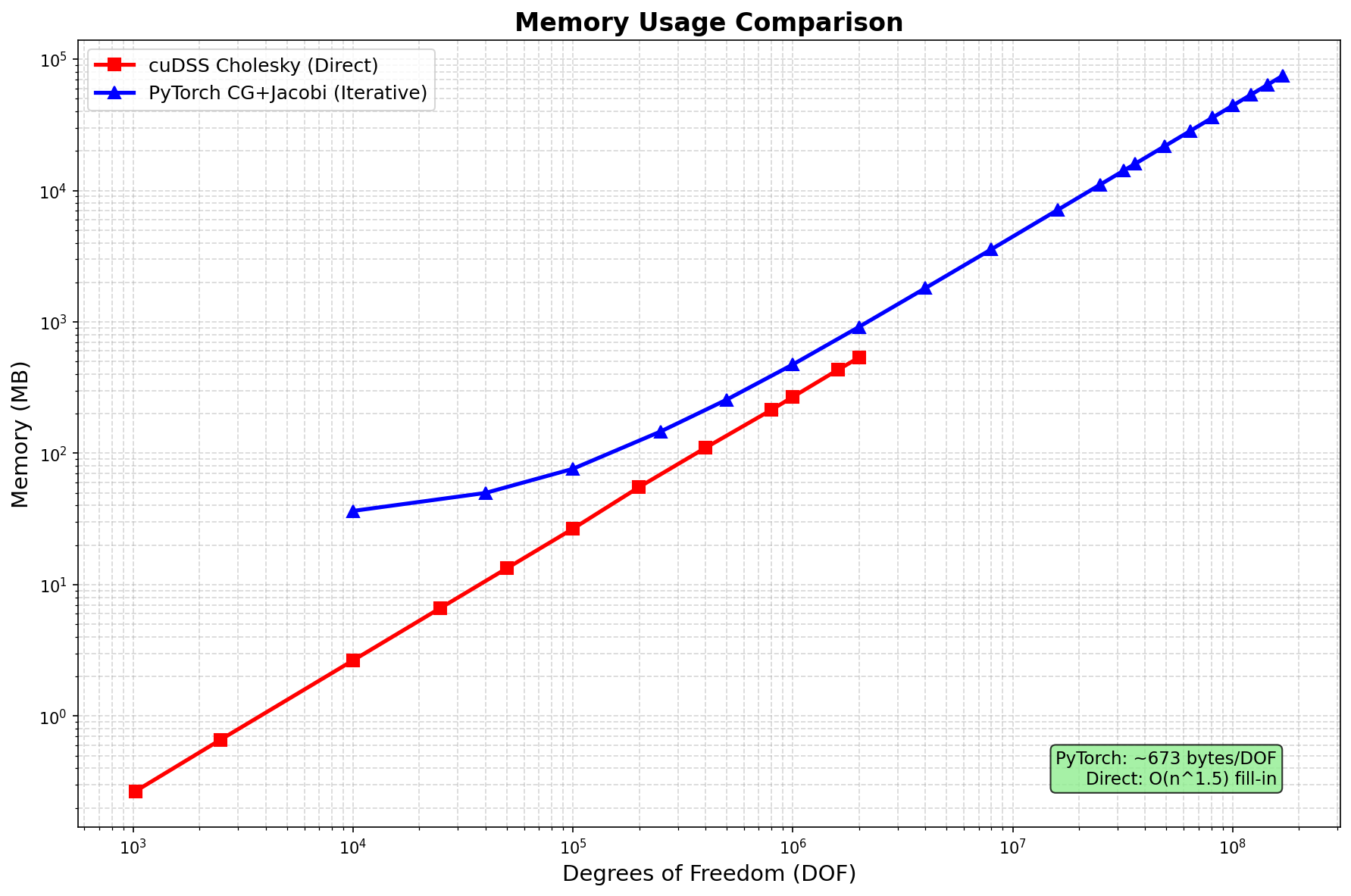
| Method | Memory Scaling | Notes |
|---|---|---|
| SciPy LU | O(n^1.5) fill-in | CPU only, limited to ~2M DOF |
| cuDSS Cholesky | O(n^1.5) fill-in | GPU, limited to ~2M DOF |
| PyTorch CG+Jacobi | O(n) ~443 bytes/DOF | Scales to 169M+ DOF |
Accuracy
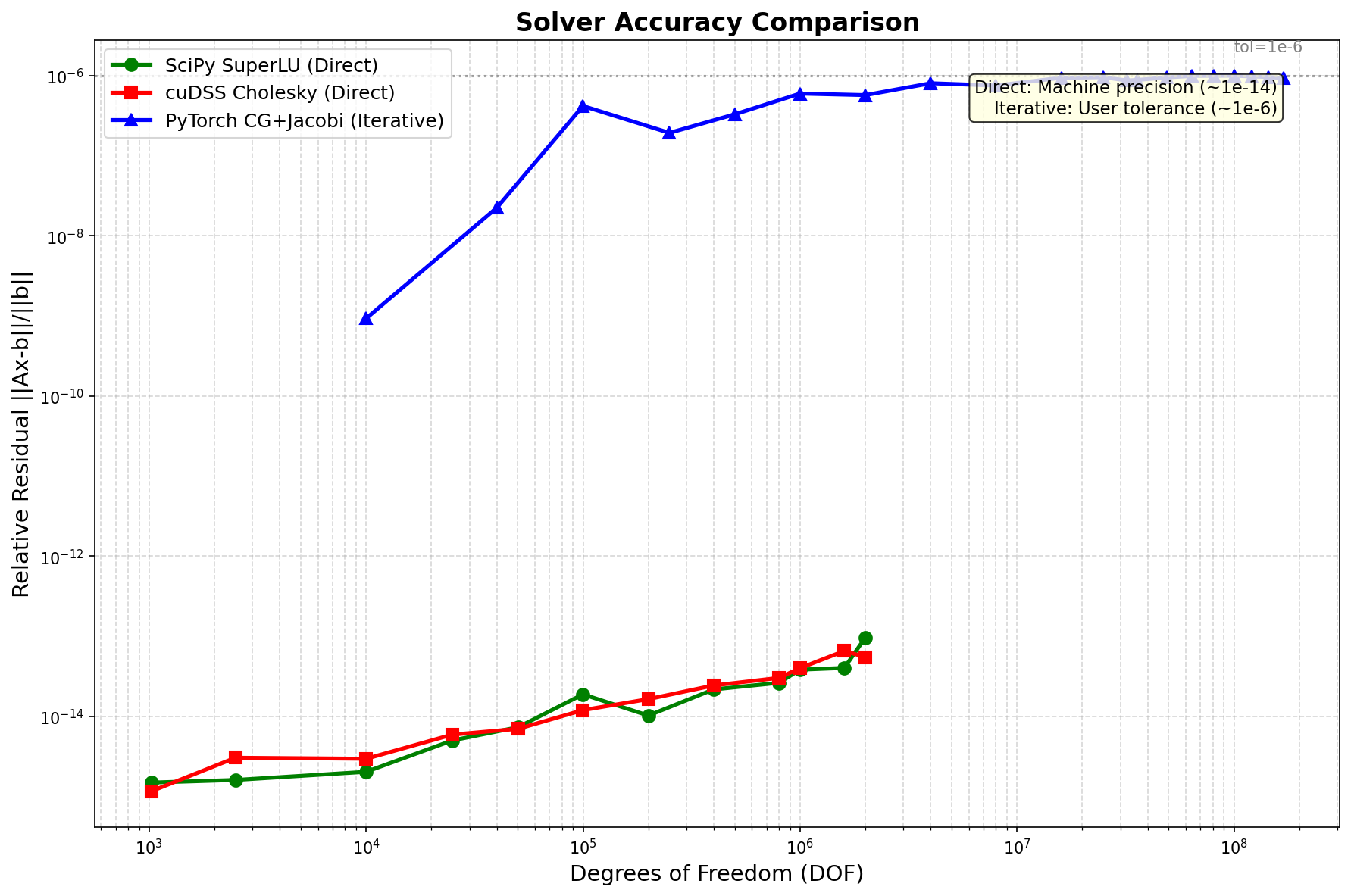
| Method | Precision | Notes |
|---|---|---|
| Direct solvers | ~1e-14 | Machine precision |
| Iterative (tol=1e-6) | ~1e-6 | User-configurable tolerance |
Key Findings
- Iterative solver scales to 169M DOF with O(n^1.1) time complexity
- Direct solvers limited to ~2M DOF due to O(n^1.5~2) memory fill-in
- PyTorch CG+Jacobi is 100x faster than direct solvers at 2M DOF
- Memory efficient: 443 bytes/DOF (vs theoretical minimum 144 bytes/DOF)
- Trade-off: Direct solvers achieve machine precision, iterative achieves ~1e-6
Distributed Solve (Multi-GPU)
3-4x NVIDIA H200 GPUs with NCCL backend:
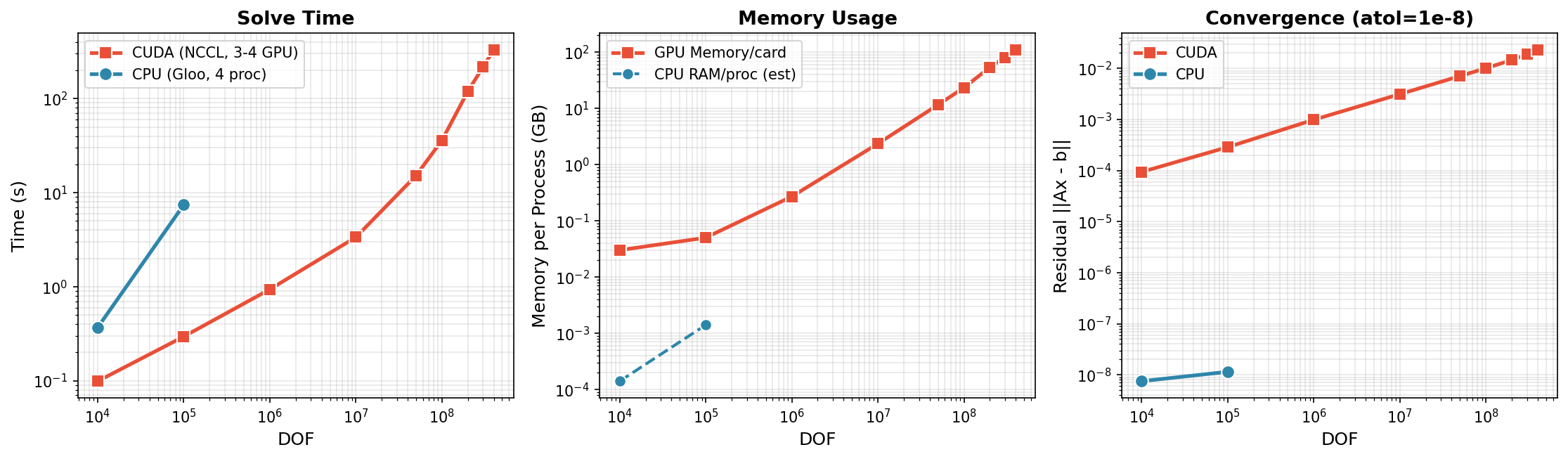
CUDA (3-4 GPU, NCCL) - Scales to 400M DOF:
| DOF | Time | Memory/GPU | Notes |
|---|---|---|---|
| 10K | 0.1s | 0.03 GB | 4 GPU |
| 100K | 0.3s | 0.05 GB | 4 GPU |
| 1M | 0.9s | 0.27 GB | 4 GPU |
| 10M | 3.4s | 2.35 GB | 4 GPU |
| 50M | 15.2s | 11.6 GB | 4 GPU |
| 100M | 36.1s | 23.3 GB | 4 GPU |
| 200M | 119.8s | 53.7 GB | 3 GPU |
| 300M | 217.4s | 80.5 GB | 3 GPU |
| 400M | 330.9s | 110.3 GB | 3 GPU |
Key Findings:
- Scales to 400M DOF on 3x H200 GPUs (110 GB/GPU)
- Near-linear scaling: 10M→400M is 40x DOF, ~100x time
- Memory efficient: ~275 bytes/DOF per GPU
- 500M DOF requires >140GB/GPU, exceeds H200 capacity
# Run distributed solve with 4 GPUs
torchrun --standalone --nproc_per_node=4 examples/distributed/distributed_solve.py
API Reference
Core Classes
SparseTensor- Wrapper with batched solve, norm, eigs, svd methodsSparseTensorList- List of SparseTensors with batched operations and isolated graph priorsDSparseTensor- Distributed sparse tensor with halo exchangeDSparseTensorList- Distributed list for batched graph operations across GPUsLUFactorization- LU factorization for repeated solves
Class Hierarchy

| Single Matrix | List (isolated graph priors) | |
|---|---|---|
| Local | SparseTensor |
SparseTensorList |
| Distributed | DSparseTensor |
DSparseTensorList |
Conversions:
- Horizontal:
to_block_diagonal()/to_connected_components()/to_list() - Vertical:
partition()/gather()
Main Functions
spsolve(val, row, col, shape, b, backend='auto', method='auto')- Solve Ax=bspsolve_coo(A_sparse, b, **kwargs)- Solve using PyTorch sparse tensornonlinear_solve(residual_fn, u0, *params, method='newton')- Solve F(u,θ)=0 with adjoint gradients
Backend Utilities
get_available_backends()- List available backendsget_backend_methods(backend)- List methods for a backendselect_backend(device, n, dtype)- Auto-select backendis_scipy_available(),is_cudss_available(), etc.
Performance Tips
- Use float64 for iterative solvers (better convergence)
- Use cholesky for SPD matrices (2x faster than LU)
- Use scipy+lu for CPU (all sizes)
- Use cudss+cholesky for CUDA (up to ~2M DOF)
- Use pytorch+cg for very large problems (> 2M DOF)
- Use cupy for GPU iterative solvers (CG, GMRES) or as a direct solver fallback
- Use LU factorization for repeated solves with same matrix
- Determinant computation:
- Use CPU for sparse matrices - CUDA requires dense conversion (much slower)
- For CUDA tensors, use
.cpu().det().cuda()for better performance - Use float64 for numerical stability
- Avoid for very large matrices (det values can overflow)
- For distributed matrices, be aware of data gather overhead
- Singular matrices may cause LU decomposition to fail
Requirements
- Python >= 3.8
- PyTorch >= 1.10.0
- SciPy (recommended for CPU)
- CUDA Toolkit (for GPU backends)
- nvmath-python (optional, for cuDSS backend)
- cupy-cuda12x (optional, for CuPy backend)
Performance Tips
Determinant Computation
# ❌ Slow for sparse matrices
det = A_cuda.det()  # 2.5 ms

# ✅ Fast - use CPU even for CUDA tensors
det = A_cuda.cpu().det()  # 1.3 ms (1.9x faster!)
Why? cuDSS doesn't expose sparse determinant, requiring O(n²) dense conversion. CPU sparse LU is O(nnz^1.5), much faster for sparse matrices.
Linear Solve
- Small matrices (< 1000): Use CPU with SciPy backend
- Large matrices (> 1000): Use CUDA with cuDSS backend
- Iterative methods: Use
method='cg'ormethod='bicgstab'for large systems
See benchmarks/README.md for detailed performance analysis.
Contributing
We welcome contributions! Please see CONTRIBUTING.md for:
- Development workflow
- Code conventions
- Testing guidelines
- Benchmark standards
Quick conventions:
- Benchmarks:
benchmarks/benchmark_<feature>.py→results/benchmark_<feature>/ - Examples:
examples/<feature>.py - Tests:
tests/test_<module>.py
See TODO.md for the development roadmap.
License
Apache License 2.0 - Copyright 2024-2026 Mingyuan Chi and Shizheng Wen. See LICENSE.
Citation
If you find this library useful, please cite our paper:
@article{chi2026torchsla,
  title={torch-sla: Differentiable Sparse Linear Algebra with Adjoint Solvers and Sparse Tensor Parallelism for PyTorch},
  author={Chi, Mingyuan and Wen, Shizheng},
  journal={arXiv preprint arXiv:2601.13994},
  year={2026},
  url={https://arxiv.org/abs/2601.13994}
}
Project details


Download files
Download the file for your platform. If you're not sure which to choose, learn more about installing packages.
Source Distribution
Built Distribution
Filter files by name, interpreter, ABI, and platform.
If you're not sure about the file name format, learn more about wheel file names.
Copy a direct link to the current filters
File details
Details for the file torch_sla-0.2.1.tar.gz.
File metadata
- Download URL: torch_sla-0.2.1.tar.gz
- Upload date:
- Size: 144.1 kB
- Tags: Source
- Uploaded using Trusted Publishing? Yes
- Uploaded via: twine/6.1.0 CPython/3.13.12
File hashes
| Algorithm | Hash digest | |
|---|---|---|
| SHA256 |
88894db827752e8a333e781fe837ad192fc349f99f01c3b9c12a51467caf60fa
|
|
| MD5 |
29ec8ca0acda29815f121c8312326467
|
|
| BLAKE2b-256 |
491c0b19b7694ac087a3343720646560555b27f713a88de0fc4ae054d19c7283
|
Provenance
The following attestation bundles were made for torch_sla-0.2.1.tar.gz:
Publisher:
publish.yml on sparsexlab/torch-sla
-
Statement:
-
Statement type:
https://in-toto.io/Statement/v1 -
Predicate type:
https://docs.pypi.org/attestations/publish/v1 -
Subject name:
torch_sla-0.2.1.tar.gz -
Subject digest:
88894db827752e8a333e781fe837ad192fc349f99f01c3b9c12a51467caf60fa - Sigstore transparency entry: 1581043331
- Sigstore integration time:
-
Permalink:
sparsexlab/torch-sla@bdc8c0a9993a41dcdec61503fac6aa3275587826 -
Branch / Tag:
refs/tags/v0.2.1 - Owner: https://github.com/sparsexlab
-
Access:
public
-
Token Issuer:
https://token.actions.githubusercontent.com -
Runner Environment:
github-hosted -
Publication workflow:
publish.yml@bdc8c0a9993a41dcdec61503fac6aa3275587826 -
Trigger Event:
release
-
Statement type:
File details
Details for the file torch_sla-0.2.1-py3-none-any.whl.
File metadata
- Download URL: torch_sla-0.2.1-py3-none-any.whl
- Upload date:
- Size: 123.0 kB
- Tags: Python 3
- Uploaded using Trusted Publishing? Yes
- Uploaded via: twine/6.1.0 CPython/3.13.12
File hashes
| Algorithm | Hash digest | |
|---|---|---|
| SHA256 |
2e30adc554704d4221d23b5acf478d17f2b3b42aee670a780e3e16dd06b62a0d
|
|
| MD5 |
193a36d84e6e7a5b25796af1282db417
|
|
| BLAKE2b-256 |
cae74f86abbabfb200a3d0c8bb4dc1dde163bec1990d931b4f1cf80ecc52cd8a
|
Provenance
The following attestation bundles were made for torch_sla-0.2.1-py3-none-any.whl:
Publisher:
publish.yml on sparsexlab/torch-sla
-
Statement:
-
Statement type:
https://in-toto.io/Statement/v1 -
Predicate type:
https://docs.pypi.org/attestations/publish/v1 -
Subject name:
torch_sla-0.2.1-py3-none-any.whl -
Subject digest:
2e30adc554704d4221d23b5acf478d17f2b3b42aee670a780e3e16dd06b62a0d - Sigstore transparency entry: 1581043620
- Sigstore integration time:
-
Permalink:
sparsexlab/torch-sla@bdc8c0a9993a41dcdec61503fac6aa3275587826 -
Branch / Tag:
refs/tags/v0.2.1 - Owner: https://github.com/sparsexlab
-
Access:
public
-
Token Issuer:
https://token.actions.githubusercontent.com -
Runner Environment:
github-hosted -
Publication workflow:
publish.yml@bdc8c0a9993a41dcdec61503fac6aa3275587826 -
Trigger Event:
release
-
Statement type:






