
TubeAmp
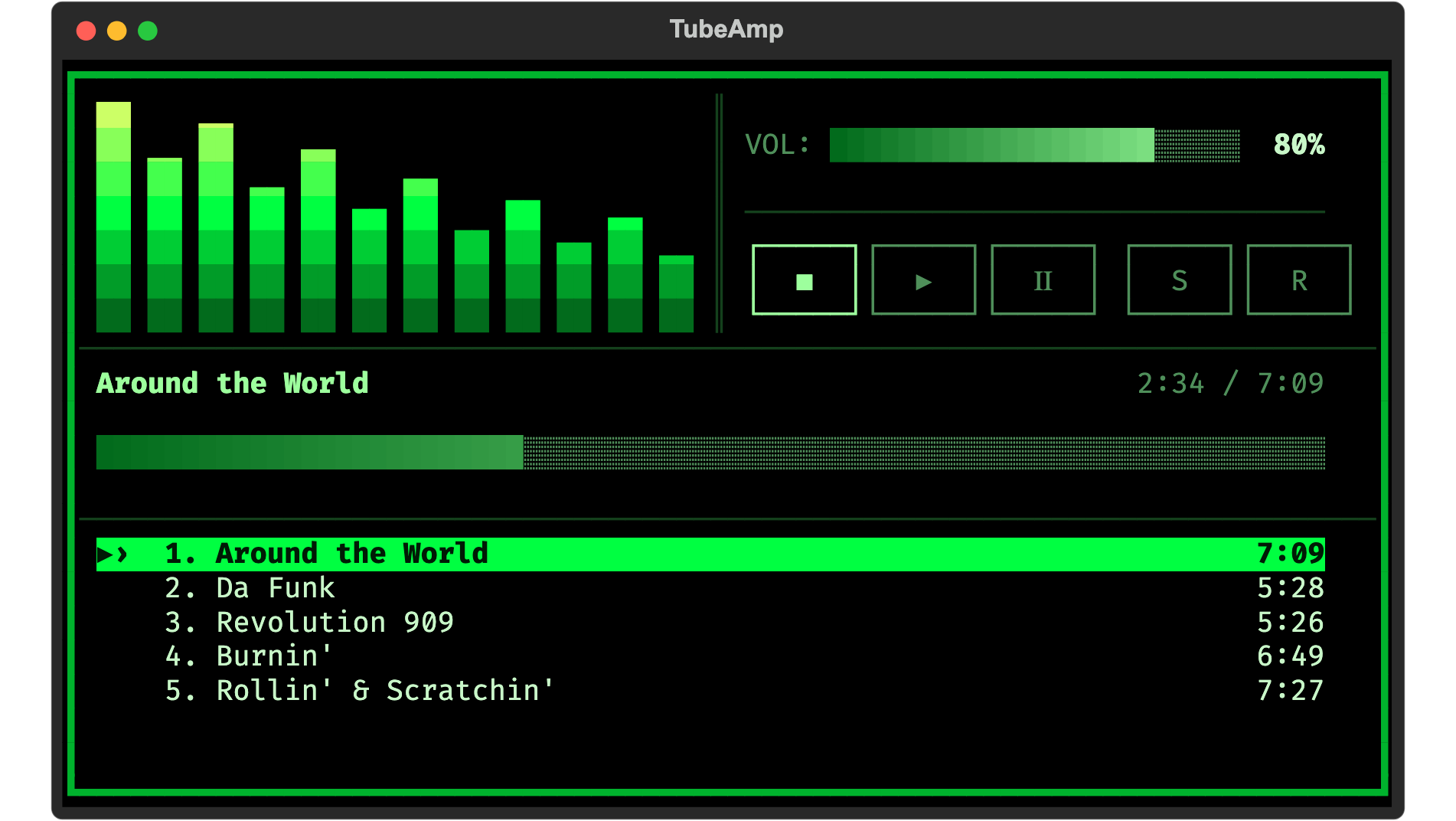
A retro-styled terminal music player that streams audio from YouTube. Think Winamp meets the terminal.
curl -fsSL https://raw.githubusercontent.com/tomekceszke/tubeamp/main/install.sh | bash
macOS and Linux. Installs mpv, ffmpeg and TubeAmp itself, showing every command that
needs sudo and asking before it runs. Then type tubeamp.
Rather read it before you run it? Sensible:
curl -fsSL https://raw.githubusercontent.com/tomekceszke/tubeamp/main/install.sh -o install.sh
less install.sh && bash install.sh
Windows needs WSL2 first — see Installation. Prefer to do it by hand, or already have Homebrew or uv? Quick Start has the manual steps.
Quick Start
The one-liner at the top does all of this for you. By hand, if you would rather:
# macOS — the formula pulls in mpv and ffmpeg for you
brew install tomekceszke/tubeamp/tubeamp
tubeamp

# Linux — system libraries, a tool installer, then TubeAmp
sudo apt install mpv libmpv2 ffmpeg          # Debian/Ubuntu; see below for others
uv tool install tubeamp                      # or: pipx install tubeamp
tubeamp
Windows needs WSL2 first; see Installation.
Features
- Stream audio directly from YouTube (via yt-dlp + mpv)
- Real-time spectrum visualizer (offline FFT analysis, synced to playback)
- YouTube playlist import, search, and lazy-loading queue
- Full keyboard-driven TUI (via Textual)
- 10 dark themes, from CRT phosphor to editor classics (see below)
- Shuffle, repeat (off/all/one), and volume controls
- Configurable via TOML (
~/.config/tubeamp/config.toml)
System Requirements
- Python 3.11+
- libmpv — Audio playback engine, loaded through ctypes (required)
- ffmpeg — Audio decoding for the spectrum visualizer (required)
yt-dlp is a Python dependency and is installed into the virtualenv, so it does not
need to be installed system-wide. TubeAmp puts the virtualenv's bin directory on
PATH at startup so mpv's ytdl_hook finds that copy rather than an older
distribution package.
Installing Dependencies
# macOS — the mpv formula ships libmpv
brew install mpv ffmpeg

# Arch Linux — the mpv package ships libmpv
sudo pacman -S mpv ffmpeg

# Ubuntu/Debian — the mpv package does NOT pull the shared library in,
# and ensurepip lives in a separate package
sudo apt install mpv libmpv2 ffmpeg python3-venv

# Fedora
sudo dnf install mpv mpv-libs ffmpeg
Without the libmpv runtime package TubeAmp refuses to start and names the package to
install for your system. ./install.sh handles all of this and verifies the result
before finishing.
Installation
Nothing here is a binary you have to trust on faith. Every release is built from a tagged commit by a GitHub Actions workflow and published to PyPI through Trusted Publishing, so PyPI shows a Verified provenance marker linking each file back to the commit and the workflow run that produced it.
The install script
The one-liner at the top of this page runs install.sh, which is short
enough to read in a minute and does exactly four things: finds a Python 3.11+, installs
libmpv and ffmpeg through your own package manager, puts TubeAmp in its own virtualenv
under ~/.local/share/tubeamp, and links it into ~/.local/bin.
It shows every command before running it and asks first — including the ones needing
sudo, and before it touches your shell's startup file. It never installs Homebrew for
you; on macOS without it, it stops and points you at brew.sh.
bash install.sh --dry-run     # print the whole plan, change nothing
bash install.sh --yes         # no questions, for scripts and the impatient
bash install.sh --uninstall   # remove it again, leaving ~/.config/tubeamp alone
Re-running it upgrades an existing install. The sections below are the same work done by hand, if you would rather not run someone else's script at all.
macOS
brew install tomekceszke/tubeamp/tubeamp
The formula lives in tomekceszke/homebrew-tubeamp and declares mpv and ffmpeg, so the system dependencies come along with it. No Homebrew? Install it from brew.sh first, or follow the Linux steps below, which work on macOS too.
If playback stops working after a while, YouTube has most likely moved on from the
pinned yt-dlp; brew upgrade tubeamp is the fix.
Linux, and macOS without Homebrew
First libmpv and ffmpeg from your package manager (see Installing Dependencies above). Then an installer for Python command-line tools, if you do not already have one — either works, and both keep TubeAmp in its own environment rather than mixed into your system Python:
curl -LsSf https://astral.sh/uv/install.sh | sh   # uv, read it first if you like
# or, from your package manager:
sudo apt install pipx
Then TubeAmp itself:
uv tool install tubeamp     # or: pipx install tubeamp
tubeamp
If tubeamp comes back as "command not found", the install directory is not on
your PATH yet. Both tools install into ~/.local/bin; uv tool update-shell (or
pipx ensurepath) adds it, and the change takes effect in a new terminal.
Upgrade with uv tool upgrade tubeamp — worth doing when a video refuses to play,
since that is usually a stale yt-dlp.
Windows
Not supported natively: python-mpv loads libmpv-2.dll through ctypes, and the
official mpv build for Windows does not ship that library. TubeAmp runs under WSL2
instead, where the Linux instructions apply unchanged and WSLg handles audio — but
be aware that setting WSL2 up is its own detour, and it needs a reboot:
wsl --install # in PowerShell as administrator, then reboot
After the reboot, in the Ubuntu shell:
curl -fsSL https://raw.githubusercontent.com/tomekceszke/tubeamp/main/install.sh | bash
tubeamp
From source
git clone https://github.com/tomekceszke/tubeamp.git
cd tubeamp
./install.sh
./run.sh
It is the same install.sh, and it notices the difference: run from a checkout it
installs the working tree in editable mode into .venv instead of fetching a release,
so your edits take effect without reinstalling. run.sh rebuilds that virtualenv if a
Python upgrade has left its interpreter symlinks dangling.
First Run
TubeAmp starts with an empty playlist and lists what to press:
/— search YouTube by artist or song, or paste a playlist or video URLh— every keybindingt— theme picker
To load a playlist automatically on startup, set youtube.default_playlist in
~/.config/tubeamp/config.toml.
Usage
tubeamp             # launch the player
tubeamp --version   # report the version without starting the TUI
tubeamp --help      # usage, config path, log path

./run.sh            # from a source checkout
Once running, press / to search YouTube or paste a playlist URL.
Keybindings
| Key | Action |
|---|---|
Space |
Play / Pause |
x |
Stop |
Up / Down |
Navigate playlist |
j / k |
Navigate playlist |
Enter |
Play selected track |
Left / Right |
Seek -/+ 10s |
- / + |
Volume down / up |
, / . |
Previous / next track |
s |
Toggle shuffle |
r |
Cycle repeat mode |
t |
Theme picker |
/ |
Search YouTube |
[ / ] |
Decrease / increase bars |
Page Up/Down |
Scroll playlist page |
Home / End |
Jump to first/last |
F12 |
Save screenshot (SVG) |
h |
Show help |
q |
Quit |
Configuration
Global config at ~/.config/tubeamp/config.toml (auto-created):
[audio]
volume = 80
quality = "bestaudio"

[visualizer]
backend = "analyzed"        # "analyzed" (FFT) or "simulated"
bars = 16
framerate = 30
sensitivity = 100           # percent gain on bar height

[youtube]
cookies_browser = ""        # "firefox", "chrome", etc.
default_playlist = ""       # auto-load on startup

[ui]
theme = "classic"
Working from a source checkout, a local.toml beside pyproject.toml overrides the
global file — handy for a personal default playlist you do not want committed (it is
in .gitignore). It is deliberately ignored anywhere else, so an installed tubeamp
never picks up a stray local.toml from whatever directory you happen to be in.
See local.toml.example.
Themes
Press t to open the picker; each row shows the palette and the player behind
the dialog repaints as you move the highlight, so a theme is judged on the real
UI. Esc puts the original back.
| Key | Theme | |
|---|---|---|
classic |
Classic | green phosphor terminal |
monochrome |
Monochrome | plain white on black |
amber |
Amber | amber CRT |
commander |
Commander | Midnight Commander blue |
cyberpunk |
Cyberpunk | acid yellow, cyan and red |
synthwave |
Synthwave | purple, hot pink and sunset yellow |
htop |
htop | green meters, cyan header, blue-green-red spectrum |
gruvbox |
Gruvbox Dark | |
ayu |
Ayu Dark | electric blue on near-black |
dracula |
Dracula |
Every colour on screen comes from the theme, so a palette also sets the
background, the frame and the spectrum gradient. A config naming a dropped
theme still works: retro resolves to amber, monokai to dracula, and
solarized-dark (like nord) to ayu.
Local overrides in local.toml (not committed, see local.toml.example).
Logging goes to ~/.config/tubeamp/tubeamp.log at INFO level; set
TUBEAMP_LOG_LEVEL=DEBUG for per-frame detail.
Architecture
See ARCHITECTURE.md for detailed design documentation.
Development
# Install with dev dependencies
pip install -e ".[dev]"

# Install the pre-commit hooks
pre-commit install

# Lint, type-check, test
ruff check src/ tests/
mypy src/ tests/
pytest
See CONTRIBUTING.md before opening a pull request.
Disclaimer
TubeAmp is an independent project, not affiliated with, endorsed by or sponsored by YouTube, Google, Winamp or Llama Group. Winamp is referenced only to describe the kind of interface this takes after.
Streams are resolved with yt-dlp. Playing YouTube content outside the official clients may conflict with YouTube's Terms of Service — check what applies where you are, and use it for content you are entitled to access.
License
MIT
1 maintainer

Metadata
1 maintainer
Release files for tubeamp 0.1.3
For a detailed explanation of source distributions (sdists) and built distributions (wheels), please see the package formats documentation.
Source distribution (sdist)
| File | Size | Uploaded | |
|---|---|---|---|
| tubeamp-0.1.3.tar.gz | 62.1 kB | Details |
Built distribution (wheel)
| File | Interpreter | ABI | Platform | Reset |
|---|---|---|---|---|
| tubeamp-0.1.3-py3-none-any.whl | Python 3 | none | any | Details |
Total release size: 117.0 kB
Release files / tubeamp-0.1.3.tar.gz
| Download URL | tubeamp-0.1.3.tar.gz |
|---|---|
| Size | 62.1 kB |
| Tags | Source |
|
SHA-256 checksum How to use checksums |
d20cb516e59c529e188855901c7f38725e8f1761e15c657c27d1a70ecc0ab831
|
|
BLAKE2b-256 checksum How to use checksums |
ff5f7db6e193498fa957a407963d0172e025c21c9df0a4ed62990bc9596ff510
|
| Upload date | |
|
Uploaded using Trusted Publishing? What is trusted publishing? |
Yes |
| Uploaded via |
twine/7.0.0 CPython/3.13.14
|
Provenance
Provenance describes where a file came from. On PyPI, provenance is shared via attestations, which provide a verifiable record of the build or publishing details. View details, limitations and caveats.


PyPI Publish Attestation
PyPI verified that this artifact, at this checksum, originated from the publisher listed below.
Signed by GitHub Actions, verified by PyPI on Sep 10, 2026.
Transparency logRelease files / tubeamp-0.1.3-py3-none-any.whl
| Download URL | tubeamp-0.1.3-py3-none-any.whl |
|---|---|
| Size | 54.8 kB |
| Tags | Python 3 |
|
SHA-256 checksum How to use checksums |
d639faa285d1401fcf4394d3bc3afa747b63b99e9d1e9f54d3d4fb5dd4c60c81
|
|
BLAKE2b-256 checksum How to use checksums |
dbaf8354d036ccca7a76f6d3461f03e88f0c8b8eb5a4dbd45c4dfaec7dcf5b1d
|
| Upload date | |
|
Uploaded using Trusted Publishing? What is trusted publishing? |
Yes |
| Uploaded via |
twine/7.0.0 CPython/3.13.14
|
Provenance
Provenance describes where a file came from. On PyPI, provenance is shared via attestations, which provide a verifiable record of the build or publishing details. View details, limitations and caveats.
PyPI Publish Attestation
PyPI verified that this artifact, at this checksum, originated from the publisher listed below.
Signed by GitHub Actions, verified by PyPI on Sep 10, 2026.
Transparency log













