
Check username availability across multiple popular platforms

Reason this release was yanked:
structure mismatch with standard rules
Project description
User Scanner







A powerful Email OSINT tool that checks if a specific email is registered on various sites, combined with username scanning for branding or OSINT — 2-in-1 tool.
Perfect for fast, accurate and lightweight email OSINT
Perfect for finding a unique username across GitHub, Twitter, Reddit, Instagram, and more, all in a single command.
Features
- ✅ Email & username OSINT: check email registrations and username availability across social, developer, creator, and other platforms
- ✅ Dual-mode usage: works as an email scanner, username scanner, or username-only tool
- ✅ Clear results:
Registered/Not Registeredfor emails andAvailable/Taken/Errorfor usernames with precise failure reasons - ✅ Fully modular architecture for easy addition of new platform modules
- ✅ Bulk scanning support for usernames and emails via input files
- ✅ Wildcard-based username permutations with automatic variation generation
- ✅ Multiple output formats: console, JSON, and CSV, with file export support
- ✅ Proxy support with rotation and pre-scan proxy validation
- ✅ Smart auto-update system with interactive upgrade prompts via PyPI
Virtual Environment (optional but recommended)
# create venv
python -m venv .venv
Activate venv
# Linux / macOS
source .venv/bin/activate

# Windows (PowerShell)
.venv\Scripts\Activate.ps1
Installation
# upgrade pip
python -m pip install --upgrade pip

# install
pip install user-scanner
Important Flags
| Flag | Description |
|---|---|
-u, --username USERNAME |
Scan a single username across platforms |
-e, --email EMAIL |
Scan a single email across platforms |
-uf, --username-file FILE |
Scan multiple usernames from file (one per line) |
-ef, --email-file FILE |
Scan multiple emails from file (one per line) |
-c, --category CATEGORY |
Scan all platforms in a specific category |
-lu, --list-user |
List all available modules for username scanning |
-le, --list-email |
List all available modules for email scanning |
-m, --module MODULE |
Scan a single specific module |
-p, --permute PERMUTE |
Generate username permutations using a pattern/suffix |
-P, --proxy-file FILE |
Use proxies from file (one per line) |
--validate-proxies |
Validate proxies before scanning (tests against google.com) |
-s, --stop STOP |
Limit the number of permutations generated |
-d, --delay DELAY |
Delay (in seconds) between requests |
-f, --format {csv,json} |
Select output format |
-o, --output OUTPUT |
Save results to a file |
Usage
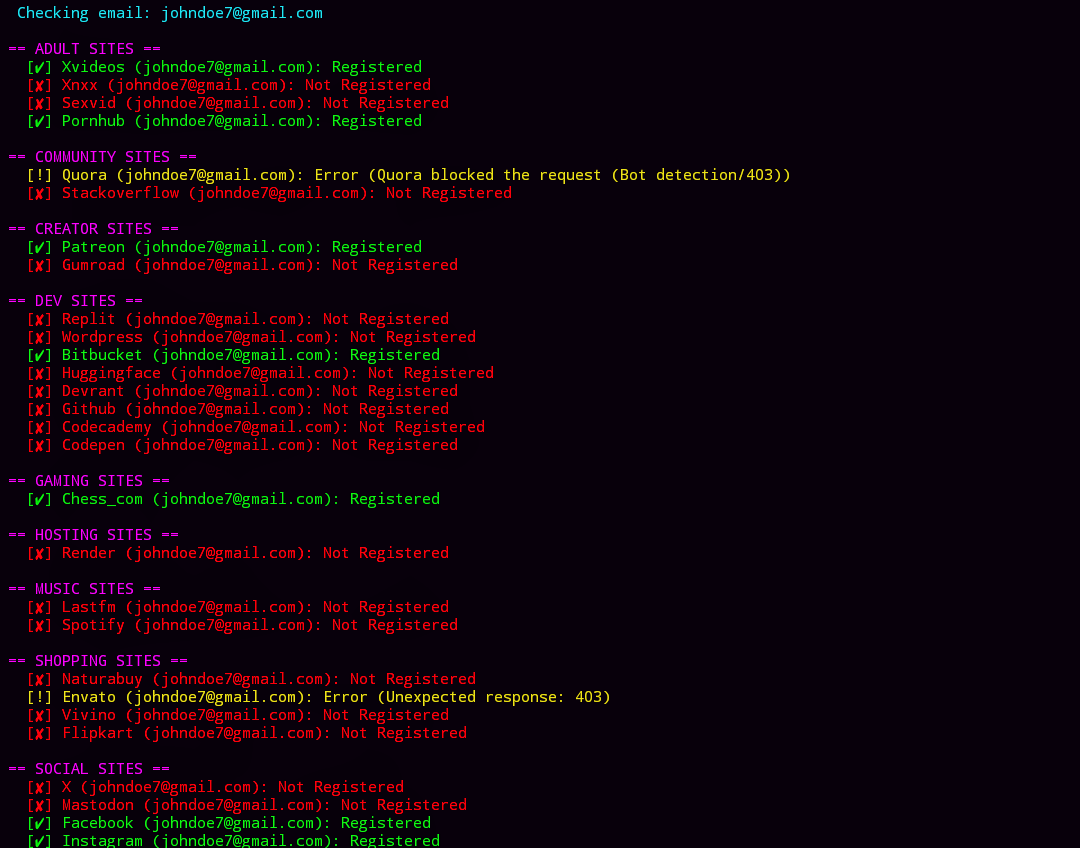
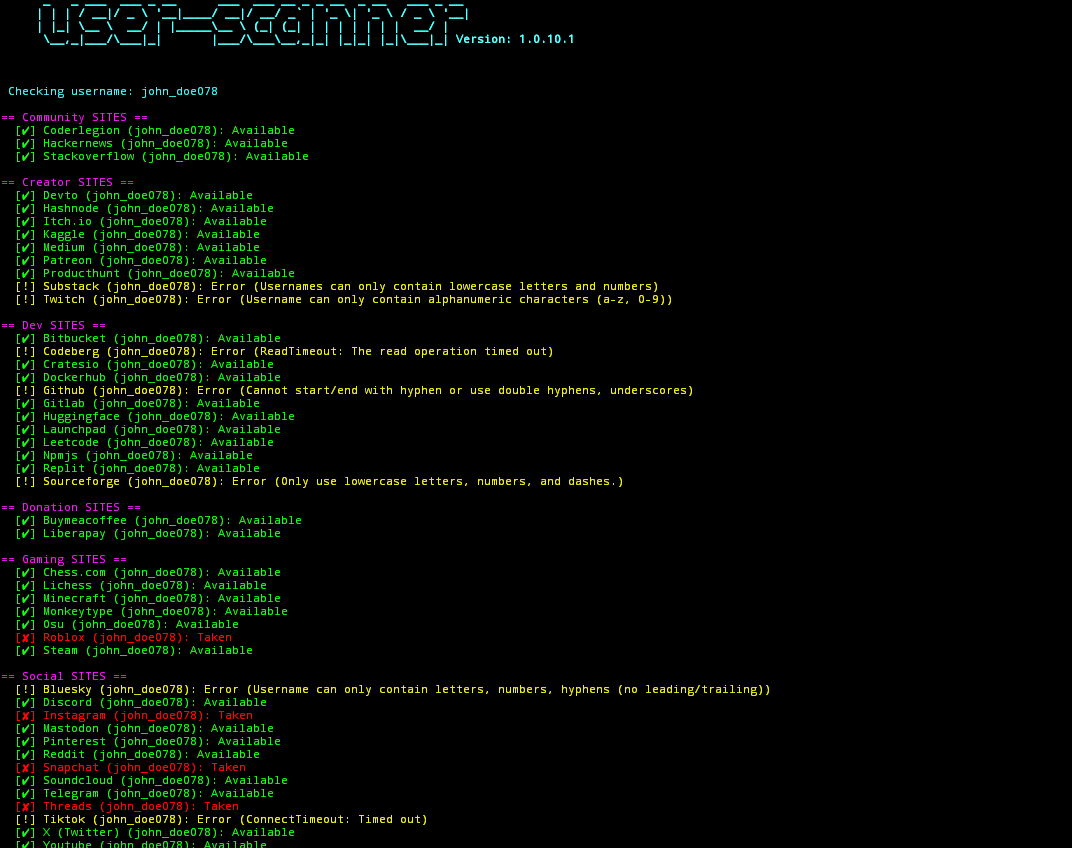
Basic username/email scan
Scan a single email or username across all available modules/platforms:
user-scanner -e john_doe@gmail.com   # single email scanning
user-scanner -u john_doe             # single username scanning
Selective scanning
Scan only specific categories or single modules:
user-scanner -u john_doe -c dev # developer platforms only
user-scanner -u john_doe -m github # only GitHub
Bulk email/username scanning
Scan multiple emails/usernames from a file (one email/username per line):
- Can also be combined with categories or modules using
-c,-mand other flags
user-scanner -ef emails.txt     # bulk email scan
user-scanner -uf usernames.txt  # bulk username scan
Username/Email variations (suffix only)
Generate & check username variations using a permutation from the given suffix:
user-scanner -u john_ -p ab # john_a, ..., john_ab, john_ba
Using Proxies
Route requests through proxy servers:
user-scanner -u john_doe -P proxies.txt
Validate proxies before scanning (tests each proxy against google.com):
user-scanner -u john_doe -P proxies.txt --validate-proxies # recommended
This will:
- Filter out non-working proxies
- Save working proxies to
validated_proxies.txt - Use only validated proxies for scanning
Screenshots:
- Note*: New modules are constantly getting added so screenshots might show only limited, outdated output:
Contributing
Modules are organized under user_scanner/:
user_scanner/
├── email_scan/       # Currently in development
│   ├── social/       # Social email scan modules (Instagram, Mastodon, X, etc.)
|   ├── adult/        # Adult sites
|    ...               # New sites to be added soon
├── user_scan/
│   ├── dev/          # Developer platforms (GitHub, GitLab, npm, etc.)
│   ├── social/       # Social platforms (Twitter/X, Reddit, Instagram, Discord, etc.)
│   ├── creator/      # Creator platforms (Hashnode, Dev.to, Medium, Patreon, etc.)
│   ├── community/    # Community platforms (forums, StackOverflow, HackerNews, etc.)
│   ├── gaming/       # Gaming sites (chess.com, Lichess, Roblox, Minecraft, etc.)
    ...
Module guidelines:
This project contains small "validator" modules that check whether a username exists on a given platform. Each validator is a single function that returns a Result object (see core/orchestrator.py).
Result semantics:
- Result.available() →
available - Result.taken() →
taken - Result.error(message: Optional[str]) →
error, blocked, unknown, or request failure (include short diagnostic message when helpful)
Follow this document when adding or updating validators.
See CONTRIBUTING.md for examples.
Dependencies:
License
This project is licensed under the MIT License. See LICENSE for details.
⚠️ Disclaimer
This tool is provided for educational purposes and authorized security research only.
- User Responsibility: Users are solely responsible for ensuring their usage complies with all applicable laws and the Terms of Service (ToS) of any third-party providers.
- Methodology: The tool interacts only with publicly accessible, unauthenticated web endpoints. It does not bypass authentication, security controls, or access private user data.
- No Profiling: This software performs only basic yes/no availability checks. It does not collect, store, aggregate, or analyze user data, behavior, or identities.
- Limitation of Liability: The software is provided “as is”, without warranty of any kind. The developers assume no liability for misuse or any resulting damage or legal consequences.
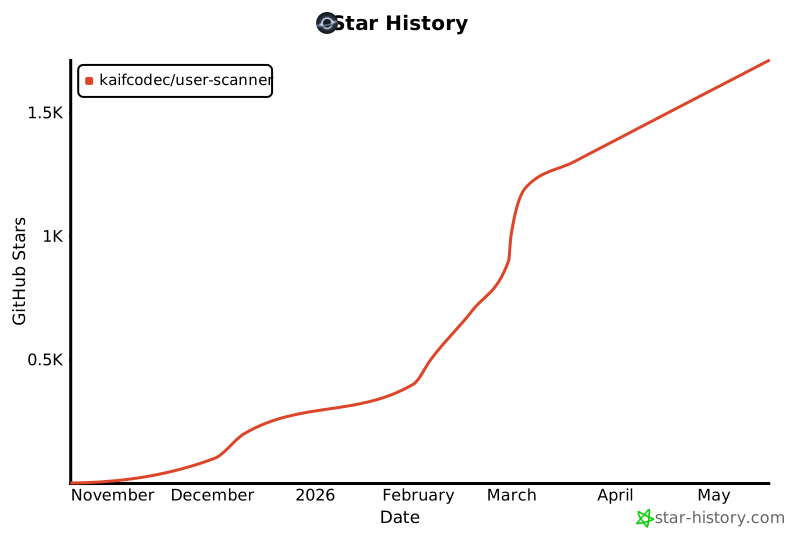
Star History
Release history Release notifications | RSS feed


Download files
Download the file for your platform. If you're not sure which to choose, learn more about installing packages.
Source Distribution
Built Distribution
Filter files by name, interpreter, ABI, and platform.
If you're not sure about the file name format, learn more about wheel file names.
Copy a direct link to the current filters
File details
Details for the file user_scanner-1.1.0.5.tar.gz.
File metadata
- Download URL: user_scanner-1.1.0.5.tar.gz
- Upload date:
- Size: 44.5 kB
- Tags: Source
- Uploaded using Trusted Publishing? No
- Uploaded via: python-requests/2.31.0
File hashes
| Algorithm | Hash digest | |
|---|---|---|
| SHA256 |
bebdb2984068379b3b08658968ecba3b1bbda15e31ebf39715d6950af9d2d2e3
|
|
| MD5 |
c96105a618b5a6d72600873e16397c74
|
|
| BLAKE2b-256 |
08400003d685d42293a174c4853440d6c8aeb7c38cbecebbff6db89fdb002a3c
|
File details
Details for the file user_scanner-1.1.0.5-py3-none-any.whl.
File metadata
- Download URL: user_scanner-1.1.0.5-py3-none-any.whl
- Upload date:
- Size: 102.8 kB
- Tags: Python 3
- Uploaded using Trusted Publishing? No
- Uploaded via: python-requests/2.31.0
File hashes
| Algorithm | Hash digest | |
|---|---|---|
| SHA256 |
d2bbe1e6afc700c30d3c30084dcad8b093aef2deb13074a98377d36a4e265e4b
|
|
| MD5 |
cc5924f147e784afa104a7ec1e20c868
|
|
| BLAKE2b-256 |
5b7636e7c63be1466a5a4d6d42472a51af43ec772ea4da1750090f18380e0938
|






