
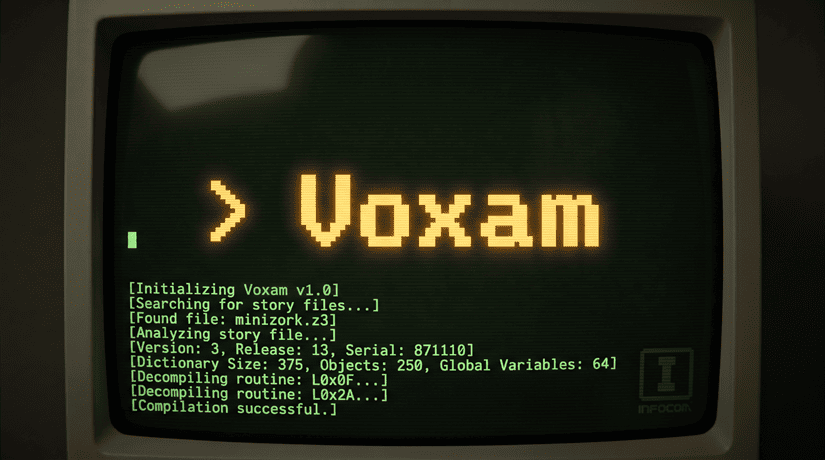
A Specification-Accurate Z-Machine and Glulx Implementation
Early and Late Infocom + Modern Inform
(+ Dialog w/ Å-machine + Arcturus)


Works On








If you find any of this useful, consider leaving a ⭐️ for the repo.
An interpreter for the Z-Machine, for Glulx, and for the Å-machine, written in Python.
Three virtual machines, spanning the whole history of interactive fiction:
- The Z-Machine is the virtual machine Infocom designed in 1979 to run its text adventures, and which the community has used ever since -- the home of everything from Zork to the modern Inform and PunyInform games, and the target of Arcturus, a modern programming language and compiler designed for writing interactive fiction that compiles down to efficient Infocom Z-Machine story files.
- Glulx is the Z-Machine's successor, built to shed its size limits, and the target of today's Inform.
- The Å-machine is a specialized virtual machine created by Linus Åkesson to run interactive fiction written in his Dialog programming language -- the newest of the three.
Voxam reads a compiled story file and executes it, with two guiding commitments:
- Fidelity to the specifications: the Z-Machine Standard, the Glulx and Glk specifications, and the Å-machine, with every rule the interpreter enforces citing the section it came from.
- Reproducibility, so that a recorded play session replays identically, forever.
Voxam is developed against real games. The Zork trilogy, Trinity, A Mind Forever Voyaging, The Hitchhiker's Guide to the Galaxy, and -- filed in triplicate, blood pressure rising -- Bureaucracy have all been played to winning conclusions, several to perfect scores. Arthur draws the sword from the stone in what is, as far as I know, the first seeded, replayable Arthur session anywhere; The Lurking Horror and Sherlock reach perfect scores with their sounds heard aloud; Arthur, Shogun, and Zork Zero render their art in a real graphics window; and even Journey -- Infocom's finale, a game with no command line at all -- replays through its opening chapter as pure keystrokes. Forty-four recordings verify those sessions end-to-end, their annotations doubling as an archaeology of where the games' published walkthroughs go wrong. And now Glulx joins them: Adventure answers at the terminal, and glulxercise says "All tests passed." The Å-machine arrives certified harder still: every test battery its reference implementation ships replays under Voxam byte-identical to the reference engine's own transcripts -- Miss Gosling's Last Case walked three hundred fifty-one commands to its finale among them.
The full ledger -- the current release, what plays, what is certified, and what remains -- lives in STATUS.md; the road here, told era by era, is HISTORY.md; the thinking underneath it all, principles and vocabulary alike, is DESIGN.md; and the setup for working on Voxam itself is CONTRIBUTING.md.
voxam-rs is a port of
this interpreter to Rust, kept in its own repository, and this
implementation is its reference: every seeded session recorded
here is expected to replay byte-identically there, and the
port's parity sweeps prove it rather than assert it. The port
carries PORT.md, its design document, which is also where
Voxam's own extensions to the GlkOte protocol are specified.
That is why a few citations in this codebase read
PORT: What the sidecar carries where the rest name a published
specification: the wire's extensions belong to no standard, so
they are written down once, in the one place both
implementations can be held to.
How to Play
One command, several faces: every face speaks the Z-Machine and Glulx, all but the pygame window speak the Å-machine too, and a story file is all any of them needs:
- At the terminal.
voxam story.z5-- with thescreenextra installed, the painted display takes over: status line, windows, menus, real time.--plainkeeps the classic text stream. - In a window.
voxam --graphics story.ulx-- the pygame window: the illustrated home of the Version 6 games, Glulx's canvases and mouse, and a fine roomy home for everything else. - In a browser.
voxam --web story.gblorb-- a GlkOte tab on your own machine, in your system's own light or whichever you pick, art and covers inlined, saves written beside the story. - As a desktop app. Grab the Voxam installer for your
platform from the
latest release
(Windows, macOS, Linux; unsigned, so expect the usual
first-run nudge). The shell drives the
voxamcommand, so install that first --pipx install voxamoruv tool install voxamputs it on the PATH. - On a wire.
voxam --glkote story.z8-- the whole session as JSON stanzas on stdin and stdout, the seam any GlkOte-speaking host drives down a pipe.
Installation of the command itself is one line -- see Installation -- and the flags' full stories live in Playing stories.
Installation
Voxam requires Python 3.12 or later.
pip install voxam
or, as an isolated tool:
pipx install voxam
If you're using uv managed Python:
uv tool install voxam
And uvx voxam story.z5 runs it without installing anything at
all -- uv fetches the package to its cache, runs the command, and
leaves your PATH untouched, which is the quickest possible way to
try Voxam on a story file.
The painted screen frontend rides in the screen extra, the
pygame window in the graphics extra, and sampled-sound playback
in the sound extra beside them:
pip install "voxam[screen,graphics,sound]"
Again, if you're using uv managed Python:
uv tool install "voxam[screen,graphics,sound]"
On Windows and macOS the sound extra is self-contained; on Linux,
PortAudio comes from the distribution (apt install libportaudio2
or the local equivalent). Without the extras, Voxam plays as a
plain text stream. Every game still works; the status line
simply stays imaginary, and the sound games play in the conforming
silence they were shipped to accept.
Voxam ships no story files. Bring your own: the IF Archive hosts hundreds of freely available games, and story files you own from commercial collections work as-is.
Playing stories
Point Voxam at a story file and play at the terminal:
voxam path/to/story.z3
At a terminal with the screen extra installed, the painted
frontend takes over automatically: status line, windows, menus,
real-time input. Pass --plain to keep the classic stream
instead; pipes and scripted replays always use the stream, which
is what keeps recordings deterministic. And --graphics opens
the pygame window, which is the home of the Version 6 games, and
a fine roomy home for the earlier ones too. --zoom sets how much
of the desktop it takes (0.85 by default; --zoom 0 keeps the
classic compact 80 by 24). --theme sets its ink and paper --
dark by default, or paper, sepia, or classic for the old
pure white on black.
Glulx stories play the same way: a .ulx file or a packaged
.gblorb is recognized by its own magic, and at a real terminal
it earns the painted glass: the Glk window tree drawn across
the whole screen, status grids in place, buffer text wrapping
behind a [MORE] pause, styles in terminal dress, and the
gblorb's AIFF sounds playing when the sound extra is installed:
voxam path/to/story.ulx
--plain keeps the classic stream, buffer text flowing as prose
and grids drawn as blocks, and a piped session keeps it on its
own, which is exactly how the glulxercise certification drives
it. And --graphics opens the pygame window here too: the same
tree in a real window, the fitted faces carrying the styles, the
gblorb's sounds aboard, and a glulx badge on the fram, plus
everything only a window can offer: graphics canvases with the
gblorb's PNG art drawn on, mouse clicks in each window's own
units, and hyperlinks in the reader's blue, selected by click.
The newest face is the browser's. --web serves a Glulx story to
a browser tab over the GlkOte protocol, which is the display library
of Lectrote and the modern web interpreters, shipped inside the
package, nothing to install and no network beyond your own
machine:
voxam --web path/to/story.gblorb
The story's title rides on the tab, its art is served straight
from the gblorb, each turn is one HTTP exchange, and reloading
the page starts the story over; --port moves it off 8080. A
turn that takes long enough to be worth mentioning raises a
working light that counts the seconds, so a page still thinking
is never mistaken for one that has died. The
page arrives in whichever light your system already prefers, and
the chip in the corner offers System, Paper, Sepia, Dark, and
Frotz, which is the DOS Infocom look WinFrotz still opens in:
white on deep blue, with the status bar its exact inverse. The
choice is remembered, and applied before the first paint, so a
chosen ink never flashes the other one on its way in. Each ink
names its own status bar rather than deriving one by inverting
the story, which is what keeps §8.2's line legible on a light
page instead of dissolving into the prose beneath it.
Typing save in the tab asks for a name through the display's
own prompt and writes the Quetzal file beside the story, where
restore -- and every other interpreter -- can find it. And
--glkote speaks the same protocol as JSON lines on stdin and
stdout -- one update stanza out, one event stanza in -- which is
the seam any GlkOte-speaking host drives down a pipe. Both faces
speak the elder machines whole: a .z3 through .z8 plays
beside a .ulx or .gblorb, status line and split windows in
the protocol's own grid, and the Version 6 stage as one scaled
canvas in the art's own coordinates.
A display that asks for it by name gets one thing stock GlkOte
does not carry: a voxam block riding beside the windows, with
the plain facts of the session in it. Where the player stands
(the room's object and its printed name), the command the
machine was actually handed, the score and the turn count, and
one bit that says an undo, a restore, or a restart just broke
the causal thread. It is a feed for the features every display
has had to guess at by reading the transcript (a map, a
notebook, a "take me back to the kitchen"), and it does the
knowing, not the drawing: no graph, no layout, and no
compass-word parsing lives inside Voxam. A display that never
asks for the block never sees it, and no update is ever sent
into being for its sake.
Å-machine stories play the same way: an .aastory is
recognized by its own form and verified by its own checksum
before it runs:
voxam path/to/story.aastory
The terminal is the third machine's home face, wrapped at your
terminal's own width the way the reference frontends wrap;
typing save asks for a filename on the spot and writes an
AASV file any conforming interpreter can revive, restore
reads one back with the story's own header as the identity
gate, and undo is aboard without asking. --web and --glkote
carry the same story to a browser tab or down the wire -- the
desktop shell plays it through that same seam -- with the
story's META bibliography opening the page as its card and its
title riding the tab. The story also wears what its author
dressed it in: the LOOK sheet's bold, its italics (drawn as
underlines, the way Dialog's own debugger draws them), and its
colors as truecolor ink and paper, worn at a real terminal and,
under the display's own colors grant, on the wire as well. A
pipe still gets plain text, because a pipe is not a terminal
and Voxam answers the styling questions honestly per stream.
The dice are the reference
implementation's own, so a seeded Voxam session and a seeded
reference session agree forever.
Add --seed to make the dice reproducible: the same seed and the
same commands produce the same session, every time.
voxam --seed 1137 path/to/story.z3
That promise holds even when the story reseeds itself. A game may
ask for genuine unpredictability mid-session (random 0 in the
Z-Machine, @setrandom 0 in Glulx), and in an ordinary session it
gets exactly that, from the operating system's own entropy. Under
an explicit --seed, the new dice are drawn off the seeded stream
instead, so the whole run stays a function of the one seed given.
It is the only place Voxam knowingly answers a story with
something other than what the specification asks for, and it is
narrow on purpose: --seed already overrides the same rule at
game start, a session without the flag is untouched, and without
it the flag would make a promise the interpreter quietly broke.
Blorb resources ride along automatically: a .zblorb story boots
from its package, and a like-named .blb beside a story file is
found on its own and, if the names differ, then --resources names
one explicitly. A packaged iFiction record greets the player as a
card before play -- title, headline, author, and the blurb, the
little window WinFrotz shows -- standing under the cover art in the
browser and the shell, and printed with the banner at a painted
terminal. The plain stream keeps its machine-readable quiet: a
record may quote anything, so no free-form bibliography reaches
a pipe.
At a painted terminal a packaged cover picture shows before play;
--pixels draws it in real pixels after asking whether the
terminal speaks sixel, falling back to half-blocks when it
does not. --interpreter claims any §11.1.3 platform by name or
number, and --tandy sets the bit that makes early Infocom games
mind their manners.
And before playing anything, --header reads a story's own
manifest (§11.1) and reports it:
voxam --header path/to/story.z3
Release and serial answer "which version of this game is this?"
in one command -- the question the corpus's release-archaeology
keeps asking -- while the checksum is computed as §15's verify
opcode would and judged against the stored word, so a corrupt
download announces itself before it wastes an evening. Every
table address arrives with its Standard citation, and the
courtesies the game asks for -- pictures, sound, undo, a mouse,
menus -- are decoded from the flags as the compiler shipped them,
before any interpreter stamps in capabilities of its own. Packaged
.zblorb stories work as-is.
--babel names the story instead: its IFID, computed by the
Treaty of Babel's own per-format rules: the UUID:// brand
where one is burned in, the human-readable legacy identities like
ZCODE-88-840726 from the header numbers otherwise. And, when
a blorb carries an iFiction record, the record's IFID first with
its title, author, and headline beside it. Unlike the Z-Machine's
own reports, this one speaks all three machines: an .aastory's
embedded IFID unwraps from the header where one is burned in:
voxam --babel path/to/story.gblorb
The same identities name the session itself: a game the iFiction record or the Infocom catalog knows plays under its own title, in the terminal's title bar and the pygame window's alike.
And --decompose reads a resource file apart: a .zblorb,
.gblorb, .blb, or .blorb, packaged story or sidecar alike,
and an .aastory census in the same dress, its header's claims
and its dictionary's word count read from the chunks themselves:
voxam --decompose story.zblorb
Every chunk is listed in file order with whatever Voxam's own
decoders can say about it: the packaged story's version, release,
and serial read from its own header; each picture's pixel size
with the Fspc cover credited; each AIFF's shape and duration with
the Loop chunk's repeats credited; and the descriptive chunks in
their own words: the iFiction record, the release number, even
the wide-charactered story name and Infocom's own copyright
lines in the old .blb sets. Add --extract to free the
contents as ordinary files; either into the current directory, or
one named after the flag, created if need be:
voxam --decompose story.zblorb --extract art/
Each resource lands in the format its bytes already are, ready
for a viewer or a player: pict-1.png, snd-4.aiff (the FORM
re-framed whole, so it opens anywhere), story.z8 or
story.ulx under the story's own version, and the iFiction
record as ifiction.xml. A file already standing is never
overwritten; it just earns a note and the rest proceed.
Deeper than the manifest, --listing disassembles the whole story
txd-style: every routine with its locals, every opcode with its
operands drawn for what they mean (call targets and jump
destinations as the $addresses they reach, variables by name,
inline text decoded), then the encoded strings that follow the
code:
voxam --listing path/to/story.z3
Nothing in a story file says where its routines are, so they are found the way Mark Howell's txd found them: by decoding. A trial decode accepts an address as a routine only when every instruction holds together, the region grows through constant call operands to a fixed point, and whatever refuses to decode is reported as data rather than skipped. Zork I lists its full 440 routines, exactly txd's own count. The listing is the excavation tool for games whose source never shipped: when an expedition stalls, the routine that decided can now be read.
The listing has a live sibling: --trace rides any session --
live play or a replayed recording -- and writes every instruction
the machine actually executes to a file, rendered exactly as the
listing renders it, interrupt routines included, closing with a
tally of instructions run and distinct addresses touched:
voxam --accept recording.accept --trace session.trace
A replayed recording makes the trace a golden one: when another interpreter disagrees with Voxam about a story, the first differing line of their traces is the bug. And when a session halts, the trace's last line is the instruction that halted it. The two halves agree with each other too: every address a session executes appears in the static listing, which is also how you learn that one full walkthrough of a game may touch barely a third of its code.
Typing save in a game writes a Quetzal file beside the story --
zork1.z3 saves to zork1.sav -- and restore reads it back.
Quetzal is the standard interchange format, so saves travel between
Voxam and other interpreters.
The session files live beside the story the same way. Typing
script in a game -- the command every Infocom manual documents
for keeping a paper log -- writes the transcript to zork1.scr,
opening with Infocom's own "Here begins a transcript" banner and
closing at unscript; the player's commands appear between the
game's text exactly as §7.1.1.1 asks, and 'Flags 2' bit 0 holds
the stream's status at every moment, however the game works it. This
is the §7.4 rule A Mind Forever Voyaging depends on. Output stream
4 records the player's commands to zork1.cmd as they finish,
and §10.2's input stream 1 plays such a file back, line by line
in the very format stream 4 writes, reverting to the keyboard
when the file runs dry. Nothing is created unless the game asks:
a session that never touches the streams leaves no files behind.
The desktop shell
Voxam's native shell is a Tauri webview
wearing the same GlkOte display the browser face wears, driving
a spawned voxam --glkote down a pipe. Every release tag builds
its installers (Windows, macOS, Linux; unsigned) and attaches
them to the GitHub release beside the wheel.
The shell drives the voxam command -- uv tool install voxam or
pipx install voxam puts it in place. It looks on the PATH first,
then in the bin dirs those installers use (~/.local/bin and the
rest), then asks your login shell to resolve it, since an app
launched from the Dock or Finder never inherits a terminal's
PATH. Set VOXAM_BIN to an explicit path to skip the search. It
says so plainly when nothing turns up.
Open a story from the landing page or the File menu -- the
picker starts at the stories' own home, a pinned folder or
the last story's, so a save elsewhere never drags it away;
File > Restart Story starts it over, exactly as a reload does in
the browser face, and every story that can be named plays under
its Babel title on the title bar. The Story menu claims a §11.1.3
platform (the --interpreter flag's own roster) and sets the
legendary Tandy bit; a changed claim restarts the open story on
the spot, since the identity belongs to the booting machine --
and a Glulx story simply ignores it. The Display menu dresses the
page -- the story's type and size, the ink it is set in (paper,
sepia, dark, or frotz), and the measure of its column -- applied
live, remembered across sessions. The gblorb's art draws in the shell
exactly as in the browser, the pictures riding the updates
themselves. And a Glulx story's save opens a real save dialog
-- the desktop's own power, since the picker and the interpreter
share a filesystem -- the chosen path answering the protocol's
file prompt, so saves and restores work exactly as at the
painted glasses. And the Z-Machine saves there too: §15's save
and restore learned the same standing-down the reads learned,
asking for their files through the protocol's special input, so
a Zork saved in the shell is a real Quetzal on disk, restored
through the same picker.
Building the shell from source is in CONTRIBUTING.md.
Best played with
--interpreter is not a costume. Infocom's Version 6 games carry
genuine per-machine code paths, chosen at startup from the
header's interpreter number, and the flag picks which 1989 machine
Voxam is pretending to be. Recommendations, earned from the games'
own source rather than folklore:
- Shogun: the default. Its own
DISPLAY-BORDERroutine draws the right decorative rail only on the IBM machine path; claiming--interpreter amigaover the IBM picture set gives a left-rail-only screen -- Infocom's authentic Amiga behaviour, whose matching art this Blorb does not carry. - Zork Zero: either, with character. The default plays the
classic look;
--interpreter amigaengages §8.3's shared color pair and the under-cursor color sampling for the grey-parchment look the Amiga release was famous for. Both render correctly -- the Amiga is arguably the prettier way in. - Beyond Zork: any -- the flag is a personality dial. The game reshapes its whole screen model per machine (§11.1.3, §16), so each identity is a different-feeling session.
- Early version 3 games:
--tandyfor the lore. The legendary bit that makes them mind their manners -- Zork I literally prints a different licence line.
None of these are bugs routed around: they are the games' own branches, preserved and selectable.
Acceptance scripts
A live session can be written down as it is played, and replayed later:
voxam --record my-session.accept path/to/story.z3
voxam --accept my-session.accept
--record captures every line typed and key pressed -- at the
plain stream or the painted terminal alike -- flushed input by
input, so even a session that ends in a death leaves a replayable
script up to its last keystroke. A recording needs a seed to
replay, so --record without --seed rolls one and writes it
down; the banner names it. An existing file is never overwritten,
and the rare input the script grammar cannot spell exactly draws a
warning rather than being silently mangled. A recorded session is
also the raw material for a curated one: scripts are just text, so
trim the wrong turns, add annotations, and keep the seed.
An acceptance script is a plain text file of typed commands plus a few directives:
! SEED=99
! GAME=path/to/story.z1

# Comments annotate the session; blank lines are ignored.

x me. x mailbox            # inline comments start at whitespace + #
> open mailbox             # the > prefix is optional transcript style
The rules, line by line:
! KEY=VALUEis a directive:GAMEnames the story file to run, andSEEDfixes the dice (a--seedargument overrides it). A relativeGAMEpath counts from the script's own directory, and forward slashes work on every platform.#at the start of a line is a comment.- An inline comment begins at whitespace followed by
#. - A leading
>is optional and stripped; it also escapes the rare command that genuinely begins with#or!. A>alone types an empty line: the enter key. <up>,<down>,<left>,<right>, and<escape>press special keys, one line per press -- how a recording drives Beyond Zork's menus and builds its characters. A token naming no known key fails loudly, and the> <up>prompt form stays a literal command for a game that really wants angle brackets.- A line starting with three backticks is a fence: everything until the next fence is skipped entirely, directives included. Text after the backticks labels the fence, and an unclosed fence skips the rest of the file -- handy while working out a section that a seed change will invalidate, or to replay only the start of a longer script.
- Anything else is typed into the game exactly as written.
- When the commands run out, the session ends as if the player had reached end of input.
While curating a longer session, --replay types the script and
then leaves you at the prompt instead of ending, so a
work-in-progress script catches you up to where you left off:
voxam --replay some-session.accept
And when a session has to stop -- or a wrong turn needs cutting --
--resume is that whole expedition loop as one flag:
voxam --resume my-session.accept
It replays the script to its last line, hands you the prompt, and appends everything you type to the same file. Trim the bad tail in an editor, resume, and press on: a recording grows append-only, under its own seed, across as many sittings as the game demands.
RegTest scripts
Voxam also speaks RegTest, Andrew Plotkin's public-domain regression-test format for interactive fiction -- and speaks it twice over. A RegTest script of named tests, commands, and per-turn checks runs through the built-in in-process runner on any platform:
voxam --regtest my-suite.regtest
or through Plotkin's own reference implementation driving
voxam --plain over pipes on POSIX systems, same file, same
verdict. The in-process runner boots a fresh machine per test at
in-process speed, reports failures in the reference's own voice,
and reaches further than the reference's dumb-terminal mode can:
keystroke input works, because a sent line lands on the same
input seam a recording uses. The regtest/ directory holds
certified scripts that continuous integration runs under both
implementations and holds to the same verdict -- plus an Arthur
script only the built-in runner can follow, since v6's inline
keystroke prompts defeat pipe-based prompt framing. A seed on the
script's ** interpreter: line makes the whole suite
deterministic under both runners, which is not a thing most
interpreters can offer RegTest at all.
Refusal warnings
During a replay, Voxam listens for the parser's refusal dialect -- responses like "You can't see any statuette here!" or "You should close it first" that mean a recorded command did not do what it said. Each one is reported with the script line that drew it:
voxam: line 31: 'lock door' looks refused: You should close it first.
Refusals scroll past a human reader without registering, and the missing side effect may not surface until dozens of turns later. The warning points at the moment it happened, which turns the most common recording bug from an archaeology expedition into a one-line fix.
Measuring the machine
--benchmark rides any session and reports the machine's own pace
when it ends:
voxam --accept acceptance/zork1-r88-s840726.accept --benchmark
voxam: 312,349 instructions in 0.5s (585,872 per second)
The instruction count comes first because it is the honest half: a seeded session executes exactly the same instructions every time, on every machine, so two runs are comparable even when the seconds are not. The seconds and the rate are what an optimization has to move. A recording makes the fixed workload the measurement needs, so the corpus doubles as the bench.
It rides the Z-Machine and Glulx at the blocking faces. The Å-machine refuses it by name, alongside the acceptance driver and the tracer, and the wire faces are a later road.
Probing a recording
When a recording goes wrong -- a death that survives every retry, a
walkthrough command the game will not speak -- the fix is empirical,
and voxam.probe is the instrument. A seeded script is a
deterministic timeline, so a probe can replay the recorded prefix
exactly and then ask "what would happen if...?", as many times as it
takes:
from voxam.probe import Probe

probe = Probe.load("acceptance/advent.accept")
run = probe.attempt(["ne", "give eggs to troll", "ne"], drop_last=2)

for step in run.steps:
    line = step.response.strip().splitlines()[0] if step.response.strip() else ""
    flag = f"  <<< {step.refusal}" if step.refusal else ""
    print(f"[{step.command}] {line}{flag}")
Each step pairs a typed command with everything the story said
back, and flags any response spoken in the refusal dialect --
which turns a hundred-command stretch into a one-screen diagnosis.
attempt replays the script and tries a variant tail
(drop_last re-tries the ending without editing the file);
run takes the whole command list for surgery the prefix cannot
express, such as inserting turns mid-timeline; and the returned
machine is left standing for post-mortem reads of globals,
object parents, or the clock. Every run boots fresh from the seed,
so no experiment can contaminate another.
Probe scripts themselves are throwaways -- write one in a scratch
file, find the answer, record the fix in the .accept annotations,
and delete it. The harness is the part worth keeping.
The filmstrip
Any recorded walk can be photographed. --shots DIR rides
--accept: the script replays at the real pygame glass --
driven, so no [MORE] waits on a player -- and every settled
turn saves a numbered frame, the boot screen first and the final
response last. Add --browser (a path, or bare to find one on
this machine) and the same walk shoots the web display instead:
the wire's own updates render through the shipped glkote.js in
your browser's headless mode, one launch per frame, both
machines welcome.
voxam --accept bronze.accept --shots strips/before
voxam --accept bronze.accept --shots strips/after --browser
voxam --strip-diff strips/before strips/after
--strip-diff decodes every same-named frame with Voxam's own
PNG reader and compares pixel by pixel: differing frames each
get a line with a tally, frames only one strip holds are named,
and the verdict says where the strips part. The exit code speaks
RegTest's contract -- 0 identical, 1 parted -- so a regression
sweep can gate on it: photograph the corpus before a change,
photograph it after, and read only the frames that moved. A
driven, seeded walk reproduces to the pixel, and a glass strip
needs no screen at all: set SDL_VIDEODRIVER=dummy and the
window photographs in memory. One honest caveat rode home with
the feature: Version 6 games can read their presentation into
their own randomness, so a walk recorded at one face may
diverge at another -- the strip keeps every frame it earned and
says where it broke, and strips compare face-to-same-face.
Development
The contributor's setup lives in CONTRIBUTING.md: the environment and the task table, the project conventions, the pre-commit hooks and the commit message rules, and the optional reference material Voxam is developed against.
🪄 The Name


The name Voxam draws from two sources of inspiration:
- From Latin, vox means "voice," evoking the idea of turning a player's command into action, like voice into magic.
- In Zork: Grand Inquisitor, voxam was a spell meaning "to separate the energies of different magics." That maps well to the process of parsing, breaking down a command into meaningful parts, isolating intent from raw text.
So whether seen as linguistic alchemy or parser sorcery, VΘXΔM stands at the intersection of command and consequence; of input and invocation.

In terms of a few more historical details, the VOXAM spell has a hilarious relevance in Zork: Grand Inquisitor: it's a complete joke and serves absolutely no functional purpose in the main game. When you first receive your spellbook from Y'Gael at the bottom of the well, VOXAM is one of the three starting spells written inside (alongside REZROV and IGRAM). According to the in-game lore, it belongs to the class of High Magic and, as stated earlier, is defined as a spell to "separate the energies of different magics."
Its actual relevance breaks down into two categories:
- In the Main Game: Pure Flavor & Trolling. While you use REZROV to open the very first locked door and IGRAM to turn purple things invisible later on, VOXAM can't be cast successfully on anything.
- The Developer Joke: The developers included it purely as world-building flavor to pad out your initial spellbook and to trick players into trying it on various magical anomalies throughout the Great Underground Empire.
Also worth mentioning is the "Booznik" System. Later in the game, you discover that the Grand Inquisitor has "Boozniked" (reversed) all magic. If you were theoretically able to reverse VOXAM, it would mean "conjoin the energies of different magics," but the spell remains entirely useless to your inventory.
So: a spell defined as separating the energies of different magics, that generations of players cast hopefully at every anomaly in the Great Underground Empire, and that never once worked on anything -- until now. Point this one at a story file and it separates raw Z-code into opcodes, operands, and intent, exactly as advertised.
Twenty-nine years later, the spell finally works on something.
Chris McDonald, in Techno History, wrote:
"Humans are ceaseless borrowers and copiers. Perhaps, contra Ecclesiastes, there is an occasional new thing under the sun, but certainly humans think no new thoughts ex nihilo. And yet we are also ceaseless inventors. We combine existing ideas in new ways or place them in new surroundings, and suddenly the old becomes new, in a wonderful alchemy of the mind."
A borrowed machine, a borrowed spell, a borrowed voice -- combined in new surroundings until the old became new. VΘXΔM is that alchemy, practiced on Z-code.
👨💻 Author
Made with 🤍 by Jeff Nyman



☦️ Doxazein (δοξάζειν)
חֶסֶד וֶאֱמֶת אַל־יַעַזְבֻךָ קָשְׁרֵם עַל־גַּרְגְּרֹתֶיךָ כָּתְבֵם עַל־לוּחַ לִבֶּךָ
"Let not mercy and truth forsake thee:
bind them about thy neck;
write them upon the table of thine heart."
Proverbs 3:3
🕹️ Acknowledgements
This project stands on the shoulders of the team at Infocom, the MIT-born company that invented the Z-Machine to let Zork, and everything that followed, run unmodified across nearly every computer of its era. Particular thanks go to Marc Blank and Joel Berez, who designed the Z-Machine's virtual architecture, and to Tim Anderson, Bruce Daniels, and Dave Lebling, whose work on Zork at MIT gave the format a reason to exist. Thanks also to Graham Nelson, whose Inform language and Z-Machine Standards Document kept the format alive and well-documented long after Infocom itself was gone, making implementations like this one possible.
⚖️ License
The code used in this project is licensed under the MIT license.
Note: This license applies only to the code in this repository. The original Z-Machine concept, design, and any original assets belong to their respective copyright holders.
✨ Long live the classics.
1 maintainer

Metadata
1 maintainer
Release files for voxam 2.6.0
For a detailed explanation of source distributions (sdists) and built distributions (wheels), please see the package formats documentation.
Source distribution (sdist)
| File | Size | Uploaded | |
|---|---|---|---|
| voxam-2.6.0.tar.gz | 601.1 kB | Details |
Built distribution (wheel)
| File | Interpreter | ABI | Platform | Reset |
|---|---|---|---|---|
| voxam-2.6.0-py3-none-any.whl | Python 3 | none | any | Details |
Total release size: 1.2 MB
Release files / voxam-2.6.0.tar.gz
| Download URL | voxam-2.6.0.tar.gz |
|---|---|
| Size | 601.1 kB |
| Tags | Source |
|
SHA-256 checksum How to use checksums |
44b18c32dfa7053e4ee1aae3cde1a082fa6d6daac24c278d27b4d28b80c42d2b
|
|
BLAKE2b-256 checksum How to use checksums |
dd739f4d1bd8d30c51cdc1ceee6ff7f86bbc1f08160e087b1ae1fb46329cdd61
|
| Upload date | |
|
Uploaded using Trusted Publishing? What is trusted publishing? |
Yes |
| Uploaded via |
twine/7.0.0 CPython/3.13.14
|
Provenance
Provenance describes where a file came from. On PyPI, provenance is shared via attestations, which provide a verifiable record of the build or publishing details. View details, limitations and caveats.


PyPI Publish Attestation
PyPI verified that this artifact, at this checksum, originated from the publisher listed below.
Signed by GitHub Actions, verified by PyPI on Aug 31, 2026.
Transparency logRelease files / voxam-2.6.0-py3-none-any.whl
| Download URL | voxam-2.6.0-py3-none-any.whl |
|---|---|
| Size | 629.6 kB |
| Tags | Python 3 |
|
SHA-256 checksum How to use checksums |
d41658e084f2874dcad76a59f9c2eb4ea68ac3487c9693444b47f3dc9c0e5b3d
|
|
BLAKE2b-256 checksum How to use checksums |
47d2059a79df9cd283cd0c5f60b0e04814d249263debc31a18a78f3b83d935ca
|
| Upload date | |
|
Uploaded using Trusted Publishing? What is trusted publishing? |
Yes |
| Uploaded via |
twine/7.0.0 CPython/3.13.14
|
Provenance
Provenance describes where a file came from. On PyPI, provenance is shared via attestations, which provide a verifiable record of the build or publishing details. View details, limitations and caveats.
PyPI Publish Attestation
PyPI verified that this artifact, at this checksum, originated from the publisher listed below.
Signed by GitHub Actions, verified by PyPI on Aug 31, 2026.
Transparency log













