
Convert Python code to JSON and send it to the Voxelamming app.

Project description
voxelamming
This Python library converts Python code into JSON format and sends it to the Voxelamming app using WebSockets, allowing users to create 3D voxel models by writing Python scripts.
What's Voxelamming?
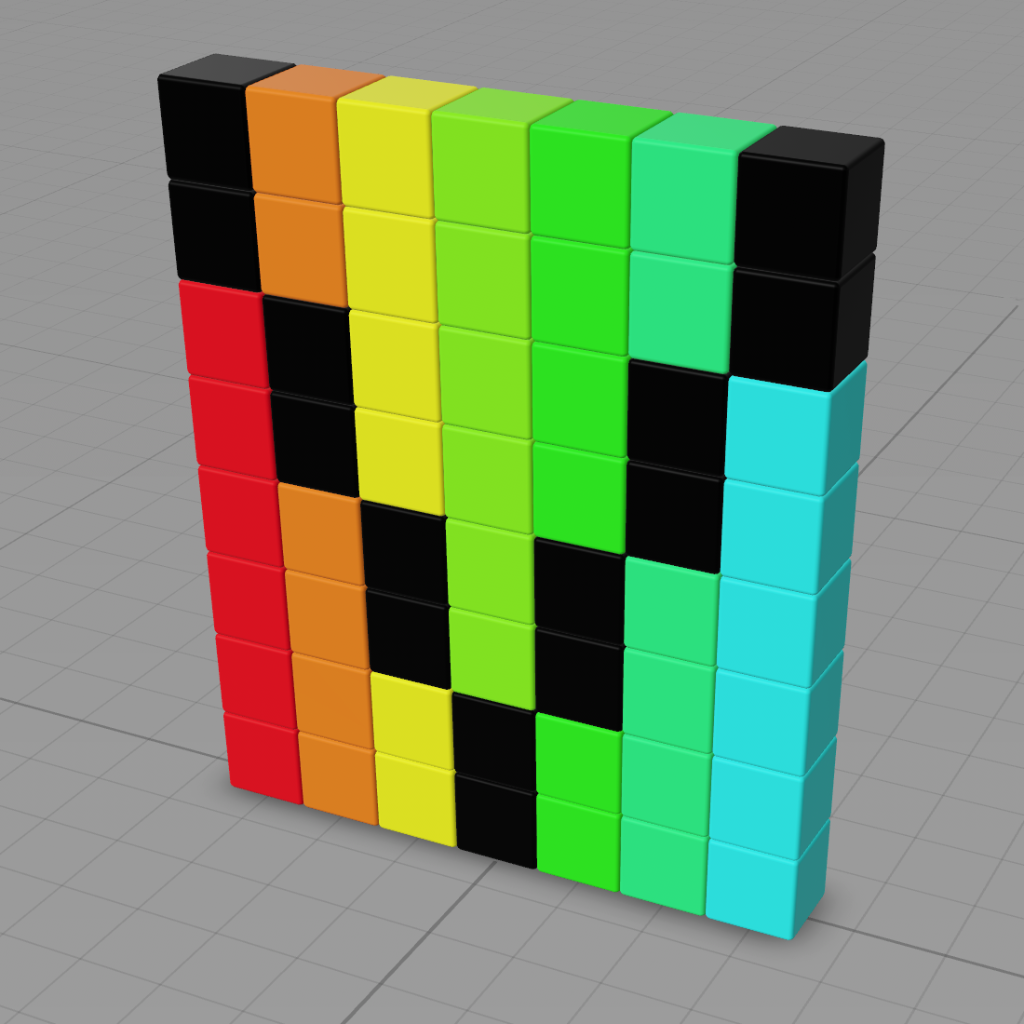
Voxelamming is an AR programming learning app. Even programming beginners can learn programming visually and enjoyably. Voxelamming supports iPhones and iPads with iOS 16 or later, and Apple Vision Pro.
Resources
- Homepage: https://creativival.github.io/voxelamming_python
- Samples: https://github.com/creativival/voxelamming/tree/main/sample/python
Installation
pip install voxelamming
Usage
Modeling
from voxelamming import Voxelamming

# Set your room name. This should match the room name displayed in your Voxelamming app.
room_name = "1000"

# Create a Voxelamming instance
voxelamming = Voxelamming(room_name)

# Define Python code to create a voxel model
voxelamming.set_box_size(0.5)
voxelamming.set_build_interval(0.01)
voxelamming.transform(0, 0, 0, pitch=0, yaw=0, roll=0)
voxelamming.animate(0, 0, 10, pitch=0, yaw=30, roll=0, scale=2, interval= 10)

for i in range(100):
  voxelamming.create_box(-1, i, 0, r=0, g=1, b=1)
  voxelamming.create_box(0, i, 0, r=1, g=0, b=0)
  voxelamming.create_box(1, i, 0, r=1, g=1, b=0)
  voxelamming.create_box(2, i, 0, r=0, g=1, b=1)

for i in range(50):
  voxelamming.remove_box(0, i * 2 + 1, 0)
  voxelamming.remove_box(1, i * 2, 0)

# Send the Python code to the Voxelamming app
voxelamming.send_data()
Game Mode
import pyxel
from voxelamming import Voxelamming


class Cat:
    def __init__(self, app):
        self.app = app
        self.name = 'cat_8x8'
        self.dot_data = (
            '-1 -1 9 -1 9 -1 -1 -1 -1 -1 9 9 9 9 -1 -1 '
            '-1 -1 9 0 9 0 9 -1 -1 -1 9 9 7 7 7 -1 -1 -1 '
            '9 9 9 -1 -1 -1 9 9 9 9 9 9 9 -1 -1 -1 9 9 7 '
            '-1 -1 -1 -1 9 9 -1 9 9 -1 -1'
        )
        self.direction = 0
        self.x = 0
        self.y = 0
        self.img = 0
        self.u = 0
        self.v = 0
        self.w = 8
        self.h = 8
        self.speed = 0.1  # Speed of the cat's movement
        self.diameter = 4  # Initial size of the cat (diameter of the circle)

    def chase(self, mouse):
        # The cat chases the mouse
        if self.x < mouse.x:
            self.x += self.speed
            self.w = 8
            self.h = 8
            self.direction = 0
        elif self.x > mouse.x:
            self.x -= self.speed
            self.w = -8
            self.h = 8
            self.direction = -180  # Flip the image

        if self.y < mouse.y:
            self.y += self.speed
        elif self.y > mouse.y:
            self.y -= self.speed

        # Gradually increase the size of the cat
        self.diameter += 0.05


class Mouse:
    def __init__(self, app):
        self.app = app
        self.name = 'mouse_8x8'
        self.dot_data = (
            '-1 -1 -1 -1 -1 -1 -1 -1 -1 13 -1 -1 13 -1 -1 -1 '
            '-1 13 13 13 -1 -1 -1 -1 -1 13 13 13 13 0 13 -1 '
            '13 13 13 13 13 13 13 0 -1 13 13 13 13 0 13 -1 '
            '-1 13 13 13 -1 -1 -1 -1 -1 13 -1 -1 13 -1 -1 -1'
        )
        self.direction = 0
        self.x = 20
        self.y = 0
        self.img = 0
        self.u = 0
        self.v = 8
        self.w = 8
        self.h = 8
        self.speed = 0.5  # Speed of the mouse's movement
        self.diameter = 8  # Size of the mouse (diameter of the circle)

    def move(self):
        # Move the mouse with arrow keys
        if pyxel.btn(pyxel.KEY_LEFT):
            self.x -= self.speed
            self.u = 0
            self.v = 8
            self.w = -8
            self.h = 8
            self.direction = 180  # Rotate 180 degrees
        if pyxel.btn(pyxel.KEY_RIGHT):
            self.x += self.speed
            self.u = 0
            self.v = 8
            self.w = 8
            self.h = 8
            self.direction = 0
        if pyxel.btn(pyxel.KEY_UP):
            self.y += self.speed
            self.u = 8
            self.v = 8
            self.w = 8
            self.h = 8
            self.direction = 90
        if pyxel.btn(pyxel.KEY_DOWN):
            self.y -= self.speed
            self.u = 8
            self.v = 8
            self.w = 8
            self.h = -8
            self.direction = -90

        # Limit movement within the screen
        self.x = max(-self.app.window_width // 2, min(self.app.window_width // 2, self.x))
        self.y = max(-self.app.window_height // 2, min(self.app.window_height // 2, self.y))


class App:
    def __init__(self):
        # Initialize Pyxel
        self.dot_size = 1  # Size of the sprite's dots displayed in the AR space (centimeters)
        self.window_width = 64 * 4 / 3  # The width of the AR window will be multiplied by self.dot_size (centimeters)
        self.window_height = 64  # The height of the AR window will be multiplied by self.dot_size (centimeters)
        self.window_angle = 80  # Tilt of the AR window (degrees)
        self.sprite_base_diameter = 8  # Base diameter of the sprite (reference value for sprite sending scale)
        self.cat = Cat(self)
        self.mouse = Mouse(self)
        self.game_started = False
        self.game_over = False
        self.score = 0  # Initial score
        self.last_score_update_time = 0  # Timer to update the score

        # Initialize Voxelamming
        self.vox = Voxelamming('1000')
        self.vox.set_box_size(self.dot_size)
        self.vox.set_game_screen(self.window_width, self.window_height, self.window_angle, red=1, green=1, blue=0, alpha=0.8)
        self.vox.set_game_score(self.score)
        cat_scale = self.cat.diameter / self.sprite_base_diameter
        mouse_scale = self.mouse.diameter / self.sprite_base_diameter
        self.vox.create_sprite(self.cat.name, self.cat.dot_data, self.cat.x, self.cat.y, self.cat.direction, cat_scale,
                               True)
        self.vox.create_sprite(self.mouse.name, self.mouse.dot_data, self.mouse.x, self.mouse.y, self.mouse.direction,
                               mouse_scale, True)
        self.vox.send_data()
        self.vox.clear_data()

        pyxel.init(self.window_width, self.window_height, title='Cat Game')

        pyxel.load('my_resource.pyxres')

        pyxel.run(self.update, self.draw)

    def update(self):
        if not self.game_started:
            if pyxel.btnp(pyxel.MOUSE_BUTTON_LEFT):
                self.reset_game()
            return

        if self.game_over:
            if pyxel.btnp(pyxel.MOUSE_BUTTON_LEFT):
                self.reset_game()
            return

        self.mouse.move()  # Update the position of the mouse
        self.cat.chase(self.mouse)  # The cat chases the mouse

        # Collision detection: Game over when the cat's circle touches the mouse
        if ((self.cat.x - self.mouse.x) ** 2 + (self.cat.y - self.mouse.y) ** 2) < (
                self.cat.diameter / 2 + self.mouse.diameter / 2) ** 2:
            self.game_over = True

            # Send game over (change the window to red)
            self.vox.set_box_size(self.dot_size)
            self.vox.set_game_screen(self.window_width, self.window_height, self.window_angle, red=1, green=0, blue=0, alpha=0.8)
            self.vox.set_game_score(self.score)
            self.vox.set_command('gameOver')
            self.vox.send_data()
            self.vox.clear_data()

        # Add score every second
        if pyxel.frame_count - self.last_score_update_time >= 30:  # Pyxel's default FPS is 30
            self.score += 1
            self.last_score_update_time = pyxel.frame_count

        # Send sprite information every 0.1 seconds
        if pyxel.frame_count - self.last_score_update_time >= 3:  # Pyxel's default FPS is 30
            if not self.game_over:  # Do not send immediately after game over
                self.vox.set_box_size(self.dot_size)
                self.vox.set_game_screen(self.window_width, self.window_height, self.window_angle, red=1, green=1, blue=0, alpha=0.5)
                self.vox.set_game_score(self.score)
                cat_scale = self.cat.diameter / self.sprite_base_diameter
                mouse_scale = self.mouse.diameter / self.sprite_base_diameter
                self.vox.move_sprite(self.cat.name, self.cat.x, self.cat.y, self.cat.direction, cat_scale, True)
                self.vox.move_sprite(self.mouse.name, self.mouse.x, self.mouse.y, self.mouse.direction, mouse_scale, True)
                self.vox.send_data()
                self.vox.clear_data()

    def draw(self):
        pyxel.cls(1)

        # Display the score at the top left
        pyxel.text(2, 2, f"Score: {self.score}", pyxel.COLOR_WHITE)

        if not self.game_started:
            pyxel.text(self.window_width // 2 - 26, self.window_height // 2 - 8, "Click to start",
                       pyxel.frame_count % 16)
            self.draw_cursor()  # Draw custom cursor
            return

        if self.game_over:
            pyxel.text(self.window_width // 2 - 26, self.window_height // 2 - 8, "Game Over!", pyxel.frame_count % 16)
            pyxel.text(self.window_width // 2 - 26, self.window_height // 2 + 8, "Click to start",
                       pyxel.frame_count % 16)
            self.draw_cursor()  # Draw custom cursor
            return

        # Draw a circle that gradually grows larger
        cat_x, cat_y = self.get_sprite_position(self.cat.x, self.cat.y)
        pyxel.circ(cat_x + 4, cat_y + 4, self.cat.diameter / 2, pyxel.COLOR_RED)

        # Draw the cat's sprite
        pyxel.blt(cat_x, cat_y, self.cat.img, self.cat.u, self.cat.v, self.cat.w, self.cat.h, 1)

        # Draw the mouse's sprite
        mouse_x, mouse_y = self.get_sprite_position(self.mouse.x, self.mouse.y)
        pyxel.blt(mouse_x, mouse_y, self.mouse.img, self.mouse.u, self.mouse.v, self.mouse.w, self.mouse.h, 1)

    def get_sprite_position(self, x, y):
        return self.window_width // 2 + x - 4, self.window_height // 2 - y - 4

    def reset_game(self):
        self.score = 0  # Reset score
        self.last_score_update_time = pyxel.frame_count  # Reset timer
        self.cat = Cat(self)  # Initialize the cat (position, size)
        self.mouse = Mouse(self)  # Initialize the mouse (position)
        self.game_started = True
        self.game_over = False

    @staticmethod
    def draw_cursor():
        cursor_x = pyxel.mouse_x
        cursor_y = pyxel.mouse_y
        pyxel.blt(cursor_x - 4, cursor_y - 4, 0, 0, 16, 8, 8, 1)


App()
This code snippet demonstrates a simple example where a red voxel is created at a specific location. You can use various functions provided by the Voxelamming class to build more complex models.
Method description
| Modeling Method name | Description | Arguments |
|---|---|---|
set_room_name(room_name) |
Sets the room name for communicating with the device. | room_name: Room name (string) |
set_box_size(size) |
Sets the size of the voxel (default: 1.0). | size: Size (float) |
set_build_interval(interval) |
Sets the placement interval of the voxels (default: 0.01 seconds). | interval: Interval (float) |
change_shape(shape) |
Changes the shape of the voxel. | shape: Shape ("box", "sphere", "plane") |
change_material(is_metallic, roughness) |
Changes the material of the voxel. | is_metallic: Whether to make it metallic (boolean), roughness: Roughness (float) |
create_box(x, y, z, r, g, b, alpha) |
Places a voxel. | x, y, z: Position (float), r, g, b, alpha: Color (float, 0-1) |
create_box(x, y, z, texture) |
Places a voxel with texture. | x, y, z: Position (float), texture: Texture name (string) |
remove_box(x, y, z) |
Removes a voxel. | x, y, z: Position (float) |
write_sentence(sentence, x, y, z, r, g, b, alpha) |
Draws a string with voxels. | sentence: String (string), x, y, z: Position (float), r, g, b, alpha: Color (float, 0-1) |
set_light(x, y, z, r, g, b, alpha, intensity, interval, light_type) |
Places a light. | x, y, z: Position (float), r, g, b, alpha: Color (float, 0-1), intensity: Intensity (float), interval: Blinking interval (float), light_type: Type of light ("point", "spot", "directional") |
set_command(command) |
Executes a command. | command: Command ("axis", "japaneseCastle", "float", "liteRender") |
draw_line(x1, y1, z1, x2, y2, z2, r, g, b, alpha) |
Draws a line between two points. | x1, y1, z1: Starting point (float), x2, y2, z2: Ending point (float), r, g, b, alpha: Color (float, 0-1) |
create_model(model_name, x, y, z, pitch, yaw, roll, scale, entity_name) |
Creates a built-in model (USDZ). | model_name: Name of the model (string), x, y, z: Translation values (float), pitch, yaw, roll: Rotation values (float), scale: Scale (float), entity_name: Name assigned to the created model (string) |
move_model(entity_name, x, y, z, pitch, yaw, roll, scale) |
Moves the created model (USDZ). | entity_name: Name assigned to the created model (string), x, y, z: Translation values (float), pitch, yaw, roll: Rotation values (float), scale: Scale (float) |
send_data(name) |
Sends voxel data to the device; if the name argument is set, the voxel data can be stored and reproduced as history. | |
clear_data() |
Initializes voxel data. | |
transform(x, y, z, pitch, yaw, roll) |
Moves and rotates the coordinate system of the voxel. | x, y, z: Translation amount (float), pitch, yaw, roll: Rotation amount (float) |
animate(x, y, z, pitch, yaw, roll, scale, interval) |
Animates a voxel. | x, y, z: Translation amount (float), pitch, yaw, roll: Rotation amount (float), scale: Scale (float), interval: Interval (float) |
animate_global(x, y, z, pitch, yaw, roll, scale, interval) |
Animates all voxels. | x, y, z: Translation amount (float), pitch, yaw, roll: Rotation amount (float), scale: Scale (float), interval: Interval (float) |
push_matrix() |
Saves the current coordinate system to the stack. | |
pop_matrix() |
Restores the coordinate system from the stack. | |
frame_in() |
Starts recording a frame. | |
frame_out() |
Ends recording a frame. | |
set_frame_fps(fps) |
Sets the frame rate (default: 2). | fps: Frame rate (int) |
set_frame_repeats(repeats) |
Sets the number of frame repetitions (default: 10). | repeats: Number of repetitions (int) |
| Game Method Name | Description | Arguments |
set_game_screen_size(width, height, angle=90, r=1, g=1, b=0, alpha=0.5) |
Sets the game screen size. | width, height: screen size (float), angle: angle (float), r, g, b, alpha: color (float, 0-1) |
set_game_score(score) |
Sets the game score. | score: game score (int) |
send_game_over() |
Triggers game over. | |
create_sprite(sprite_name, color_list, x, y, direction=90, scale=1, visible=True) |
Creates a sprite. | sprite_name: sprite name (string), color_list: dot color data (string), x, y: position (float), direction: angle (float), scale: scale (float), visible: visibility (boolean) |
move_sprite(sprite_name, x, y, direction=90, scale=1, visible=True) |
Moves a sprite. | sprite_name: sprite name (string), x, y: position (float), direction: angle (float), scale: scale (float), visible: visibility (boolean) |
Notes
- Ensure that the Voxelamming app is running and connected to the same room name specified in your Python script.
- This library requires Python 3.9 or higher.
- Executing arbitrary Python code can be a security risk. Be cautious when running code from untrusted sources.
This library is under active development. More features and improvements are planned for future releases.
License
Author
creativival
Release history Release notifications | RSS feed


Download files
Download the file for your platform. If you're not sure which to choose, learn more about installing packages.
Source Distributions
Built Distribution
Filter files by name, interpreter, ABI, and platform.
If you're not sure about the file name format, learn more about wheel file names.
Copy a direct link to the current filters
File details
Details for the file voxelamming-0.3.4-py3-none-any.whl.
File metadata
- Download URL: voxelamming-0.3.4-py3-none-any.whl
- Upload date:
- Size: 13.6 kB
- Tags: Python 3
- Uploaded using Trusted Publishing? No
- Uploaded via: twine/5.1.1 CPython/3.10.14
File hashes
| Algorithm | Hash digest | |
|---|---|---|
| SHA256 |
2d0442ac905e07da3ef07a42810e64f3e590bffcae8fb42085c40fd340568034
|
|
| MD5 |
d10c080222491f7a79e2ed7e5cd667ea
|
|
| BLAKE2b-256 |
8d23f4678f448b177132e7715e51c506561d5d1723f0af80802726aa70739a26
|






