
VTK Prompt





A command-line interface and web-based UI for generating VTK visualization code using Large Language Models (Anthropic Claude, OpenAI GPT, NVIDIA NIM, and local models).
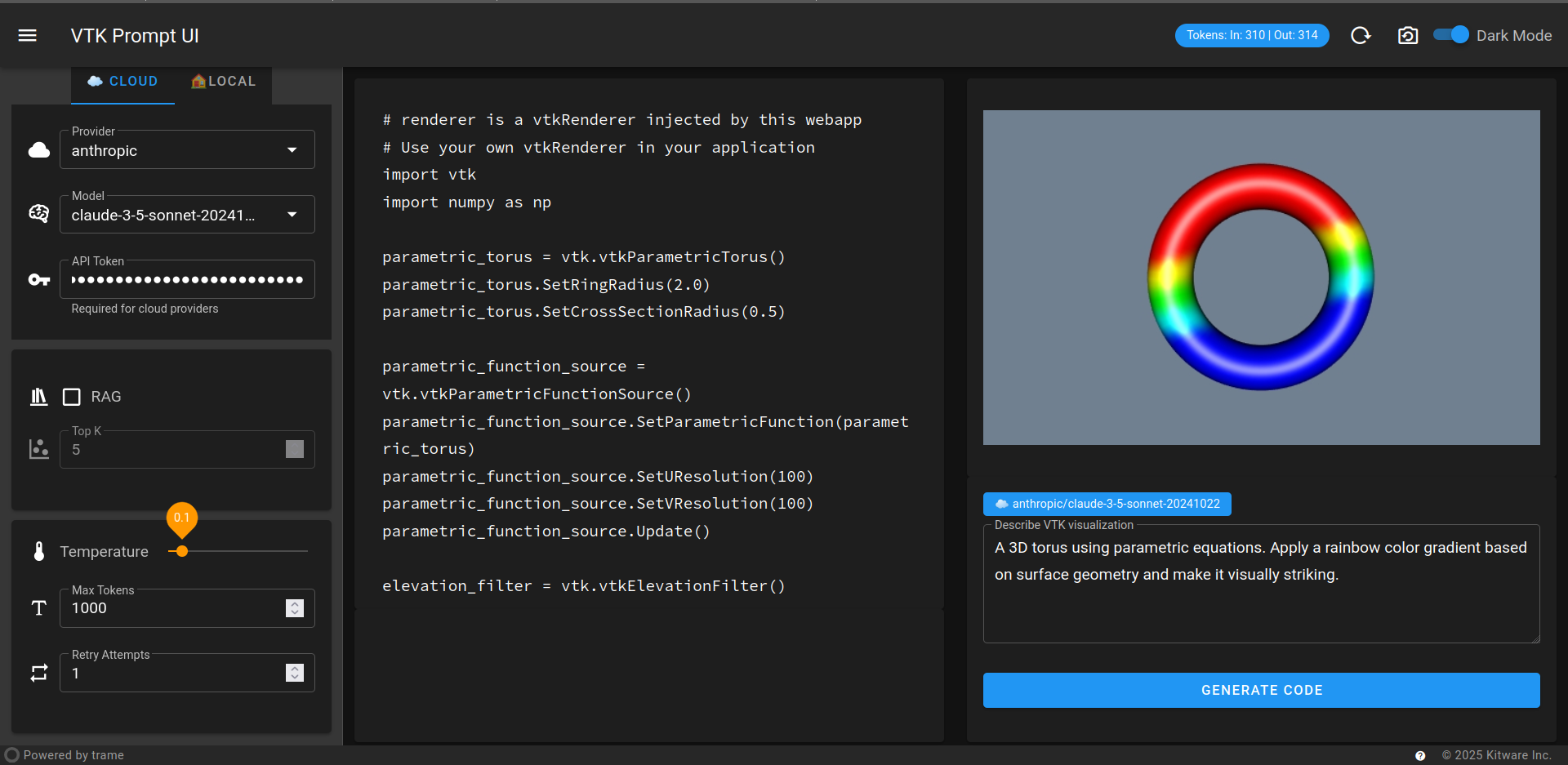
Features
- Multiple LLM providers: Anthropic Claude, OpenAI GPT, NVIDIA NIM, and local models
- Interactive web UI with live VTK rendering
- Context-enhanced generation via vtk-mcp: semantic search over VTK examples and docs, class API lookup, and full code validation
- Real-time visualization of generated code
- Token usage tracking and cost monitoring
- CLI and Python API for integration
Installation
From PyPI (Stable)
# pip
pip install vtk-prompt

# uv (recommended)
uv pip install vtk-prompt
From TestPyPI (Latest Development)
pip install -i https://test.pypi.org/simple/ --extra-index-url https://pypi.org/simple/ vtk-prompt
From Source
git clone https://github.com/vicentebolea/vtk-prompt.git
cd vtk-prompt

# pip
pip install -e .

# uv
uv pip install -e .
Quick Start
1. Set up API keys
export ANTHROPIC_API_KEY="your-anthropic-key"
export OPENAI_API_KEY="your-openai-key"  # Optional
2. Launch Web UI (Recommended)
vtk-prompt-ui
Access the UI at http://localhost:8080
3. Or use CLI
# Generate VTK code
vtk-prompt "Create a red sphere" -t $ANTHROPIC_API_KEY

# With vtk-mcp for context-enhanced generation
vtk-prompt "Create a sphere with custom resolution" --mcp-url http://localhost:8000 -t $API_KEY

# Different providers
vtk-prompt "Create a blue cube" --provider openai -t $OPENAI_API_KEY
vtk-prompt "Create a cone" --provider nim --token YOUR_NIM_TOKEN
Usage
Web UI Features
The web interface provides:
- Model selection: Choose between Claude models (Haiku, Sonnet 4) and other providers
- Token control: Adjust maximum tokens for responses
- Usage tracking: Real-time display of input/output tokens and costs
- vtk-mcp integration: Enter a vtk-mcp server URL to enable context retrieval and code validation
- Live preview: See VTK visualizations rendered in real-time
- Code export: View, edit, and copy generated VTK code
- Local & cloud support: Both cloud APIs and local model endpoints
Command Line Interface
# Basic usage
vtk-prompt "Create a red sphere" -t $API_KEY

# Advanced options
vtk-prompt "Create a textured cone with 32 resolution" \
  --provider anthropic \
  --model claude-opus-5 \
  --max-tokens 4000 \
  --mcp-url http://localhost:8000 \
  --verbose \
  -t $API_KEY

# Using different providers
vtk-prompt "Create a blue cube" --provider openai --model gpt-4.1 -t $OPENAI_API_KEY
vtk-prompt "Create a cylinder" --provider nim --model meta/llama-3.3-70b-instruct -t $NIM_KEY
Docker Compose
The compose files run the vtk-prompt web UI (port 8080) and, optionally, a vtk-mcp server.
Pick the case that matches your setup; every command runs from the repo root and puts the
UI at http://localhost:8080. Set your LLM key first (ANTHROPIC_API_KEY or
OPENAI_API_KEY, in your shell or in .env, see .env.example).
| Case | Command |
|---|---|
| 1. UI + bundled vtk-mcp, no sign-in | docker compose up --build |
| 2. UI + bundled vtk-mcp, Google sign-in | docker compose -f docker-compose.yml -f docker-compose.auth.yml up --build |
| 3. UI + your own vtk-mcp, no sign-in | docker compose -f docker-compose.yml -f docker-compose.external-mcp.yml up --build --no-deps vtk-prompt |
| 4. UI + your own vtk-mcp, Google sign-in | docker compose -f docker-compose.yml -f docker-compose.auth.yml -f docker-compose.external-mcp.yml up --build --no-deps vtk-prompt |
Add -d to run in the background. To stop, run the same command with down instead of
up ... (add -v only if you also want to delete the saved data volumes). The service
restarts automatically if it exits.
--no-deps vtk-prompt(cases 3 and 4) starts only the UI. Without it compose also starts the bundled vtk-mcp and Qdrant, which fails if your own vtk-mcp already uses port 8000.- With Podman,
podman composerejects-fon older versions; set the files inCOMPOSE_FILEinstead, for exampleCOMPOSE_FILE=docker-compose.yml:docker-compose.auth.yml podman compose up --build. - A
ghcr.io/kitware/vtk-prompt/vtk-promptimage is also built from every commit on master.
Using your own vtk-mcp (cases 3 and 4)
Set VTK_PROMPT_MCP_URL to your server (HTTP transport; the container must be able to reach
it), in your shell or in .env. Compose stops with a message if it is missing.
The URL is fixed for everyone: the settings dialog shows it prefilled, read-only and marked
as set by the administrator, and it overrides any mcp_url in a user's config file. The same
lock works outside Docker: set VTK_PROMPT_MCP_URL, or pass --mcp-url to vtk-prompt-ui
or vtk-prompt-gateway. Without it, each user types their own URL in the settings.
Google sign-in (cases 2 and 4)
Sign-in is off unless you add docker-compose.auth.yml. Any Google account can sign in
(or only your organization, see below). Each user gets a folder
<users dir>/<google id>/ (/data/users, a volume) holding their settings and
conversations, and runs in their own vtk-prompt-ui process, so users never see each
other's data. It needs three values in .env (copy .env.example); compose stops with a
message if one is missing:
GOOGLE_CLIENT_IDandGOOGLE_CLIENT_SECRET, from the Google Cloud Console:- Create or pick a project.
- APIs & Services > OAuth consent screen: choose External, or Internal to allow only your Google Workspace organization (no test users or verification needed), and set an app name and support email. With External in Testing mode, add the accounts that may sign in as test users.
- APIs & Services > Credentials > Create credentials > OAuth client ID, type
"Web application", with the authorized redirect URI
<public url>/auth/callback. - Copy the client ID and secret shown.
VTK_PROMPT_SECRET_KEY, which signs the login cookie. It does not come from Google; generate it withopenssl rand -hex 32.VTK_PROMPT_BASE_URL, the public URL, only when the site is not opened athttp://localhost:8080.
Google only accepts redirect URIs on http://localhost or on https:// with a real domain
name (not a bare hostname such as http://myserver:8080, and not an IP address); otherwise
sign-in fails with Error 400: invalid_request. So:
- Just you, or testing: open
http://localhost:8080(from another machine, withssh -L 8080:localhost:8080 <server>) and registerhttp://localhost:8080/auth/callback. - Other users: serve the UI under a domain such as
prompt.example.combehind an HTTPS proxy, setVTK_PROMPT_BASE_URL=https://prompt.example.comand registerhttps://prompt.example.com/auth/callback.
Outside Docker, run vtk-prompt-gateway --port 8080 instead of vtk-prompt-ui with the
same environment variables (VTK_PROMPT_USERS_DIR sets the parent folder). Per-user
processes are not stopped while idle.
vtk-mcp Integration
Context-enhanced generation is powered by vtk-mcp, a local MCP server that exposes VTK knowledge tools to the LLM.
- Start vtk-mcp (see its README for setup):
docker compose up # or: uvicorn vtk_mcp.transport.http:app --port 8000
- Use with vtk-prompt:
vtk-prompt "Create a vtkSphereSource with texture mapping" --mcp-url http://localhost:8000 -t $API_KEY
When --mcp-url is set the LLM has access to all vtk-mcp tools during generation
(class lookup, method signatures, import validation, semantic search) and the generated code
is validated against the VTK API with validate_vtk_code before being returned.
Python API
from vtk_prompt import VTKPromptClient

client = VTKPromptClient()
code = client.generate_code("Create a red sphere")
print(code)
Model Configuration
Model configuration with YAML prompt files:
# Model and parameter configuration
model: anthropic/claude-opus-5
modelParameters:
  temperature: 0.2
  max_tokens: 6000
Using custom prompt files:
# CLI: Use your custom prompt file
vtk-prompt "Create a sphere" --prompt-file custom_vtk_prompt.yml

# CLI: Or with additional CLI overrides
vtk-prompt "Create a complex scene" --prompt-file custom_vtk_prompt.yml --retry-attempts 3

# UI: Use your custom prompt file
vtk-prompt-ui --server --prompt-file custom_vtk_prompt.yml
Model Parameters Guide
Temperature Settings:
0.1-0.3: More focused, deterministic code generation0.4-0.7: Balanced creativity and consistency (recommended)0.8-1.0: More creative but potentially less reliable
Token Limits: Token usage can vary significantly between models and providers. These are general guidelines:
1000-2000: Simple visualizations and basic VTK objects3000-4000: Complex scenes with multiple objects5000+: Detailed implementations with extensive documentation
Note: Different models have different token limits and costs. Check your provider's documentation for specific model capabilities.
Testing
# Run all tests with tox
tox -e test

# Or directly with pytest (pip or uv)
pip install -e ".[test]" && pytest
uv pip install -e ".[test]" && pytest
Configuration
Environment Variables
ANTHROPIC_API_KEY- Anthropic Claude API keyOPENAI_API_KEY- OpenAI API key (also used for NVIDIA NIM)
Supported Providers & Models
| Provider | Default Model | Base URL |
|---|---|---|
| anthropic | claude-sonnet-5 | https://api.anthropic.com/v1 |
| openai | gpt-4.1 | https://api.openai.com/v1 |
| gemini | gemini-2.5-pro | https://generativelanguage.googleapis.com/v1beta |
| nim | meta/llama-3.3-70b-instruct | https://integrate.api.nvidia.com/v1 |
| custom | User-defined | User-defined (for local models) |
Custom/Local Models
You can use local models via OpenAI-compatible APIs:
# Using Ollama
vtk-prompt "Create a sphere" \
  --provider custom \
  --base-url http://localhost:11434/v1 \
  --model llama2

# Using LM Studio
vtk-prompt "Create a cube" \
  --provider custom \
  --base-url http://localhost:1234/v1 \
  --model local-model
CLI Reference
Usage: vtk-prompt [OPTIONS] INPUT_STRING

  Generate and execute VTK code using LLMs.

Options:
  --provider [openai|anthropic|gemini|nim]
                                  LLM provider to use
  -m, --model TEXT                Model name to use
  -k, --max-tokens INTEGER        Max # of tokens to generate
  --temperature FLOAT             Temperature for generation (0.0-2.0)
  -t, --token TEXT                API token for the selected provider [required]
  --base-url TEXT                 Base URL for API (auto-detected or custom)
  -v, --verbose                   Show generated source code
  --mcp-url TEXT                  vtk-mcp server URL (enables context retrieval and code validation)
  --top-k INTEGER                 Number of examples to retrieve from vtk-mcp
  --retry-attempts INTEGER        Number of times to retry if validation fails
  --conversation TEXT             Path to conversation file for chat history
  --prompt-file TEXT              Path to custom YAML prompt file
  --help                          Show this message and exit.
Available Commands
vtk-prompt- Main CLI for code generationvtk-prompt-ui- Launch web interfacegen-vtk-file- Generate VTK XML files
Contributing
Contributions are welcome! Please feel free to submit a Pull Request.
For detailed development instructions, see DEVELOPMENT.md which covers:
- Setting up the development environment
- Running tests and linting
- Developer mode for the web UI
- Code formatting and type checking
- Pre-commit hooks
- Fork the repository
- Create your feature branch (
git checkout -b feature/amazing-feature) - Commit your changes (
git commit -m 'Add some amazing feature') - Push to the branch (
git push origin feature/amazing-feature) - Open a Pull Request
Testing
The project includes a comprehensive test suite with code coverage reporting.
Running Tests
# Run all tests with coverage
pytest

# Run specific test categories
pytest tests/test_cli.py                    # CLI functionality tests
pytest tests/test_providers_smoke.py        # Provider smoke tests
pytest -m "not smoke"                       # Exclude API-dependent tests

# Generate coverage report
pytest --cov=src/vtk_prompt --cov-report=html
Test Categories
- CLI Tests: Argument parsing, provider integration, error handling
- Smoke Tests: Real API connectivity testing (requires API keys)
- Client Tests: Core VTKPromptClient functionality
- Integration Tests: End-to-end workflow testing
Coverage reports are generated in htmlcov/ directory. Current coverage:
11.0% (improving with ongoing test development).
License
This project is licensed under the MIT License - see the LICENSE file for details.
Architecture
- Core: Python package with CLI and API
- UI: Trame-based web interface with VTK rendering
- vtk-mcp: External MCP server providing VTK knowledge, semantic search, and code validation
- Providers: Unified interface for multiple LLM APIs
Links
Made with care for the VTK and scientific visualization community.
1 maintainer

Metadata
1 maintainer
Release files for vtk-prompt 0.3.1
For a detailed explanation of source distributions (sdists) and built distributions (wheels), please see the package formats documentation.
Source distribution (sdist)
| File | Size | Uploaded | Provenance | Actions |
|---|---|---|---|---|
| vtk_prompt-0.3.1.tar.gz | 167.7 kB | With provenance | Details for vtk_prompt-0.3.1.tar.gz |
Built distribution (wheel)
| File | Interpreter | ABI | Platform | Actions Reset |
|---|---|---|---|---|
| vtk_prompt-0.3.1-py3-none-any.whl | Python 3 | none | any | Details for vtk_prompt-0.3.1-py3-none-any.whl |
Total release size: 323.8 kB
Release files / vtk_prompt-0.3.1.tar.gz
| Download URL | vtk_prompt-0.3.1.tar.gz |
|---|---|
| Size | 167.7 kB |
| Tags | Source |
|
SHA-256 checksum How to use checksums |
8fcf78d16ab6ec87011db7c9011021be0f22243fdc0ed93b0b4b2d5195d2c51f
|
|
BLAKE2b-256 checksum How to use checksums |
97db433bd2bb716c4c46c9506141a85982dca916feb66214bebbe69a89386942
|
| Upload date | |
|
Uploaded using Trusted Publishing? What is trusted publishing? |
Yes |
| Uploaded via |
twine/7.0.0 CPython/3.13.16
|
Provenance
Provenance describes where a file came from. On PyPI, provenance is shared via attestations, which provide a verifiable record of the build or publishing details. View details, limitations and caveats.


PyPI Publish Attestation
PyPI verified that this artifact, at this checksum, originated from the publisher listed below.
Signed by GitHub Actions, verified by PyPI on Nov 12, 2026.
Transparency logRelease files / vtk_prompt-0.3.1-py3-none-any.whl
| Download URL | vtk_prompt-0.3.1-py3-none-any.whl |
|---|---|
| Size | 156.1 kB |
| Tags | Python 3 |
|
SHA-256 checksum How to use checksums |
3cb36759647f80aec5252ca62dac54713dbc7cfbfa487ff262708f18b723f1de
|
|
BLAKE2b-256 checksum How to use checksums |
cf4e6540cacf8adc3e33ba2b251806e523b762ffd2842daa47a68bdd4e01c9bd
|
| Upload date | |
|
Uploaded using Trusted Publishing? What is trusted publishing? |
Yes |
| Uploaded via |
twine/7.0.0 CPython/3.13.16
|
Provenance
Provenance describes where a file came from. On PyPI, provenance is shared via attestations, which provide a verifiable record of the build or publishing details. View details, limitations and caveats.
PyPI Publish Attestation
PyPI verified that this artifact, at this checksum, originated from the publisher listed below.
Signed by GitHub Actions, verified by PyPI on Nov 12, 2026.
Transparency logSecurity for vtk-prompt 0.3.1
Provenance
Provenance describes where a file came from. On PyPI, provenance is shared via attestations, which provide a verifiable record of the build or publishing details. View details, limitations and caveats.
Full provenance
Both files in this release have been uploaded with provenance metadata.
Attestation for vtk_prompt-0.3.1.tar.gz
PyPI Publish Attestation
PyPI verified that this artifact, at this checksum, originated from the publisher listed below.
Signed by GitHub Actions, verified by PyPI on Nov 12, 2026.
Transparency logA note on package security
PyPI is a repository for distributing packages, not a service for auditing them. While third-party security researchers and our staff do their best to detect and remove malicious packages, PyPI cannot guarantee the quality, security or suitability of any given package.
To learn more about protecting yourself from malicious actors, visit our package security documentation.














