
WavqWise
Sense, Forecast, Alert.
Pluggable temporal intelligence, 37 models, 5 pipelines, Real-time streaming, Auto GPU.


Quick Start | 5 Pipelines | 37 Models | Real-Time | Weather | Dam Monitoring | Colab
What Makes WavqWise Different
| Feature | Nixtla | Darts | Prophet | WavqWise |
|---|---|---|---|---|
| Batch forecasting | Yes | Yes | Yes | Yes |
| Real-time streaming | No | No | No | Yes |
| Incremental update (no retrain) | No | No | No | Yes |
| Anomaly detection | No | No | No | Yes |
| EEG / Signal processing | No | No | No | Yes |
| Trading indicators | No | No | No | Yes |
| Weather (GraphCast / Aurora) | No | No | No | Yes |
| Dam / Water level monitoring | No | No | No | Yes |
| Auto GPU / ONNX / TensorRT | No | No | No | Yes |
| Plugin any external model | No | No | No | Yes |
| CLI + PNG charts + CSV/JSON export | No | No | No | Yes |
Quick Start
pip install wavqwise
from wavqwise import WavqPipeline

pipeline = WavqPipeline()
pipeline.load("sales.csv", target="revenue", time="date")
forecast = pipeline.forecast(horizon=30, model="arima")
forecast.plot()
Change "arima" to "xgboost" or "chronos" : same code. Model is a parameter, not an architecture decision.
5 Pipelines
1. WavqPipeline : Forecasting
from wavqwise import WavqPipeline

pipeline = WavqPipeline()
pipeline.load("data.csv", target="sales", time="date")
forecast = pipeline.forecast(horizon=30, model="ema")

# Incremental update (not retrain)
pipeline.update(new_data)
forecast = pipeline.forecast(horizon=30)

# Compare models
pipeline.compare_models(["arima", "ema", "xgboost"], horizon=14)

# Auto-select best
pipeline.forecast(model="auto")

# Ensemble
pipeline.forecast(model=["arima", "ets", "xgboost"])
2. AnomalyPipeline : Detection with Severity
from wavqwise import AnomalyPipeline

detector = AnomalyPipeline()
detector.load("sensor.csv", target="temperature", time="timestamp")
result = detector.detect(method="zscore")  # or "iqr", "isolation_forest"
print(result.summary())
# Anomalies: 93/10000 (0.9%) | Method: zscore
3. SignalPipeline : EEG & Biosignals
from wavqwise import SignalPipeline

sig = SignalPipeline()
sig.load("eeg.csv", channels=["Fp1", "Fp2", "C3", "C4"], sample_rate=256)
sig.filter(low=1, high=50, notch=50)
bands = sig.extract_bands(["delta", "theta", "alpha", "beta", "gamma"])
events = sig.detect_events(threshold=3.0)
4. TradingPipeline : Financial Analysis
from wavqwise.trading.indicators.momentum import RSIIndicator
from wavqwise.trading.indicators.trend import MACDIndicator
from wavqwise.trading.indicators.volatility import BollingerBandsIndicator

stock = RSIIndicator(14).compute(stock_data)
stock = MACDIndicator().compute(stock)
stock = BollingerBandsIndicator(20, 2).compute(stock)

pipeline = WavqPipeline()
pipeline.load(stock, target="Close", time="Date")
forecast = pipeline.forecast(horizon=30, model="ema")
5. WeatherPipeline : Weather Forecasting
from wavqwise import WeatherPipeline

weather = WeatherPipeline()
weather.load_city("Chennai", days=365)  # Real data from Open-Meteo
forecast = weather.forecast(target="temperature_2m_mean", horizon=14, model="ema")
weather.compare_models(horizon=14)
Real-Time Streaming
The feature no other forecasting library has:
pipeline = WavqPipeline()
pipeline.load(history, target="temperature", time="timestamp")

stream = pipeline.stream(
    model="ema",
    anomaly_method="zscore",
    on_anomaly=lambda e: send_alert(e),
    on_forecast=lambda f: update_dashboard(f),
)

# Push data as it arrives
stream.push({"timestamp": "2025-01-01 10:00", "temperature": 72.3})

# Or connect to live source
stream.connect_csv("live_sensor.csv", poll_interval=5)
stream.connect_callback(my_sensor_reader, interval=1.0)

print(stream.summary())
# Stream: 500 points | 3 anomalies | window=200 | model=ema | LIVE
Dam Water Level Monitoring
49 real dams across 13 countries. Filter by any country, state, or river.
from wavqwise.weather.dam_database import DamDB

# Tamil Nadu only
DamDB.filter(country="India", state="Tamil Nadu")
# Returns: Mettur, Vaigai, Bhavanisagar, Amaravathi, Sathanur,
#          Krishnagiri, Papanasam, Sholayar (8 dams)

# California only
DamDB.filter(country="USA", state="California")
# Returns: Oroville Dam, Shasta Dam

# All Indian dams
DamDB.filter(country="India")  # 22 dams across 10 states

# Search by river
DamDB.search("cauvery")  # Mettur Dam, KRS Dam

# Big dams worldwide
DamDB.filter(min_capacity=1000)  # 14 mega dams

# All countries
DamDB.list_countries()
# Australia, Brazil, China, Egypt, Ethiopia, Ghana,
# India, Italy, Japan, Switzerland, Turkey, USA, Zimbabwe
Flood Early Warning
pipeline = WavqPipeline()
pipeline.load(dam_data, target="water_level_ft", time="date")
forecast = pipeline.forecast(horizon=30, model="ema")

# Real-time flood monitoring
stream = pipeline.stream(
    model="ema",
    anomaly_method="zscore",
    on_anomaly=lambda e: flood_alert(e),
)
stream.push(new_sensor_reading)
Weather Forecasting
5 open-source weather foundation models (all free, all run locally):
| Model | By | GitHub |
|---|---|---|
| GraphCast | Google DeepMind | google-deepmind/graphcast |
| GenCast | Google DeepMind | google-deepmind/gencast |
| Aurora | Microsoft | microsoft/aurora |
| Pangu-Weather | Huawei | 198808xc/Pangu-Weather |
| FourCastNet | NVIDIA | NVlabs/FourCastNet |
Real weather data via Open-Meteo API (free, no key, 20+ cities built-in):
from wavqwise import WeatherPipeline

weather = WeatherPipeline()
weather.load_city("Tokyo", days=365)
forecast = weather.forecast(target="temperature_2m_mean", horizon=30, model="ema")

# Weather indicators: heat index, wind chill, dew point, thermal comfort
# Multi-city comparison supported
Output Formats
Four output modes : no HTML dependency required:
from wavqwise.visualization.renderer import ResultRenderer, CLIPrinter, DataExporter

# PNG charts (matplotlib)
ResultRenderer.forecast_chart(history, forecast, target, time_col,
    source="India-WRIS", save_path="forecast.png")
ResultRenderer.dam_network_chart(dams, save_path="network.png")
ResultRenderer.anomaly_chart(data, save_path="anomalies.png")
ResultRenderer.comparison_chart(comparison, save_path="comparison.png")

# CLI tables (terminal)
CLIPrinter.table(["Dam", "Level", "Status"], rows)
CLIPrinter.dam_status("Mettur Dam", level=92, capacity=120)
CLIPrinter.forecast_summary(result)

# CSV / JSON export with source metadata
DataExporter.to_csv(data, "output.csv", source="india-wris.nrsc.gov.in")
DataExporter.to_json(data, "output.json", source="USGS")

# HTML interactive (optional, via folium)
from wavqwise.visualization.map_viz import WeatherMap
wmap = WeatherMap()
wmap.add_dam_marker("Mettur Dam", 11.79, 77.80, water_level=92, capacity=120)
wmap.save("dashboard.html")
Plugin Any External Model
# Way 1: Register your own class (needs fit + predict)
WavqPipeline.register("my_model", MyModelClass)
pipeline.forecast(model="my_model")

# Way 2: Wrap any sklearn model
from wavqwise.core.adapter import ModelAdapter
adapter = ModelAdapter.from_sklearn(GradientBoostingRegressor())
pipeline.forecast(model=adapter)

# Way 3: Adapters for popular PyPI libraries
from wavqwise.adapters import NixtlaAdapter, DartsAdapter, ProphetAdapter
pipeline.forecast(model=NixtlaAdapter("AutoARIMA"))
pipeline.forecast(model=DartsAdapter("NBEATSModel"))
pipeline.forecast(model=ProphetAdapter())
Auto GPU / ONNX / TensorRT
Auto-detected on startup. No configuration needed.
pipeline = WavqPipeline()
print(pipeline.runtime_info())
Priority: TensorRT → ONNX GPU → CUDA → MPS (Apple) → ONNX CPU → CPU
from wavqwise.runtime import ONNXExporter, ONNXPredictor

exporter = ONNXExporter()
exporter.export_sklearn(model, "model.onnx", n_features=13)
exporter.optimize_for_tensorrt("model.onnx")  # FP16

predictor = ONNXPredictor("model.onnx")  # Auto GPU
result = predictor.predict(input_array)
print(predictor.benchmark(input_array))
37 Pluggable Models
| Category | Models |
|---|---|
| Traditional (11) | MA, EMA, ARIMA, SARIMA, ETS, Holt-Winters, Theta, CES, Croston, Naive, Seasonal Naive |
| ML (7) | XGBoost, LightGBM, CatBoost, Random Forest, Ridge, Lasso, ElasticNet |
| Neural (3) | NeuralProphet, N-BEATS, TFT |
| Foundation (5) | Chronos, TimesFM, Lag-Llama, Moirai, HuggingFace Hub |
| Cloud (3) | TimeGPT, Ollama, OpenAI |
| Weather (5) | GraphCast, GenCast, Aurora, Pangu-Weather, FourCastNet |
| Custom | Any class with fit() + predict() via WavqPipeline.register() |
Real Data Sources (All Free, No API Key)
| Source | URL | Coverage |
|---|---|---|
| Open-Meteo | api.open-meteo.com | Global weather, 80+ years history |
| India-WRIS | india-wris.nrsc.gov.in | 5000+ Indian dams |
| CWC India | cwc.gov.in | 91 major reservoirs |
| USGS | waterservices.usgs.gov | 1.5M+ US water sites |
| Global Dam Watch | globaldamwatch.org | 7000+ reservoirs worldwide |
| MNE (EEG) | mne.tools | Clinical EEG datasets |
| Yahoo Finance | via yfinance | Global stock data |
Demos (11 scripts)
| Demo | What it does | Run |
|---|---|---|
| Forecasting | Sales forecast + model comparison + incremental | python demos/demo_forecasting.py |
| Anomaly Detection | Sensor anomaly (Z-Score + IQR + severity) | python demos/demo_anomaly_detection.py |
| EEG Real Data | MNE clinical EEG classification | python demos/demo_eeg_real_data.py |
| EEG Classification | 3-class mental state classification | python demos/demo_eeg_classification.py |
| EEG Analysis | Band power extraction + event detection | python demos/demo_eeg_analysis.py |
| Trading Real Data | AAPL with RSI/MACD/Bollinger/Stochastic | python demos/demo_trading_real_data.py |
| Trading Forecast | Stock price forecast + signals | python demos/demo_trading_forecast.py |
| Weather Forecast | Temperature/rain/wind for any city | python demos/demo_weather_forecast.py |
| Dam Monitoring | Tamil Nadu dams, flood alerts, streaming | python demos/demo_dam_monitoring.py |
| Dam World | 49 dams, 13 countries, PNG + CLI + CSV output | python demos/demo_dam_world.py |
| Real-Time Stream | Live sensor monitoring with anomaly alerts | python demos/demo_realtime_streaming.py |
Colab Notebooks (6 notebooks)
| Notebook | Data | Open |
|---|---|---|
| Weather Forecast | Open-Meteo real weather |  |
| Dam Monitoring | 49 dams, 13 countries | |
| EEG Real Data | MNE clinical EEG | |
| EEG Classification | Mental state classification | |
| Trading Real Data | yfinance AAPL/TSLA/MSFT | |
| Trading Forecast | Stock analysis + indicators | |
CLI
wavqwise forecast --input data.csv --target sales --model arima --horizon 30
wavqwise detect --input sensor.csv --target temp --method zscore
wavqwise models
Install
pip install wavqwise                    # Core
pip install wavqwise[traditional]       # + ARIMA, SARIMA, ETS
pip install wavqwise[ml]               # + XGBoost, LightGBM
pip install wavqwise[neural]           # + NeuralProphet, N-BEATS
pip install wavqwise[foundation]       # + Chronos, TimesFM
pip install wavqwise[signals]          # + EEG (MNE)
pip install wavqwise[trading]          # + yfinance, indicators
pip install wavqwise[database]         # + PostgreSQL, MongoDB, InfluxDB
pip install wavqwise[onnx-gpu]         # + ONNX Runtime GPU
pip install wavqwise[tensorrt]         # + TensorRT
pip install wavqwise[all]              # Everything
Docker
cd docker
docker-compose up -d
# WavqWise:    demos run automatically
# Jupyter:     localhost:8888
# TimescaleDB: localhost:5432
# Grafana:     localhost:3000
Testing (59 tests)
make smoke        # 22 smoke tests (does it run?)
make sanity       # 20 sanity tests (is output correct?)
make ab           # 5 A/B comparison tests (which model wins?)
make integration  # 7 integration tests (full pipeline flows)
make test         # All 59 tests
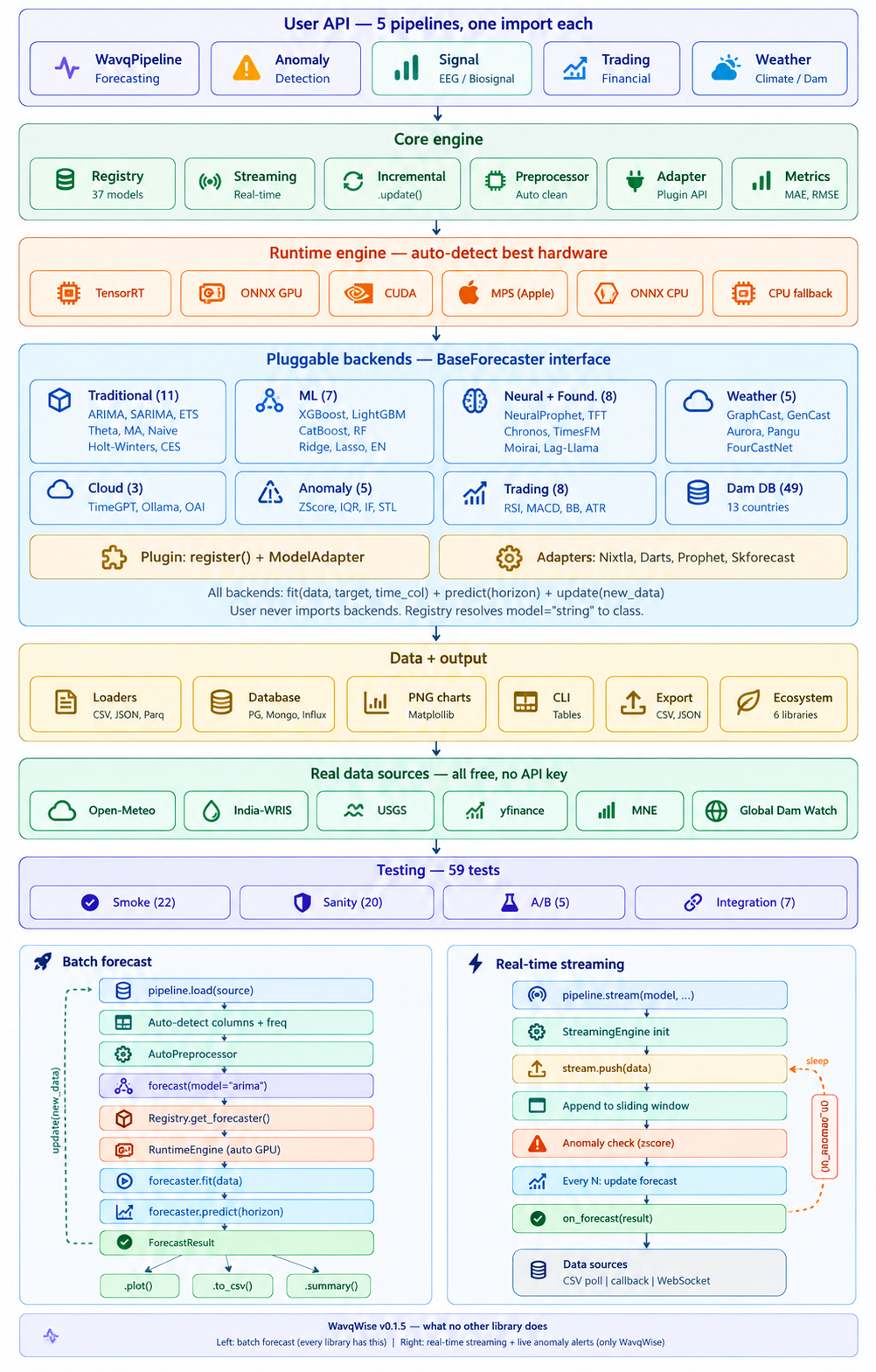
Architecture
Ecosystem
| Library | Domain | Tagline | PyPI |
|---|---|---|---|
| SightRAG | Vision | See. Search. Retrieve. |  |
| Sonarwise | Audio | Hear. Search. Retrieve. |  |
| Docqwise | Documents | Read. Extract. Retrieve. |  |
| WavqWise | Temporal | Sense. Forecast. Alert. |  |
| Adaptive Intelligence | Orchestration | Learn. Remember. Adapt. |  |
| LLMEvalKit | Evaluation | Evaluate. Score. Improve. |  |
License
Apache 2.0 License
Author
Venkatkumar Rajan
1 maintainer

Metadata
1 maintainer
Release files for wavqwise 0.1.6
For a detailed explanation of source distributions (sdists) and built distributions (wheels), please see the package formats documentation.
Source distribution (sdist)
| File | Size | Uploaded | |
|---|---|---|---|
| wavqwise-0.1.6.tar.gz | 67.9 kB | Details |
Built distribution (wheel)
| File | Interpreter | ABI | Platform | Reset |
|---|---|---|---|---|
| wavqwise-0.1.6-py3-none-any.whl | Python 3 | none | any | Details |
Total release size: 154.8 kB
Release files / wavqwise-0.1.6.tar.gz
| Download URL | wavqwise-0.1.6.tar.gz |
|---|---|
| Size | 67.9 kB |
| Tags | Source |
|
SHA-256 checksum How to use checksums |
efba97ada33ec3eb2017bb851e07b5ba1107e3bee76e1de97a28987c658b62d2
|
|
BLAKE2b-256 checksum How to use checksums |
5efb615313c433eab0de0d3fb5e6e2522593ff5ef3a104d9caec28b127b3d94a
|
| Upload date | |
|
Uploaded using Trusted Publishing? What is trusted publishing? |
No |
| Uploaded via |
twine/7.0.0 CPython/3.12.0
|
Release files / wavqwise-0.1.6-py3-none-any.whl
| Download URL | wavqwise-0.1.6-py3-none-any.whl |
|---|---|
| Size | 86.9 kB |
| Tags | Python 3 |
|
SHA-256 checksum How to use checksums |
e16b1e20079a84310754b9434e64aee23def5aafc89bf5e12277e03a76a6d1c5
|
|
BLAKE2b-256 checksum How to use checksums |
6a7422d9f32fe072f0951c8d137d0471e726b2e2c20cd32694190bd49da6b5bf
|
| Upload date | |
|
Uploaded using Trusted Publishing? What is trusted publishing? |
No |
| Uploaded via |
twine/7.0.0 CPython/3.12.0
|














