
Independent client for Bloomberg-connected data workflows
Verified details
These details have been verified by PyPIProject links
GitHub Statistics
Maintainers

Project description

xbbg: Bloomberg Data Workflows Built for Humans (and AI)





Quick Links: Discord • Documentation • Installation • Quickstart • Examples • Contributing • Changelog
Latest release: xbbg==1.2.0 (release: notes)
This
mainbranch is the Rust-powered v1 release, a significant upgrade over 0.x in performance and architecture. Need the legacy pure-Python behavior? Userelease/0.x.
Important: xbbg is an independent open-source project. It is not affiliated with, endorsed by, sponsored by, or approved by Bloomberg Finance L.P. or its affiliates. Bloomberg, Bloomberg Terminal, B-PIPE, BQL, and related names are trademarks or service marks of their respective owners. xbbg does not grant access to Bloomberg services, data, software, licenses, credentials, or entitlements; users must obtain and use those separately under their own Bloomberg agreements and applicable policies.
Table of Contents
- Overview
- Why Choose xbbg?
- Complete API Reference
- Requirements
- Installation
- Quickstart
- Power User and Infrastructure APIs
- Examples
- Troubleshooting
- Development
- Contributing
- Getting Help
- Links
- License
Overview
xbbg is an independent, Rust-powered client library for Bloomberg-connected data workflows across Python, JavaScript, and Rust: broad SDK-backed request coverage, a native runtime, and clean language-native interfaces without legacy wrapper bloat.
This main branch is the v1 release: request execution is Rust-powered for performance and reliability while preserving the familiar Python xbbg API and exposing the same engine to JavaScript and Rust workflows.
Key Features
|
Complete API Coverage
|
Enterprise-Grade Features
|
|
Excel Compatibility
|
Developer Experience
|
Quick Example
from xbbg import blp

# Reference data
prices = blp.bdp(['AAPL US Equity', 'MSFT US Equity'], 'PX_LAST')

# Historical data
hist = blp.bdh('SPX Index', 'PX_LAST', '2024-01-01', '2024-12-31')

# Intraday bars with sub-minute precision
intraday = blp.bdib('TSLA US Equity', dt='2024-01-15', interval=10, intervalHasSeconds=True)
See py-xbbg/examples/xbbg_jupyter_examples.ipynb for comprehensive tutorials and examples.
Why Choose xbbg?
xbbg is a third-party, Rust-powered client library for Python workflows that run in an already authorized Bloomberg environment. It is built for teams that need ZFP over leased lines, B-PIPE authentication, TLS, failover servers, SOCKS5, SDK logging, Arrow-native data movement, typed Python ergonomics, and broad SDK-backed request coverage without hand-written session and event-loop boilerplate.
Feature Coverage
xbbg provides a higher-level alternative to direct blpapi code for many common workflows: high-level helpers cover common request patterns, while the generic request layer lets authorized users reach Bloomberg services and operations when they need a lower-level path.
- Broad
blpapiworkflow coverage: Reference, Historical, Bulk, Intraday, Tick, Streaming, BQL, BEQS, BSRCH, BQR, BTA, YAS, fields, portfolios, curves, government lookup, and raw/generic service requests - Less raw SDK boilerplate in applications: session setup, auth, request dispatch, event parsing, Arrow output, async execution, logging, errors, and retries can be handled by xbbg instead of repeated application-local SDK loops
- Sub-second precision: Down to 10-second intraday bars (unique to xbbg)
- Real-time streaming: Live market data with async support
- Advanced utilities: Futures/CDX contract resolution, currency conversion, market hours
📊 Enterprise-Grade Without Bloat
- ZFP over leased lines:
zfp_remotesupport for Bloomberg-provisioned ZFP environments with the client credentials and trust material supplied to the user - B-PIPE and SAPI-ready authentication: User, application, user+application, directory, manual, and token auth modes for authorized enterprise identity flows
- Transport control for managed networks: Already-provisioned direct hosts, ordered failover servers, TLS, SOCKS5 proxying, startup attempts, auto-restart, and retry policy are all explicit configuration, not ad hoc connection strings
- Operational observability: xbbg tracing, Bloomberg SDK log bridging, SDK runtime detection, worker health, and request environment snapshots make failures inspectable instead of opaque
- Concurrency and isolation: Independent request worker pools and isolated subscription sessions keep batch requests, live streams, and scoped engines from stepping on each other
- User-owned middleware hooks: Request middleware gives platform teams a place to implement their own audit logging, entitlement-aware checks, request labeling, metrics, tracing, policy handling, and standardized error handling around Bloomberg requests
- Validation and governance hooks: Field validation modes, persistent field caches, middleware context, and stable output contracts help teams implement request behavior controls without standing in for Bloomberg permissions or internal governance controls
- Advanced zero-copy architecture: Rust decodes Bloomberg payloads into typed Arrow builders, releases the GIL around native work, wraps native
ArrowTableresults in a Narwhals DataFrame by default for dataframe ergonomics, and exposes explicit native/PyArrow/pandas/Polars/DuckDB conversions when requested - Benchmarking across changes: Dedicated live and offline benchmark harnesses track request latency, allocation behavior, cache contention, subscription replay throughput, and competitor equivalence so performance regressions are visible instead of guessed
- Rust-powered hot path: SDK-backed sessions, request execution, parsing, and Arrow handoff run in the shared native engine instead of slow Python event-loop glue
- No bloat: every core dependency supports the data path — SDK runtime integration, typed tabular interchange, backend conversion, benchmarking, diagnostics, or runtime packaging
💡 Developer Experience
- Excel-style request compatibility: Use familiar Bloomberg Excel add-in style request names and date formats where xbbg supports them
- Pythonic API: Consistent, intuitive function names (
bdp,bdh,bdib) - Rich documentation: 100+ examples, Jupyter notebooks, comprehensive guides
- Active community: Discord support, regular updates, responsive maintainers
🚀 Performance & Reliability
- Broad Python Bloomberg workflow surface: xbbg covers simple BDP/BDH/BDS and scales to intraday bars, ticks, subscriptions, BQL, BEQS, BSRCH, BTA, YAS, ZFP, B-PIPE auth, TLS, failover, SOCKS5, and more when your Bloomberg environment supports those services
- High-performance architecture: Rust worker pools, typed Arrow builders, async execution, GIL-free native work, zero-copy columnar handoff, and reusable SDK sessions reduce repeated Python session boilerplate used by older wrappers
- Benchmark-driven engineering: xbbg tracks performance across changes with live Bloomberg benchmarks, offline replay harnesses, allocation profiling, cache-contention measurements, subscription replay tests, and competitor equivalence checks
- No bloat: every core dependency supports the data path — SDK runtime integration, typed tabular interchange, backend conversion, benchmarking, diagnostics, or runtime packaging
- Battle-tested: Used in production by hedge funds, asset managers, and research teams
- Modern Python: Supports Python 3.10-3.14 with latest language features
- CI/CD pipeline: Automated testing across multiple Python versions and platforms
- Semantic versioning: Predictable releases with clear upgrade paths
Comparison with Alternatives
The gap is not cosmetic. The other Python Bloomberg packages are either narrower wrappers around BDP/BDH/BDS, seldom-updated legacy pandas-era clients, or partial modern experiments. They can be useful for small scripts, but they generally cover fewer Bloomberg-connected workflows, expose less enterprise transport configuration, provide different async/session architecture, or do not carry the same benchmark-driven Rust/Arrow runtime. xbbg aims to cover the simple path and the institutional path in one independent client library.
Detailed competitor notes
vs. raw blpapi
- Bloomberg's official SDK surface is intentionally low-level: every application has to handle session startup, service opening, request construction, correlation IDs, event-loop parsing, retries, logging, and dataframe conversion.
- xbbg keeps SDK access underneath through Bloomberg's C/C++ SDK while reducing hand-written event-loop code with a typed Rust engine, async worker pools, structured exceptions, Arrow output, and generic requests.
- For many normal applications, xbbg can reduce direct
blpapicode while still depending on the user's Bloomberg runtime, permissions, and entitlements.
vs. bbg-fetch / BloombergFetch
- Small, homegrown pandas helper package for prices/fundamentals/curves/analytics; targets Python 3.9–3.12 and is not a modern Python 3.13+ option.
- Hard-depends on
numpy>=2.0andpandas>=2.2.0(plus optionalpyarrow, Jupyter, and dev extras), so it is not meaningfully simpler than xbbg's core dependency surface. - Missing the institutional surface: intraday bars, ticks, streaming, BQL/BEQS/BSRCH/BQR/BTA, ZFP, B-PIPE/SAPI auth, SDK logging, multi-backend output, typed Arrow transport, async execution, and generic Bloomberg service requests.
vs. pdblp
- Legacy pandas-era wrapper; its own README says it has been superseded by
blpand is no longer under active development. - No modern
Requires-Pythonfloor; only declarespandas>=0.18.0, exactly the old pandas-wrapper model xbbg replaces. - Covers a small subset of Bloomberg data and leaves async, streaming, enterprise transports, Rust/Arrow performance, typed errors, diagnostics, multi-backend output, and broad service coverage outside the package.
vs. blp
- Cleaner than pdblp, but still a Python-level interface around Bloomberg Open API concepts.
- Declares Python
>=3.6and mandatorypandas, keeping it in the classic Python/pandas wrapper category. - xbbg goes further with native Rust execution, reusable worker pools, Arrow-native output, near-complete
blpapiworkflow coverage, enterprise connection modes, high-level analytics, and benchmark coverage across changes.
vs. polars-bloomberg
- Locks the whole workflow into Polars; xbbg gives you Polars as an optional conversion alongside pandas, DuckDB, Narwhals, and raw xbbg native Arrow paths.
- Partial Bloomberg surface: useful BQL/search-style coverage, but not full API coverage across BDP/BDS/BDH/BDIB/BDTICK/streaming, enterprise transports, middleware, diagnostics, or generic service requests.
- xbbg is the broader client: same modern Polars-friendly output when you want it, without giving up other supported request workflows or forcing every team onto one dataframe library.
| Feature | xbbg | bbg-fetch (BloombergFetch) | pdblp | blp | polars-bloomberg |
|---|---|---|---|---|---|
| Data Services | |||||
| Reference Data (BDP/BDS) | ✅ | ✅ | ✅ | ✅ | ✅ |
| Historical Data (BDH) | ✅ | ✅ | ✅ | ✅ | ✅ |
| Intraday Bars (BDIB) | ✅ | ❌ | ❌ | ❌ | ✅ |
| Tick-by-Tick Data | ✅ | ❌ | ❌ | ❌ | ❌ |
| Real-time Subscriptions | ✅ | ❌ | ❌ | ❌ | ❌ |
| Advanced Features | |||||
| Equity Screening (BEQS) | ✅ | ❌ | ❌ | ❌ | ❌ |
| Query Language (BQL) | ✅ | ❌ | ❌ | ❌ | ✅ |
| Quote Request (BQR) | ✅ | ❌ | ❌ | ❌ | ❌ |
| Search (BSRCH) | ✅ | ❌ | ❌ | ❌ | ✅ |
| Technical Analysis (BTA) | ✅ | ❌ | ❌ | ❌ | ❌ |
| Yield & Spread Analysis (YAS) | ✅ | ❌[^1] | ❌ | ❌ | ❌ |
| Developer Features | |||||
| Excel-compatible syntax | ✅ | ❌ | ❌ | ❌ | ❌ |
| Sub-minute intervals (10s bars) | ✅ | ❌ | ❌ | ❌ | ❌ |
| Async/await support | ✅ | ❌ | ❌ | ❌ | ❌ |
| Multi-backend output | ✅ | ❌ | ❌ | ❌ | ❌ |
| Utilities | |||||
| Currency conversion | ✅ | ❌ | ❌ | ❌ | ❌ |
| Futures contract resolution | ✅ | ✅[^2] | ❌ | ❌ | ❌ |
| CDX index resolution | ✅ | ❌ | ❌ | ❌ | ❌ |
| Exchange market hours | ✅ | ❌ | ❌ | ❌ | ❌ |
| Project Health | |||||
| Active development | ✅ | ✅ | ❌[^5] | ✅ | ✅ |
| Python version support | 3.10-3.14[^6] | 3.9-3.12[^3] | legacy 3.x[^7] | 3.6+[^8] | 3.12+ |
| Live last commit[^4] |  |
 |
 |
 |
 |
| DataFrame library | Multi-backend | pandas | pandas | pandas | Polars |
| Type hints | ✅ Full | ❌ | ❌ | Partial | ✅ Full |
| Real CI matrix across all supported Python versions[^9] | ✅ | ❌ | ❌ | ❌ | ❌ |
[^1]: BloombergFetch README advertises bond analytics by ISIN, but not Bloomberg YAS request coverage.
[^2]: BloombergFetch README advertises futures contract tables, active contract series, and roll handling rather than the broader xbbg futures helper surface.
[^3]: bbg-fetch targets Python 3.9–3.12; its installed hard dependencies currently include NumPy and pandas, with optional pyarrow, Jupyter, and dev extras.
[^4]: Last-commit badges are live shields.io badges against each GitHub repository's default branch; click through for the commit history. pdblp is still marked inactive by its own README even if repository metadata changes.
[^5]: pdblp has been superseded by blp and is no longer under active development.
[^6]: xbbg supports and tests Python 3.10, 3.11, 3.12, 3.13, and 3.14.
[^7]: pdblp package metadata does not declare a modern Requires-Python; its README says Python 3.x and the package depends on pandas>=0.18.0.
[^8]: blp declares Python >=3.6 and a mandatory pandas dependency in its package metadata.
[^9]: xbbg is the only package in this comparison with a real CI matrix that exercises every supported Python version. The competitors either lack active CI across their claimed range, are legacy/inactive, or test a narrower slice than their advertised compatibility.
Bottom line: xbbg is the broadest, most actively maintained independent client in this comparison for Bloomberg-connected Python workflows. It offers modern Rust/Arrow internals, benchmarked performance across changes, enterprise transports, async execution, configurable sessions, generic service requests, and non-pandas backends without switching libraries. It remains a third-party project and depends on the user's own Bloomberg runtime, entitlements, and applicable terms.
Common objections, answered
- “Rust and Narwhals are dependency bloat.” False. xbbg has a deliberately small core dependency surface:
narwhalsplus the native engine. The Rust engine emits xbbg native Arrow objects (ArrowTable/ArrowRecordBatch) directly, and Narwhals provides the lightweight plugin interface that lets one engine serve pandas, Polars, DuckDB, and other dataframe consumers when you explicitly request conversion. By contrast,bbg-fetchinstallsnumpy>=2.0andpandas>=2.2.0as hard dependencies, with optionalpyarrow, Jupyter, and dev extras. Pandas-based wrappers are not dependency-free; they just make pandas mandatory and still leave you with Python event-loop parsing, one-off dataframe shaping, and a narrow API. xbbg is leaner where it matters: fewer core concepts, fewer repeated parsing paths, fewer mandatory dataframe assumptions, and one native engine for the supported workflow surface. - “Use a lighter package for simple
bdp()calls.” xbbg is still simple at the call site (xbbg.bdp(...)), but it does not trap you in a narrow architecture when that same notebook grows into B-PIPE auth, async batch jobs, intraday bars, BQL, streaming, typed outputs, or non-pandas pipelines. - “Fixed income and government bonds are gaps.” xbbg has explicit fixed-income coverage: ISIN/CUSIP/SEDOL support, BDS cash-flow style data, BSRCH fixed-income searches, BQR dealer quotes, YAS helpers, bond analytics, curves, and CDX analytics. When Bloomberg returns no data for a security/field/date combination, xbbg surfaces the request result instead of implying unavailable Bloomberg data exists.
- “You need raw
blpapifor SAPI or B-PIPE session control.” xbbg exposes session configuration for already-provisioned hosts, ordered failoverservers, ZFP over leased lines, TLS credentials, SOCKS5, SAPI/B-PIPE auth modes (user,app,userapp,dir,manual,token), startup attempts, auto-restart, retry policy, SDK logging, scopedEngine(...)instances, and request/subscription worker pools. For unusual Bloomberg operations, the generic request layer can reduce hand-writtenblpapirequest/event-loop code without bypassing Bloomberg permissions or entitlements. - “Does xbbg automatically save Bloomberg data locally?” xbbg does not require a
BBG_ROOTmarket-data cache or auto-save Bloomberg responses as local Parquet files. Core requests return typed tables/dataframes to the caller. Users remain responsible for evaluating any local storage, caching, logging, or downstream persistence under their Bloomberg agreements, entitlements, and internal policies. - “High-level means black-box troubleshooting.” No. xbbg is high-level at the Python API and low-level where debugging matters: structured exception classes, SDK detection via
get_sdk_info(), xbbg tracing, Bloomberg SDK log bridging withenable_sdk_logging(), request IDs, worker health, middleware context, request environment snapshots, raw request access, and JSON output modes for inspecting Bloomberg payloads.
Complete API Reference
Unless noted otherwise, the typed request helpers below have async
a...counterparts (bdp→abdp,bcurves→abcurves, etc.).
Reference Data - Point-in-Time Snapshots
| Function | Description | Key Features |
|---|---|---|
bdp() |
Get current/reference data | Multiple tickers & fields Excel-style overrides ISIN/CUSIP/SEDOL support |
bds() |
Bulk/multi-row data | Portfolio holdings Fixed income cash flows Corporate actions |
abdp() |
Async reference data | Non-blocking operations Concurrent requests Web application friendly |
abds() |
Async bulk data | Parallel bulk queries Same API as bds() |
bflds() |
Unified field metadata | Get field info or search by keyword Single function for both use cases |
fieldInfo() |
Field metadata lookup (alias for bflds) |
Data types & descriptions Discover available fields |
fieldSearch() |
Search Bloomberg fields (alias for bflds) |
Find fields by keyword Explore data catalog |
blkp() |
Find tickers by name | Company name search Asset class filtering |
bport() |
Portfolio data queries | Dedicated portfolio API Holdings & weights |
Fixed Income Analytics
| Function | Description | Key Features |
|---|---|---|
yas() |
Yield & Spread Analysis | YAS calculator wrapper YTM/YTC yield types Price↔yield conversion Spread calculations |
preferreds() |
Preferred security screening | Issuer-centric lookup BQL-backed preferred universe |
corporate_bonds() |
Corporate bond screening | Cross-market debt lookup Issuer-to-bond discovery |
xbbg.extfollows the same async naming convention as the core API: extension helpers generally exposea...variants without needing separate conceptual documentation for each async name.
Bond Analytics (via xbbg.ext)
| Function | Description | Key Features |
|---|---|---|
bond_info() |
Bond reference metadata | Ratings, maturity, coupon |
bond_risk() |
Duration and risk metrics | Modified/Macaulay duration, convexity, DV01 |
bond_spreads() |
Spread analytics | OAS, Z-spread, I-spread, ASW |
bond_cashflows() |
Cash flow schedule | Coupon and principal payments |
bond_key_rates() |
Key rate durations | Key rate DV01s and risks |
bond_curve() |
Relative value comparison | Multi-bond analytics |
Options Analytics (via xbbg.ext)
| Function | Description | Key Features |
|---|---|---|
option_info() |
Contract metadata | Strike, expiry, exercise type |
option_greeks() |
Greeks and implied vol | Delta, gamma, theta, vega, IV |
option_pricing() |
Value decomposition | Intrinsic/time value, activity |
option_chain() |
Chain via overrides | CHAIN_TICKERS with filtering |
option_chain_bql() |
Chain via BQL | Rich filtering, expiry/strike ranges |
option_screen() |
Multi-option comparison | Side-by-side analytics |
Options helper enums exported by xbbg.ext:
PutCall— put/call selectorChainPeriodicity— chain interval / expiry groupingStrikeRef— strike-reference modeExerciseType— American/European exercise metadataExpiryMatch— expiry matching strategy
CDX Analytics (via xbbg.ext)
| Function | Description | Key Features |
|---|---|---|
cdx_info() |
CDX reference metadata | Series, version, constituents |
cdx_defaults() |
Default history | Settled defaults in index |
cdx_pricing() |
Market pricing | Spread, price, recovery rate |
cdx_risk() |
Risk metrics | DV01, duration, spread sensitivity |
cdx_basis() |
Basis analytics | CDX vs intrinsics spread |
cdx_default_prob() |
Default probability | Implied default rates |
cdx_cashflows() |
Cash flow schedule | Premium and protection legs |
cdx_curve() |
Term structure | Multi-tenor curve analytics |
Historical Data - Time Series Analysis
| Function | Description | Key Features |
|---|---|---|
bdh() |
End-of-day historical data | Flexible date ranges Excel-compatible aliases ( Per, Fill, Points, etc.)Local presentation aliases ( Dts, DtFmt, Sort, Direction)Dividend/split adjustments |
abdh() |
Async historical data | Non-blocking time series Batch historical queries Same alias support as bdh() |
dividend() |
Dividend & split history | All dividend types Projected dividends Date range filtering |
earnings() |
Corporate earnings | Geographic breakdowns Product segments Fiscal period analysis |
turnover() |
Trading volume & turnover | Multi-currency support Automatic FX conversion |
Intraday Data - High-Frequency Analysis
| Function | Description | Key Features |
|---|---|---|
bdib() |
Intraday bar data | Sub-minute bars (10s intervals) Session filtering (open/close) Exchange-aware timing Timezone control ( tz parameter) |
bdtick() |
Tick-by-tick data | Trade & quote events Condition codes Exchange/broker details |
Screening & Advanced Queries
| Function | Description | Key Features |
|---|---|---|
beqs() |
Bloomberg Equity Screening | Custom screening criteria Private & public screens |
bql() |
Bloomberg Query Language | SQL-like syntax Complex transformations Options chain analysis |
bqr() |
Bloomberg Quote Request | Tick-level dealer quotes Broker attribution codes Spread price & yield data Date offset support (-2d, -1w) |
bsrch() |
SRCH (Search) queries | Fixed income searches Commodity screens Weather data |
bcurves() |
Yield-curve discovery | Country/currency filters Curve ID lookup |
bgovts() |
Government security search | Treasury/sovereign lookup Partial or exact matching |
bta() |
Technical Analysis | 50+ technical indicators Custom studies |
ta_studies() |
Technical analysis catalog | Discover available studies |
ta_study_params() |
TA parameter inspection | Study inputs, defaults, and metadata |
etf_holdings() |
ETF holdings via BQL | Complete holdings list Weights & positions |
Real-Time - Live Market Data
| Function | Description | Key Features |
|---|---|---|
subscribe() |
Real-time subscriptions | Async iteration Topic failure isolation status / events / stats observability |
stream() |
Simplified streaming | Context manager Non-blocking updates |
vwap() |
Real-time VWAP | Streaming volume-weighted average price |
mktbar() |
Real-time market bars | Streaming OHLCV bars |
depth() |
Market depth | Streaming order book levels B-PIPE required |
chains() |
Option/futures chains | Real-time chain data B-PIPE required |
Utilities
| Function | Description | Key Features |
|---|---|---|
convert_ccy() |
Currency conversion | Multi-currency DataFrames Historical FX rates Automatic alignment |
fut_ticker() |
Futures contract resolution | Generic to specific mapping Date-aware selection |
active_futures() |
Active futures selection | Volume-based logic Roll date handling |
cdx_ticker() |
CDX index resolution | Series mapping Index family support |
active_cdx() |
Active CDX selection | On-the-run detection Lookback windows |
Schema Introspection
| Function | Description | Key Features |
|---|---|---|
bops() |
List service operations | Discover available request types |
bschema() |
Get operation schema | Field definitions, types, enums |
list_valid_elements() |
Valid request elements | Check parameter names before sending |
get_enum_values() |
Enum values for a field | Discover valid override values |
generate_stubs() |
IDE stub generation | Auto-complete for request parameters |
Engine Lifecycle
| Function | Description | Key Features |
|---|---|---|
configure() |
Engine and session setup | Server host/port, auth, options Replaces connect() / disconnect() |
shutdown() |
Stop engine and sessions | Graceful cleanup |
reset() |
Reset engine state | Clear sessions and caches |
is_connected() |
Check connection status | Boolean connectivity check |
Request Middleware
| Function | Description | Key Features |
|---|---|---|
add_middleware() |
Register request middleware | Hooks for user-owned audit logging, entitlement-aware checks, metrics, tracing, policy handling, request labeling |
set_middleware() |
Replace middleware chain | Install a known platform pipeline in one call |
get_middleware() |
Inspect middleware chain | Useful in apps/tests before mutation or user-owned compliance checks |
remove_middleware() |
Unregister middleware | Clean removal for scoped tests or application shutdown |
clear_middleware() |
Clear middleware chain | Reset to a pristine request path |
RequestContext |
Request metadata | Request ID, request payload, timing, results, errors |
RequestEnvironment |
Engine/auth snapshot | Host, auth method, validation mode, server list, transport context |
Additional Features
- Timezone Support: Exchange-aware market hours for 50+ global exchanges;
bdib()/bdtick()supportrequest_tzandoutput_tz(interpretation andtime-column relabeling in the Rust engine; Bloomberg wire format remains UTC) - Per-request field validation:
validate_fields=can override engine-level validation onbdp()/bds()/bdh() - Scoped engines:
Engine(...)lets you route a block of requests to a dedicated connection without mutating global state - Configurable Logging: Debug mode for troubleshooting
- Batch Processing: Efficient multi-ticker queries
- Explicit output contracts: Core metadata columns are stable; generic BDS preserves Bloomberg bulk subfield labels exactly
- Non-live test helpers:
xbbg.testingexposesmock_engine()and TestUtil-backed helpers for unit testing Bloomberg flows without a live terminal - Bloomberg ZFP over leased lines:
blp.configure(zfp_remote='8194' | '8196', tls_client_credentials=..., tls_trust_material=...)uses Bloomberg's ZFP leased-line session setup directly. ZFP is a distinct enterprise transport mode from directhost/port/servers/SOCKS5 configuration.
Requirements
-
Bloomberg C++ SDK version 3.12.1 or higher:
- Visit Bloomberg API Library and download C++ Supported Release
- For local source builds in this repo, install it with
bash ./scripts/sdktool.shon macOS/Linux or.\scripts\sdktool.ps1on Windows PowerShell - If you manage the SDK yourself, set
BLPAPI_ROOTto the extracted SDK root - You are responsible for obtaining and using Bloomberg SDK/runtime components under your own Bloomberg agreements and entitlements; xbbg does not redistribute or license them.
-
Bloomberg official Python API:
pip install blpapi --index-url=https://blpapi.bloomberg.com/repository/releases/python/simple/
-
Python dependencies (core):
narwhals>=2.0plus the nativexbbg._coreextension. PyArrow is optional; when installed, it backs the default Narwhals DataFrame for legacy-compatible behavior. -
Optional conversion backends (install separately if needed):
pyarrow- For actualpyarrow.Tableconversion (pip install xbbg[pyarrow]orpip install pyarrow)pandas- For pandas DataFrame conversion (pip install xbbg[pandas]orpip install pandas)polars- For Polars DataFrame / LazyFrame conversion (pip install xbbg[polars]orpip install polars)duckdb- For DuckDB relation conversion (pip install xbbg[duckdb]orpip install duckdb)- Native Narwhals plugin - Included with xbbg as the minimal fallback when no PyArrow/pandas/Polars backend is installed; emits a one-time warning because it intentionally has a smaller dataframe surface
Installation
pip install xbbg
For most users, also install Bloomberg's official Python package so xbbg can auto-detect the SDK runtime:
pip install blpapi --index-url=https://blpapi.bloomberg.com/repository/releases/python/simple/
Supported Python versions: 3.10 – 3.14 (universal wheel).
Quick verification:
import xbbg

print(xbbg.__version__)
print(xbbg.get_sdk_info())

# Optional: if you manage the SDK yourself instead of using blpapi/DAPI
# xbbg.set_sdk_path('/path/to/blpapi_cpp')
# xbbg.clear_sdk_path()  # remove a manual override
MCP Server for Claude Code / OpenCode
Need xbbg inside a coding agent instead of Python code? Install the local MCP wrapper + binary from GitHub Releases:
curl -fsSL https://raw.githubusercontent.com/alpha-xone/xbbg/main/scripts/install-xbbg-mcp.sh | sh
The installer currently targets macOS arm64 and Linux amd64. Windows .zip assets are attached to GitHub releases for manual installation.
GitHub release assets include only the xbbg wrapper/binary pair. They do not bundle Bloomberg SDK files or the Bloomberg runtime. You must obtain and use any Bloomberg SDK/runtime components separately from Bloomberg or another source you are authorized to use, subject to your Bloomberg agreements and entitlements.
Claude Code:
claude mcp add --transport stdio xbbg -- ~/.local/bin/xbbg-mcp
OpenCode:
{
  "$schema": "https://opencode.ai/config.json",
  "mcp": {
    "xbbg": {
      "type": "local",
      "command": ["/Users/you/.local/bin/xbbg-mcp"],
      "enabled": true
    }
  }
}
The launcher searches for the Bloomberg runtime via XBBG_MCP_LIB_DIR, BLPAPI_LIB_DIR, BLPAPI_ROOT, a locally staged authorized SDK under vendor/blpapi-sdk/, or the official blpapi Python package. See apps/xbbg-mcp/README.md for the full env surface.
Quickstart
Basic Usage
from xbbg import blp

# Get current stock prices
prices = blp.bdp(['AAPL US Equity', 'MSFT US Equity'], 'PX_LAST')
print(prices)
Common Workflows
📊 Get Reference Data (Current Snapshot)
# Single ticker, multiple fields
info = blp.bdp('NVDA US Equity', ['Security_Name', 'GICS_Sector_Name', 'PX_LAST'])

# Multiple tickers, single field
prices = blp.bdp(['AAPL US Equity', 'MSFT US Equity', 'GOOGL US Equity'], 'PX_LAST')

# With overrides (e.g., VWAP for specific date)
vwap = blp.bdp('AAPL US Equity', 'Eqy_Weighted_Avg_Px', VWAP_Dt='20240115')
📈 Get Historical Data (Time Series)
# Simple historical query
hist = blp.bdh('SPX Index', 'PX_LAST', '2024-01-01', '2024-12-31')

# Multiple fields
ohlc = blp.bdh('AAPL US Equity', ['open', 'high', 'low', 'close'], '2024-01-01', '2024-01-31')

# With dividend/split adjustments
adjusted = blp.bdh('AAPL US Equity', 'px_last', '2024-01-01', '2024-12-31', adjust='all')

# Weekly data with forward fill
weekly = blp.bdh('SPX Index', 'PX_LAST', '2024-01-01', '2024-12-31', Per='W', Fill='P')

# Excel-style request aliases and presentation controls
weekly = blp.bdh(
    'SPX Index',
    'PX_LAST',
    '2024-01-01',
    '2024-12-31',
    Per='W',        # periodicitySelection='WEEKLY'
    Fill='P',       # nonTradingDayFillMethod='PREVIOUS_VALUE'
    Points=10,      # maxDataPoints=10
    Dts='Show',     # keep date column
    DtFmt='Both',   # add period labels alongside dates
    Sort='Reverse', # newest rows first
    Direction='V',  # vertical/long output shape
)
⏱️ Get Intraday Data (High Frequency)
# 5-minute bars
bars_5m = blp.bdib('SPY US Equity', dt='2024-01-15', interval=5)

# 1-minute bars (default)
bars_1m = blp.bdib('TSLA US Equity', dt='2024-01-15')

# Sub-minute bars (10-second intervals) - UNIQUE TO XBBG!
bars_10s = blp.bdib('AAPL US Equity', dt='2024-01-15', interval=10, intervalHasSeconds=True)

# Session filtering (e.g., first 30 minutes)
opening = blp.bdib('SPY US Equity', dt='2024-01-15', session='day_open_30')

# Get data in UTC instead of exchange local time
bars_utc = blp.bdib('SPY US Equity', dt='2024-01-15', tz='UTC')
🔍 Advanced Queries (BQL, Screening)
# Bloomberg Query Language
result = blp.bql("get(px_last) for('AAPL US Equity')")

# Equity screening
screen_results = blp.beqs(screen='MyScreen', asof='2024-01-01')

# ETF holdings
holdings = blp.etf_holdings('SPY US Equity')

# Search queries
bonds = blp.bsrch("FI:MYSEARCH")

# Dealer quotes with broker codes (BQR)
quotes = blp.bqr("XYZ 4.5 01/15/30@MSG1 Corp", date_offset="-2d")
🔧 Utilities (Futures, Currency, etc.)
# Resolve futures contract
contract = blp.fut_ticker('ES1 Index', '2024-01-15', freq='ME')  # → 'ESH24 Index'

# Get active futures
active = blp.active_futures('ESA Index', '2024-01-15')

# Currency conversion
hist_usd = blp.bdh('BMW GR Equity', 'PX_LAST', '2024-01-01', '2024-01-31')
hist_eur = blp.convert_ccy(hist_usd, ccy='EUR')

# Dividend history
divs = blp.dividend('AAPL US Equity', start_date='2024-01-01', end_date='2024-12-31')
Fixed Income Analytics (Bond, CDX)
from xbbg.ext import bond_info, bond_risk, bond_spreads, cdx_info, cdx_pricing

# Bond reference data
info = bond_info('T 4.5 05/15/38 Govt')

# Bond risk metrics (duration, convexity, DV01)
risk = bond_risk('T 4.5 05/15/38 Govt')

# Bond spreads (OAS, Z-spread, ASW)
spreads = bond_spreads('T 4.5 05/15/38 Govt')

# CDX index info
cdx = cdx_info('CDX IG CDSI GEN 5Y Corp')

# CDX pricing
px = cdx_pricing('CDX IG CDSI GEN 5Y Corp')
Options Analytics
from xbbg.ext import option_info, option_greeks, option_chain_bql

# Option contract metadata
info = option_info('AAPL US 01/17/25 C200 Equity')

# Greeks and implied volatility
greeks = option_greeks('AAPL US 01/17/25 C200 Equity')

# Option chain via BQL (rich filtering)
chain = option_chain_bql('AAPL US Equity', expiry='2025-01-17')
Best Practices
- Excel users: Use the same field names and date formats as Bloomberg Excel
- Performance: Rust-powered request execution and Arrow-native output reduce Python overhead for large Bloomberg responses
- Async operations: Use
abdp(),abdh(),abds()for non-blocking requests - Debugging: Set
logging.getLogger('xbbg').setLevel(logging.DEBUG)for detailed logs
Connection Options
By default, xbbg connects to localhost on port 8194. To connect to a remote Bloomberg server or configure authentication, use configure():
from xbbg import blp

# Connect to a remote Bloomberg server
blp.configure(server_host='192.168.1.100', server_port=18194)

# With SAPI authentication
blp.configure(
    server_host='192.168.1.100',
    server_port=18194,
    auth_method='app',
    app_name='myapp:SAPI',
)

# All subsequent calls use the configured connection
blp.bdp(tickers='NVDA US Equity', flds=['Security_Name'])
You can also pass server and port as kwargs to individual function calls for ad-hoc connections.
Engine Architecture
xbbg v1 is powered by a Rust async engine with pre-warmed worker pools:
┌─────────────────────────────────────────────────┐
│                   xbbg Engine                   │
│                                                 │
│  ┌──────────────────────┐  ┌─────────────────┐  │
│  │  Request Worker Pool │  │ Subscription    │  │
│  │  (request_pool_size) │  │ Session Pool    │  │
│  │                      │  │ (sub_pool_size) │  │
│  │  Worker 1 ──session  │  │                 │  │
│  │  Worker 2 ──session  │  │  Session 1      │  │
│  │  ...                 │  │  ...            │  │
│  └──────────────────────┘  └─────────────────┘  │
│           │ round-robin          │ isolated      │
│           ▼                      ▼               │
│    bdp/bdh/bds/bdib       subscribe/stream       │
│    bql/bsrch/beqs         vwap/mktbar/depth      │
└─────────────────────────────────────────────────┘
- Request workers each hold an independent Bloomberg session. Concurrent
bdp/bdh/bdscalls are dispatched round-robin across workers, sorequest_pool_size=4allows 4 parallel Bloomberg requests. - Subscription sessions are isolated per session to avoid cross-contamination between topic streams. Each
subscribe()call gets its own Bloomberg session from the pool. - Workers are pre-warmed at first use — sessions are started and services opened before your first request, eliminating cold-start latency.
EngineConfig Reference
Call configure() before any Bloomberg request to tune the engine. All fields have sensible defaults:
from xbbg import configure, EngineConfig

# Keyword arguments (most common)
configure(request_pool_size=4, subscription_pool_size=2)

# Or use an EngineConfig object
configure(EngineConfig(request_pool_size=4, subscription_pool_size=2))
Connection & Session
| Parameter | Default | Description |
|---|---|---|
host |
'localhost' |
Bloomberg server host. Aliases: server_host, server |
port |
8194 |
Bloomberg server port. Alias: server_port |
num_start_attempts |
3 |
Retries before giving up on session start. Alias: max_attempt |
auto_restart_on_disconnection |
True |
Auto-reconnect on session disconnect. Alias: auto_restart |
Worker Pools
| Parameter | Default | Description |
|---|---|---|
request_pool_size |
2 |
Number of pre-warmed request workers (parallel Bloomberg sessions for bdp/bdh/bds/etc.) |
subscription_pool_size |
1 |
Number of pre-warmed subscription sessions (isolated sessions for subscribe/stream) |
warmup_services |
['//blp/refdata', '//blp/apiflds'] |
Services to pre-open on startup |
Subscription Tuning
| Parameter | Default | Description |
|---|---|---|
subscription_flush_threshold |
1 |
Ticks buffered before flushing to Python (increase for throughput, decrease for latency) |
subscription_stream_capacity |
256 |
Backpressure buffer size per subscription stream |
overflow_policy |
'drop_newest' |
Slow consumer policy: 'drop_newest' or 'block' |
Internal Buffers
| Parameter | Default | Description |
|---|---|---|
max_event_queue_size |
10000 |
Bloomberg SDK event queue depth |
command_queue_size |
256 |
Internal command channel capacity |
Validation
| Parameter | Default | Description |
|---|---|---|
validation_mode |
'disabled' |
Field validation: 'disabled', 'strict' (reject unknown fields), or 'lenient' (warn) |
field_cache_path |
~/.xbbg/field_cache.json |
Path for persistent field type cache. Set to customize location |
Authentication (SAPI / B-PIPE)
| Parameter | Default | Description |
|---|---|---|
auth_method |
None |
Auth mode: 'user', 'app', 'userapp', 'dir', 'manual', or 'token' |
app_name |
None |
Application name (required for app, userapp, manual) |
user_id |
None |
Bloomberg user ID (required for manual) |
ip_address |
None |
Bloomberg IP address (required for manual) |
dir_property |
None |
Active Directory property (required for dir) |
token |
None |
Auth token (required for token) |
Auth mode examples:
# B-PIPE application auth
configure(auth_method='app', app_name='myapp:8888', host='bpipe-host')

# Manual auth (SAPI)
configure(auth_method='manual', app_name='myapp', user_id='12345', ip_address='10.0.0.1')

# Active Directory auth
configure(auth_method='dir', dir_property='mail')
Async Functions
Every sync function has an async counterpart prefixed with a — for example bdp() → abdp(), bdh() → abdh(), bdib() → abdib(). In the v1 architecture, async implementations are the canonical source of truth and sync functions delegate via _run_sync().
Common async families:
| Sync | Async |
|---|---|
bdp, bds, bdh, bdib, bdtick |
abdp, abds, abdh, abdib, abdtick |
bql, bsrch, bqr, beqs |
abql, absrch, abqr, abeqs |
blkp, bport, bcurves, bgovts |
ablkp, abport, abcurves, abgovts |
subscribe, stream, vwap, mktbar, depth, chains |
asubscribe, astream, avwap, amktbar, adepth, achains |
bta, bflds, fieldInfo, fieldSearch |
abta, abflds, afieldInfo, afieldSearch |
In scripts (no existing event loop)
import asyncio
from xbbg import blp

async def get_data():
    df = await blp.abdp(tickers='AAPL US Equity', flds=['PX_LAST', 'VOLUME'])
    return df

async def get_multiple():
    # Concurrent requests — runs in parallel on a single thread
    results = await asyncio.gather(
        blp.abdp(tickers='AAPL US Equity', flds=['PX_LAST']),
        blp.abdp(tickers='MSFT US Equity', flds=['PX_LAST']),
        blp.abdh(tickers='GOOGL US Equity', start_date='2024-01-01'),
    )
    return results

data = asyncio.run(get_data())
multiple = asyncio.run(get_multiple())
In Jupyter notebooks
Jupyter and VS Code Interactive already run an event loop. For one-shot request/response calls, you can keep using the familiar sync API:
from xbbg import blp

df = blp.bdp(tickers='AAPL US Equity', flds=['PX_LAST', 'VOLUME'])
hist = blp.bdh(tickers='AAPL US Equity', flds='PX_LAST', start_date='2024-01-01')
bdp, bdh, bds, bdib, bdtick, and request use a notebook-only background event-loop bridge when IPykernel already has a loop running.
If your notebook cell is already async, use the async APIs directly:
from xbbg import blp

df = await blp.abdp(tickers='AAPL US Equity', flds=['PX_LAST', 'VOLUME'])
Important: Generic async applications such as FastAPI or ASGI services should still use
await blp.abdp(...)/await blp.abdh(...). The sync bridge is only for IPykernel notebook environments and does not apply to streaming or long-lived async APIs.
Benefits:
- Non-blocking: async APIs don't block the event loop
- Concurrent: use
asyncio.gather()for parallel requests - Compatible: async APIs work with web frameworks; one-shot sync APIs work in notebooks
- Same API: identical parameters between sync and async versions (
bdp/abdp,bdh/abdh)
Multi-Backend Support
Starting with v1, xbbg defaults to a Narwhals DataFrame. When PyArrow is installed, that Narwhals frame is backed by a real pyarrow.Table, preserving the pre-native-backend behavior and full Narwhals expression support. Minimal installs fall back through installed dataframe libraries and finally xbbg's native Arrow carrier; that final native-plugin fallback emits a one-time RuntimeWarning because it intentionally does not implement the full PyArrow/Narwhals expression surface. Request backend="native" / Backend.NATIVE when you want the raw xbbg._core.ArrowTable; request backend="pyarrow" / Backend.PYARROW when you want PyArrow's full table API.
Conversion backends are explicit opt-ins. Install only the libraries you actually use.
Supported Backends
| Backend | Type | Output | Best For |
|---|---|---|---|
default / narwhals |
Core wrapper | Narwhals DataFrame over PyArrow when installed, otherwise installed dataframe backends or xbbg._core.ArrowTable fallback |
Backwards-compatible dataframe ergonomics without pandas/PyArrow as hard deps |
native |
Native eager | xbbg._core.ArrowTable |
Zero-copy xbbg-native workflows, Arrow PyCapsule interop |
pyarrow |
Optional conversion | pyarrow.Table |
Full PyArrow table functionality and Arrow ecosystem integrations |
pandas |
Optional conversion | pd.DataFrame |
Traditional dataframe workflows, compatibility |
polars |
Optional conversion | pl.DataFrame |
High-performance eager analytics |
polars_lazy |
Optional conversion | pl.LazyFrame |
Deferred Polars execution |
duckdb |
Optional conversion | DuckDB relation | SQL analytics and OLAP queries |
narwhals_lazy |
Native plugin | Narwhals LazyFrame over xbbg Arrow objects | Library-agnostic lazy evaluation |
modin, cudf, dask, ibis, pyspark, sqlframe |
Optional Narwhals-backed conversions | Native objects for installed libraries | Specialized distributed/GPU/SQL workflows |
Note: wide / Format.WIDE was removed in v1.0.0rc4. Use semi_long for one row per security, or pivot a long result explicitly in your downstream DataFrame library.
Native Arrow Carrier API
backend="native" returns xbbg-owned carrier objects, not pyarrow or arro3 objects. The carrier is intentionally small: it exposes Arrow-shaped table, batch, and column access without dataframe compute semantics.
table = bdp("AAPL US Equity", "PX_LAST", backend="native")

print(table.shape)          # (rows, columns)
print(table.column_names)   # schema-order names
print(table.nbytes)         # Arrow buffer bytes referenced by the carrier

first = table.column(table.column_names[0])
print(first.to_pylist())
print(first.null_count)

subset = table.select(table.column_names[:2]).head(5)
batches = subset.to_batches()
Use table.to_pyarrow(), table.to_pandas(), or table.to_polars() when you explicitly want a third-party object. Those methods import optional packages lazily and keep the native backend contract xbbg-owned.
Check Backend Availability
from xbbg import get_available_backends, print_backend_status, is_backend_available

# Narwhals/default and native carrier are always available
print(is_backend_available("narwhals"))  # True
print(is_backend_available("native"))    # True

# Lists Backend.NARWHALS, Backend.NATIVE, plus installed optional conversion backends
print(get_available_backends())

# Check if a specific optional conversion backend is available
if is_backend_available("polars"):
    print("Polars is installed!")

# Print detailed status of all backends
print_backend_status()
Usage
from xbbg import blp, Backend

# Default Narwhals DataFrame; PyArrow-backed when PyArrow is installed
df = blp.bdh("SPX Index", "PX_LAST", "2024-01-01", "2024-12-31")
print(df.columns, len(df))

# Explicit native carrier
table = blp.bdp("AAPL US Equity", "PX_LAST", backend="native")

# Optional conversions
table_pyarrow = blp.bdp("IBM US Equity", "PX_LAST", backend=Backend.PYARROW)
df_pandas = blp.bdp("MSFT US Equity", "PX_LAST", backend=Backend.PANDAS)
df_polars = blp.bdp("AAPL US Equity", "PX_LAST", backend=Backend.POLARS)
duckdb_rel = blp.bdh("SPX Index", "PX_LAST", "2024-01-01", "2024-12-31", backend=Backend.DUCKDB)
nw_df = blp.bdp("AAPL US Equity", "PX_LAST", backend=Backend.NARWHALS)
Narwhals can also consume native xbbg Arrow objects directly through the included plugin:
import narwhals as nw
from xbbg import blp

table = blp.bdp("AAPL US Equity", "PX_LAST", backend="native")
nw_df = nw.from_native(table)
Output Formats
Control the shape of your data with the format parameter:
| Format | Description | Use Case |
|---|---|---|
long |
Tidy format with ticker, field, value columns | Analysis, joins, aggregations |
long_typed |
Typed value columns per data type | Type-safe analysis, no casting needed |
long_metadata |
String values with dtype metadata column | Serialization, debugging, data catalogs |
semi_long |
One row per security/date, fields as columns | Quick inspection, Excel-style output, replacement for removed wide |
from xbbg import blp

# Long format (tidy data, default)
df_long = blp.bdp(["AAPL US Equity", "MSFT US Equity"], ["PX_LAST", "VOLUME"], format="long")

# Semi-long format (one row per ticker, fields as columns)
df_semi = blp.bdh("SPX Index", "PX_LAST", "2024-01-01", "2024-12-31", format="semi_long")
Global Configuration
Set defaults for your entire session:
from xbbg import set_backend, Backend
from xbbg import blp, get_backend

# Without configuration, calls use Backend.NARWHALS
print(get_backend())  # None means the default public backend is Backend.NARWHALS

# Set Polars as default backend
set_backend(Backend.POLARS)
print(get_backend())  # Backend.POLARS

# All subsequent calls use this default
df = blp.bdp("AAPL US Equity", "PX_LAST")  # Returns Polars DataFrame
Why native Arrow + optional conversions?
- Default compatibility: the public default is a Narwhals DataFrame so existing dataframe-style code keeps
len(df),df.columns, and explicit conversions - Explicit native carrier:
backend="native"returns the raw xbbgArrowTable - Explicit PyArrow:
backend="pyarrow"returns a realpyarrow.Tablewhen PyArrow is installed - Interoperability: Arrow PyCapsule methods let Arrow-aware libraries consume xbbg data while keeping PyArrow optional
Power User and Infrastructure APIs
The core blp.bdp() / blp.bdh() workflow covers most day-to-day usage, but the current package exposes several advanced surfaces that are easy to miss if you only skim the quickstart. This section summarizes the non-obvious parts of the public API so the README tracks the package more faithfully.
Generic Requests and Raw JSON
For uncommon Bloomberg operations, raw service access, or debugging request payloads, use the generic request layer:
| Surface | Purpose | Notes |
|---|---|---|
request() / arequest() |
Low-level request entrypoint | Works with arbitrary Bloomberg services and operations |
Service / Operation |
Enum wrappers for service URIs and request types | Safer than hand-typed strings |
RequestParams |
Dataclass for validated request payloads | Useful in middleware or reusable request builders |
OutputMode |
Output transport (ARROW or JSON) |
JSON is useful for debugging Bloomberg payloads |
ExtractorHint |
Override extraction strategy | Advanced escape hatch for bulk/custom responses |
from xbbg import Operation, OutputMode, Service, request

# Generic refdata request
df = request(
    Service.REFDATA,
    Operation.REFERENCE_DATA,
    securities=['AAPL US Equity'],
    fields=['PX_LAST', 'VOLUME'],
)

# Raw JSON transport for debugging/custom parsing
raw = request(
    Service.REFDATA,
    Operation.REFERENCE_DATA,
    securities=['AAPL US Equity'],
    fields=['PX_LAST'],
    output=OutputMode.JSON,
)
Schema, Operations, and IDE Stubs
xbbg ships two schema surfaces:
blp.bops()/blp.bschema()for quick interactive discoveryxbbg.schemafor typed schema objects and stub-generation utilities
| Surface | Purpose |
|---|---|
bops() / abops() |
List operations available on a Bloomberg service |
bschema() / abschema() |
Return service/operation schema as plain dictionaries |
xbbg.schema.get_schema() / aget_schema() |
Return typed ServiceSchema objects |
xbbg.schema.get_operation() / aget_operation() |
Return typed OperationSchema objects backed by ElementInfo trees |
xbbg.schema.list_operations() / alist_operations() |
Enumerate operations for a service |
xbbg.schema.get_enum_values() / aget_enum_values() |
Discover valid enum values for an element |
xbbg.schema.list_valid_elements() / alist_valid_elements() |
Inspect valid request element names before sending |
generate_stubs() / configure_ide_stubs() |
Generate IDE-friendly stubs from cached Bloomberg schema |
generate_ta_stubs() |
Generate TA helper stubs for study-specific autocomplete |
from xbbg import blp
from xbbg.schema import get_operation, list_operations

print(blp.bops())  # quick list for //blp/refdata
print(list_operations('//blp/instruments'))

hist_schema = get_operation('//blp/refdata', 'HistoricalDataRequest')
print(hist_schema.request.children[0].name)
Field Metadata, Cache, and Type Resolution
There are three related layers here:
bflds()/fieldInfo()/fieldSearch()for Bloomberg field catalog discoveryxbbg.field_cachefor Arrow type resolution and cache managementfield_types=request overrides for per-call control
| Surface | Purpose |
|---|---|
bflds() / abflds() |
Unified field-info and field-search entrypoint |
bfld() / abfld() |
Alias for bflds() |
fieldInfo() / afieldInfo() |
Alias for bflds(fields=...) |
fieldSearch() / afieldSearch() |
Alias for bflds(search_spec=...) |
resolve_field_types() / aresolve_field_types() |
Resolve Bloomberg fields to Arrow types |
cache_field_types() |
Pre-warm the field cache |
get_field_info() |
Return structured FieldInfo objects |
get_field_cache_stats() |
Inspect cache path and entry count |
clear_field_cache() |
Clear in-memory and on-disk field cache |
FieldTypeCache |
Compatibility facade over the Rust resolver |
from xbbg import blp
from xbbg.field_cache import (
    get_field_cache_stats,
    resolve_field_types,
)

catalog = blp.fieldSearch('vwap')
details = blp.fieldInfo(['PX_LAST', 'VOLUME'])
types = resolve_field_types(['PX_LAST', 'NAME', 'DVD_EX_DT'])
stats = get_field_cache_stats()
Important current behavior:
- Field type resolution is Rust-backed and persistent
field_cache_path=can be set viaconfigure(...)before the engine startslong_typedandlong_metadataformats are driven by these resolved field types
Market Metadata and Session Overrides
The xbbg.markets module exposes exchange/session helpers that complement request APIs:
| Surface | Purpose |
|---|---|
ExchangeInfo |
Structured exchange metadata record returned by Bloomberg-backed helpers |
SessionWindows |
Dataclass representing derived market sessions (day, pre, post, etc.) |
market_info() |
Lightweight market metadata for a security |
market_timing() |
Session timing lookup for a ticker/session combination |
ccy_pair() |
FX conversion metadata for currency pair normalization |
exch_info() |
Exchange/session metadata lookup |
get_session_windows() / derive_sessions() |
Derive named session windows without a data request |
fetch_exchange_info() / afetch_exchange_info() |
Bloomberg-backed exchange metadata fetch |
set_exchange_override() / get_exchange_override() / clear_exchange_override() |
Runtime override lifecycle for timezone/session metadata |
list_exchange_overrides() / has_override() |
Inspect override state |
convert_session_times_to_utc() |
Convert local market sessions to UTC |
from xbbg.markets import get_session_windows, market_info, set_exchange_override

print(market_info('ES1 Index'))
print(get_session_windows('AAPL US Equity', mic='XNAS', regular_hours=('09:30', '16:00')))

set_exchange_override(
    'MY_PRIVATE_TICKER Equity',
    timezone='America/New_York',
    sessions={'regular': ('09:30', '16:00')},
)
SDK Detection, Logging, and Diagnostics
Beyond configure(), the package exposes helpers for SDK discovery, backend validation, and engine diagnostics:
| Surface | Purpose |
|---|---|
get_sdk_info() |
Show detected Bloomberg SDK sources and active runtime |
set_sdk_path() / clear_sdk_path() |
Manually override SDK discovery |
set_log_level() / get_log_level() |
Control Rust-side logging verbosity |
enable_sdk_logging() |
Surface underlying Bloomberg SDK logs |
get_available_backends() / is_backend_available() |
Inspect installed dataframe backends |
check_backend() |
Validate backend availability/version and get install guidance |
get_supported_formats() / is_format_supported() |
Inspect backend/format compatibility |
check_format_compatibility() / validate_backend_format() |
Guard backend + format combinations programmatically |
from xbbg import Backend, check_backend, get_sdk_info, print_backend_status, validate_backend_format

print(get_sdk_info())
check_backend('polars')
validate_backend_format(Backend.PANDAS, 'semi_long')
print_backend_status()
Testing Utilities
xbbg.testing is part of the supported public surface for non-live tests:
| Helper | Purpose |
|---|---|
MockResponse |
Structured canned-response container used by mock_engine() |
create_mock_response() |
Build canned request responses without a live terminal |
mock_engine() |
Context manager that intercepts xbbg calls and returns canned responses |
create_mock_event() |
Build Bloomberg blpapi.test events when blpapi is installed |
get_admin_message_definition() |
Fetch TestUtil admin-message definitions for mocked admin events |
deserialize_service() |
Deserialize service XML for TestUtil-backed mocks |
append_message_dict() |
Populate mock Bloomberg messages from Python dictionaries |
from xbbg import blp
from xbbg.testing import create_mock_response, mock_engine

response = create_mock_response(
    service='//blp/refdata',
    operation='ReferenceDataRequest',
    data={'AAPL US Equity': {'PX_LAST': 210.5}},
)

with mock_engine([response]):
    df = blp.bdp('AAPL US Equity', 'PX_LAST')
Exception Types
The current exception surface is intentionally typed and worth calling out in the README because many workflows want to catch Bloomberg failures explicitly:
| Exception | Typical use |
|---|---|
BlpError |
Base class for Bloomberg-related failures |
BlpSessionError |
Session startup/connectivity/auth failures |
BlpRequestError |
Request-level failure with service/operation context |
BlpSecurityError |
Security-specific request failure |
BlpFieldError |
Field-specific request failure |
BlpValidationError |
Invalid request shape, bad elements, bad enum values |
BlpTimeoutError |
Request timed out |
BlpInternalError |
Internal engine/runtime failure |
BlpBPipeError |
B-PIPE-only feature used without B-PIPE access (depth, chains) |
from xbbg import blp
from xbbg.exceptions import BlpBPipeError, BlpValidationError

try:
    blp.depth('AAPL US Equity')
except BlpBPipeError:
    ...
except BlpValidationError as exc:
    print(exc.element, exc.suggestion)
Examples
📊 Reference Data
Equity and Index Securities
from xbbg import blp

# Single point-in-time data (BDP)
blp.bdp(tickers='NVDA US Equity', flds=['Security_Name', 'GICS_Sector_Name'])
Out[2]:
               security_name        gics_sector_name
NVDA US Equity   NVIDIA Corp  Information Technology
# With field overrides
blp.bdp('AAPL US Equity', 'Eqy_Weighted_Avg_Px', VWAP_Dt='20181224')
Out[3]:
                eqy_weighted_avg_px
AAPL US Equity               148.75
# Multiple tickers and fields
blp.bdp(
    tickers=['AAPL US Equity', 'MSFT US Equity', 'GOOGL US Equity'],
    flds=['Security_Name', 'GICS_Sector_Name', 'PX_LAST']
)
Out[3a]:
                  security_name        gics_sector_name px_last
AAPL US Equity        Company A  Information Technology  150.25
GOOGL US Equity    Company B  Communication Services  165.30
MSFT US Equity   Company C  Information Technology  180.45
# Bulk/block data (BDS) - multi-row per ticker
blp.bds('AAPL US Equity', 'DVD_Hist_All', DVD_Start_Dt='20180101', DVD_End_Dt='20180531')
bds() and abds() preserve Bloomberg bulk subfield labels exactly as emitted.
The only xbbg-added columns are ticker and field; field-specific columns may
contain spaces, punctuation, and Bloomberg casing such as Future's Ticker or
Last Trade Date. Normalize or rename these columns in your own code when you
need a stable application schema.
Fixed Income Securities
xbbg supports fixed income securities using standard security identifiers (ISIN, CUSIP, SEDOL). Use the /isin/{isin}, /cusip/{cusip}, or /sedol/{sedol} format as the ticker:
# Reference data using ISIN
blp.bdp(tickers='/isin/US1234567890', flds=['SECURITY_NAME', 'MATURITY', 'COUPON', 'PX_LAST'])
Out[9]:
                       security_name    maturity coupon    px_last
/isin/US1234567890  US Treasury Note  2035-05-15   4.25  101.25
# Cash flow schedule using ISIN
blp.bds(tickers='/isin/US1234567890', flds='DES_CASH_FLOW')
The cash-flow output follows the same BDS contract: ticker and field are
xbbg metadata columns, and Bloomberg cash-flow subfield labels are preserved
verbatim.
Note: Fixed income securities work with bdp(), bds(), and bdh() functions. The identifier format (/isin/, /cusip/, /sedol/) is automatically passed to blpapi.
Yield & Spread Analysis (YAS)
The yas() function provides a convenient wrapper for Bloomberg's YAS calculator:
from xbbg import blp
from xbbg.api.fixed_income import YieldType

# Get yield to maturity
blp.yas('T 4.5 05/15/38 Govt')
Out[11]:
                     YAS_BOND_YLD
ticker
T 4.5 05/15/38 Govt         4.348
# Calculate yield from price
blp.yas('T 4.5 05/15/38 Govt', price=95.0)
Out[12]:
                     YAS_BOND_YLD
ticker
T 4.5 05/15/38 Govt          5.05
# Calculate price from yield
blp.yas('T 4.5 05/15/38 Govt', flds='YAS_BOND_PX', yield_=4.8)
Out[13]:
                     YAS_BOND_PX
ticker
T 4.5 05/15/38 Govt    97.229553
# Yield to call for callable bonds
blp.yas('AAPL 2.65 05/11/50 Corp', yield_type=YieldType.YTC)
Out[14]:
                          YAS_BOND_YLD
ticker
AAPL 2.65 05/11/50 Corp          5.431
# Multiple YAS analytics
blp.yas('T 4.5 05/15/38 Govt', ['YAS_BOND_YLD', 'YAS_MOD_DUR', 'YAS_ASW_SPREAD'])
Out[15]:
                     YAS_ASW_SPREAD  YAS_BOND_YLD  YAS_MOD_DUR
ticker
T 4.5 05/15/38 Govt       33.093531         4.348     9.324928
Available parameters:
settle_dt: Settlement date (YYYYMMDD or datetime)yield_type:YieldType.YTM(default) orYieldType.YTCprice: Input price to calculate yieldyield_: Input yield to calculate pricespread: Spread to benchmark in basis pointsbenchmark: Benchmark bond ticker for spread calculations
Field Information and Search
# Unified field lookup (recommended)
blp.bflds(fields=['PX_LAST', 'VOLUME'])  # Get metadata for specific fields
blp.bflds(search_spec='vwap')            # Search for fields by keyword

# Convenience aliases
blp.fieldInfo(['PX_LAST', 'VOLUME'])     # Same as bflds(fields=...)
blp.fieldSearch('vwap')                  # Same as bflds(search_spec=...)
Security Lookup
# Look up securities by company name
blp.blkp('IBM', max_results=10)
# Lookup with asset class filter
blp.blkp('Apple', yellowkey='eqty', max_results=20)
Portfolio Data
# Get portfolio data (dedicated function)
blp.bport('PORTFOLIO_NAME', 'PORTFOLIO_MWEIGHT')
📈 Historical Data
# End-of-day historical data (BDH)
blp.bdh(
    tickers='SPX Index', flds=['high', 'low', 'last_price'],
    start_date='2018-10-10', end_date='2018-10-20',
)
Out[4]:
           SPX Index
                high      low last_price
2018-10-10  2,874.02 2,784.86   2,785.68
2018-10-11  2,795.14 2,710.51   2,728.37
2018-10-12  2,775.77 2,729.44   2,767.13
2018-10-15  2,775.99 2,749.03   2,750.79
2018-10-16  2,813.46 2,766.91   2,809.92
2018-10-17  2,816.94 2,781.81   2,809.21
2018-10-18  2,806.04 2,755.18   2,768.78
2018-10-19  2,797.77 2,760.27   2,767.78
# Multiple tickers and fields
blp.bdh(
    tickers=['AAPL US Equity', 'MSFT US Equity'],
    flds=['px_last', 'volume'],
    start_date='2024-01-01', end_date='2024-01-10',
)
Out[4a]:
           AAPL US Equity             MSFT US Equity
                  px_last      volume        px_last      volume
2024-01-02         150.25  45000000.0         180.45  25000000.0
2024-01-03         151.30  42000000.0         181.20  23000000.0
2024-01-04         149.80  48000000.0         179.90  24000000.0
2024-01-05         150.10  44000000.0         180.15  22000000.0
2024-01-08         151.50  46000000.0         181.80  26000000.0
# Excel-compatible inputs with periodicity
blp.bdh(
    tickers='SHCOMP Index', flds=['high', 'low', 'last_price'],
    start_date='2018-09-26', end_date='2018-10-20',
    Per='W', Fill='P', Days='A',
)
Out[5]:
           SHCOMP Index
                   high      low last_price
2018-09-28     2,827.34 2,771.16   2,821.35
2018-10-05     2,827.34 2,771.16   2,821.35
2018-10-12     2,771.94 2,536.66   2,606.91
2018-10-19     2,611.97 2,449.20   2,550.47
# Dividend/split adjustments
blp.bdh('AAPL US Equity', 'px_last', '20140606', '20140609', adjust='all')
Out[15]:
           AAPL US Equity
                  px_last
2014-06-06          85.22
2014-06-09          86.58
# Dividend history
blp.dividend(['C US Equity', 'MS US Equity'], start_date='2018-01-01', end_date='2018-05-01')
Out[13]:
                dec_date     ex_date    rec_date    pay_date  dvd_amt dvd_freq      dvd_type
C US Equity   2018-01-18  2018-02-02  2018-02-05  2018-02-23     0.32  Quarter  Regular Cash
MS US Equity  2018-04-18  2018-04-27  2018-04-30  2018-05-15     0.25  Quarter  Regular Cash
MS US Equity  2018-01-18  2018-01-30  2018-01-31  2018-02-15     0.25  Quarter  Regular Cash
# Earnings breakdowns
blp.earnings('AMD US Equity', by='Geo', Eqy_Fund_Year=2017, Number_Of_Periods=1)
Out[12]:
                 level    fy2017  fy2017_pct
Asia-Pacific      1.00  3,540.00       66.43
    China         2.00  1,747.00       49.35
    Japan         2.00  1,242.00       35.08
    Singapore     2.00    551.00       15.56
United States     1.00  1,364.00       25.60
Europe            1.00    263.00        4.94
Other Countries   1.00    162.00        3.04
⏱️ Intraday Data
# Intraday bars (1-minute default)
blp.bdib(ticker='BHP AU Equity', dt='2018-10-17').tail()
Out[9]:
                          BHP AU Equity
                                   open  high   low close   volume num_trds
2018-10-17 15:56:00+11:00         33.62 33.65 33.62 33.64    16660      126
2018-10-17 15:57:00+11:00         33.65 33.65 33.63 33.64    13875      156
2018-10-17 15:58:00+11:00         33.64 33.65 33.62 33.63    16244      159
2018-10-17 15:59:00+11:00         33.63 33.63 33.61 33.62    16507      167
2018-10-17 16:10:00+11:00         33.66 33.66 33.66 33.66  1115523      216
Selecting bar intervals:
- Minute-based intervals (default): Use the
intervalparameter to specify minutes. By default,interval=1(1-minute bars). Common intervals:interval=5→ 5-minute barsinterval=15→ 15-minute barsinterval=30→ 30-minute barsinterval=60→ 1-hour bars
# 5-minute bars
blp.bdib(ticker='AAPL US Equity', dt='2025-11-12', interval=5).head()

# 15-minute bars
blp.bdib(ticker='AAPL US Equity', dt='2025-11-12', interval=15).head()
- Sub-minute intervals (seconds): Set
intervalHasSeconds=Trueand specify seconds:
# 10-second bars
blp.bdib(ticker='AAPL US Equity', dt='2025-11-12', interval=10, intervalHasSeconds=True).head()
Out[9a]:
                          AAPL US Equity
                                   open    high     low   close volume num_trds
2025-11-12 09:31:00-05:00        150.25  150.35  150.20  150.30  25000      150
2025-11-12 09:31:10-05:00        150.30  150.40  150.25  150.35  18000      120
2025-11-12 09:31:20-05:00        150.35  150.45  150.30  150.40  22000      135
Note: By default, interval is interpreted as minutes. Set intervalHasSeconds=True to use seconds-based intervals.
# Market session filtering
blp.bdib(ticker='7974 JT Equity', dt='2018-10-17', session='am_open_30').tail()
Out[11]:
                          7974 JT Equity
                                    open      high       low     close volume num_trds
2018-10-17 09:27:00+09:00      39,970.00 40,020.00 39,970.00 39,990.00  10800       44
2018-10-17 09:28:00+09:00      39,990.00 40,020.00 39,980.00 39,980.00   6300       33
2018-10-17 09:29:00+09:00      39,970.00 40,000.00 39,960.00 39,970.00   3300       21
2018-10-17 09:30:00+09:00      39,960.00 40,010.00 39,950.00 40,000.00   3100       19
2018-10-17 09:31:00+09:00      39,990.00 40,000.00 39,980.00 39,990.00   2000       15
How the session parameter works
The session parameter is resolved by xbbg.core.config.intervals.get_interval()
and xbbg.core.process.time_range() using exchange metadata from
xbbg/markets/config/exch.yml:
-
Base sessions (no underscores) map directly to session windows defined for the ticker's exchange in
exch.yml:allday- Full trading day including pre/post market (e.g.,[400, 2000]for US equities)day- Regular trading hours (e.g.,[0930, 1600]for US equities)am- Morning session (e.g.,[901, 1130]for Japanese equities)pm- Afternoon session (e.g.,[1230, 1458]for Japanese equities)pre- Pre-market session (e.g.,[400, 0930]for US equities)post- Post-market session (e.g.,[1601, 2000]for US equities)night- Night trading session (e.g.,[1710, 700]for Australian futures)
Not all exchanges define all sessions. For example,
GBP CurncyusesCurrencyGenericwhich definesalldayanddayonly. -
Compound sessions (with underscores) allow finer control by combining a base session with modifiers (
open,close,normal,exact):- Open windows (first N minutes of a session):
day_open_30→ first 30 minutes of thedaysessionam_open_30→ first 30 minutes of theamsession- Note:
openis not a base session; useday_open_30, notopen_30
- Close windows (last N minutes of a session):
day_close_20→ last 20 minutes of thedaysessionam_close_30→ last 30 minutes of theamsession- Note:
closeis not a base session; useday_close_20, notclose_20
- Normal windows (skip open/close buffers):
day_normal_30_20→ skips first 30 min and last 20 min ofdayam_normal_30_30→ skips first 30 min and last 30 min ofam
- Exact clock times (exchange-local HHMM format):
day_exact_2130_2230→ [21:30, 22:30] local time (marker session)allday_exact_2130_2230→ [21:30, 22:30] local time (actual window)allday_exact_2130_0230→ [21:30, 02:30 next day] local time
- Open windows (first N minutes of a session):
-
Resolution order and fallbacks:
blp.bdib/blp.bdtickcalltime_range(), which:- Uses
exch.yml+get_interval()andconst.exch_info()to resolve local session times and exchange timezone. - Converts that window to UTC and then to your requested
tzargument (e.g.,'UTC','NY','Europe/London'). - If exchange metadata is missing for
sessionand the asset, it may fall back to pandas‑market‑calendars (PMC) for simple sessions ('day'/'allday'), based on the exchange code.
- Uses
-
Errors and diagnostics:
- If a
sessionname is not defined for the ticker's exchange,get_interval()raises aValueErrorlisting the available sessions for that exchange and points toxbbg/markets/exch.yml. - For compound sessions whose base session doesn't exist (e.g. mis-typed
am_open_30for an exchange that has noamsection),get_interval()returnsSessNAandtime_range()will then try the PMC fallback or ultimately raise a clearValueError.
- If a
In practice:
- Use simple names like
session='day'orsession='allday'when you just want the main trading hours. - Use compound names like
session='day_open_30'orsession='am_normal_30_30'when you need to focus on opening/closing auctions or to exclude "micro" windows (e.g. the first X minutes). - If you add or customize sessions, update
exch.ymland rely onget_interval()to pick them up automatically.
# Using reference exchange for market hours
blp.bdib(ticker='ESM0 Index', dt='2020-03-20', ref='ES1 Index').tail()
out[10]:
                          ESM0 Index
                                open     high      low    close volume num_trds        value
2020-03-20 16:55:00-04:00   2,260.75 2,262.25 2,260.50 2,262.00    412      157   931,767.00
2020-03-20 16:56:00-04:00   2,262.25 2,267.00 2,261.50 2,266.75    812      209 1,838,823.50
2020-03-20 16:57:00-04:00   2,266.75 2,270.00 2,264.50 2,269.00   1136      340 2,576,590.25
2020-03-20 16:58:00-04:00   2,269.25 2,269.50 2,261.25 2,265.75   1077      408 2,439,276.00
2020-03-20 16:59:00-04:00   2,265.25 2,272.00 2,265.00 2,266.50   1271      378 2,882,978.25
# Tick-by-tick data with event types and condition codes
blp.bdtick(ticker='XYZ US Equity', dt='2024-10-15', session='day', types=['TRADE']).head()
Out[12]:
                          XYZ US Equity
                                   volume    typ   cond exch            trd_time
2024-10-15 09:30:15-04:00           1500  TRADE     @  NYSE  2024-10-15 09:30:15
2024-10-15 09:30:23-04:00            800  TRADE     @  NYSE  2024-10-15 09:30:23
2024-10-15 09:30:31-04:00           2200  TRADE     @  NYSE  2024-10-15 09:30:31
# Tick data with timeout (useful for large requests)
blp.bdtick(ticker='XYZ US Equity', dt='2024-10-15', session='day', timeout=1000)
Note: bdtick requests can take longer to respond. Use timeout parameter (in milliseconds) if you encounter empty DataFrames due to timeout.
Timezone handling (bdib / bdtick)
Bloomberg intraday APIs use UTC on the wire. The Rust engine accepts two optional knobs:
request_tz: How naivestart_datetime/end_datetime(and the implicit full-day window when usingdt=) are interpreted before the request. Omit or useUTCto keep the previous behavior (naive times treated as UTC wall times, matching older examples that use e.g.14:30for US cash open).output_tz: Relabel the Arrow/Pandastimecolumn to an IANA zone (same instants; only the timestamp type metadata changes). Omit orUTCleaves UTC.
Supported labels (case-insensitive where noted): UTC, local (machine IANA zone), exchange (resolve via the request’s security and cached/Bloomberg metadata), short aliases NY, LN, TK, HK, a reference ticker string containing a space (same as exch_info), or any IANA name (e.g. Europe/Zurich).
# Naive times in America/New_York → converted to UTC in the engine before the API call
bars = await blp.abdib(
    "SPY US Equity",
    start_datetime="2024-01-15 09:30",
    end_datetime="2024-01-15 16:00",
    interval=5,
    request_tz="America/New_York",
)

# Present tick times in the listing’s exchange zone (resolved in Rust)
ticks = await blp.abdtick(
    "SPY US Equity",
    "2024-01-15 09:30",
    "2024-01-15 10:00",
    request_tz="exchange",
    output_tz="exchange",
)

# Native datetime objects are accepted everywhere a date or datetime is taken.
# Tz-aware values preserve their tz; tz-naive values use request_tz.
from datetime import datetime
from zoneinfo import ZoneInfo

bars = await blp.abdib(
    "SPY US Equity",
    start_datetime=datetime(2024, 1, 15, 9, 30, tzinfo=ZoneInfo("America/New_York")),
    end_datetime=datetime(2024, 1, 15, 16, 0, tzinfo=ZoneInfo("America/New_York")),
    interval=5,
)
See the Dates and Datetimes guide
for the full accepted set across bdh / bdib / bdtick / overrides
and the JS / Node bindings.
# Trading volume & turnover (currency-adjusted, in millions)
blp.turnover(['ABC US Equity', 'DEF US Equity'], start_date='2024-01-01', end_date='2024-01-10', ccy='USD')
Out[13]:
            ABC US Equity  DEF US Equity
2024-01-02        15,304        8,920
2024-01-03        18,450       12,340
2024-01-04        14,890        9,560
2024-01-05        16,720       11,230
2024-01-08        10,905        7,890
# Currency conversion for historical data
hist = blp.bdh(['GHI US Equity'], ['px_last'], '2024-01-01', '2024-01-10')
blp.convert_ccy(hist, ccy='EUR')
Out[14]:
            GHI US Equity
2024-01-02        169.66
2024-01-03        171.23
2024-01-04        170.45
2024-01-05        172.10
2024-01-08        169.46
🔍 Screening & Queries
# Bloomberg Query Language (BQL)
# IMPORTANT: The 'for' clause must be OUTSIDE get(), not inside
# Correct: get(px_last) for('AAPL US Equity')
# Incorrect: get(px_last for('AAPL US Equity'))
# blp.bql("get(px_last) for('AAPL US Equity')")  # doctest: +SKIP

# BQL Options query example - sum open interest
# blp.bql("get(sum(group(open_int))) for(filter(options('SPX Index'), expire_dt=='2025-11-21'))")  # doctest: +SKIP

# BQL Options metadata - get available expiries
# blp.bql("get(expire_dt) for(options('INDEX Ticker'))")  # doctest: +SKIP

# BQL Options metadata - get option tickers for an underlying
# blp.bql("get(id) for(options('INDEX Ticker'))")  # doctest: +SKIP

# BQL Options metadata - get option chain (expiry, strike, put/call)
# blp.bql("get(id, expire_dt, strike_px, PUT_CALL) for(filter(options('INDEX Ticker'), expire_dt=='YYYY-MM-DD'))")  # doctest: +SKIP

# ETF Holdings (BQL)
# blp.etf_holdings('SPY US Equity')  # doctest: +SKIP
# Returns:
#               holding       id_isin SOURCE POSITION_TYPE  weights  position
# 0     MSFT US Equity  US5949181045    ETF             L   0.0725   123456.0
# 1     AAPL US Equity  US0378331005    ETF             L   0.0685   112233.0
# 2     NVDA US Equity  US67066G1040    ETF             L   0.0450    88776.0

# Bloomberg Equity Screening (BEQS)
# blp.beqs(screen='MyScreen', asof='2023-01-01')  # doctest: +SKIP

# SRCH (Search) - Fixed Income example
# blp.bsrch("FI:YOURSRCH")  # doctest: +SKIP
Out[16]:
              id
0  !!ABC123 Mtge
1  !!DEF456 Mtge
2  !!GHI789 Mtge
3  !!JKL012 Mtge
4  !!MNO345 Mtge
# SRCH - Weather data with parameters
blp.bsrch(  # doctest: +SKIP
    "comdty:weather",
    overrides={
        "provider": "wsi",
        "location": "US_XX",
        "model": "ACTUALS",
        "frequency": "DAILY",
        "target_start_date": "2021-01-01",
        "target_end_date": "2021-01-05",
        "location_time": "false",
        "fields": "WIND_SPEED|TEMPERATURE|HDD_65F|CDD_65F|HDD_18C|CDD_18C|PRECIPITATION_24HR|CLOUD_COVER|FEELS_LIKE_TEMPERATURE|MSL_PRESSURE|TEMPERATURE_MAX_24HR|TEMPERATURE_MIN_24HR"
    }
)
Out[17]:
              Reported Time  Wind Speed (m/s)  Temperature (°C)  Heating Degree Days (°F)  Cooling Degree Days (°F)
0 2021-01-01 06:00:00+00:00              3.45              -2.15                   38.25                     0.0
1 2021-01-02 06:00:00+00:00              2.10              -1.85                   36.50                     0.0
2 2021-01-03 06:00:00+00:00              1.95              -2.30                   37.80                     0.0
3 2021-01-04 06:00:00+00:00              2.40              -2.65                   38.10                     0.0
4 2021-01-05 06:00:00+00:00              2.15              -1.20                   35.75                     0.0
Note: The bsrch() function uses the blpapi Excel service (//blp/exrsvc) and supports user-defined SRCH screens, commodity screens, and blpapi example screens. For weather data and other specialized searches, use the overrides parameter to pass search-specific parameters.
# Bloomberg Quote Request (BQR) - Dealer quotes with broker codes
# Emulates Excel =BQR() function for fixed income dealer quotes

# Get fixed-income dealer quotes from last 2 days; BQR requests broker codes by default
# blp.bqr('XYZ 4.5 01/15/30@MSG1 Corp', date_offset='-2d')  # doctest: +SKIP

# Using ISIN with MSG1 pricing source (recommended for dealer attribution)
# blp.bqr('/isin/US123456789@MSG1 Corp', date_offset='-2d')  # doctest: +SKIP

# With spread data
# blp.bqr(  # doctest: +SKIP
#     'XYZ 4.5 01/15/30@MSG1 Corp',
#     date_offset='-2d',
#     include_spread_price=True,
# )

# With explicit date range
# blp.bqr('XYZ 4.5 01/15/30@MSG1 Corp', start_date='2024-01-15', end_date='2024-01-17')  # doctest: +SKIP

# Get only trade events
# blp.bqr('XYZ 4.5 01/15/30@MSG1 Corp', date_offset='-1d', event_types=['TRADE'])  # doctest: +SKIP

```pydocstring
Out[18]:
                              ticker                 time event_type   price      size spread_price broker_buy broker_sell
0  XYZ 4.5 01/15/30@MSG1 Corp  2024-01-15 10:30:00        BID   98.75  10000000         29.0       DLRA         NaN
1  XYZ 4.5 01/15/30@MSG1 Corp  2024-01-15 10:30:05        ASK   99.00   5000000         24.1        NaN        DLRB
2  XYZ 4.5 01/15/30@MSG1 Corp  2024-01-15 11:45:00      TRADE   98.85   2500000          NaN       DLRC        DLRC
Note: The bqr() function emulates Bloomberg Excel's =BQR() formula for fixed-income dealer quotes. It requests broker attribution by default and returns 0.x-compatible BQR columns such as event_type, price, broker_buy, and broker_sell. Prefer an ISIN input with @MSG1 Corp, e.g. /isin/US037833FB15@MSG1 Corp, for broker-level attribution. bqr() warns when an attributed request does not use that shape; if Bloomberg still returns quote rows without broker codes, bqr() raises instead of silently returning unattributed ticks. Pass include_broker_codes=False only when raw quote ticks without dealer attribution are intentional. Optional parameters include include_spread_price, include_yield, include_condition_codes, and include_exchange_codes.
📡 Real-time
# Real-time market data streaming (async)
# async for tick in blp.astream(['AAPL US Equity'], ['LAST_PRICE']):  # doctest: +SKIP
#     print(tick)  # doctest: +SKIP

# Subscriptions with failure isolation and health metadata
# sub = await blp.asubscribe(['AAPL US Equity'], ['LAST_PRICE'])  # doctest: +SKIP
# async for update in sub:  # doctest: +SKIP
#     print(update)  # doctest: +SKIP

# Full Bloomberg payload (e.g. INITPAINT summary fields beyond your request list):
# sub = await blp.asubscribe(['XBTUSD Curncy'], ['LAST_PRICE', 'BID', 'ASK'], all_fields=True)  # doctest: +SKIP

# Real-time VWAP streaming
# async for bar in blp.avwap(['AAPL US Equity']):  # doctest: +SKIP
#     print(bar)  # doctest: +SKIP
🔧 Utilities
# Futures ticker resolution (generic to specific contract)
blp.fut_ticker('ES1 Index', '2024-01-15', freq='ME')
Out[15]:
'ESH24 Index'
# Active futures contract selection (volume-based)
blp.active_futures('ESA Index', '2024-01-15')
Out[16]:
'ESH24 Index'
# CDX index ticker resolution (series mapping)
blp.cdx_ticker('CDX IG CDSI GEN 5Y Corp', '2024-01-15')
Out[17]:
'CDX IG CDSI S45 5Y Corp'
# Active CDX contract selection
blp.active_cdx('CDX IG CDSI GEN 5Y Corp', '2024-01-15', lookback_days=10)
Out[18]:
'CDX IG CDSI S45 5Y Corp'
🔧 Troubleshooting
❌ Empty DataFrame Returned
Possible causes:
- ✅ Bloomberg Terminal not running → Start Bloomberg Terminal
- ✅ Wrong ticker format → Use
'AAPL US Equity'not'AAPL' - ✅ Data not available for date/time → Check Bloomberg Terminal
- ✅ Timeout too short → Increase:
blp.bdtick(..., timeout=1000)
Quick fix:
# Verify ticker exists
blp.blkp('Apple', yellowkey='eqty')

# Check field availability
blp.fieldSearch('price')
🔌 Connection Errors
Checklist:
- ✅ Bloomberg Terminal is running and logged in
- ✅ Default connection is
localhost:8194 - ✅ For remote:
blp.bdp(..., server='192.168.1.100', port=18194) - ✅ Bloomberg API (blpapi) is installed
Test connection:
from xbbg import blp
blp.bdp('AAPL US Equity', 'PX_LAST')  # Should return data
⏱️ Timeout Errors
Solutions:
# Increase timeout (milliseconds)
blp.bdtick('AAPL US Equity', dt='2024-01-15', timeout=5000)

# Break large requests into chunks
dates = pd.date_range('2024-01-01', '2024-12-31', freq='MS')
chunks = [blp.bdh('SPX Index', 'PX_LAST', start, end) for start, end in zip(dates[:-1], dates[1:])]
result = pd.concat(chunks)
🔍 Field Not Found
Find the right field:
# Search for fields
blp.fieldSearch('vwap')  # Find VWAP-related fields

# Get field info
blp.fieldInfo(['PX_LAST', 'VOLUME'])  # See data types & descriptions

# Check in Bloomberg Terminal
# Type FLDS<GO> to browse all fields
🐛 Still Stuck?
Get help fast:
- 💬 Discord: Join our community - Usually get answers within hours
- 🐛 GitHub Issues: Report bugs - Include error messages & code
- 📚 Documentation: Docs - Comprehensive guides
- 📓 Examples:
xbbg_jupyter_examples.ipynb- 100+ working examples
When reporting issues, include:
- xbbg version:
import xbbg; print(xbbg.__version__) - Python version:
python --version - Error message (full traceback)
- Minimal code to reproduce
Development
Setup
Set up the development environment with pixi:
# Stage an authorized Bloomberg SDK locally under vendor/blpapi-sdk/ and let xbbg discover it
bash ./scripts/sdktool.sh               # macOS/Linux
# .\scripts\sdktool.ps1                # Windows PowerShell

# Install environment and compile the Rust extension
pixi install
pixi run install
If you already manage the SDK yourself, you can still set BLPAPI_ROOT manually.
Running Tests and Linting
pixi run test                  # run tests
pixi run lint                  # lint Python + Rust
pixi run ci                    # full sweep: fmt-check + lint + typecheck + test
For non-live application tests, xbbg.testing can mock Bloomberg-style responses:
from xbbg import blp
from xbbg.testing import create_mock_response, mock_engine

response = create_mock_response(
    service="//blp/refdata",
    operation="ReferenceDataRequest",
    data={"AAPL US Equity": {"PX_LAST": 254.23}},
)

with mock_engine([response]):
    df = blp.bdp("AAPL US Equity", "PX_LAST")
Building
pixi run build
Publishing is handled via GitHub Actions using PyPI Trusted Publishing (OIDC).
Documentation
The public docs live at xbbg.org. The previous in-repo Starlight source is archived under archive/docs/ for historical reference; it is no longer built or deployed by this repository.
Contributing
We welcome contributions! Please see CONTRIBUTING.md for detailed guidelines on:
- Setting up your development environment
- Code style and standards
- Testing requirements
- Pull request process
- Community guidelines
Quick start for contributors:
# Fork and clone the repository
git clone https://github.com/YOUR-USERNAME/xbbg.git
cd xbbg

# Set up development environment
pixi install && pixi run install

# Run tests and linting
pixi run ci
Getting Help
Community Support
- Discord: Join our community for discussions, questions, and help
- GitHub Issues: Report bugs or request features
- GitHub Discussions: Share ideas and ask questions
Resources
- Documentation: xbbg.org
- Examples:
py-xbbg/examples/xbbg_jupyter_examples.ipynb - Changelog: CHANGELOG.md
- Security: SECURITY.md
Links
- PyPI Package
- Documentation
- Source Code
- Issue Tracker
- Discord Community
- Changelog
- Contributing Guidelines
- Code of Conduct
- Security Policy
License
This project is licensed under the Apache License 2.0 - see the LICENSE file for details.
Star History
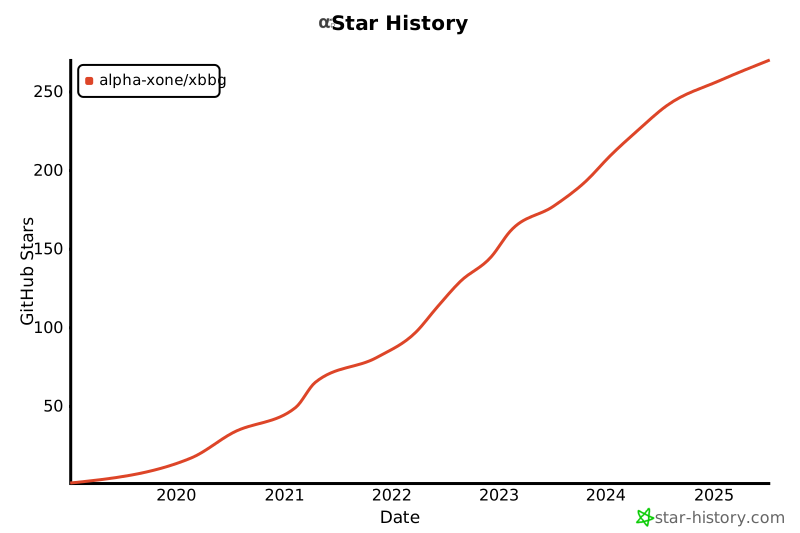
Project Status
| Category | Badge |
|---|---|
| Docs |  |
| Build |  |
| License |  |
For detailed release history, see CHANGELOG.md.
Project details
Verified details
These details have been verified by PyPIProject links
GitHub Statistics
Maintainers
Release history Release notifications | RSS feed


Download files
Download the file for your platform. If you're not sure which to choose, learn more about installing packages.
Source Distribution
Built Distributions
Filter files by name, interpreter, ABI, and platform.
If you're not sure about the file name format, learn more about wheel file names.
Copy a direct link to the current filters
File details
Details for the file xbbg-1.2.0.tar.gz.
File metadata
- Download URL: xbbg-1.2.0.tar.gz
- Upload date:
- Size: 641.7 kB
- Tags: Source
- Uploaded using Trusted Publishing? Yes
- Uploaded via: twine/6.1.0 CPython/3.13.12
File hashes
| Algorithm | Hash digest | |
|---|---|---|
| SHA256 |
aaf4ddcfdd754b43033978b7f2bb977703642efeebc391c8138188df04677aa9
|
|
| MD5 |
3e766074ab7f8a9fec3eac11447cbbfc
|
|
| BLAKE2b-256 |
b0242b1d744ee1e29a6c1db49b580c506014d1bd2a9ab504ea45e0b6f8cfeaac
|
Provenance
The following attestation bundles were made for xbbg-1.2.0.tar.gz:
Publisher:
pypi_upload.yml on alpha-xone/xbbg
-
Statement:
-
Statement type:
https://in-toto.io/Statement/v1 -
Predicate type:
https://docs.pypi.org/attestations/publish/v1 -
Subject name:
xbbg-1.2.0.tar.gz -
Subject digest:
aaf4ddcfdd754b43033978b7f2bb977703642efeebc391c8138188df04677aa9 - Sigstore transparency entry: 1398970289
- Sigstore integration time:
-
Permalink:
alpha-xone/xbbg@e84017865c82b4eaa946f18963ebb6e0eba07732 -
Branch / Tag:
refs/tags/v1.2.0 - Owner: https://github.com/alpha-xone
-
Access:
public
-
Token Issuer:
https://token.actions.githubusercontent.com -
Runner Environment:
github-hosted -
Publication workflow:
pypi_upload.yml@e84017865c82b4eaa946f18963ebb6e0eba07732 -
Trigger Event:
workflow_dispatch
-
Statement type:
File details
Details for the file xbbg-1.2.0-cp314-cp314-win_amd64.whl.
File metadata
- Download URL: xbbg-1.2.0-cp314-cp314-win_amd64.whl
- Upload date:
- Size: 2.2 MB
- Tags: CPython 3.14, Windows x86-64
- Uploaded using Trusted Publishing? Yes
- Uploaded via: twine/6.1.0 CPython/3.13.12
File hashes
| Algorithm | Hash digest | |
|---|---|---|
| SHA256 |
18adb07e6cfb0686dfc9de8194c78069a37ce94d6478864709c3190507493c90
|
|
| MD5 |
edd108d438dc9fa184581b3ec4ac9162
|
|
| BLAKE2b-256 |
54c50e81e22fdc5394c78d8320be128de2d97911253537bf67104a23f823e351
|
Provenance
The following attestation bundles were made for xbbg-1.2.0-cp314-cp314-win_amd64.whl:
Publisher:
pypi_upload.yml on alpha-xone/xbbg
-
Statement:
-
Statement type:
https://in-toto.io/Statement/v1 -
Predicate type:
https://docs.pypi.org/attestations/publish/v1 -
Subject name:
xbbg-1.2.0-cp314-cp314-win_amd64.whl -
Subject digest:
18adb07e6cfb0686dfc9de8194c78069a37ce94d6478864709c3190507493c90 - Sigstore transparency entry: 1398970416
- Sigstore integration time:
-
Permalink:
alpha-xone/xbbg@e84017865c82b4eaa946f18963ebb6e0eba07732 -
Branch / Tag:
refs/tags/v1.2.0 - Owner: https://github.com/alpha-xone
-
Access:
public
-
Token Issuer:
https://token.actions.githubusercontent.com -
Runner Environment:
github-hosted -
Publication workflow:
pypi_upload.yml@e84017865c82b4eaa946f18963ebb6e0eba07732 -
Trigger Event:
workflow_dispatch
-
Statement type:
File details
Details for the file xbbg-1.2.0-cp314-cp314-manylinux_2_34_x86_64.whl.
File metadata
- Download URL: xbbg-1.2.0-cp314-cp314-manylinux_2_34_x86_64.whl
- Upload date:
- Size: 2.5 MB
- Tags: CPython 3.14, manylinux: glibc 2.34+ x86-64
- Uploaded using Trusted Publishing? Yes
- Uploaded via: twine/6.1.0 CPython/3.13.12
File hashes
| Algorithm | Hash digest | |
|---|---|---|
| SHA256 |
2106cb1611d3c32a699f1c9da49bf2dddd657e4986fd832f2e871ad2004573cf
|
|
| MD5 |
3012d13ee6d5a3e918f12fb95e31328d
|
|
| BLAKE2b-256 |
86d1532159b0066ac2d8d1235660f2d056a24ddeabea08213e7c748683d48312
|
Provenance
The following attestation bundles were made for xbbg-1.2.0-cp314-cp314-manylinux_2_34_x86_64.whl:
Publisher:
pypi_upload.yml on alpha-xone/xbbg
-
Statement:
-
Statement type:
https://in-toto.io/Statement/v1 -
Predicate type:
https://docs.pypi.org/attestations/publish/v1 -
Subject name:
xbbg-1.2.0-cp314-cp314-manylinux_2_34_x86_64.whl -
Subject digest:
2106cb1611d3c32a699f1c9da49bf2dddd657e4986fd832f2e871ad2004573cf - Sigstore transparency entry: 1398970410
- Sigstore integration time:
-
Permalink:
alpha-xone/xbbg@e84017865c82b4eaa946f18963ebb6e0eba07732 -
Branch / Tag:
refs/tags/v1.2.0 - Owner: https://github.com/alpha-xone
-
Access:
public
-
Token Issuer:
https://token.actions.githubusercontent.com -
Runner Environment:
github-hosted -
Publication workflow:
pypi_upload.yml@e84017865c82b4eaa946f18963ebb6e0eba07732 -
Trigger Event:
workflow_dispatch
-
Statement type:
File details
Details for the file xbbg-1.2.0-cp314-cp314-macosx_11_0_universal2.whl.
File metadata
- Download URL: xbbg-1.2.0-cp314-cp314-macosx_11_0_universal2.whl
- Upload date:
- Size: 2.1 MB
- Tags: CPython 3.14, macOS 11.0+ universal2 (ARM64, x86-64)
- Uploaded using Trusted Publishing? Yes
- Uploaded via: twine/6.1.0 CPython/3.13.12
File hashes
| Algorithm | Hash digest | |
|---|---|---|
| SHA256 |
17165a04edc923b6f153257a0822ff8a5206f93bb3dd400863266fb1348b7aa4
|
|
| MD5 |
2c667dab1a77d4197965d455f9aafd7a
|
|
| BLAKE2b-256 |
2e49d97f1fbbf78a476ce98e7a9e9125d6e9d17935ff5e03afcd913260868838
|
Provenance
The following attestation bundles were made for xbbg-1.2.0-cp314-cp314-macosx_11_0_universal2.whl:
Publisher:
pypi_upload.yml on alpha-xone/xbbg
-
Statement:
-
Statement type:
https://in-toto.io/Statement/v1 -
Predicate type:
https://docs.pypi.org/attestations/publish/v1 -
Subject name:
xbbg-1.2.0-cp314-cp314-macosx_11_0_universal2.whl -
Subject digest:
17165a04edc923b6f153257a0822ff8a5206f93bb3dd400863266fb1348b7aa4 - Sigstore transparency entry: 1398970400
- Sigstore integration time:
-
Permalink:
alpha-xone/xbbg@e84017865c82b4eaa946f18963ebb6e0eba07732 -
Branch / Tag:
refs/tags/v1.2.0 - Owner: https://github.com/alpha-xone
-
Access:
public
-
Token Issuer:
https://token.actions.githubusercontent.com -
Runner Environment:
github-hosted -
Publication workflow:
pypi_upload.yml@e84017865c82b4eaa946f18963ebb6e0eba07732 -
Trigger Event:
workflow_dispatch
-
Statement type:
File details
Details for the file xbbg-1.2.0-cp313-cp313-win_amd64.whl.
File metadata
- Download URL: xbbg-1.2.0-cp313-cp313-win_amd64.whl
- Upload date:
- Size: 2.1 MB
- Tags: CPython 3.13, Windows x86-64
- Uploaded using Trusted Publishing? Yes
- Uploaded via: twine/6.1.0 CPython/3.13.12
File hashes
| Algorithm | Hash digest | |
|---|---|---|
| SHA256 |
ba701cb32e8b415169b9e4ab59257d2bb9a0bb1b1695998afbc5a6e0f4cdb42d
|
|
| MD5 |
ca73e920c7f997d65977bfa2bd7655fd
|
|
| BLAKE2b-256 |
fd2cc8b636fefc27fa46455af394a582c2c61cde99c8d63dfc5b9e03123bba83
|
Provenance
The following attestation bundles were made for xbbg-1.2.0-cp313-cp313-win_amd64.whl:
Publisher:
pypi_upload.yml on alpha-xone/xbbg
-
Statement:
-
Statement type:
https://in-toto.io/Statement/v1 -
Predicate type:
https://docs.pypi.org/attestations/publish/v1 -
Subject name:
xbbg-1.2.0-cp313-cp313-win_amd64.whl -
Subject digest:
ba701cb32e8b415169b9e4ab59257d2bb9a0bb1b1695998afbc5a6e0f4cdb42d - Sigstore transparency entry: 1398970354
- Sigstore integration time:
-
Permalink:
alpha-xone/xbbg@e84017865c82b4eaa946f18963ebb6e0eba07732 -
Branch / Tag:
refs/tags/v1.2.0 - Owner: https://github.com/alpha-xone
-
Access:
public
-
Token Issuer:
https://token.actions.githubusercontent.com -
Runner Environment:
github-hosted -
Publication workflow:
pypi_upload.yml@e84017865c82b4eaa946f18963ebb6e0eba07732 -
Trigger Event:
workflow_dispatch
-
Statement type:
File details
Details for the file xbbg-1.2.0-cp313-cp313-manylinux_2_34_x86_64.whl.
File metadata
- Download URL: xbbg-1.2.0-cp313-cp313-manylinux_2_34_x86_64.whl
- Upload date:
- Size: 2.5 MB
- Tags: CPython 3.13, manylinux: glibc 2.34+ x86-64
- Uploaded using Trusted Publishing? Yes
- Uploaded via: twine/6.1.0 CPython/3.13.12
File hashes
| Algorithm | Hash digest | |
|---|---|---|
| SHA256 |
e82ca17d01e6626f41958ea8b89de70f1a3e37c27087d1349882834c29d96210
|
|
| MD5 |
e567e0c0f3d3e7c3b776ab905e6a3e6e
|
|
| BLAKE2b-256 |
bb7abaa8c7ba151c8a3c02c7ef44ad3e9c11527a218a12a660a2e210b3abd1bd
|
Provenance
The following attestation bundles were made for xbbg-1.2.0-cp313-cp313-manylinux_2_34_x86_64.whl:
Publisher:
pypi_upload.yml on alpha-xone/xbbg
-
Statement:
-
Statement type:
https://in-toto.io/Statement/v1 -
Predicate type:
https://docs.pypi.org/attestations/publish/v1 -
Subject name:
xbbg-1.2.0-cp313-cp313-manylinux_2_34_x86_64.whl -
Subject digest:
e82ca17d01e6626f41958ea8b89de70f1a3e37c27087d1349882834c29d96210 - Sigstore transparency entry: 1398970421
- Sigstore integration time:
-
Permalink:
alpha-xone/xbbg@e84017865c82b4eaa946f18963ebb6e0eba07732 -
Branch / Tag:
refs/tags/v1.2.0 - Owner: https://github.com/alpha-xone
-
Access:
public
-
Token Issuer:
https://token.actions.githubusercontent.com -
Runner Environment:
github-hosted -
Publication workflow:
pypi_upload.yml@e84017865c82b4eaa946f18963ebb6e0eba07732 -
Trigger Event:
workflow_dispatch
-
Statement type:
File details
Details for the file xbbg-1.2.0-cp313-cp313-macosx_11_0_universal2.whl.
File metadata
- Download URL: xbbg-1.2.0-cp313-cp313-macosx_11_0_universal2.whl
- Upload date:
- Size: 2.1 MB
- Tags: CPython 3.13, macOS 11.0+ universal2 (ARM64, x86-64)
- Uploaded using Trusted Publishing? Yes
- Uploaded via: twine/6.1.0 CPython/3.13.12
File hashes
| Algorithm | Hash digest | |
|---|---|---|
| SHA256 |
4f1371d8388f74fafeda2d93388b7afdcc3ced566e599506a364fc9da56e6571
|
|
| MD5 |
6e9298ebaedea427e6a43c9f6988efc4
|
|
| BLAKE2b-256 |
d7f2b73bc784affe7df78575adb77a84e681d35d64567d76aaacf6c118a7974e
|
Provenance
The following attestation bundles were made for xbbg-1.2.0-cp313-cp313-macosx_11_0_universal2.whl:
Publisher:
pypi_upload.yml on alpha-xone/xbbg
-
Statement:
-
Statement type:
https://in-toto.io/Statement/v1 -
Predicate type:
https://docs.pypi.org/attestations/publish/v1 -
Subject name:
xbbg-1.2.0-cp313-cp313-macosx_11_0_universal2.whl -
Subject digest:
4f1371d8388f74fafeda2d93388b7afdcc3ced566e599506a364fc9da56e6571 - Sigstore transparency entry: 1398970329
- Sigstore integration time:
-
Permalink:
alpha-xone/xbbg@e84017865c82b4eaa946f18963ebb6e0eba07732 -
Branch / Tag:
refs/tags/v1.2.0 - Owner: https://github.com/alpha-xone
-
Access:
public
-
Token Issuer:
https://token.actions.githubusercontent.com -
Runner Environment:
github-hosted -
Publication workflow:
pypi_upload.yml@e84017865c82b4eaa946f18963ebb6e0eba07732 -
Trigger Event:
workflow_dispatch
-
Statement type:
File details
Details for the file xbbg-1.2.0-cp312-cp312-win_amd64.whl.
File metadata
- Download URL: xbbg-1.2.0-cp312-cp312-win_amd64.whl
- Upload date:
- Size: 2.1 MB
- Tags: CPython 3.12, Windows x86-64
- Uploaded using Trusted Publishing? Yes
- Uploaded via: twine/6.1.0 CPython/3.13.12
File hashes
| Algorithm | Hash digest | |
|---|---|---|
| SHA256 |
d3e6d39b40df065a7753ea20795d3c9c19118a306e29e0e7baafa15eb5b09f14
|
|
| MD5 |
6c7c653bf5496763a2fd851f98617e3f
|
|
| BLAKE2b-256 |
17b39ffaadbf9cbc52a46546d449435c459192821e1b8e77fbc815f0d125a3a0
|
Provenance
The following attestation bundles were made for xbbg-1.2.0-cp312-cp312-win_amd64.whl:
Publisher:
pypi_upload.yml on alpha-xone/xbbg
-
Statement:
-
Statement type:
https://in-toto.io/Statement/v1 -
Predicate type:
https://docs.pypi.org/attestations/publish/v1 -
Subject name:
xbbg-1.2.0-cp312-cp312-win_amd64.whl -
Subject digest:
d3e6d39b40df065a7753ea20795d3c9c19118a306e29e0e7baafa15eb5b09f14 - Sigstore transparency entry: 1398970363
- Sigstore integration time:
-
Permalink:
alpha-xone/xbbg@e84017865c82b4eaa946f18963ebb6e0eba07732 -
Branch / Tag:
refs/tags/v1.2.0 - Owner: https://github.com/alpha-xone
-
Access:
public
-
Token Issuer:
https://token.actions.githubusercontent.com -
Runner Environment:
github-hosted -
Publication workflow:
pypi_upload.yml@e84017865c82b4eaa946f18963ebb6e0eba07732 -
Trigger Event:
workflow_dispatch
-
Statement type:
File details
Details for the file xbbg-1.2.0-cp312-cp312-manylinux_2_34_x86_64.whl.
File metadata
- Download URL: xbbg-1.2.0-cp312-cp312-manylinux_2_34_x86_64.whl
- Upload date:
- Size: 2.5 MB
- Tags: CPython 3.12, manylinux: glibc 2.34+ x86-64
- Uploaded using Trusted Publishing? Yes
- Uploaded via: twine/6.1.0 CPython/3.13.12
File hashes
| Algorithm | Hash digest | |
|---|---|---|
| SHA256 |
89a3642467bd2d5420e3daf90a18e8f5b7ec17d1c02cefdd0518bf47951edaf5
|
|
| MD5 |
9ad05df69ee9400943ff4c3eb52c9136
|
|
| BLAKE2b-256 |
53c669789d8ffd8b793d2a092a30500f6b36b5c51ece2f9b9acfa6f9abd496c2
|
Provenance
The following attestation bundles were made for xbbg-1.2.0-cp312-cp312-manylinux_2_34_x86_64.whl:
Publisher:
pypi_upload.yml on alpha-xone/xbbg
-
Statement:
-
Statement type:
https://in-toto.io/Statement/v1 -
Predicate type:
https://docs.pypi.org/attestations/publish/v1 -
Subject name:
xbbg-1.2.0-cp312-cp312-manylinux_2_34_x86_64.whl -
Subject digest:
89a3642467bd2d5420e3daf90a18e8f5b7ec17d1c02cefdd0518bf47951edaf5 - Sigstore transparency entry: 1398970344
- Sigstore integration time:
-
Permalink:
alpha-xone/xbbg@e84017865c82b4eaa946f18963ebb6e0eba07732 -
Branch / Tag:
refs/tags/v1.2.0 - Owner: https://github.com/alpha-xone
-
Access:
public
-
Token Issuer:
https://token.actions.githubusercontent.com -
Runner Environment:
github-hosted -
Publication workflow:
pypi_upload.yml@e84017865c82b4eaa946f18963ebb6e0eba07732 -
Trigger Event:
workflow_dispatch
-
Statement type:
File details
Details for the file xbbg-1.2.0-cp312-cp312-macosx_11_0_universal2.whl.
File metadata
- Download URL: xbbg-1.2.0-cp312-cp312-macosx_11_0_universal2.whl
- Upload date:
- Size: 2.1 MB
- Tags: CPython 3.12, macOS 11.0+ universal2 (ARM64, x86-64)
- Uploaded using Trusted Publishing? Yes
- Uploaded via: twine/6.1.0 CPython/3.13.12
File hashes
| Algorithm | Hash digest | |
|---|---|---|
| SHA256 |
d820fdd2a56cafb6c650c93a0331d3df941be8c721927ec054d2fc342a5545b1
|
|
| MD5 |
26c074f758fa2f32bc421b0ce3b135b1
|
|
| BLAKE2b-256 |
457e640c49d53868edd83682ed00f54ed72fbde34e7b6244d9f3146c3f8ab71b
|
Provenance
The following attestation bundles were made for xbbg-1.2.0-cp312-cp312-macosx_11_0_universal2.whl:
Publisher:
pypi_upload.yml on alpha-xone/xbbg
-
Statement:
-
Statement type:
https://in-toto.io/Statement/v1 -
Predicate type:
https://docs.pypi.org/attestations/publish/v1 -
Subject name:
xbbg-1.2.0-cp312-cp312-macosx_11_0_universal2.whl -
Subject digest:
d820fdd2a56cafb6c650c93a0331d3df941be8c721927ec054d2fc342a5545b1 - Sigstore transparency entry: 1398970301
- Sigstore integration time:
-
Permalink:
alpha-xone/xbbg@e84017865c82b4eaa946f18963ebb6e0eba07732 -
Branch / Tag:
refs/tags/v1.2.0 - Owner: https://github.com/alpha-xone
-
Access:
public
-
Token Issuer:
https://token.actions.githubusercontent.com -
Runner Environment:
github-hosted -
Publication workflow:
pypi_upload.yml@e84017865c82b4eaa946f18963ebb6e0eba07732 -
Trigger Event:
workflow_dispatch
-
Statement type:
File details
Details for the file xbbg-1.2.0-cp311-cp311-win_amd64.whl.
File metadata
- Download URL: xbbg-1.2.0-cp311-cp311-win_amd64.whl
- Upload date:
- Size: 2.1 MB
- Tags: CPython 3.11, Windows x86-64
- Uploaded using Trusted Publishing? Yes
- Uploaded via: twine/6.1.0 CPython/3.13.12
File hashes
| Algorithm | Hash digest | |
|---|---|---|
| SHA256 |
daa08ae1124aa40184657f804be0f53e193b66a0b030d06eb2665ead66e25491
|
|
| MD5 |
e6e7241d0e0ce40c9c041c7bff6a4ec3
|
|
| BLAKE2b-256 |
24d85b43b2d7e645209affc9cc33e1895ee678615a6f395b4759ca9ce4bf112f
|
Provenance
The following attestation bundles were made for xbbg-1.2.0-cp311-cp311-win_amd64.whl:
Publisher:
pypi_upload.yml on alpha-xone/xbbg
-
Statement:
-
Statement type:
https://in-toto.io/Statement/v1 -
Predicate type:
https://docs.pypi.org/attestations/publish/v1 -
Subject name:
xbbg-1.2.0-cp311-cp311-win_amd64.whl -
Subject digest:
daa08ae1124aa40184657f804be0f53e193b66a0b030d06eb2665ead66e25491 - Sigstore transparency entry: 1398970375
- Sigstore integration time:
-
Permalink:
alpha-xone/xbbg@e84017865c82b4eaa946f18963ebb6e0eba07732 -
Branch / Tag:
refs/tags/v1.2.0 - Owner: https://github.com/alpha-xone
-
Access:
public
-
Token Issuer:
https://token.actions.githubusercontent.com -
Runner Environment:
github-hosted -
Publication workflow:
pypi_upload.yml@e84017865c82b4eaa946f18963ebb6e0eba07732 -
Trigger Event:
workflow_dispatch
-
Statement type:
File details
Details for the file xbbg-1.2.0-cp311-cp311-manylinux_2_34_x86_64.whl.
File metadata
- Download URL: xbbg-1.2.0-cp311-cp311-manylinux_2_34_x86_64.whl
- Upload date:
- Size: 2.5 MB
- Tags: CPython 3.11, manylinux: glibc 2.34+ x86-64
- Uploaded using Trusted Publishing? Yes
- Uploaded via: twine/6.1.0 CPython/3.13.12
File hashes
| Algorithm | Hash digest | |
|---|---|---|
| SHA256 |
f22c6645d5f756d3ce0847d9dee853ddf9ecbf057cf0646a4c2a7ab39eccc8c2
|
|
| MD5 |
6735eadfc9beb609bdfdb7d4d8191a7c
|
|
| BLAKE2b-256 |
5a28ba1743d7e11a04bb1a5947abd79823035e77d6487700433504632ddd839b
|
Provenance
The following attestation bundles were made for xbbg-1.2.0-cp311-cp311-manylinux_2_34_x86_64.whl:
Publisher:
pypi_upload.yml on alpha-xone/xbbg
-
Statement:
-
Statement type:
https://in-toto.io/Statement/v1 -
Predicate type:
https://docs.pypi.org/attestations/publish/v1 -
Subject name:
xbbg-1.2.0-cp311-cp311-manylinux_2_34_x86_64.whl -
Subject digest:
f22c6645d5f756d3ce0847d9dee853ddf9ecbf057cf0646a4c2a7ab39eccc8c2 - Sigstore transparency entry: 1398970335
- Sigstore integration time:
-
Permalink:
alpha-xone/xbbg@e84017865c82b4eaa946f18963ebb6e0eba07732 -
Branch / Tag:
refs/tags/v1.2.0 - Owner: https://github.com/alpha-xone
-
Access:
public
-
Token Issuer:
https://token.actions.githubusercontent.com -
Runner Environment:
github-hosted -
Publication workflow:
pypi_upload.yml@e84017865c82b4eaa946f18963ebb6e0eba07732 -
Trigger Event:
workflow_dispatch
-
Statement type:
File details
Details for the file xbbg-1.2.0-cp311-cp311-macosx_11_0_universal2.whl.
File metadata
- Download URL: xbbg-1.2.0-cp311-cp311-macosx_11_0_universal2.whl
- Upload date:
- Size: 2.2 MB
- Tags: CPython 3.11, macOS 11.0+ universal2 (ARM64, x86-64)
- Uploaded using Trusted Publishing? Yes
- Uploaded via: twine/6.1.0 CPython/3.13.12
File hashes
| Algorithm | Hash digest | |
|---|---|---|
| SHA256 |
4902a58cec0b7f659d7390bad4d5aaa9ec1099fb04ed9c9166fab02b7f4a95de
|
|
| MD5 |
d9bca903739bb0b6d84300abfb48c2dd
|
|
| BLAKE2b-256 |
a0b3d8ef52e5e6c051f170ce6011debb4db4bd9c5039b0d575c8e03c4323c121
|
Provenance
The following attestation bundles were made for xbbg-1.2.0-cp311-cp311-macosx_11_0_universal2.whl:
Publisher:
pypi_upload.yml on alpha-xone/xbbg
-
Statement:
-
Statement type:
https://in-toto.io/Statement/v1 -
Predicate type:
https://docs.pypi.org/attestations/publish/v1 -
Subject name:
xbbg-1.2.0-cp311-cp311-macosx_11_0_universal2.whl -
Subject digest:
4902a58cec0b7f659d7390bad4d5aaa9ec1099fb04ed9c9166fab02b7f4a95de - Sigstore transparency entry: 1398970366
- Sigstore integration time:
-
Permalink:
alpha-xone/xbbg@e84017865c82b4eaa946f18963ebb6e0eba07732 -
Branch / Tag:
refs/tags/v1.2.0 - Owner: https://github.com/alpha-xone
-
Access:
public
-
Token Issuer:
https://token.actions.githubusercontent.com -
Runner Environment:
github-hosted -
Publication workflow:
pypi_upload.yml@e84017865c82b4eaa946f18963ebb6e0eba07732 -
Trigger Event:
workflow_dispatch
-
Statement type:
File details
Details for the file xbbg-1.2.0-cp310-cp310-win_amd64.whl.
File metadata
- Download URL: xbbg-1.2.0-cp310-cp310-win_amd64.whl
- Upload date:
- Size: 2.1 MB
- Tags: CPython 3.10, Windows x86-64
- Uploaded using Trusted Publishing? Yes
- Uploaded via: twine/6.1.0 CPython/3.13.12
File hashes
| Algorithm | Hash digest | |
|---|---|---|
| SHA256 |
f52c04c3e87d6871dd85297a008e5c8ab892b5127590f1f1b680dd93212cbe4b
|
|
| MD5 |
7b20bc3300e92834d60116a881062e9b
|
|
| BLAKE2b-256 |
93b210048a2ca23c154065e96db601d8c4fdf77c7bf557ccc4c4a8abb3f8c8ff
|
Provenance
The following attestation bundles were made for xbbg-1.2.0-cp310-cp310-win_amd64.whl:
Publisher:
pypi_upload.yml on alpha-xone/xbbg
-
Statement:
-
Statement type:
https://in-toto.io/Statement/v1 -
Predicate type:
https://docs.pypi.org/attestations/publish/v1 -
Subject name:
xbbg-1.2.0-cp310-cp310-win_amd64.whl -
Subject digest:
f52c04c3e87d6871dd85297a008e5c8ab892b5127590f1f1b680dd93212cbe4b - Sigstore transparency entry: 1398970390
- Sigstore integration time:
-
Permalink:
alpha-xone/xbbg@e84017865c82b4eaa946f18963ebb6e0eba07732 -
Branch / Tag:
refs/tags/v1.2.0 - Owner: https://github.com/alpha-xone
-
Access:
public
-
Token Issuer:
https://token.actions.githubusercontent.com -
Runner Environment:
github-hosted -
Publication workflow:
pypi_upload.yml@e84017865c82b4eaa946f18963ebb6e0eba07732 -
Trigger Event:
workflow_dispatch
-
Statement type:
File details
Details for the file xbbg-1.2.0-cp310-cp310-manylinux_2_34_x86_64.whl.
File metadata
- Download URL: xbbg-1.2.0-cp310-cp310-manylinux_2_34_x86_64.whl
- Upload date:
- Size: 2.5 MB
- Tags: CPython 3.10, manylinux: glibc 2.34+ x86-64
- Uploaded using Trusted Publishing? Yes
- Uploaded via: twine/6.1.0 CPython/3.13.12
File hashes
| Algorithm | Hash digest | |
|---|---|---|
| SHA256 |
35d0381cb7d2f21965b7fbed5d0e50f5c8ff39a24818cae706a85a1b92ab099f
|
|
| MD5 |
71f0d00f5ff8a2f18e667ec61721579a
|
|
| BLAKE2b-256 |
d2085dfcd04663c80685a93e88689eecba1a4a0e16b87523c72973ea8255001d
|
Provenance
The following attestation bundles were made for xbbg-1.2.0-cp310-cp310-manylinux_2_34_x86_64.whl:
Publisher:
pypi_upload.yml on alpha-xone/xbbg
-
Statement:
-
Statement type:
https://in-toto.io/Statement/v1 -
Predicate type:
https://docs.pypi.org/attestations/publish/v1 -
Subject name:
xbbg-1.2.0-cp310-cp310-manylinux_2_34_x86_64.whl -
Subject digest:
35d0381cb7d2f21965b7fbed5d0e50f5c8ff39a24818cae706a85a1b92ab099f - Sigstore transparency entry: 1398970383
- Sigstore integration time:
-
Permalink:
alpha-xone/xbbg@e84017865c82b4eaa946f18963ebb6e0eba07732 -
Branch / Tag:
refs/tags/v1.2.0 - Owner: https://github.com/alpha-xone
-
Access:
public
-
Token Issuer:
https://token.actions.githubusercontent.com -
Runner Environment:
github-hosted -
Publication workflow:
pypi_upload.yml@e84017865c82b4eaa946f18963ebb6e0eba07732 -
Trigger Event:
workflow_dispatch
-
Statement type:
File details
Details for the file xbbg-1.2.0-cp310-cp310-macosx_11_0_universal2.whl.
File metadata
- Download URL: xbbg-1.2.0-cp310-cp310-macosx_11_0_universal2.whl
- Upload date:
- Size: 2.2 MB
- Tags: CPython 3.10, macOS 11.0+ universal2 (ARM64, x86-64)
- Uploaded using Trusted Publishing? Yes
- Uploaded via: twine/6.1.0 CPython/3.13.12
File hashes
| Algorithm | Hash digest | |
|---|---|---|
| SHA256 |
4ae814cda2b948c9622785dc5ea9cea62c39cf4561ef65258216bfd0fa0e29be
|
|
| MD5 |
a896030101bf709933546961525281ee
|
|
| BLAKE2b-256 |
1261104f930a7f2787b94a186ac05feee9eddc20224d20ab8f7ac593fdf0a08c
|
Provenance
The following attestation bundles were made for xbbg-1.2.0-cp310-cp310-macosx_11_0_universal2.whl:
Publisher:
pypi_upload.yml on alpha-xone/xbbg
-
Statement:
-
Statement type:
https://in-toto.io/Statement/v1 -
Predicate type:
https://docs.pypi.org/attestations/publish/v1 -
Subject name:
xbbg-1.2.0-cp310-cp310-macosx_11_0_universal2.whl -
Subject digest:
4ae814cda2b948c9622785dc5ea9cea62c39cf4561ef65258216bfd0fa0e29be - Sigstore transparency entry: 1398970319
- Sigstore integration time:
-
Permalink:
alpha-xone/xbbg@e84017865c82b4eaa946f18963ebb6e0eba07732 -
Branch / Tag:
refs/tags/v1.2.0 - Owner: https://github.com/alpha-xone
-
Access:
public
-
Token Issuer:
https://token.actions.githubusercontent.com -
Runner Environment:
github-hosted -
Publication workflow:
pypi_upload.yml@e84017865c82b4eaa946f18963ebb6e0eba07732 -
Trigger Event:
workflow_dispatch
-
Statement type:






