
A Python agent harness with configurable tools and guardrails - one who yokes agents together

Project description
Yoker





A Python agent harness with configurable tools, guardrails, and Ollama backend integration.
Installation
pip install yoker
Quick Start
python -m yoker
Or with an agent definition:
python -m yoker --agent examples/agents/researcher.md
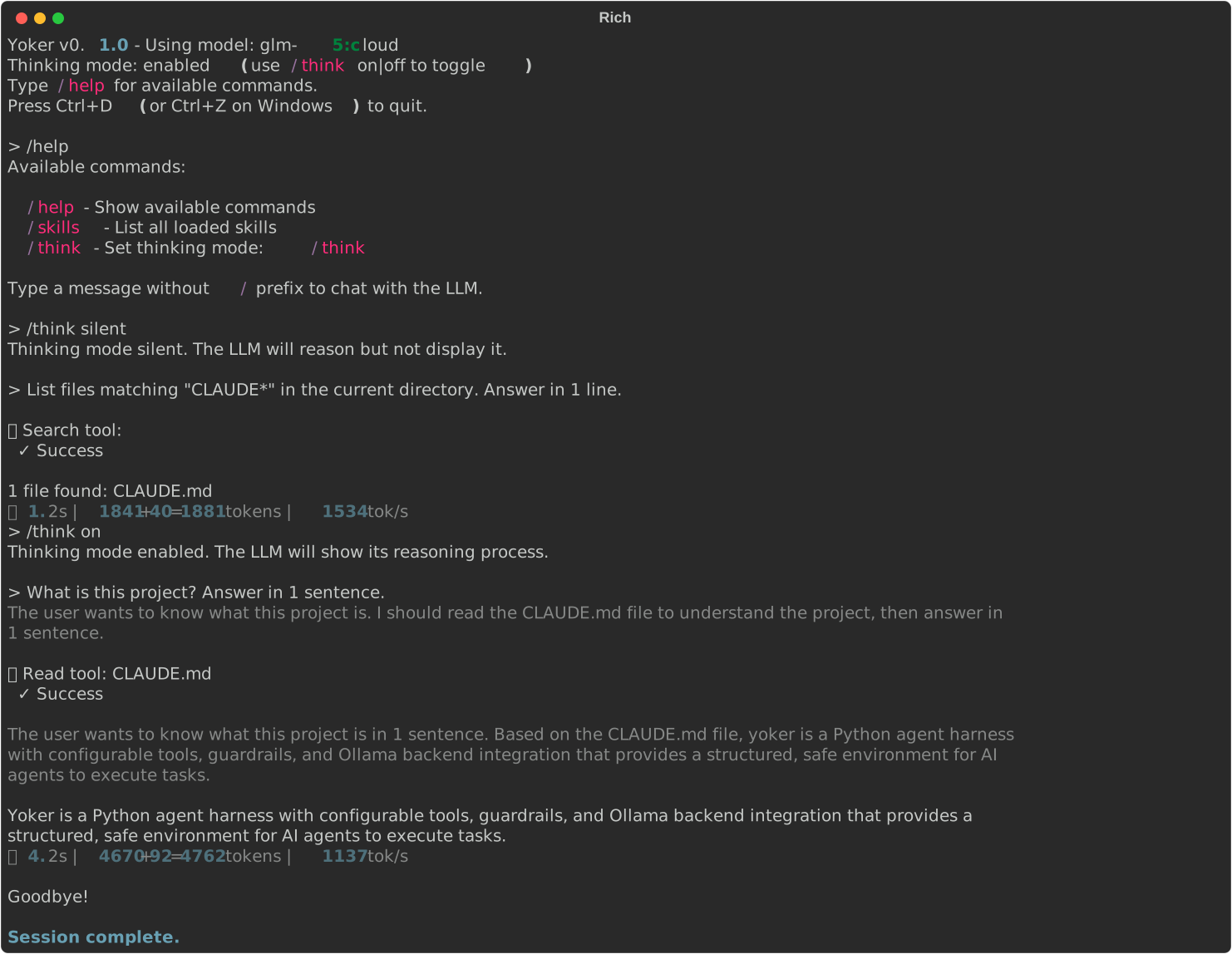
Example session:
Why Yoker?
Yoker fills a unique gap in the coding agent ecosystem: a library-first, transparent agent harness designed for developers who want full control, visibility, and simplicity.
Key Differentiators:
- Library-first - Embed in your applications, not locked into a CLI
- LLM-neutral - Choose your provider, your model, your cost model
- No hidden manipulation - All prompts visible, editable, configurable
- Static permissions - Deterministic boundaries, not runtime prompts
- Full transparency - Event-driven, everything inspectable
See docs/rationale.md for the full rationale and comparison with other solutions.
Features
Current Features:
- Chat loop - Interactive conversation with Ollama
- Tool calling - Structured tool execution with parameters
-
readtool - Read file contents with guardrails -
listtool - Directory listing with pattern filtering -
writetool - Write files with overwrite protection -
updatetool - Edit existing files with replace, insert, and delete operations -
searchtool - Search file contents with regex or filenames with glob -
existencetool - Check if files or folders exist with security hardening -
mkdirtool - Create directories with recursive parent creation and depth limits -
gittool - Git operations (status, log, diff, branch, show) with permission-controlled commit/push -
web_searchtool - Web search with SSRF protection, domain filtering, and rate limiting -
web_fetchtool - Fetch web content with SSRF protection, URL validation, and size limits -
agenttool - Spawn subagents with isolated context and recursion limits - Slash commands - Built-in commands:
/help,/think on|off - Thinking mode - LLM reasoning trace with gray output
- Streaming - Real-time token streaming from Ollama
- Configuration - TOML-based configuration system
- Agent definitions - Load agents from Markdown files with YAML frontmatter
- Multiline input -
Esc+Enterfor newlines,Enterto submit - Rich output - Styled terminal output with Rich
- Event-driven architecture - Library-first design with event emission
- Context persistence - Session resumption with JSONL storage
- Event logging - Full session replay capability
- Demo scripts - Generate documentation screenshots from Markdown scripts
- Update tool - Edit existing files with replace, insert, and delete operations
Planned Features:
- Guardrails - Tool parameter validation
- Permissions - Static TOML-based access control
- Multi-agent orchestration - Run coordinated agent teams
- Backend providers - OpenAI, Anthropic, custom backends
- Tool timing metrics - Performance tracking
- Token usage tracking - Cost monitoring
- Tool result caching - Reduce redundant calls
- Parallel tool execution - Concurrent read operations
Interactive Input
The interactive session supports:
- Multiline input: Press
Esc+Enterto add newlines,Enterto submit - Command history: Up/Down arrows navigate previous messages
- History search:
Ctrl+Rto search through history - Keyboard navigation: Arrow keys, Ctrl+A/E for cursor positioning
- Text selection: Click and drag to select output, copy with Ctrl+Shift+C or Cmd+C
Slash Commands
| Command | Description |
|---|---|
/help |
Show available commands |
/think on|off |
Enable/disable LLM thinking trace |
Thinking Mode
When thinking is enabled, the LLM shows its reasoning process:
[Thinking]
Let me analyze this step by step...
First, I need to understand the file structure...

[Response]
Based on my analysis, here's what I found...
Demo Session Script
Generate terminal screenshots for documentation from Markdown script files:
# Run default demo script (demos/session.md)
python scripts/demo_session.py

# Run a specific demo script
python scripts/demo_session.py --script demos/list-tool.md

# Run all demo scripts in a directory
python scripts/demo_session.py --scripts-dir demos/

# Real LLM + log conversation for replay
python scripts/demo_session.py --script demos/session.md --log

# Replay from log (no LLM calls)
python scripts/demo_session.py --script demos/session.md --replay

# With an agent definition
python scripts/demo_session.py --script demos/session.md --agent examples/agents/markdown.md
Configuration
Yoker auto-discovers configuration files:
./yoker.toml(current directory)~/.yoker.toml(user home directory)- Built-in defaults
# Zero-configuration startup - uses auto-discovered config
python -m yoker
Or create a yoker.toml file for explicit configuration:
[harness]
name = "my-yoke"
log_level = "INFO"

[backend]
provider = "ollama"

[backend.ollama]
base_url = "http://localhost:11434"
model = "llama3.2:latest"

[agents]
definition = "./agents/researcher.md"  # Optional: agent definition file

[tools.read]
enabled = true
allowed_extensions = [".txt", ".md", ".py"]
See examples/yoker.toml for the full configuration reference.
Architecture
Yoker uses an event-driven architecture for library-first design. The Agent emits events; application code handles UI.
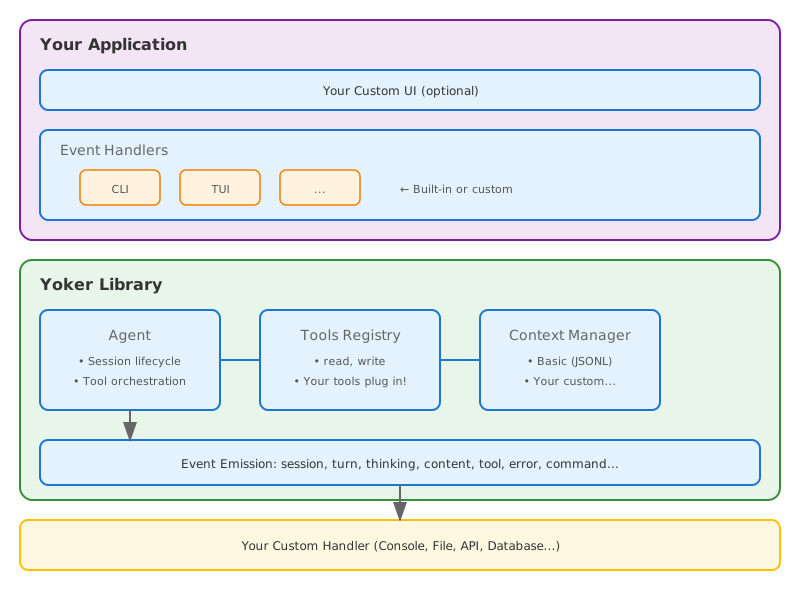
Event Types: Session (start/end), Turn (start/end), Thinking (start/chunk/end), Content (start/chunk/end), Tool (call/result), Error, Command
Documentation
- Full documentation
- Installation guide
- Quick start
- Why Yoker? - Project rationale and comparison
- Architecture
Development
git clone https://github.com/christophevg/yoker.git
cd yoker
make setup    # Create virtual environment and install dependencies

make test     # Run tests with coverage
make check    # Type checking + linting
make docs     # Build documentation
Requires Python 3.10+. Uses uv for dependency management. See CLAUDE.md for project conventions.
Contributing
Contributions welcome! Please read CLAUDE.md for project conventions and development guidelines.
Changelog
See GitHub Releases for version history.
License
MIT License - see LICENSE for details.
Name: "yoker" - One who yokes. The agent noun from "yoke" (PIE yeug- meaning "to join"). Pairs with "clitic" (both are joining tools). See docs/NAME.md for full etymology.
Release history Release notifications | RSS feed


Download files
Download the file for your platform. If you're not sure which to choose, learn more about installing packages.
Source Distribution
Built Distribution
Filter files by name, interpreter, ABI, and platform.
If you're not sure about the file name format, learn more about wheel file names.
Copy a direct link to the current filters
File details
Details for the file yoker-0.4.0.tar.gz.
File metadata
- Download URL: yoker-0.4.0.tar.gz
- Upload date:
- Size: 831.0 kB
- Tags: Source
- Uploaded using Trusted Publishing? No
- Uploaded via: twine/6.2.0 CPython/3.11.15
File hashes
| Algorithm | Hash digest | |
|---|---|---|
| SHA256 |
dcadbfda209b3a1f19bf8c4a213adeea99149220fba6631370c5c6027d4f8c1b
|
|
| MD5 |
3374430970764c7c514a9bf317f1b593
|
|
| BLAKE2b-256 |
d3188fae0cd0210c082dcc18211237dc632575cf56ce1b0a25e9dd9152159954
|
File details
Details for the file yoker-0.4.0-py3-none-any.whl.
File metadata
- Download URL: yoker-0.4.0-py3-none-any.whl
- Upload date:
- Size: 123.0 kB
- Tags: Python 3
- Uploaded using Trusted Publishing? No
- Uploaded via: twine/6.2.0 CPython/3.11.15
File hashes
| Algorithm | Hash digest | |
|---|---|---|
| SHA256 |
9948d5dddda558c5027099b25de4f5fef7d2d9ed5b8486ae9e8f2a586f343a1d
|
|
| MD5 |
3dabd8990f8dd62b973fe7680ec3e611
|
|
| BLAKE2b-256 |
4e9caa9b4a2c4d909452e244c6e5560455fc64a891e138e648715b2fd7180570
|






