
A cross-platform curses-based monitoring tool

Project description









Summary
Glances is a cross-platform monitoring tool which aims to present a large amount of monitoring information through a curses or Web based interface. The information dynamically adapts depending on the size of the user interface.
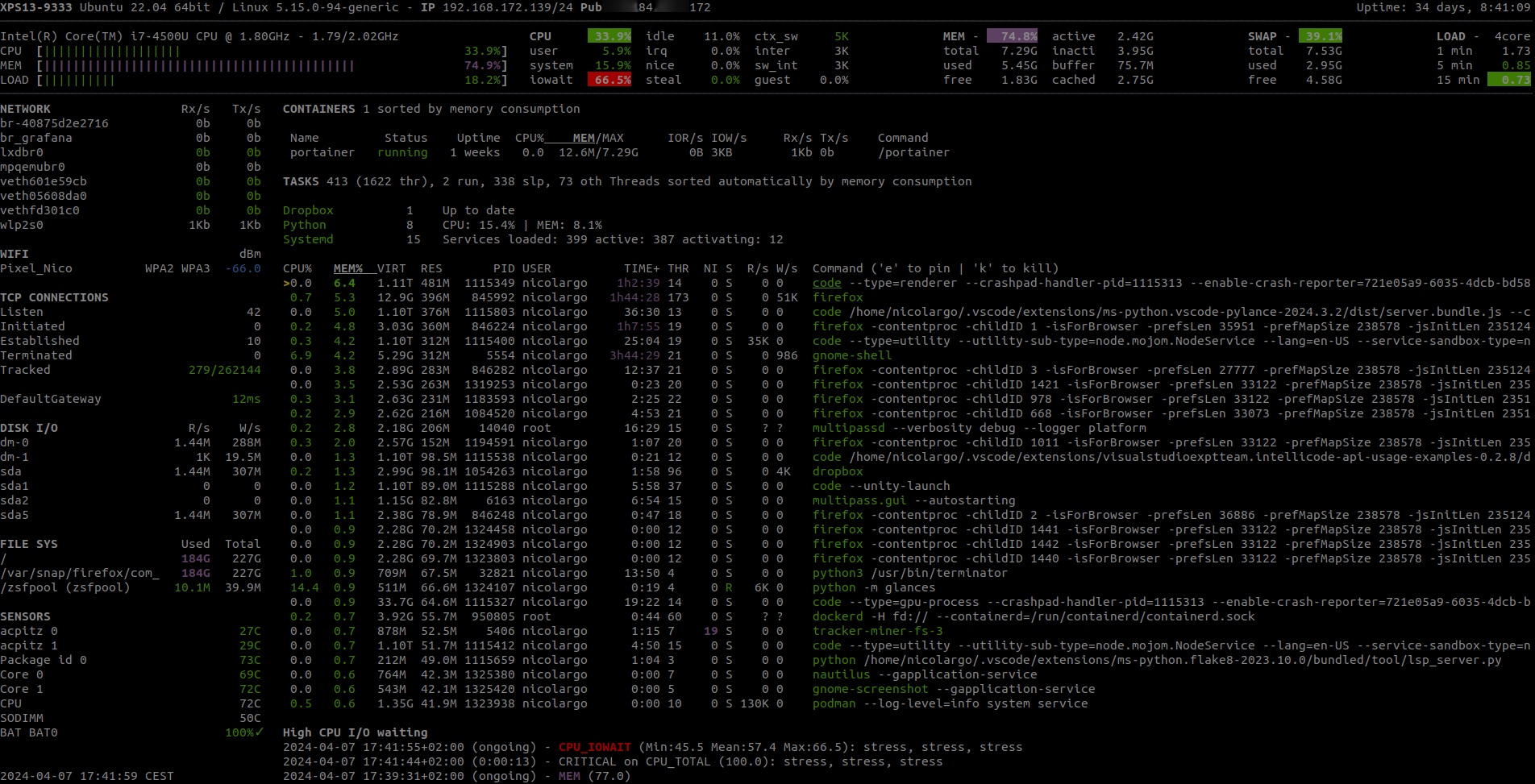
It can also work in client/server mode. Remote monitoring could be done via terminal, Web interface or API (XML-RPC and RESTful). Stats can also be exported to files or external time/value databases.
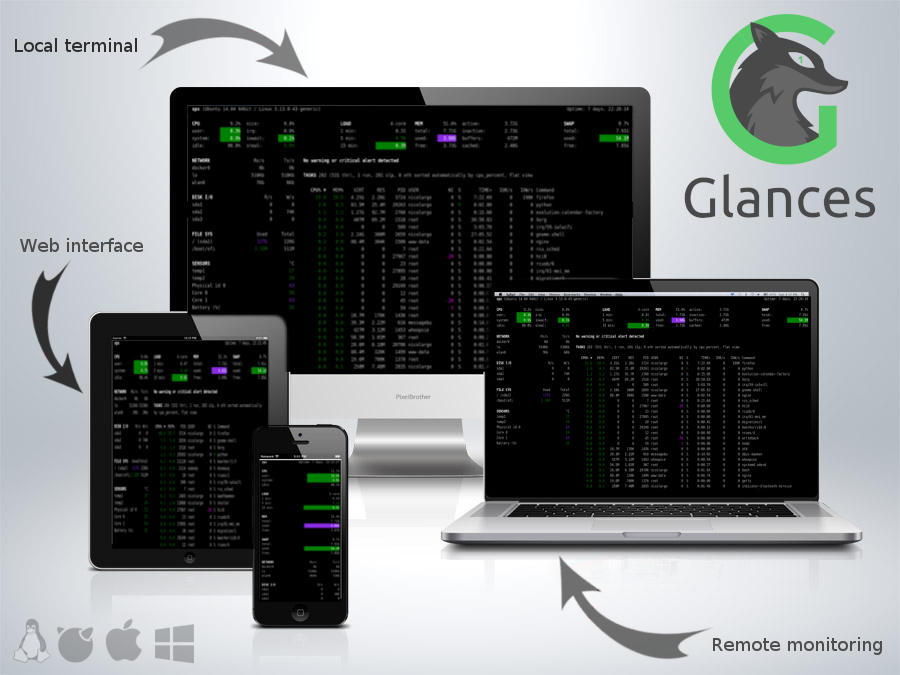
Glances is written in Python and uses libraries to grab information from your system. It is based on an open architecture where developers can add new plugins or exports modules.
Requirements
python>=2.7 or python>=3.4
psutil>=5.3.0 (better with latest version)
defusedxml (in order to monkey patch xmlrpc)
future (for Python 2 support)
Note for Python 2.6 users
Glances no longer supports Python 2.6. Please upgrade to a minimum Python version of 2.7/3.4+ or downgrade to Glances 2.6.2 (last version with Python 2.6 support).
Deprecation warning note for Python 2.x users
Glances version 4.0 will no longer supports Python 2.x.
Optional dependencies:
bernhard (for the Riemann export module)
bottle (for Web server mode)
cassandra-driver (for the Cassandra export module)
chevron (for the action script feature)
couchdb (for the CouchDB export module)
docker (for the Docker monitoring support) [Linux/macOS-only]
elasticsearch (for the Elastic Search export module)
graphitesender (For the Graphite export module)
hddtemp (for HDD temperature monitoring support) [Linux-only]
influxdb (for the InfluxDB version 1 export module)
influxdb-client (for the InfluxDB version 2 export module) [Only for Python >= 3.6]
kafka-python (for the Kafka export module)
netifaces (for the IP plugin)
py3nvml (for the GPU plugin) [Only for Python 3]
pika (for the RabbitMQ/ActiveMQ export module)
potsdb (for the OpenTSDB export module)
prometheus_client (for the Prometheus export module)
py-cpuinfo (for the Quicklook CPU info module)
pygal (for the graph export module)
pymdstat (for RAID support) [Linux-only]
pysnmp (for SNMP support)
pySMART.smartx (for HDD Smart support) [Linux-only]
pyzmq (for the ZeroMQ export module)
requests (for the Ports, Cloud plugins and RESTful export module)
scandir (for the Folders plugin) [Only for Python < 3.5]
sparklines (for the Quick Plugin sparklines option)
statsd (for the StatsD export module)
wifi (for the wifi plugin) [Linux-only]
zeroconf (for the autodiscover mode)
Installation
There are several methods to test/install Glances on your system. Choose your weapon!
PyPI: The simple way
Glances is on PyPI. By using PyPI, you will be using the latest stable version.
To install Glances, simply use pip:
pip install --user glancesNote: Python headers are required to install psutil, a Glances dependencie. For example, on Debian/Ubuntu you need to install first the python-dev package (python-devel on Fedora/CentOS/RHEL). For Windows, just install psutil from the binary installation file.
Note 2 (for the Wifi plugin): If you want to use the Wifi plugin, you need to install the wireless-tools package on your system.
You can also install the following libraries in order to use optional features (like the Web interface, exports modules…):
pip install --user 'glances[action,browser,cloud,cpuinfo,docker,export,folders,gpu,graph,ip,raid,snmp,web,wifi]'To upgrade Glances to the latest version:
pip install --user --upgrade glances
pip install --user --upgrade glances[...]
If you need to install Glances in a specific user location, use:
export PYTHONUSERBASE=~/mylocalpath
pip install --user glances
If you are administrator and want to install Glances for all users:
sudo pip install glancesThe current develop branch is also published to the test.pypi.org package index. If you want to test the develop version, enter:
pip install --user -i https://test.pypi.org/simple/ GlancesGlances Auto Install script: the total way
To install both dependencies and the latest Glances production ready version (aka master branch), just enter the following command line:
curl -L https://bit.ly/glances | /bin/bashor
wget -O- https://bit.ly/glances | /bin/bashNote: This is only supported on some GNU/Linux distributions and Mac OS X. If you want to support other distributions, please contribute to glancesautoinstall.
Docker: the funny way
Glances containers are availables. You can use it to monitor your server and all your other containers!
Get the Glances container:
docker pull nicolargo/glances:<version>Example:
nicolargo/glances:3.2.0 (or nicolargo/glances:alpine-3.2.0) for version 3.2.0 with minimal dependencies
nicolargo/glances:3.2.0-full for version 3.2.0 with full dependencies
For a complete images list:
Run the container in console mode:
docker run --rm -v /var/run/docker.sock:/var/run/docker.sock:ro --pid host --network host -it nicolargo/glances:3.2.0-fullAdditionally, if you want to use your own glances.conf file, you can create your own Dockerfile:
FROM nicolargo/glances:latest
COPY glances.conf /glances/conf/glances.conf
CMD python -m glances -C /glances/conf/glances.conf $GLANCES_OPT
Alternatively, you can specify something along the same lines with docker run options:
docker run -v `pwd`/glances.conf:/glances/conf/glances.conf -v /var/run/docker.sock:/var/run/docker.sock:ro --pid host -it nicolargo/glances:3.2.0-fullWhere `pwd`/glances.conf is a local directory containing your glances.conf file.
Run the container in Web server mode (notice the GLANCES_OPT environment variable setting parameters for the glances startup command):
docker run -d --restart="always" -p 61208-61209:61208-61209 -e GLANCES_OPT="-w" -v /var/run/docker.sock:/var/run/docker.sock:ro --pid host nicolargo/glances:3.2.0-fullGNU/Linux
Glances is available on many Linux distributions, so you should be able to install it using your favorite package manager. Be aware that when you use this method the operating system package for Glances may not be the latest version.
FreeBSD
To install the binary package:
# pkg install py37-glancesTo install Glances from ports:
# cd /usr/ports/sysutils/py-glances/
# make install clean
macOS
If you do not want to use the glancesautoinstall script, follow this procedure.
macOS users can install Glances using Homebrew or MacPorts.
Homebrew
$ brew install glancesMacPorts
$ sudo port install glancesWindows
Install Python for Windows (Python 2.7.9+ and 3.4+ ship with pip) and then run the following command:
$ pip install glancesAndroid
You need a rooted device and the Termux application (available on the Google Play Store).
Start Termux on your device and enter:
$ apt update
$ apt upgrade
$ apt install clang python
$ pip install bottle
$ pip install glances
And start Glances:
$ glancesYou can also run Glances in server mode (-s or -w) in order to remotely monitor your Android device.
Source
To install Glances from source:
$ wget https://github.com/nicolargo/glances/archive/vX.Y.tar.gz -O - | tar xz
$ cd glances-*
# python setup.py installNote: Python headers are required to install psutil.
Chef
An awesome Chef cookbook is available to monitor your infrastructure: https://supermarket.chef.io/cookbooks/glances (thanks to Antoine Rouyer)
Puppet
You can install Glances using Puppet: https://github.com/rverchere/puppet-glances
Ansible
A Glances Ansible role is available: https://galaxy.ansible.com/zaxos/glances-ansible-role/
Usage
For the standalone mode, just run:
$ glancesFor the Web server mode, run:
$ glances -wand enter the URL http://<ip>:61208 in your favorite web browser.
For the client/server mode, run:
$ glances -son the server side and run:
$ glances -c <ip>on the client one.
You can also detect and display all Glances servers available on your network or defined in the configuration file:
$ glances --browserYou can also display raw stats on stdout:
$ glances --stdout cpu.user,mem.used,load
cpu.user: 30.7
mem.used: 3278204928
load: {'cpucore': 4, 'min1': 0.21, 'min5': 0.4, 'min15': 0.27}
cpu.user: 3.4
mem.used: 3275251712
load: {'cpucore': 4, 'min1': 0.19, 'min5': 0.39, 'min15': 0.27}
...
or in a CSV format thanks to the stdout-csv option:
$ glances --stdout-csv now,cpu.user,mem.used,load
now,cpu.user,mem.used,load.cpucore,load.min1,load.min5,load.min15
2018-12-08 22:04:20 CEST,7.3,5948149760,4,1.04,0.99,1.04
2018-12-08 22:04:23 CEST,5.4,5949136896,4,1.04,0.99,1.04
...
and RTFM, always.
Documentation
For complete documentation have a look at the readthedocs website.
If you have any question (after RTFM!), please post it on the official Q&A forum.
Gateway to other services
Glances can export stats to: CSV file, JSON file, InfluxDB, Cassandra, CouchDB, OpenTSDB, Prometheus, StatsD, ElasticSearch, RabbitMQ/ActiveMQ, ZeroMQ, Kafka, Riemann, Graphite and RESTful server.
How to contribute ?
If you want to contribute to the Glances project, read this wiki page.
There is also a chat dedicated to the Glances developers:

Donation
If this project help you, you can give me a tip ;)
See the sponsors page.
Author
Nicolas Hennion (@nicolargo) <nicolas@nicolargo.com>
License
Glances is distributed under the LGPL version 3 license. See COPYING for more details.
Release history Release notifications | RSS feed


Download files
Download the file for your platform. If you're not sure which to choose, learn more about installing packages.
Source Distribution
Built Distribution
Filter files by name, interpreter, ABI, and platform.
If you're not sure about the file name format, learn more about wheel file names.
Copy a direct link to the current filters
File details
Details for the file Glances-3.2.3.tar.gz.
File metadata
- Download URL: Glances-3.2.3.tar.gz
- Upload date:
- Size: 6.9 MB
- Tags: Source
- Uploaded using Trusted Publishing? No
- Uploaded via: twine/3.4.2 importlib_metadata/4.6.4 pkginfo/1.7.1 requests/2.26.0 requests-toolbelt/0.9.1 tqdm/4.62.0 CPython/3.9.6
File hashes
| Algorithm | Hash digest | |
|---|---|---|
| SHA256 |
9ffa5a749a48b5b3d9750ec31d835b0dab0da783e8dd4b98b2c2e8c36564f751
|
|
| MD5 |
4478766c819677a12ea9ee5cbeb64f22
|
|
| BLAKE2b-256 |
41cacef055c2f1452ac54cfb7014d116bd4e9c2d74ac8328b46815abc85fd35a
|
File details
Details for the file Glances-3.2.3-py3-none-any.whl.
File metadata
- Download URL: Glances-3.2.3-py3-none-any.whl
- Upload date:
- Size: 1.5 MB
- Tags: Python 3
- Uploaded using Trusted Publishing? No
- Uploaded via: twine/3.4.2 importlib_metadata/4.6.4 pkginfo/1.7.1 requests/2.26.0 requests-toolbelt/0.9.1 tqdm/4.62.0 CPython/3.9.6
File hashes
| Algorithm | Hash digest | |
|---|---|---|
| SHA256 |
13aa950c26e617458b29211041a832dac570f6547c1f3baa2037d3bb3f6012f9
|
|
| MD5 |
b2b390528320db65a09b356edb9074fb
|
|
| BLAKE2b-256 |
2283a921ae2fdc1a09d3fd4a182b0219f2342cc7737348921b2acdb144310d12
|






