
AgentVerity
Your agent test passed. Would it pass again?





A Python library and CLI that reruns the decisions your agent makes and reports whether they are repeatable enough, and varied enough, to trust as a regression baseline: the reviewed run you save as expected behaviour and compare future releases against. It can read runs another evaluator already collected, so you do not pay for the same calls twice.
The 60-second problem
Consider a routing workflow: a model classifies each payment dispute and directs it to one of six specialist queues. Promptfoo runs six cases 26 times. Its configured quality checks accept either fraud queue for one ambiguous card-security case. All 156/156 assertions pass.
Would you save that run as the expected behaviour for future releases?
AgentVerity reuses the same Promptfoo export and finds this:
4. STABILITY BY ROUTE
   route              cases  pairs  flips  95% CI            result
   card_security          1     13      8  [0.355, 0.823]    stochastic
   cash_withdrawal        1     13      0  [0.000, 0.228]    undecided
   duplicate_charge       1     13      0  [0.000, 0.228]    undecided
   ...
   flip pairs:
     card_security <-> merchant_dispute  x8
The contract check passes, but the decision switches between card_security
and merchant_dispute in 8 of 13 paired reruns. Those labels send work to
different queues, controls, and owners, and a moving reference makes every
later regression failure noisy. One pooled score would have hidden which route
was moving, and the five quiet routes have too few reruns to call stable.
So AgentVerity names the unstable route, leaves the five underpowered routes
undecided, and refuses to freeze this run as a baseline.
Try it without model calls
The repository includes that recorded Promptfoo run:
git clone --depth 1 https://github.com/mrwersa/agentverity.git
cd agentverity
python -m pip install agentverity
agentverity assess \
  --promptfoo examples/promptfoo_bridge/results.json \
  --suite examples/payment_decisions.json
That last command performs arithmetic over saved decisions. It makes no model or provider calls.
Already using DeepEval? Pass the same precomputed
LLMTestCase objects to evidence_from_deepeval. Using neither, but holding a
log with one line per run? Name the two fields and import it:
agentverity assess --jsonl runs.jsonl \
  --input-path probe.text --decision-path result.route
Order matters there, and the small neutral evidence format says why: runs are paired in the order the file gives them, so a log sorted by decision reports a stability the run never had.
If you would rather AgentVerity make the calls itself, install the adapter for your framework. The core has no agent library as a dependency, so this is the only place one is needed:
pip install "agentverity[strands]"     # Strands Agents
pip install "agentverity[langgraph]"   # LangGraph
What it checks
| Check | Developer question |
|---|---|
| Decision stability | Does the same case keep reaching the same decision? |
| Observed spread | Did all test inputs collapse onto one decision? |
| Declared coverage | Were all required decisions and critical routes represented and returned? |
| Route evidence | Which route moves, and which quiet routes still lack enough reruns? |
| Relation coverage | Did an input transformation genuinely exercise each route, or was it a no-op? |
It keeps three outcomes separate:
- stable enough for the declared tolerance
- unstable above that tolerance
- undecided because the run did not collect enough evidence
Once you have two runs, agentverity compare-evidence before.json after.json
answers the question a single report cannot: what moved? It reports which
per-route intervals shifted, which decisions appeared or disappeared, and how
the flip pairs changed, so a release that is still green for a different reason
than last week does not pass unnoticed.
Measured on real systems
Two runs, answering different questions. The first shows the analysis survives a real deployment. The second shows what the analysis is actually for, and it exists because of a limitation the first one had.
Does it work in a real pipeline?
A Strands routing agent on Amazon Bedrock, with DeepEval route-quality checks, AgentVerity, AgentCore Runtime, and CloudWatch. The London run recorded 6/6 correct routes, no changes across 36 repeat pairs, all six routes reached, and 78 successful cloud calls with no errors or throttles.
Read the caveat, because it is the honest part. Those 36 pairs are six routes at six pairs each, and six pairs bound a route at about 39%. That run is systems-integration evidence, not per-route certification. An earlier attempt was repeatable but only 5/6 correct, which is why the release policy needs both quality and evidence rather than treating either as sufficient.
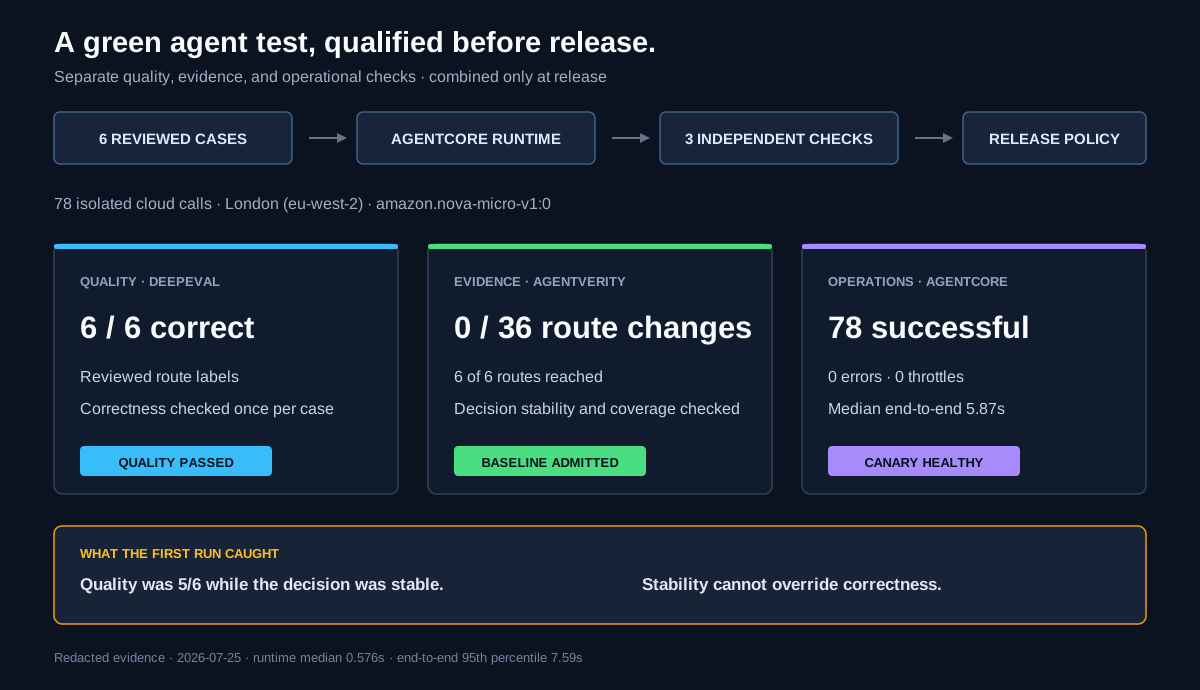
That gate is pooled on purpose. Declare route-specific targets when admission needs a per-route claim.
What does per-route analysis actually find?
4,380 real calls against the twenty tools a published agent exposes, across three models, for 0.70 USD. Enough repeats this time to certify a route rather than only reach it.
model                                           correct  always the same
amazon/nova-micro-v1                               4/10             1/10
openai/gpt-4o-mini                                 7/10             8/10
mistralai/mistral-small-3.2-24b-instruct           5/10            10/10
mistral-small returned the same tool on every probe and was correct on half
of them. gpt-4o-mini is unstable on two routes and correct on seven. Rank
on stability alone and the worse agent wins, which is why this library says
repeatability is not correctness and why that sentence needs numbers.
The two unstable routes are transfer and approve, two of the three the
suite marks critical. Pooled, the same evidence reads 8.5% and does not say
which routes carry it.
Running assess on that evidence still returns NOT TRUSTWORTHY, and the
reason changed for the better. It used to be a disagreement inside the report:
the contract counted the first answer per case while the route table counted
every repeat, so approve came back 98 times and was reported as never
reached. Coverage now counts the distinct cases that reached a decision on any
repeat, so approve is observed. Three routes remain genuinely unreached, and
the refusal is about them rather than about an inconsistency.
The evidence, and the commands to re-run it for nothing
Never repeat live customer requests. Reviewed synthetic cases only, in CI, before release, or on a schedule.
Where it sits beside your evaluator
Keep Promptfoo, DeepEval, or your own assertions to decide whether each answer is correct. AgentVerity reuses those same results to find unstable routes, missing decisions, and runs too small to support a reliable baseline.
| What you run | Question it answers |
|---|---|
| Promptfoo, DeepEval, your assertions | Was this answer acceptable? |
| AgentVerity | Are the repeated answers stable and covered enough to save as expected behaviour? |
| LangSmith, AgentCore, your observability | What happened during this run, and in production? |
| AgentMandate | What is this agent permitted to do, and did this release widen it? |
Those are different layers of evidence, and one does not substitute for another:
| Layer | Example question |
|---|---|
| Outcome | Was the refund recorded in the case system? |
| Trajectory | Which tools or agents acted, and in what order? |
| Decision | Did the workflow choose refund, review, or deny? |
An evaluation framework can grade the first two. AgentVerity qualifies the repeatability and declared coverage of the bounded decision, in the step between a green quality run and saving that run as a reference.
It is a test and release step, not serving-path middleware:
| Stage | Use it for |
|---|---|
| Local development | Diagnose a moving or one-route-only test set |
| Pull request | Qualify a candidate baseline and publish JUnit |
| Pre-release | Refuse unstable, incomplete, or underpowered evidence |
| Scheduled canary | Recheck reviewed synthetic cases and emit OpenTelemetry |
Where it belongs in the full test and release pipeline, including the layers it does not own, and agent-release-gate, which runs AgentVerity beside authority analysis on one agent, offline.
Is it for my agent?
Use it when:
- the component chooses from named routes, approvals, policies, tools, or hand-offs
- repeated runs can start from equivalent isolated state
- you can write deliberately varied cases for the decisions that matter
It fits the agent workflow patterns whose value is a named choice rather than open prose:
| Pattern | The decision under test |
|---|---|
| Routing | Which specialist path or queue an input is classified into |
| Orchestrator-workers | Which worker the orchestrator dispatches to next |
| Evaluator-optimiser | Whether the evaluator accepts, revises, or rejects |
| Tool use | Which tool is selected, and the ordered tool path taken |
| Multi-agent supervisor | Which agent receives the handoff |
| Guardrail or policy gate | Approve, review, escalate, or deny |
Concrete examples: support and payment routing, fraud triage, incident dispatch, approval flows, and bounded tool selection.
Use another evaluator for open-ended chat, RAG quality, generated content, or coding-agent output. If such a system also emits a reviewed route or approval, AgentVerity can qualify that decision layer.
Check applicability and exact limits.
Why rerun counts are harder than they look
Picking three or five reruns by convention is guesswork:
- 36 paired reruns with no changes only bound the change rate below 9.6%.
- A claim below 5% needs 73 zero-change pairs.
- A short quiet run is therefore
undecided, not proven stable.
AgentVerity sizes the run from your tolerance, uses non-overlapping pairs, and
keeps three answers: stable enough, unstable, or undecided. The default
balanced setting uses a 5% tolerance.
A small pytest loop can collect calls. The library packages the harder policy: evidence sizing, route-specific targets, and one consistent decision across text, JSON, JUnit, telemetry, and snapshots.
Read the executable arithmetic and design.
The evidence gate
assess diagnoses decisions another evaluator already collected. snapshot
and check apply the same admission policy when AgentVerity calls your agent
itself. Either way the gate refuses to save a baseline until:
- calls complete
- decisions are stable enough
- the cases reach the required decisions
- a person approves the reference outputs as correct
The bundled payment-dispute example runs two test sets:
python examples/payment_dispute_gate.py
| Probe set | Exact-match | Verdict stability | Declared coverage | Baseline |
|---|---|---|---|---|
| Narrow, 6 duplicate-charge cases | ✅ 6/6 | ✅ verdict-deterministic | ❌ 1/6 required routes | ❌ REFUSED |
| Repaired, 6 dispute categories | ✅ 6/6 | ✅ verdict-deterministic | ✅ 6/6 required routes | ✅ ADMITTED |
Both score 6/6. The narrow set is a valid unit test for one route, but it is not a system-wide baseline. The repaired set reaches all six required routes and can be admitted.
Before spending model calls, inspect the zero-change evidence budget:
agentverity plan --suite examples/route_stability_plan.json
Then create the reviewed baseline:
agentverity snapshot \
  --agent examples/payment_dispute_gate.py:build_agent \
  --suite examples/payment_decisions.json \
  --output baseline.json \
  --accept-reference
The same checks run before agentverity check reports differences as
regressions. Snapshot files retain SHA-256 input fingerprints rather than raw
prompts.
The contract can also declare stricter stability targets for critical routes and minimum case counts. Repeats support a stability claim. Distinct reviewed cases support breadth. AgentVerity keeps those two claims separate.
What it does not prove
TRUSTWORTHY means the supplied cases produced stable, non-collapsed evidence
at the declared tolerance and satisfied any declared decision contract.
It does not prove:
- that each decision was correct or safe
- that every code branch or behavioural boundary was tested
- that several cases are semantically diverse
- that an open-ended answer is high quality
It also does not store traces, host a dashboard, or monitor production traffic. Static coverage, Promptfoo or DeepEval quality checks, and production observability remain separate parts of the stack.
Go deeper
- Which agents fit, and what the result does not prove
- Why arbitrary rerun counts fail
- How to read and budget per-route evidence
- Reuse Promptfoo, DeepEval, or generic evidence without duplicate calls
- Qualify a categorical LLM judge without confusing stability with validity
- Integrations and AgentCore validation
- API guide
- API stability and path to 1.0
- Security and data handling
Read the design story: Introducing AgentVerity: What Does a Green Agent Test Prove?
Development
pip install -e ".[dev]"
python -m pytest -q
ruff check .
CI covers Python 3.10 through 3.14, lint, package construction, and the
generated README evidence. A coverage job enforces at least 90% statement
coverage, and the branch-protection CI gate requires that job to pass.
Status and licence
Alpha. Pin a minor series for production use, for example
agentverity~=0.15.0. Patch releases preserve the public API.
Apache-2.0. Contributions are welcome through the pull-request workflow.
1 maintainer

Download files
Download the file for your platform. If you're not sure which to choose, learn more about installing packages.
Source Distribution
Built Distribution
Filter files by name, interpreter, ABI, and platform.
If you're not sure about the file name format, learn more about wheel file names.
Copy a direct link to the current filters
File details
Details for the file agentverity-0.15.0.tar.gz.
File metadata
- Download URL: agentverity-0.15.0.tar.gz
- Upload date:
- Size: 872.3 kB
- Tags: Source
- Uploaded using Trusted Publishing? Yes
- Uploaded via: twine/7.0.0 CPython/3.13.14
File hashes
| Algorithm | Hash digest | |
|---|---|---|
| SHA256 |
4cdd91408d668867a814130d5c990877f1f44f904c230067b88c06e96d594e4b
|
|
| MD5 |
fa1d72c5205f3ca1ca7f534e3745e836
|
|
| BLAKE2b-256 |
2ada216a862725f5535018634c580557b4a23fa507b38922340fc62ebf957638
|
Provenance
The following attestation bundles were made for agentverity-0.15.0.tar.gz:
Publisher:
release.yml on mrwersa/agentverity
-
Statement:
-
Statement type:
https://in-toto.io/Statement/v1 -
Predicate type:
https://docs.pypi.org/attestations/publish/v1 -
Subject name:
agentverity-0.15.0.tar.gz -
Subject digest:
4cdd91408d668867a814130d5c990877f1f44f904c230067b88c06e96d594e4b - Sigstore transparency entry: 2334992693
- Sigstore integration time:
-
Permalink:
mrwersa/agentverity@7035d2ef99630f038663ba94bf08fe0405c61b6c -
Branch / Tag:
refs/heads/main - Owner: https://github.com/mrwersa
-
Access:
public
-
Token Issuer:
https://token.actions.githubusercontent.com -
Runner Environment:
github-hosted -
Publication workflow:
release.yml@7035d2ef99630f038663ba94bf08fe0405c61b6c -
Trigger Event:
workflow_run
-
Statement type:
File details
Details for the file agentverity-0.15.0-py3-none-any.whl.
File metadata
- Download URL: agentverity-0.15.0-py3-none-any.whl
- Upload date:
- Size: 98.2 kB
- Tags: Python 3
- Uploaded using Trusted Publishing? Yes
- Uploaded via: twine/7.0.0 CPython/3.13.14
File hashes
| Algorithm | Hash digest | |
|---|---|---|
| SHA256 |
a669de65d6bca78dbaf87723e470744b9da773838645751df1b96a820af0d201
|
|
| MD5 |
5c4addcb2d7cddc2f432133e434bee4b
|
|
| BLAKE2b-256 |
2498959ddace1bc4e2cc20577a8f376250d5f3170a122b83a516c1c86bba3cb8
|
Provenance
The following attestation bundles were made for agentverity-0.15.0-py3-none-any.whl:
Publisher:
release.yml on mrwersa/agentverity
-
Statement:
-
Statement type:
https://in-toto.io/Statement/v1 -
Predicate type:
https://docs.pypi.org/attestations/publish/v1 -
Subject name:
agentverity-0.15.0-py3-none-any.whl -
Subject digest:
a669de65d6bca78dbaf87723e470744b9da773838645751df1b96a820af0d201 - Sigstore transparency entry: 2334992694
- Sigstore integration time:
-
Permalink:
mrwersa/agentverity@7035d2ef99630f038663ba94bf08fe0405c61b6c -
Branch / Tag:
refs/heads/main - Owner: https://github.com/mrwersa
-
Access:
public
-
Token Issuer:
https://token.actions.githubusercontent.com -
Runner Environment:
github-hosted -
Publication workflow:
release.yml@7035d2ef99630f038663ba94bf08fe0405c61b6c -
Trigger Event:
workflow_run
-
Statement type:







