














App Mesh
One secure, lightweight daemon to run, schedule, and remote-control apps across machines.
🧭 Concepts
App Mesh gives you two capabilities: Hosting and Computing.
🎛 Hosting
Declare an app once. The daemon keeps it running.
- Lifecycle — start, stop, and recover the app after a crash or a daemon restart
- Scheduling — cron, fixed intervals, start and end dates, daily time windows
- Protection — health checks, CPU and memory limits, OS user, tenant isolation
- Any app — a native process or a Docker app
Think systemd on every machine. Or Kubernetes desired state, for any app.
🧮 Computing
Submit work to any node. Get the result back.
- Command or script — starts a new process, runs once
- Task message — reuses a warm app that is already running, no startup cost
- Parallel and control — fan out work across nodes; run sync or async, stream output, set timeouts
- Workflow — chain many work items into a DAG pipeline and run it natively
- AI — send task messages to a hosted LLM agent, or give coding agents a sandbox node to build and run
Think serverless, on your own machines.
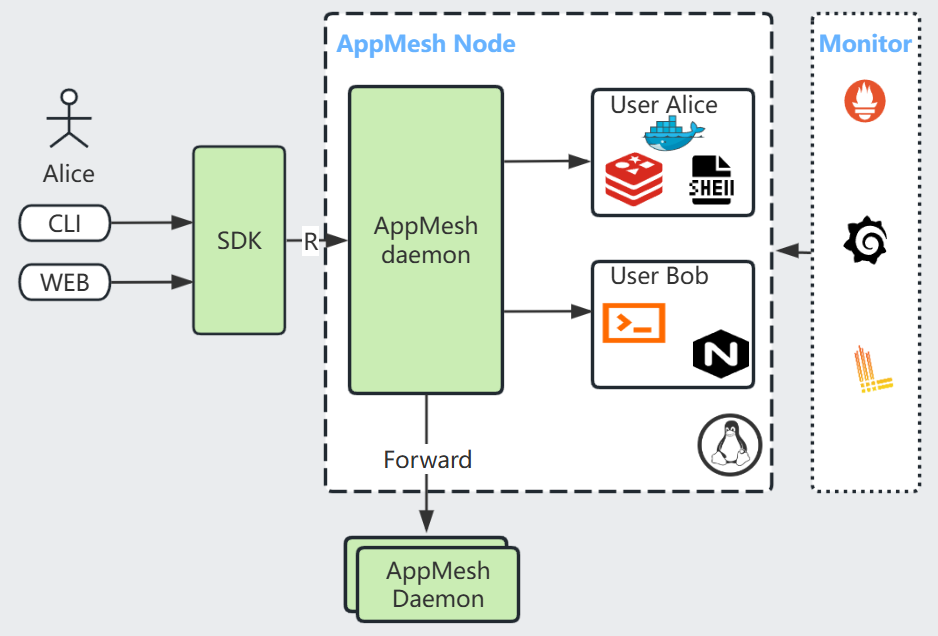
⚡ Quick Start
Start the daemon in Docker:
docker run -d --restart=always --name=appmesh --net=host -v appmesh-work:/opt/appmesh/work -v /var/run/docker.sock:/var/run/docker.sock laoshanxi/appmesh:latest
The appmesh-work volume persists authentication state and application
definitions; without it, a recreated container loses the administrator
password and every registered app. The container runs as UID 482 — grant that
identity access to the Docker socket to manage Docker apps.
Host your first app with the appm CLI — open a shell in the daemon container:
$ docker exec -ti appmesh bash

# Sign in once (non-interactive)
$ /opt/appmesh/script/appmesh-auth.sh print-initial-password | appm logon -u admin@appmesh.local --password-stdin

# List registered applications
$ appm ls
ID  NAME      OWNER   ENABLED  HEALTH  PID  USER     MEMORY  %CPU  RETURN
0   py-task   system  Yes      OK      574  appmesh  32.5Mi  0     -
1   py-exec   system  -        -       -    -        -       -     -
2   identity  system  Yes      OK      344  appmesh  40.5Mi  0     -
3   dexuser   system  Yes      OK      573  appmesh  17.5Mi  0     -
4   workflow  system  Yes      OK      575  appmesh  13.7Mi  0     -

# Register a new application
$ appm add -a myapp -c "python3 -u -c 'import time; [print(i, time.ctime()) or time.sleep(1) for i in range(10)]'"

# View its live output
$ appm ls -a myapp -o
0 Wed Sep 16 10:56:12 2026
1 Wed Sep 16 10:56:13 2026
2 Wed Sep 16 10:56:14 2026

# appm -h for more usage
Send a task message to a running app through the SDK. Mint an admin token first (see the authentication guide):
$ export APPMESH_BEARER_TOKEN=$(/opt/appmesh/script/appmesh-auth.sh print-initial-password \
    | /opt/appmesh/script/appmesh-auth.sh user-token)
import os
from appmesh import AppMeshClient
client = AppMeshClient(bearer_token=os.environ["APPMESH_BEARER_TOKEN"])

result_from_server = "0"
for i in range(10):
    task_data = f"print({result_from_server} + {i}, end='')"
    result_from_server = client.run_task(app_name="py-task", data=task_data)
    print(result_from_server)
For native packages (.deb/.rpm), systemd setup, and cluster initialization, see the Installation Guide and the Dockerfile.
🚀 Core Capabilities
| Pillar | Capability | What you get |
|---|---|---|
| Hosting | Application management | Full remote CRUD and control — cgroup limits, OS user, environment variables, Docker apps, stdin/stdout — with monitoring of start counts, exit codes, errors, and health checks |
| Hosting | Scheduling | Long- and short-running apps, periodic jobs, cron expressions, custom timings, and policy-driven start/exit behaviors |
| Computing | Remote execution | Run commands and scripts on any node; send in-memory tasks to running applications for high-performance computing |
| Computing | Workflow engine | GitHub-Actions-style YAML pipelines with DAG scheduling, running natively on App Mesh |
| Platform | Security | OAuth/OIDC bearer authentication (RFC 6750) with Principal-based RBAC and multi-tenant isolation; SSL/TLS on TCP/HTTP/WebSocket; HMAC-PSK internal verification |
| Platform | Observability | Built-in Prometheus exporter, Grafana datasource, Loki integration, host/app resource metrics |
| Platform | Extras | File upload/download API, remote shell execution, hot config reload, bash completion |
Runs on Linux, macOS, and Windows (x86 and ARM).
🔄 Workflow Pipeline
Define CI/CD pipelines as YAML — similar to GitHub Actions, but running natively on App Mesh with the built-in Workflow Engine:
- DAG scheduling — jobs run in dependency order, independent jobs in parallel
- 4 step types — shell commands, existing Apps, Task API messages, sub-workflows
- Error handling — retry with exponential backoff,
continue-on-error,finallycleanup blocks - Expressions —
${{ inputs.env }},${{ steps.build.stdout }},success(),failure(),always() - Remote execution — target specific nodes by label or hostname
appm workflow add -f pipeline.yaml        # register
appm workflow run pipeline -e env=prod -f # run and follow output
appm workflow runs pipeline               # view history
🤖 AI & LLM Integration
The Computing pillar makes App Mesh a natural runtime for AI workloads:
- Remote sandbox for AI coding assistants — give agents an isolated build-and-run environment instead of your local shell.
- MCP server — manage App Mesh from AI clients over Model Context Protocol (Streamable HTTP with OAuth 2.1, RBAC enforced by the daemon).
- LLM agent runtime — host Claude-Agent-SDK-based agents as managed App Mesh applications; see the architecture design (SOP).
- Remote execution skill for Codex and Claude Code, and MQTT bridge for IoT scenarios.
🧰 Interfaces & SDKs
| Interface | Details |
|---|---|
| CLI | appm command reference |
| REST | REST APIs · OpenAPI spec |
| Web GUI | app-mesh-ui |
| SDKs | Python · Golang · Rust · Java · JavaScript · C++ |
💡 Success Stories
AI & automation
- Remote build-and-run sandbox for AI coding assistants
- LLM agent runtime hosted as an App Mesh app · architecture and workflow design (SOP)
- Manage App Mesh from AI clients via MCP (HTTP + OAuth)
Computing
- In-memory remote task execution
- Remote command and Python script execution
- Parallel task execution with the Python SDK
Operations & observability
- Observability stack with Grafana, Prometheus, and Loki
- Customize application startup and exit behavior
- Promote a native application into a managed microservice
- Secure REST-based file server
Platform & Kubernetes
- Run non-container applications on Kubernetes
- Kubernetes local-PV provisioning via Open Service Broker
🆚 Comparison
| Feature | App Mesh | systemd | crontab |
|---|---|---|---|
| Schedule accuracy | Seconds | Seconds | Minutes |
| Language | C++17 | C | C |
| Web GUI | √ | ||
| Command lines | √ | √ | √ |
| SDK | √ | ||
| Cron schedule expression | √ | √ | |
| Manage docker app | √ | ||
| Session login | √ | ||
| Manage stdout/stderr | √ | √ | |
| Health check | √ | ||
| Authentication | √ | ||
| Multi-tenant | √ | √ |
📚 Documentation
- Read the Docs — full documentation
- Feature Overview — the full capability map behind Hosting and Computing
- Installation Guide
- Security
- Workflow Guide
🔗 Library dependencies
Community & License
Questions and discussions are welcome on Gitter. Licensed under the MIT License.
1 maintainer

Release files for appmesh 3.0.6
For a detailed explanation of source distributions (sdists) and built distributions (wheels), please see the package formats documentation.
Built distribution (wheel)
| File | Interpreter | ABI | Platform | Reset |
|---|---|---|---|---|
| appmesh-3.0.6-py3-none-any.whl | Python 3 | none | any | Details |
Release files / appmesh-3.0.6-py3-none-any.whl
| Download URL | appmesh-3.0.6-py3-none-any.whl |
|---|---|
| Size | 59.8 kB |
| Tags | Python 3 |
|
SHA-256 checksum How to use checksums |
55d12af4a6546c47729028e2284d4b113f5d5649423717a67a7df9e0e01d50e6
|
|
BLAKE2b-256 checksum How to use checksums |
b593c951402930948de9b3fc53f8d43adbf01eac27a885ddf2ecdc5b94e9462a
|
| Upload date | |
|
Uploaded using Trusted Publishing? What is trusted publishing? |
No |
| Uploaded via |
twine/7.0.0 CPython/3.13.14
|














