
ascii2svg
Your text diagrams, drawn properly. Every character stays exactly where you put it.
Try it in your browser · Live demo · Scroll demo · Download the Claude skill
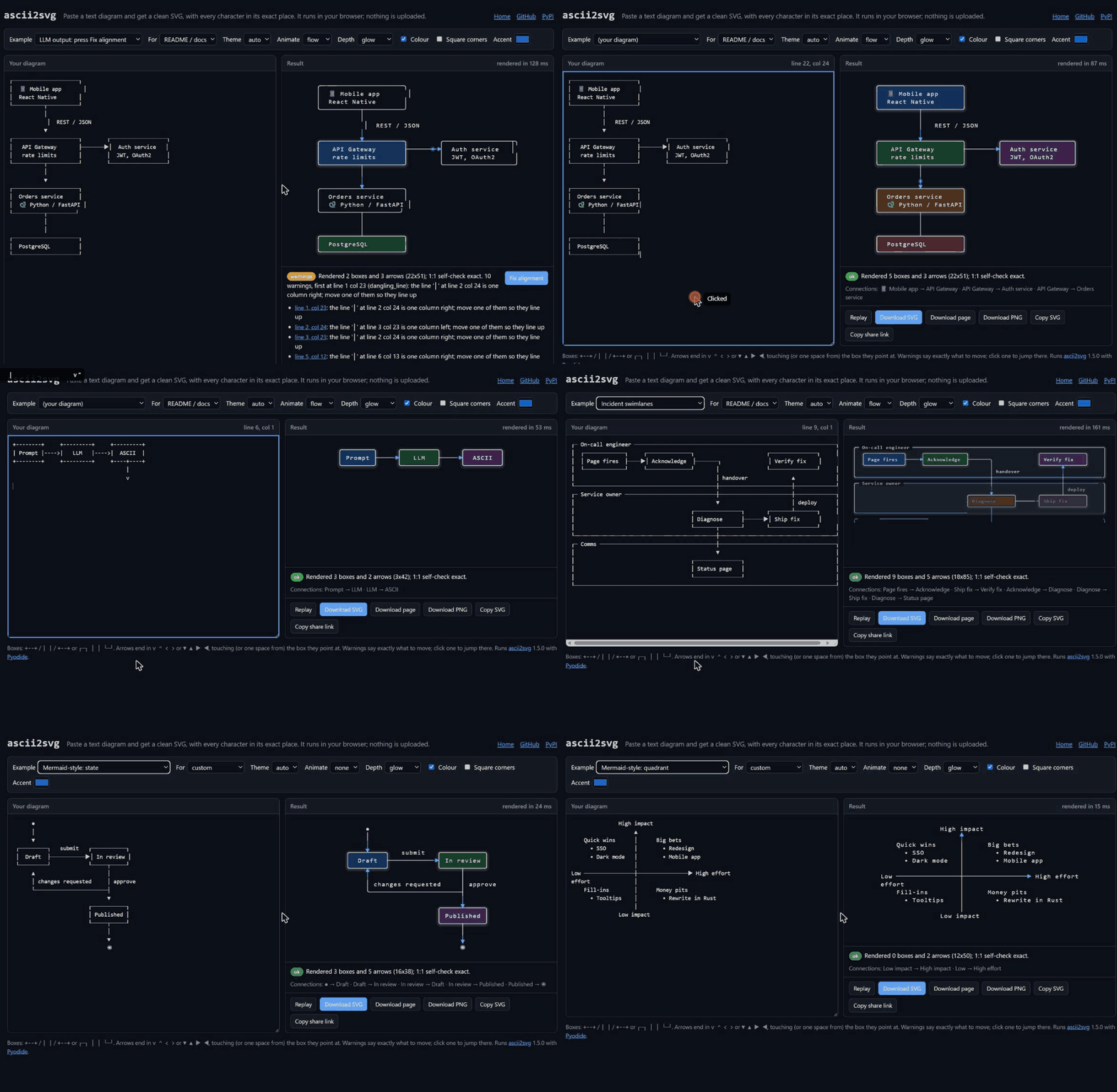
The playground: fix a model's misaligned diagram, type one live, then a tour of combined and Mermaid-style diagrams.
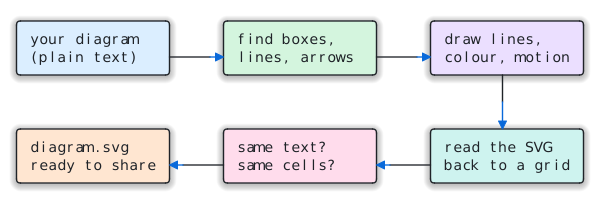
You sketch a diagram in plain text, in a README, a code comment, a chat with an AI, or a notes app. It looks right in a monospace font and falls apart everywhere else: Slack, email, Confluence, slides, a phone.
ascii2svg turns it into a crisp SVG that draws itself, follows your reader's light or dark
mode, and shows data moving along the arrows. It is still 1:1: every run reads its
own SVG back and checks it against your text, cell by cell. If anything moved, it tells you.
Type this…
+------------+     +------------+     +------------+     +-------------+
|    Idea    |---->|   Draft    |---->|   Review   |---->|   Publish   |
+------------+     +------------+     +-----+------+     +-------------+
                         ^                  |
                         |                  |
                         +------------------+
                           needs changes
…get this
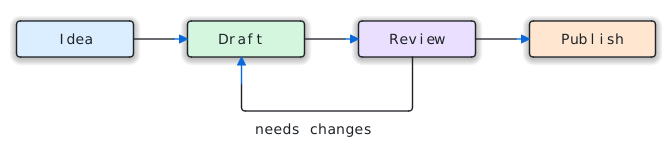
python3 scripts/ascii2svg.py workflow.txt -o workflow.svg --color --theme auto --animate
Plain + - | became real lines, v ^ < > became arrowheads, and the words stayed words.
It works just as well with Unicode box characters (┌─┐ │ └─┘ ╭╮ ═║ ▶).
Who it's for
If you don't write code: open the playground, paste your diagram, pick where it's going, and download the SVG, PNG or a web page. It runs entirely in your browser (Python compiled to WebAssembly via Pyodide); nothing is uploaded. Or ask Claude. With this repo installed as a skill, say "turn this diagram into an image for my slides" or "make this look nice for our wiki", and it picks the options for where the diagram is going, checks the result, and hands you the file. Nothing to learn.
If you do: it's one Python file with no dependencies. It reads a file, stdin, or --text, and
writes an SVG plus a JSON report that an agent or a CI job can check (exit_code, roundtrip, warnings).
It never guesses: a character it isn't sure about stays text.
LLM diagrams, fixed
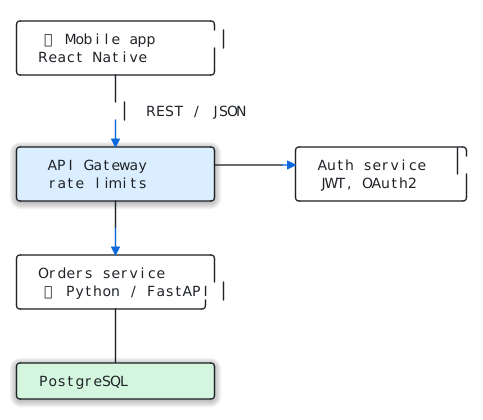
Ask any chat model for an architecture diagram and the boxes rarely line up: an emoji counted
as one column instead of two, a wall one space short, a connector that drifts sideways
between rows. --repair puts them back:
| As the model wrote it | --repair |
|---|---|
 |
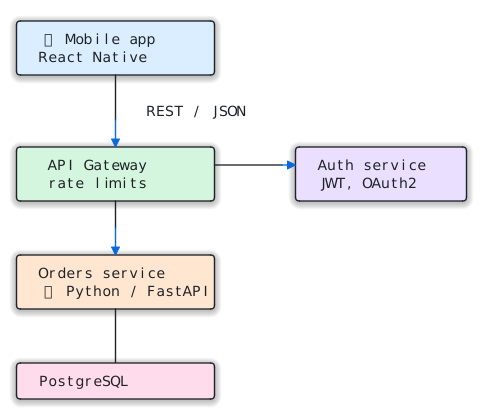 |
| 2 of 5 boxes recognised, 10 warnings | 5 boxes, 0 warnings, 5 fixes |
ascii2svg diagram.txt -o diagram.svg --repair --json
{"status": "ok", "summary": "Repaired 5 misalignments. Rendered 5 boxes and 3 arrows (22x51); 1:1 self-check exact.",
 "repair": {"edits": [{"line": 2, "col": 23, "fix": "moved the right wall '│' 1 col left"},
                      {"line": 6, "col": 12, "fix": "moved '│' 1 col left to line it up"}, "..."],
            "text": "┌─────────────────────┐\n│  📱 Mobile app      │\n..."}}
- What it fixes: ragged right walls (the top corner, every row and the bottom corner vote on where the wall belongs), drifted left walls, edges one character too long or short, connector pieces and arrowheads one or two columns off, arrowheads that stop a cell short, and gaps of one or two cells before a box.
- What it never does: change your words. Only line characters and spaces move or appear, and only into empty cells. A test strips every line character from each row, before and after, and checks that what remains is identical.
- What you get back: every edit with its line and column, and the corrected text in
repair.text, ready to paste back where the diagram came from. The 1:1 guarantee then holds against that text. Diagrams that were already right come back untouched.
In the playground, a diagram with warnings shows a Fix alignment button. It rewrites the editor text, so you see exactly what moved.
Beyond boxes
Flows that branch and merge, tables with callouts, swimlanes: all plain text, all 1:1.
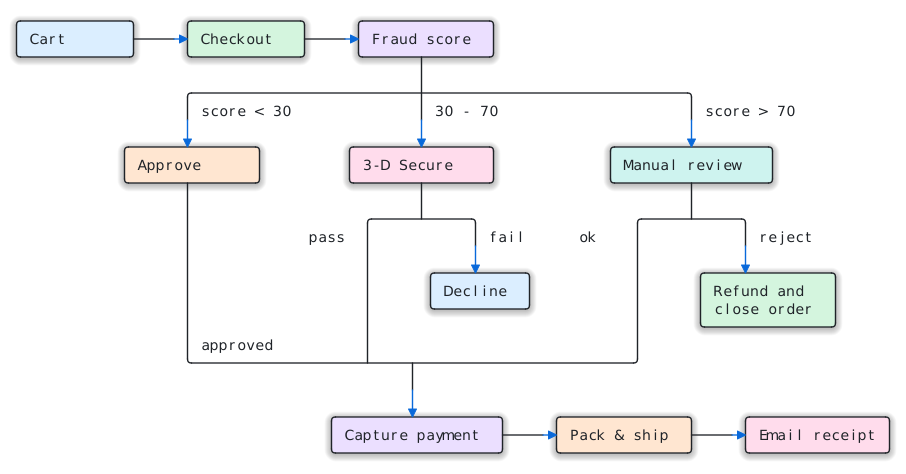
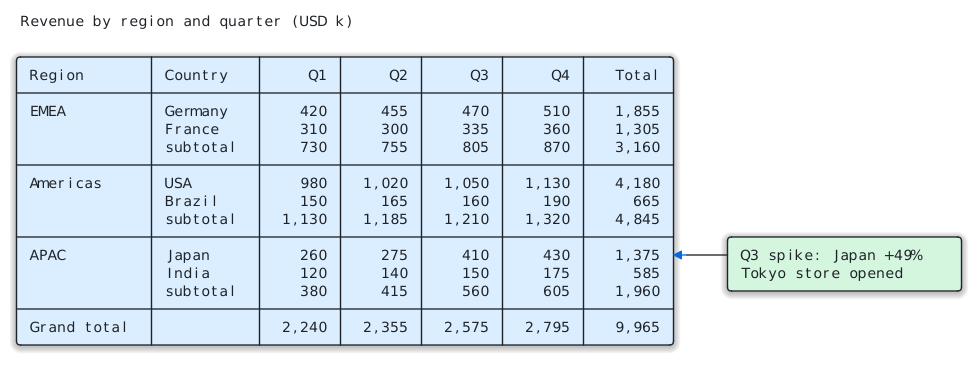
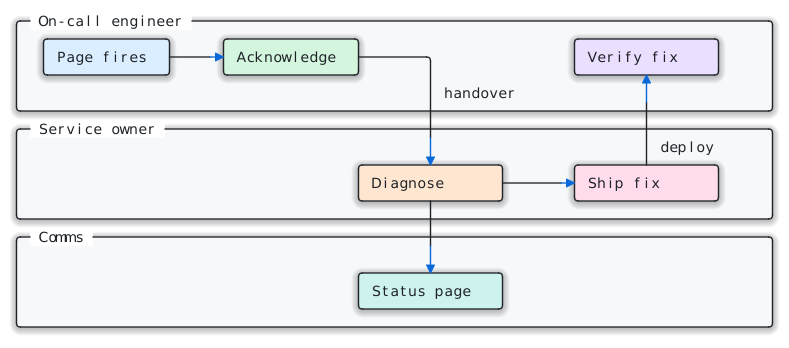
Diamonds and fan-outs drawn with / \, and charts drawn with block characters, come out as real
shapes: diagonals run corner to corner, and █▓▒░ become solid rectangles with no seams between cells.
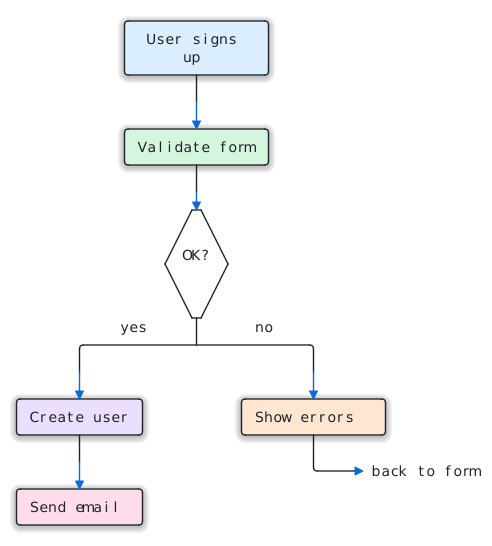
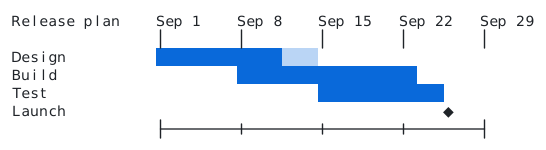
The sources are in docs/examples/,
and all of them are in the playground's example picker.
Pick a look
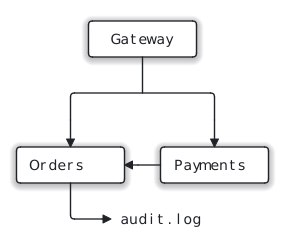
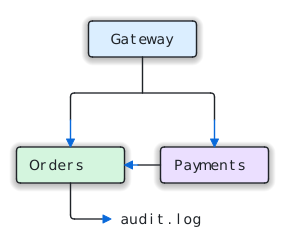
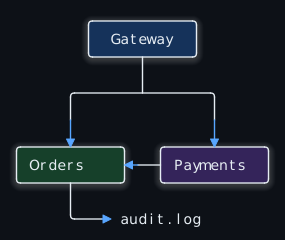
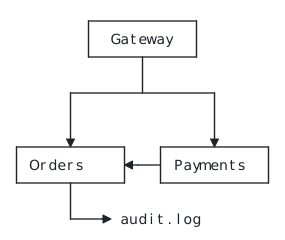
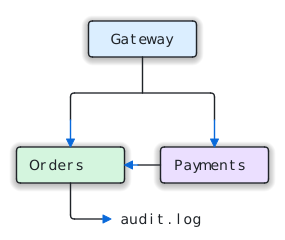
Same diagram, same guarantee, five ways:
| Default | Colour | Dark | Alive | |
|---|---|---|---|---|
 |
 |
 |
 |
 |
| (no options) | --color |
--theme dark--color |
--style flat--square |
--animate--color--theme auto |
| Option | What it does |
|---|---|
--color |
Soft tints grouped by what contains what: each top-level group gets its own hue, nested boxes keep it. Arrows turn accent blue. |
--theme light|dark|auto |
auto follows the reader's system light/dark setting, which suits GitHub READMEs and docs sites. |
--animate draw |
The diagram draws itself once, top to bottom: lines are sketched in accent blue and settle to ink, boxes fade in, arrowheads pop. |
--animate flow (or bare --animate) |
draw, then glowing pulses keep travelling along every connector toward its arrowhead, so readers can see where things go. |
--animate scroll |
For tall diagrams, as a web page: each part appears as the reader scrolls to it, and long connectors grow downward with the scroll. See below. |
-o page.html (or --html) |
A standalone web page with the diagram inline. Double-click to open, or email it. |
--style glow|shadow|flat |
Depth under the boxes. The glow shrinks automatically so it never sits behind a label. |
--square |
Keep corners square (they are rounded by default). |
--repair |
Fix typical misalignment first (see LLM diagrams, fixed). Only line characters move; your text never changes. |
--accent #hex · --font NAME · --width PX |
Your brand colour for arrows and animation, a font to try first (e.g. JetBrains Mono), and the output width. None of them affect the 1:1 check. |
The animation is careful about where it runs:
- It never changes what's drawn. An animated file is the static file plus timing. When the animation ends, you're looking at exactly what the self-check verified. Tools that don't play animation (PNG export, most editors) show the finished drawing.
- It respects the reader. With reduce motion turned on in the OS, nothing moves.
drawandflowneed no JavaScript. They use CSS and SVG<animate>only, so they play inside a plain<img>tag, which is how GitHub, Notion and most docs sites show images.- Hover a box in a browser and it lights up. That helps when you're presenting.
Tall diagrams: reveal as you scroll
A 70-row architecture diagram drawn on a timer finishes before anyone scrolls down to it.
With --animate scroll, the diagram unfolds with the reader instead:
python3 scripts/ascii2svg.py architecture.txt -o architecture.html --color --theme auto --animate scroll
- Boxes and labels fade in as they reach the lower edge of the screen.
- Long vertical connectors are drawn by the scroll: they grow downward in accent blue as you read, then settle to ink.
- Each flow pulse starts once its whole route is on screen.
- With reduce motion on, the page shows the finished diagram.
Why a web page, not just an SVG? An SVG shown as an image (which is how GitHub READMEs,
Notion and most docs sites show them) can't see the page it sits in, so it can't know how
far you've scrolled. CSS scroll timelines don't drive SVG shapes either: we tested it, and
Chromium leaves them inactive. So scroll writes an .html page with the SVG inline and about
2 KB of plain JavaScript (IntersectionObserver and CSS animations, no libraries). It uses only
standard browser features and works offline, though so far it has been tested in Chromium only. --animate scroll with a plain .svg output
is refused with an explanation. The SVG inside the page is the same self-checked drawing; the
script only decides when each part appears.
Try it: open the scroll demo and scroll.
It's docs/architecture.html, served by GitHub Pages.
Where is it going?
| Destination | Use |
|---|---|
| GitHub README, docs site | --theme auto --color --animate, then commit the .svg |
| A tall diagram people will scroll through, or a page to share | -o diagram.html --color --theme auto --animate scroll |
| Slides (Keynote, Google Slides, PowerPoint) | --color --animate draw for a live build. For a still, --color --png |
| Slack, email, Jira, anywhere SVG isn't shown | --color --png (needs pip install cairosvg). PNGs are always the finished frame |
| Printed docs, a PDF | --style flat --square |
| Dark-mode apps | --theme dark --color |
A bigger one
The flows follow the real wiring: through junctions, down to both branches of a fan-out, and across the edge of a container.
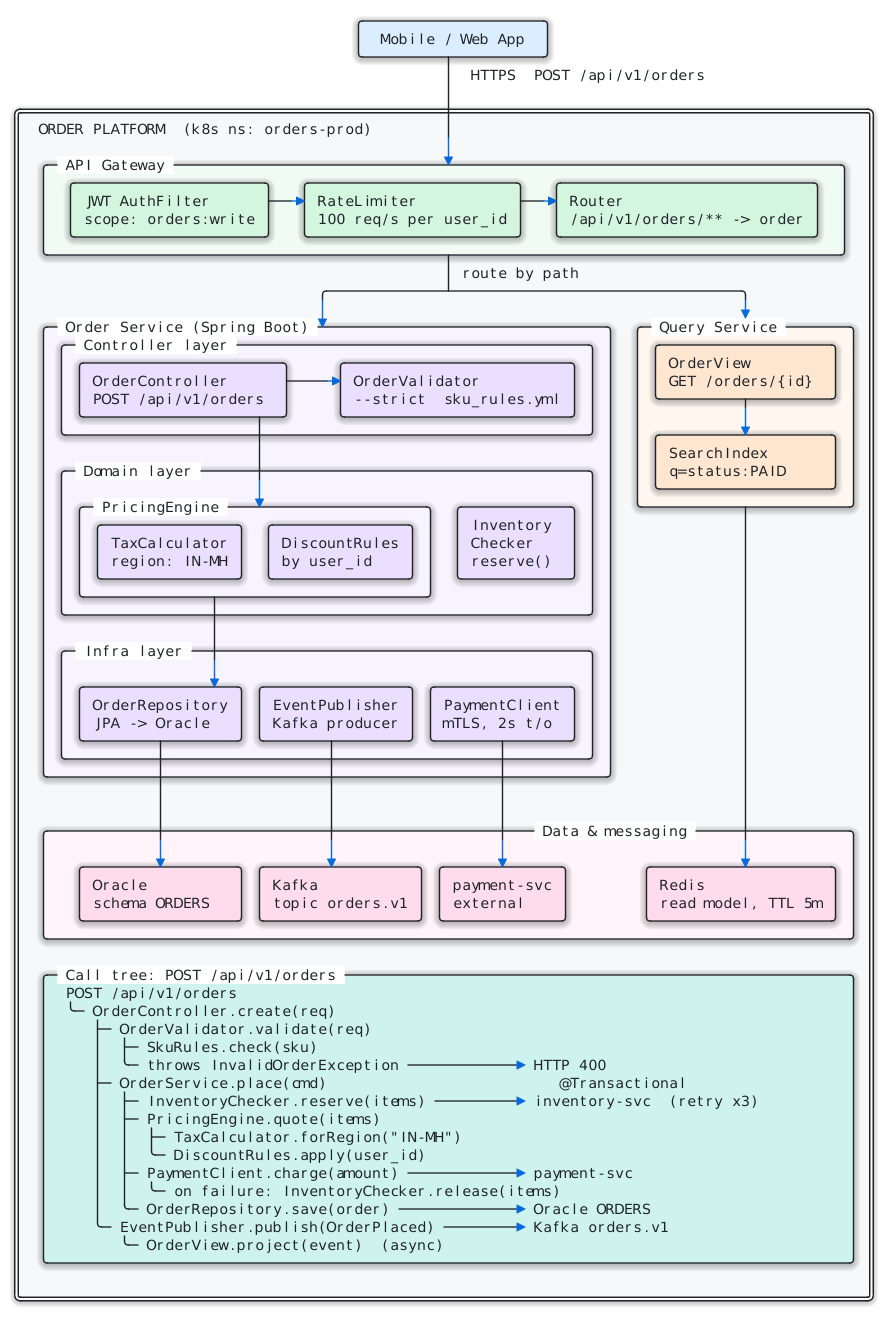
The text it came from (72 × 96 characters)
See tests/fixtures/complex_unicode.txt. 28 boxes, 18 arrows, a
call tree and double-line borders, all drawn from plain text.
Install
Python 3.9+ and nothing else:
pip install ascii2svg                 # adds the `ascii2svg` command and the `ascii2svg` module
pip install "ascii2svg[width,png]"    # optional: wcwidth (character widths) + cairosvg (--png)
It is a single file with no dependencies, so you can also just copy
scripts/ascii2svg.py into your project.
As a Python library:
import ascii2svg

svg, report = ascii2svg.render(open("diagram.txt").read(), color=True, theme="auto", animate="flow")
assert report["roundtrip"] == "exact"          # the 1:1 self-check passed
open("diagram.svg", "w", encoding="utf-8").write(svg)

page, report = ascii2svg.render(text, color=True, animate="scroll", html=True)   # a scroll-reveal page
render() takes the same options as the CLI (style, square, theme, color, animate, html,
title, tab_size) and returns the markup plus the same report as --json. It raises ValueError
for empty or oversized input and for unknown options.
As a Claude skill: download ascii2svg.skill
from the latest release (or build it: python3 tools/package_skill.py → dist/ascii2svg.skill), then:
- claude.ai / Claude desktop: Customize → Skills → upload
ascii2svg.skill. - Claude Code: unzip it into
~/.claude/skills/(you get~/.claude/skills/ascii2svg/).
SKILL.md tells Claude when to use it, which look fits which destination (including
scroll pages for tall diagrams), and how to read the report before handing you the file.
Usage
ascii2svg [INPUT ...] [-o OUT.svg|OUT.html|DIR/] [--preset NAME] [--json] [--check] [--describe] [--brief]
          [--color] [--theme light|dark|auto] [--animate [draw|flow|scroll]] [--html]
          [--style glow|shadow|flat] [--square] [--accent #HEX] [--font NAME] [--width PX]
          [--all-blocks] [--block N] [--unescape] [--strict] [--schema] [--mcp]
          [--png [PATH]] [--strict] [--text TEXT] [--tab-size N] [--title TEXT]
| Input | How |
|---|---|
| File | ascii2svg diagram.txt -o out.svg |
| stdin | cat diagram.txt | ascii2svg > out.svg |
| Inline | ascii2svg --text "$DIAGRAM" --json (the SVG comes back inside the JSON when there's no -o) |
| Markdown | The first ``` code block is used. Prose around it is dropped (and reported) |
stdout is always exactly one thing: the SVG (or the page, with --html), or (with --json) the report. A one-line
summary goes to stderr.
What gets drawn
| Source | Drawn as lines when… | Otherwise |
|---|---|---|
─│┌┐└┘├┤┬┴┼╭╮╰╯═║╔╗╚╝╪, ▼▲▶◀ |
always | – |
ASCII + - | |
they form a closed box, or attach to one directly or through + junctions |
stay text |
ASCII v ^ < > |
they end a line that is drawn, or point at a box (touching, or one space away) | stay text |
╱╲╳ |
always, corner to corner | – |
ASCII / \ |
two or more run along their own slope, with no letter or digit beside them (diamonds, fan-outs) | stay text |
Block elements █▓▒░ ▀▄▌▐ ▁▂▃▅▆▇ ▏▎▍▋▊▉ ▖▗▘▝▚▞▙▛▜▟ |
always, as exact rectangles (a run is one rectangle), so bars and shading have no seams | – |
When unsure, a character stays text, so the worst case is the character itself in its own cell,
never a wrong shape. a->b, --dry-run, user_id, C:\temp, yes/no, TCP/IP, markdown
tables and |-- file trees all stay exactly as written.
How 1:1 is guaranteed
Every run parses the SVG it just wrote (lines, curves, diagonals, arrowheads, block rectangles,
text positions) back into a character grid and compares it with the input, cell by cell. ASCII
characters may only appear as the line they stand for (-→─, |→│, +→corner or junction,
v→▼, /→╱). Any mismatch is
exit code 2. This covers every look, including animated ones and the still frame used for PNGs.
Built for agents
Every outcome is machine-readable, nothing hangs, and every problem comes with a fix.
The loop: draft the diagram, check it, fix what the hints say, then render.
ascii2svg draft.txt --check --describe      # validate + structure; writes nothing
ascii2svg draft.txt -o out.svg --preset readme --json --brief
{"status": "warnings",
 "summary": "Rendered 2 boxes and 0 arrows (8x8); 1:1 self-check exact. 1 warning, first: row 4 col 4 (dangling_line): the arrowhead 'v' at row 5 col 5 is one column right; move one of them so they line up",
 "exit_code": 0, "...": "..."}
- One JSON object on stdout for every outcome with
--json(or--check), including usage errors:{"status": "usage_error", "hint": "'--colour': did you mean --color?"}.statusandsummarycome first, so a truncated report still says what happened. The JSON is ASCII-safe, so any harness on any OS decodes it the same way. - Warnings you can act on: each has a stable
code, a 1-basedrow/col, the sourceline, and ahint. When a line misses its partner by one cell, the hint says where it is. - Silently wrong input is caught: one-line input with literal
\n(escaped_newlines; fix it with--unescape), and ASCII boxes that never close (unclosed_box: the hint names the broken wall, e.g. "its left wall at line 5 col 23 is '<'"). - No false alarms on well-formed diagrams: a line may end at a label, meet another line
side-on (sequence messages
│───▶│, drawn touching), or stop in open space (axis ticks, lifeline ends). A warning means there is evidence of a mistake: a partner one cell off, a line that stops just short of a box, a junction with a missing arm, or a box that never closes. --describeadds what the diagram says: boxes (name, title, text, position, parent) and edges (Gateway → Orders), so you can check that the picture means what you intended.--preset readme|slides|chat|print|dark|pagepicks the look from the destination. Explicit flags still win (--preset readme --no-color).--briefnever embeds the markup; without it,--jsonwithout-oreturns the markup inline, which can run to 150 KB for a large diagram.- No hangs: if you forget the input and stdin stays silent, it fails after 5 seconds with
bad_input. Pass-to wait for stdin on purpose. --schemaprints every option (kind, choices, default), preset, exit code, warning code and report field as JSON: enough to build a correct tool definition without reading docs.
Report fields
| Field | Meaning |
|---|---|
status |
ok · warnings · self_check_failed · bad_input · usage_error |
summary |
One sentence to pass on to the user |
exit_code, ok |
See exit codes; ok is false only when the self-check failed |
roundtrip |
exact: the output was read back and matches the input cell for cell |
warnings |
{code, row, col, char, line, issue, hint}; codes: dangling_line, broken_join, unclosed_box, escaped_newlines, no_structure |
diagram |
With --describe: {boxes: [...], edges: [{from, to}]}; an endpoint is {box, name}, {text} or {cell} |
rows, cols, boxes, arrowheads, flows, text_cells |
What was found |
style, theme, color, animate, html, preset |
The look that was rendered |
ascii_drawn_as_lines, ascii_line_like_kept_as_text |
How ASCII - | + v ^ < > were read |
normalized |
Every clean-up applied (tabs, odd spaces, zero-width and control characters, colour codes, code fence, indentation, bad UTF-8, --unescape) |
tips |
Suggestions, e.g. --animate scroll when a timed animation would finish off-screen |
svg / html, png |
Output paths, or the markup itself when there is no -o (unless --brief / --check) |
self_check_problems |
Only when roundtrip isn't exact |
Exit codes
| Code | Meaning |
|---|---|
| 0 | OK (warnings allowed) |
| 1 | Bad input or usage: read error and hint |
| 2 | Self-check failed: the output is not 1:1. Don't use it |
| 3 | --strict and there were warnings |
Many diagrams at once
ascii2svg README.md --all-blocks -o diagrams/ --preset readme   # every diagram in the file
ascii2svg docs/*.txt -o out/ --check                            # several files, one report each
ascii2svg README.md --block 3 -o flow.svg                       # just the third code block
Code blocks without lines or boxes (your bash and python examples) are skipped and listed under
skipped. Output files are named after the input (README-2.svg for its second code block). The
report holds one entry per diagram under diagrams, and its top-level status, summary and
exit_code cover the whole batch. Every warning also carries source_line/source_col: its position
in the file you passed, not in the extracted block, and the hint uses the same numbers.
As an MCP server
claude mcp add ascii2svg -- ascii2svg --mcp # Claude Code
{"mcpServers": {"ascii2svg": {"command": "ascii2svg", "args": ["--mcp"]}}}
The second form works for Claude Desktop, Cursor, and any other MCP client. Two tools, no dependencies:
check_diagramvalidates a diagram and returns the report, with boxes and edges; it writes nothing.render_diagramwritesoutput_path(.svg, or.htmlfor a page) with any preset or style option.
The diagram travels as a JSON string, so the escaped-newline problem can't happen. Tested against the official MCP Python SDK.
As a tool in any agent framework
Pass the diagram on stdin (or as a file), never through --text: escaped newlines are the most
common way agents break diagrams.
import json, subprocess

def render_ascii_diagram(diagram, output_path, preset="readme", describe=False):
    args = ["ascii2svg", "-", "-o", output_path, "--preset", preset, "--json", "--brief"]
    p = subprocess.run(args + (["--describe"] if describe else []), input=diagram.encode(), capture_output=True)
    return json.loads(p.stdout)          # always one JSON object, including on errors
Or skip the subprocess and call the library: svg, report = ascii2svg.render(diagram, preset="readme").
Tests
python3 tests/test_ascii2svg.py        # or: python3 -m pytest tests
python3 docs/build.py                  # regenerate every image in this README
54 tests over 23 test diagrams:
- round-trip in every style and every look
- animation that ends on the static drawing and respects reduced motion
- flow routes that start at the right box
- scroll reveal driven by the page, with no script inside the SVG
- colour groups
- the ASCII traps
- glow never behind a label
- planted faults that must be caught
- byte-identical repeat runs
- width fallback vs
wcwidth - CLI behaviour, including UTF-8 output on Windows consoles, and the
render()library API - the agent contract: JSON usage errors (never exit 2), status and summary, near-miss hints,
escaped-newline and broken-box detection,
--describeedges, presets,--schema, and no hang on a forgotten input - every diagram in a markdown file, several inputs, positions mapped back to the file, style options, and the MCP server's protocol
- the browser playground runs exactly this module, and every playground example round-trips
- no false alarms on sequence diagrams, timelines, charts with ticks and dashed boundaries, while real mistakes (a gap before a box, a broken wall) still warn; touching lines are drawn touching
--repairon LLM-style misalignment: every fixture repaired took, text provably unchanged, well-formed diagrams untouched- block elements drawn as exact rectangles (no glyphs, runs merged), and
/ \drawn only as runs, never inside words likeyes/noorC:\Users
They pass with and without the optional packages.
License
MIT. Use it, change it and ship it, commercially too; keep the copyright notice.
Not yet
- Repairing bigger misalignments.
--repairfixes pieces up to two cells off and walls up to three; anything further is left alone and warned, since guessing would risk a wrong picture. - ASCII rounded corners (
.-'). These stay text. - Free-floating ASCII connectors that touch no box (e.g.
A ---> Bbetween plain words). These stay text. - A JS/npm port.
- Every renderer checked. The original static look was verified in cairo and resvg. The new
looks (colour, themes, animation) have been checked in Chromium only so far, not yet in
Firefox, Safari, or through cairo for
--png.
1 maintainer

Release files for ascii2svg 1.6.0
For a detailed explanation of source distributions (sdists) and built distributions (wheels), please see the package formats documentation.
Source distribution (sdist)
| File | Size | Uploaded | |
|---|---|---|---|
| ascii2svg-1.6.0.tar.gz | 76.4 kB | Details |
Built distribution (wheel)
| File | Interpreter | ABI | Platform | Reset |
|---|---|---|---|---|
| ascii2svg-1.6.0-py3-none-any.whl | Python 3 | none | any | Details |
Total release size: 125.0 kB
Release files / ascii2svg-1.6.0.tar.gz
| Download URL | ascii2svg-1.6.0.tar.gz |
|---|---|
| Size | 76.4 kB |
| Tags | Source |
|
SHA-256 checksum How to use checksums |
4523806c71c4491caa17371e9a0fa325c4cd801063699dad84950e31438461f0
|
|
BLAKE2b-256 checksum How to use checksums |
d83658935e7b1ab511870caa4d2ce745f328f551f29aa2e86619d0902a1cfe86
|
| Upload date | |
|
Uploaded using Trusted Publishing? What is trusted publishing? |
Yes |
| Uploaded via |
twine/7.0.0 CPython/3.13.14
|
Provenance
Provenance describes where a file came from. On PyPI, provenance is shared via attestations, which provide a verifiable record of the build or publishing details. View details, limitations and caveats.


PyPI Publish Attestation
PyPI verified that this artifact, at this checksum, originated from the publisher listed below.
Signed by GitHub Actions, verified by PyPI on Sep 23, 2026.
Transparency logRelease files / ascii2svg-1.6.0-py3-none-any.whl
| Download URL | ascii2svg-1.6.0-py3-none-any.whl |
|---|---|
| Size | 48.6 kB |
| Tags | Python 3 |
|
SHA-256 checksum How to use checksums |
7ceafdb6cedfdac6f311fdee6ba3a90977ad9c222ce0d997f4b8f5f4e49d4cf8
|
|
BLAKE2b-256 checksum How to use checksums |
b57253b1cff225ecb711b2b7f25ce83d09e4b790b9bf40e00d35bc707e84c89e
|
| Upload date | |
|
Uploaded using Trusted Publishing? What is trusted publishing? |
Yes |
| Uploaded via |
twine/7.0.0 CPython/3.13.14
|
Provenance
Provenance describes where a file came from. On PyPI, provenance is shared via attestations, which provide a verifiable record of the build or publishing details. View details, limitations and caveats.
PyPI Publish Attestation
PyPI verified that this artifact, at this checksum, originated from the publisher listed below.
Signed by GitHub Actions, verified by PyPI on Sep 23, 2026.
Transparency log













