

Brain Framework (bf) turns a 3x3 folder of human-authored Markdown notes, shell/Python loops, and JSONL records (memories/<source>.jsonl, usages/<source>.jsonl, logs/<loop>.jsonl) into a schema-validated, UNIX-native knowledge brain with zero database or external indexer, ready for humans and AI coding harnesses to query offline with rg, jq, and DuckDB.
- Three formats, one job each. YAML for config (
bf.yamlversion: 18+ note frontmatter), Markdown for humans (concepts/,projects/,actions/with flat<slug>.mdand universal<slug>/index.mdbundles), and JSONL for records (memories/,usages/, and privatelogs/, validated by bundledbf/recordschemas plusschemas/<source>.jsonandschemas/usages.json). - Strict read/write boundary & UNIX composability.
bf status,bf review,bf read,bf query,bf check, andbf schemaare strictly read-only and never mutate disk; flat JSONL files stay directly inspectable withrg,jq, and DuckDB. - Convention-first
loops:with zero built-in LLMs. Under 6,500 lines of Python with just 5 minimal runtime dependencies (croniter,jsonschema,markdown,pyyaml,watchfiles), unifying deterministic collectors (sensors/), routines (routines/), coding-harness agents (agents/), and daemons (when: daemon) viaBF_*env +stdinJSON,stdoutJSONL data/events,stderrstructured JSONL logs, andlogs/events.jsonl.


Try it
Requires Linux or macOS, uv, ripgrep (rg), and jq, with no model or cloud account needed:
uv tool install --python 3.14 brain-framework
bf init ~/brain
cd ~/brain
bf check
bf status --format text
bf review
bf query --jq '{ref, title, headings}'
Explore the four-tool walkthrough (Workspace, Jira, GitHub, and Google Cloud fixtures) or read Getting started.
How it works
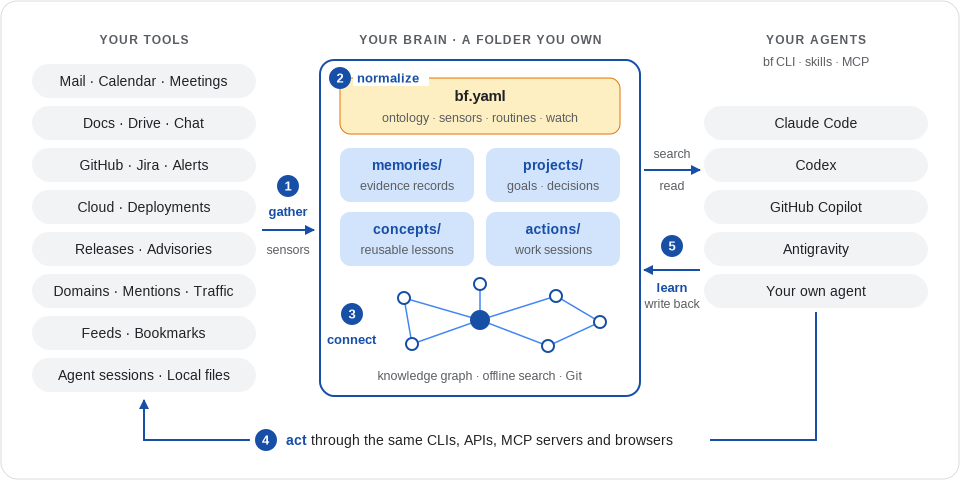
- Uniform notes,
index.mdbundles, & required schemas (Authoring): Organize Markdown acrossconcepts/,projects/,actions/(or customnotes:dirs) using flat<slug>.mdfiles or universal<slug>/index.mdbundles, enforce bundledrecord+schemas/<source>.json/schemas/usages.json, attach#idheading anchors and{rel=...}link metadata, and link across notes, records (source:id), or declared sibling brains (bf://). - Convention
loops:(sensors/,routines/,agents/), two-stream JSONL, &bf watch(Operations): Drop shell (.sh), Python (.py), or executable scripts insensors/(auto-impliesingest: upsert),routines/, oragents/(15m default timeout), stream structured JSONL logs onstderrintologs/<loop>.jsonl, coordinate overlogs/events.jsonl, and supervise withbf watch(interactive zero-dep ANSI dashboard on TTY,--format text, or--format jsonl). - Strictly read-only retrieval & FinOps separation (Retrieval): Resolve notes,
#anchorsections,source:idrecords, orbf://URIs uniformly withbf read, searchmemories/*.jsonlorusages/*.jsonlviabf query(rg/jq) or DuckDB, and inspect live health withbf status --format text. - Integrity, freshness, & schemas (Reference):
bf checkvalidatesbf.yaml, schemas, compiled-note sync,memories/&usages/, enabledloops:, links,#anchorheadings, and declared cross-brainbf://refs;bf reviewsurfacesnewer_evidence, overduestale_afternotes, and open tasks;bf schemaprints the 2 bundled Draft 2020-12 JSON Schemas (bf,record).
Good to know
- Local-first and private. Zero global config (
--brain-> enclosingbf.yaml->BF_BRAIN->$BRAIN_LOCATION->~/brain),O_NOFOLLOWpath confinement, disposable0700.bf/(locks + loop cursors), and private0700logs/(Operations). - Harnesses reason; BF verifies. Coding agents orient with
bf statusandbf review, author Markdown notes directly, emit events viabf emit, and verify withbf build && bf checkplus Python/pytest suites inevals/(Example brain). - Git-native collaboration. Track notes,
bf.yaml,schemas/,sensors/,routines/,agents/,clients/,prompts/, andevals/in Git while ignoringmemories/andusages/(keeping*.forgotten),logs/, and.bf/.
Documentation · Reference · Issues · Contribute · Governance · Security · MIT License · Third-party notices
1 maintainer

Metadata
1 maintainer
Release files for brain-framework 33.2.0
For a detailed explanation of source distributions (sdists) and built distributions (wheels), please see the package formats documentation.
Source distribution (sdist)
| File | Size | Uploaded | Provenance | Actions |
|---|---|---|---|---|
| brain_framework-33.2.0.tar.gz | 117.1 kB | With provenance | Details for brain_framework-33.2.0.tar.gz |
Built distribution (wheel)
| File | Interpreter | ABI | Platform | Actions Reset |
|---|---|---|---|---|
| brain_framework-33.2.0-py3-none-any.whl | Python 3 | none | any | Details for brain_framework-33.2.0-py3-none-any.whl |
Total release size: 245.9 kB
Release files / brain_framework-33.2.0.tar.gz
| Download URL | brain_framework-33.2.0.tar.gz |
|---|---|
| Size | 117.1 kB |
| Tags | Source |
|
SHA-256 checksum How to use checksums |
a3f8b1dc3c9722823430f68f99c3cb54508999db5009177b781fb384299b31e8
|
|
BLAKE2b-256 checksum How to use checksums |
e7f7396b86ebbf7981dfa68481916871cb361084d77f8f5e166411fa7c12e4bb
|
| Upload date | |
|
Uploaded using Trusted Publishing? What is trusted publishing? |
Yes |
| Uploaded via |
twine/7.0.0 CPython/3.13.16
|
Provenance
Provenance describes where a file came from. On PyPI, provenance is shared via attestations, which provide a verifiable record of the build or publishing details. View details, limitations and caveats.


PyPI Publish Attestation
PyPI verified that this artifact, at this checksum, originated from the publisher listed below.
Signed by GitHub Actions, verified by PyPI on Nov 23, 2026.
Transparency logRelease files / brain_framework-33.2.0-py3-none-any.whl
| Download URL | brain_framework-33.2.0-py3-none-any.whl |
|---|---|
| Size | 128.7 kB |
| Tags | Python 3 |
|
SHA-256 checksum How to use checksums |
48256e33c72d798c4ebb52b4887741075d26d4cb96ba273c52f632c35aba249e
|
|
BLAKE2b-256 checksum How to use checksums |
2ace318f7e1a4d2928131c120044cc8b43a66d5cd2ade7d72914ea484fe93087
|
| Upload date | |
|
Uploaded using Trusted Publishing? What is trusted publishing? |
Yes |
| Uploaded via |
twine/7.0.0 CPython/3.13.16
|
Provenance
Provenance describes where a file came from. On PyPI, provenance is shared via attestations, which provide a verifiable record of the build or publishing details. View details, limitations and caveats.
PyPI Publish Attestation
PyPI verified that this artifact, at this checksum, originated from the publisher listed below.
Signed by GitHub Actions, verified by PyPI on Nov 23, 2026.
Transparency logSecurity for brain-framework 33.2.0
Provenance
Provenance describes where a file came from. On PyPI, provenance is shared via attestations, which provide a verifiable record of the build or publishing details. View details, limitations and caveats.
Full provenance
Both files in this release have been uploaded with provenance metadata.
Attestation for brain_framework-33.2.0.tar.gz
PyPI Publish Attestation
PyPI verified that this artifact, at this checksum, originated from the publisher listed below.
Signed by GitHub Actions, verified by PyPI on Nov 23, 2026.
Transparency logA note on package security
PyPI is a repository for distributing packages, not a service for auditing them. While third-party security researchers and our staff do their best to detect and remove malicious packages, PyPI cannot guarantee the quality, security or suitability of any given package.
To learn more about protecting yourself from malicious actors, visit our package security documentation.














