
🐍 ChipScoPy README


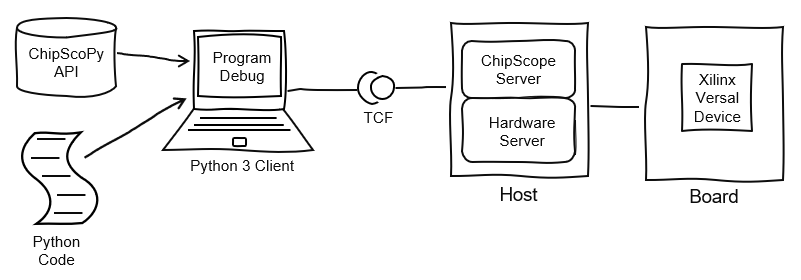
ChipScoPy is an open-source project from AMD that enables high-level control of debug IP running in Versal hardware. Using a simple Python API, developers can control and communicate with ChipScope® debug IP such as the Integrated Logic Analyzer (ILA), Virtual IO (VIO), IBERT, device memory, and more. ChipScoPy was created for Versal devices but contains some limited support for Ultrascale+ devices (see Limitations below).
Limitations
- ChipScoPy does not work with older devices such as 7-Series devices.
- ChipScoPy only supports IBERT GTY in Ultrascale+ devices, not other debug features like ILA or VIO.
Python Version Support
Python versions 3.9, 3.10, 3.11, 3.12, or 3.13 will work with ChipScoPy.
Quick Links
ChipScoPy Installation PyPI Package Dependencies
During ChipScoPy installation, the following packages (and any dependencies) are installed from the Python Package Index (PyPI) using pip.
| Package | License |
|---|---|
| Requests | Apache-2.0 |
| more-itertools | MIT |
| typing_extensions | PSF |
| loguru | MIT |
| importlib_metadata | Apache-2.0 |
| rich | MIT |
| Click | BSD |
| antlr4-python3-runtime | BSD |
| kaleido | MIT |
| plotly | MIT |
| notebook | BSD |
| ipywidgets | BSD |
| pandas | BSD |
| matplotlib | PSF |
| PyQt5 | GPL |
| ipympl | BSD |
Copyright (C) 2021-2022, Xilinx, Inc.
Copyright (C) 2022-2025, Advanced Micro Devices, Inc.
Licensed under the Apache License, Version 2.0 (the "License"); you may not use this file except in compliance with the License. You may obtain a copy of the License at
http://www.apache.org/licenses/LICENSE-2.0
Unless required by applicable law or agreed to in writing, software distributed under the License is distributed on an "AS IS" BASIS, WITHOUT WARRANTIES OR CONDITIONS OF ANY KIND, either express or implied. See the License for the specific language governing permissions and limitations under the License.
3 maintainers


Metadata
3 maintainers
Release files for chipscopy 2025.1.1748923355
For a detailed explanation of source distributions (sdists) and built distributions (wheels), please see the package formats documentation.
Source distribution (sdist)
| File | Size | Uploaded | Provenance | Actions |
|---|---|---|---|---|
| chipscopy-2025.1.1748923355.tar.gz | 363.5 kB | Without provenance | Details for chipscopy-2025.1.1748923355.tar.gz |
Built distribution (wheel)
| File | Interpreter | ABI | Platform | Actions Reset |
|---|---|---|---|---|
| chipscopy-2025.1.1748923355-py3-none-any.whl | Python 3 | none | any | Details for chipscopy-2025.1.1748923355-py3-none-any.whl |
Total release size: 878.2 kB
Release files / chipscopy-2025.1.1748923355.tar.gz
| Download URL | chipscopy-2025.1.1748923355.tar.gz |
|---|---|
| Size | 363.5 kB |
| Tags | Source |
|
SHA-256 checksum How to use checksums |
128cea7f05bf942de34c458c5ad77703b76a6acdd034aad487f98dc155d9b574
|
|
BLAKE2b-256 checksum How to use checksums |
7c92ae4d396b23eada22b4640323f68d0dd0e82555b809783cb143558544dd91
|
| Upload date | |
|
Uploaded using Trusted Publishing? What is trusted publishing? |
No |
| Uploaded via |
poetry/2.1.3 CPython/3.10.12 Linux/5.15.0-97-generic
|
Release files / chipscopy-2025.1.1748923355-py3-none-any.whl
| Download URL | chipscopy-2025.1.1748923355-py3-none-any.whl |
|---|---|
| Size | 514.8 kB |
| Tags | Python 3 |
|
SHA-256 checksum How to use checksums |
1eb19a1c5b3c269197d346dd62edbf921cf7442e6f7099275f92501110191d48
|
|
BLAKE2b-256 checksum How to use checksums |
d9d2bed2bc89e40c9dfe22f6ddd9f5a15d4cc519e222e3d560b951ed20d7de91
|
| Upload date | |
|
Uploaded using Trusted Publishing? What is trusted publishing? |
No |
| Uploaded via |
poetry/2.1.3 CPython/3.10.12 Linux/5.15.0-97-generic
|
Security for chipscopy 2025.1.1748923355
Provenance
Provenance describes where a file came from. On PyPI, provenance is shared via attestations, which provide a verifiable record of the build or publishing details. View details, limitations and caveats.
No provenance found
None of the files in this release were uploaded with provenance metadata.
A note on package security
PyPI is a repository for distributing packages, not a service for auditing them. While third-party security researchers and our staff do their best to detect and remove malicious packages, PyPI cannot guarantee the quality, security or suitability of any given package.
To learn more about protecting yourself from malicious actors, visit our package security documentation.














