

CytoDataFrame






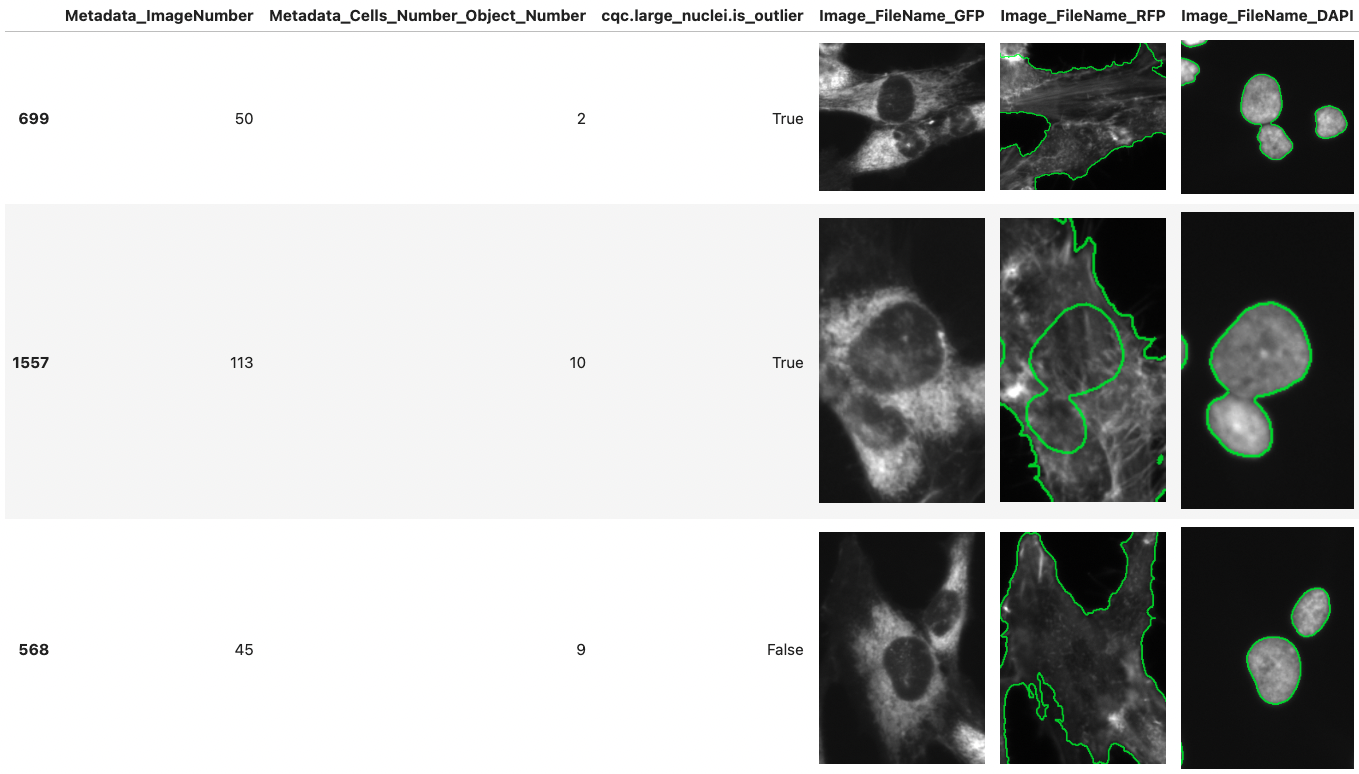
CytoDataFrame is an advanced in-memory data analysis format designed for single-cell profiling, integrating not only the data profiles but also their corresponding microscopy images and segmentation masks. Traditional single-cell profiling often excludes the associated images from analysis, limiting the scope of research. CytoDataFrame bridges this gap, offering a purpose-built solution for comprehensive analysis that incorporates both the data and images, empowering more detailed and visual insights in single-cell research.
CytoDataFrame is best suited for work within Jupyter notebooks. With CytoDataFrame you can:
- View image objects alongside their feature data using a Pandas DataFrame-like interface.
- Highlight image objects using mask or outline files to understand their segmentation.
- Adjust image displays on-the-fly using interactive slider widgets.
- Automatically detect 3D image volumes and render interactive trame views in notebooks when 3D dependencies are installed (with graceful fallback otherwise).
For 3D notebook display behavior:
- 3D-aware rendering is enabled by default (
display_options={"auto_trame_for_3d": True}). - Disable automatic trame switching with
display_options={"auto_trame_for_3d": False}. - Force trame layout regardless of auto-detection with
display_options={"view": "trame"}.
📓 Want to see CytoDataFrame in action? Check out our example notebook for a quick tour of its key features.
✨ CytoDataFrame development began within coSMicQC - a single-cell profile quality control package. Please check out our work there as well!
Installation
Install CytoDataFrame from source using the following:
# install from pypi
pip install cytodataframe

# or install directly from source
pip install git+https://github.com/cytomining/CytoDataFrame.git
Contributing, Development, and Testing
Please see our contributing documentation for more details on contributions, development, and testing.
References
2 maintainers


Metadata
2 maintainers
Release files for cytodataframe 0.2.1
For a detailed explanation of source distributions (sdists) and built distributions (wheels), please see the package formats documentation.
Built distribution (wheel)
| File | Interpreter | ABI | Platform | Actions Reset |
|---|---|---|---|---|
| cytodataframe-0.2.1-py3-none-any.whl | Python 3 | none | any | Details for cytodataframe-0.2.1-py3-none-any.whl |
Release files / cytodataframe-0.2.1-py3-none-any.whl
| Download URL | cytodataframe-0.2.1-py3-none-any.whl |
|---|---|
| Size | 47.9 kB |
| Tags | Python 3 |
|
SHA-256 checksum How to use checksums |
be12a6161c65bc933ee9bda2befdf193ec321db3c09276d1edb221da1e31d0f5
|
|
BLAKE2b-256 checksum How to use checksums |
622e55bd9b3c0ead6f5fdc61903144fdefad2067136f8232846d60b9ebf60a5d
|
| Upload date | |
|
Uploaded using Trusted Publishing? What is trusted publishing? |
Yes |
| Uploaded via |
twine/6.1.0 CPython/3.13.7
|
Provenance
Provenance describes where a file came from. On PyPI, provenance is shared via attestations, which provide a verifiable record of the build or publishing details. View details, limitations and caveats.


PyPI Publish Attestation
PyPI verified that this artifact, at this checksum, originated from the publisher listed below.
Signed by GitHub Actions, verified by PyPI on Mar 11, 2026.
Transparency logSecurity for cytodataframe 0.2.1
Provenance
Provenance describes where a file came from. On PyPI, provenance is shared via attestations, which provide a verifiable record of the build or publishing details. View details, limitations and caveats.
Full provenance
1 file in this release has been uploaded with provenance metadata.
Attestation for cytodataframe-0.2.1-py3-none-any.whl
PyPI Publish Attestation
PyPI verified that this artifact, at this checksum, originated from the publisher listed below.
Signed by GitHub Actions, verified by PyPI on Mar 11, 2026.
Transparency logA note on package security
PyPI is a repository for distributing packages, not a service for auditing them. While third-party security researchers and our staff do their best to detect and remove malicious packages, PyPI cannot guarantee the quality, security or suitability of any given package.
To learn more about protecting yourself from malicious actors, visit our package security documentation.














