
Interactive terminal viewer/editor (TUI) for CSV/TSV, Excel, Parquet, JSONL, etc.

Project description
DataFrame Textual
A powerful, interactive terminal-based viewer/editor for CSV/TSV/Excel/Parquet/Vortex/JSON/NDJSON built with Python, Polars, and Textual. Inspired by VisiData, this tool provides smooth keyboard navigation, data manipulation, and a clean interface for exploring and analyzing tabular data directly in terminal with multi-tab support for multiple files!
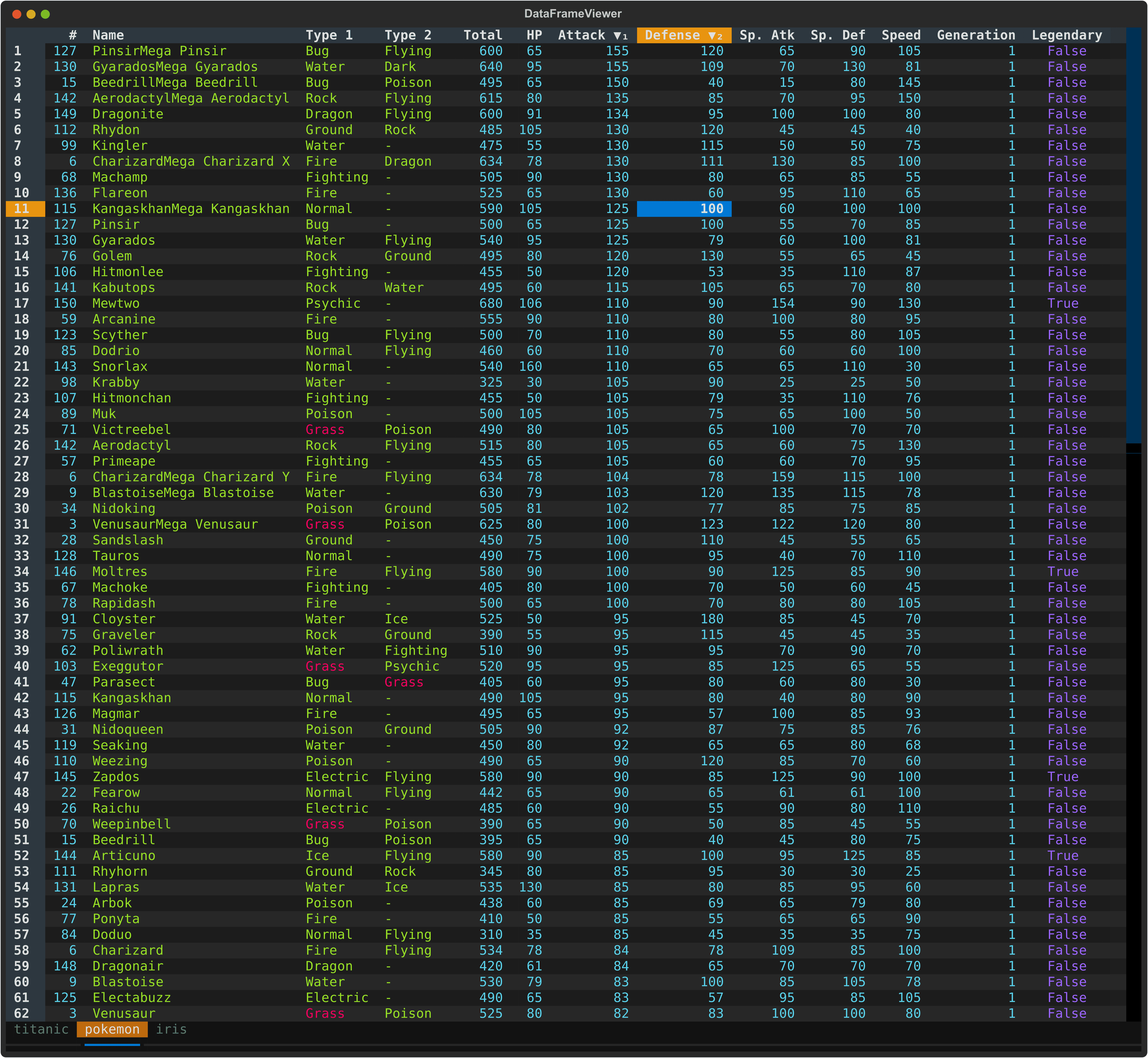
Features
Data Viewing
- 🚀 Fast Loading - Powered by Polars for efficient batch data handling
- 🎨 Rich Terminal UI - Beautiful, color-coded columns with auto-detected data types (e.g., integer, float, string)
- ⌨️ Comprehensive Keyboard Navigation - Intuitive controls with fully customizable key bindings (mostly VisiData compatible)
- 📊 Flexible Input - Read from files and/or stdin (pipes/redirects) in various formats
- 🔄 Smart Pagination - Lazy load rows on demand for handling large datasets
Data Manipulation
- 📝 Data Editing - Edit cells, delete rows, reorder columns, and beyond
- 🧹 Duplicate Removal - Remove duplicate rows
- 🔍 Search & Filter - Find values, highlight matches, and filter selected rows
- ↔️ Column/Row Reordering - Move columns and rows with simple keyboard shortcuts
- 📈 Sorting & Statistics - Multi-column sorting, frequency distribution, and histogram analysis
- 💾 Save & Undo - Save edits back to file with full undo/redo support
Advanced Features
- 📂 Multi-File Support - Open multiple files in separate tabs
- 🔄 Tab Management - Seamlessly switch between open files with keyboard shortcuts
- 🔗 Table Joins - Join two tables into a new tab
- 📑 Duplicate Tab - Create a copy of the current tab with the same data
- 🐍 Embedded Python Console - Inspect and transform the active table directly in app
- 📌 Freeze Rows/Columns - Keep important rows and columns visible while scrolling
- 📸 Take Screenshot - Capture terminal view as a SVG image
Installation
Using pip
# Install from PyPI
pip install dataframe-textual
This installs an executable dv.
Using uv
# Install from PyPI
uv tool install dataframe-textual

# Install from GitHub
uv tool install https://github.com/need47/dataframe-textual.git

# Run once with uvx without installing locally
uvx dataframe-textual <csvfile>
Development installation
# Clone the repository
git clone https://github.com/need47/dataframe-textual.git
cd dataframe-textual

# Install from local source with development dependencies
pip install -e ".[dev]"
Usage
Basic Usage - Single File
# Open one file
dv pokemon.csv
Multi-File Usage - Multiple Tabs
# Open multiple files in tabs
dv file1.csv file2.csv file3.csv

# Open multiple sheets in an Excel file as separate tabs
dv file.xlsx

# Mix files and stdin
dv data1.tsv < data2.tsv
Multi-File Usage - Single Tab
# Read all parquet files (must be of same format and same structure) into one single table
dv *.parquet --all-in-one
Command Line Options
usage: dv [-h] [-V] [-d DELIMITER] [-f FORMAT] [-F [FIELDS ...]] [-H [HEADER ...]] [-L [N]] [-I] [-T] [-E] [-C [C]] [-Q [C]] [-K N] [-A N] [-M [N]] [-N NULL [NULL ...]] [--theme [THEME]] [--all-in-one]
          [--expr EXPR] [--sql SQL] [-o OUTPUT]
          [files ...]

TUI viewer/editor for tabular data (e.g., CSV/Excel).

positional arguments:
  files                 Files to view (or read from stdin)

options:
  -h, --help            show this help message and exit
  -V, --version         show program's version number and exit
  -d, --delimiter DELIMITER
                        Specify the delimiter of the input files (must be a single character, e.g., `|` or `;`). By default, the delimiter is inferred from the file extension. If reading from stdin, the
                        delimiter must be specified unless it is tab delimited.
  -f, --format FORMAT   Specify the format of the input files (e.g., `csv` or `excel`). By default, the format is inferred from the file extension. If reading from stdin, the format must be specified
                        unless it is tab delimited.
  -F, --fields [FIELDS ...]
                        When used without values, list available fields. Otherwise, read only specified fields.
  -H, --header [HEADER ...]
                        Specify header info. When reading CSV/TSV. If used without values, assumes no header. Otherwise, use provided values as column header (e.g., `-H col1 col2 col3`).
  -L, --infer_schema_length [N]
                        Number of rows to use for inferring schema when reading CSV/TSV. Defaults to 100. When used without value, uses all rows for schema inference (can be slow for large files).
  -I, --no-inference    Do not infer data types when reading CSV/TSV. All values will be of string type.
  -T, --truncate-ragged-lines
                        Truncate ragged lines when reading CSV/TSV
  -E, --ignore-errors   Ignore errors when reading CSV/TSV
  -C, --comment-prefix [C]
                        Skip comment lines starting with `C` when reading CSV/TSV
  -Q, --quote-char [C]  Use `C` as quote character for reading CSV/TSV. When used without value, disables special handling of quote characters.
  -K, --skip-lines N    Skip first N lines when reading CSV/TSV
  -A, --skip-rows-after-header N
                        Skip N rows after header when reading CSV/TSV
  -M, --n-rows [N]      Read maximum rows
  -N, --null NULL [NULL ...]
                        Values to interpret as null values when reading CSV/TSV
  --theme [THEME]       Set the theme for the application. If used without value, show available themes.
  --all-in-one, --aio, --one
                        Read all files (must be of same format and same structure) into one single table.
  --expr EXPR           Specify a Polars expression to filter data (e.g., $age > 30)
  --sql SQL             Specify a SQL query to execute on the input file (e.g., to select and filter data)
  -o, --output OUTPUT   Output file (optionally modified) with specified format, which is inferred from file extension (e.g., .csv, .xlsx).
CLI Examples
# Open a file
dv data.csv

# Gzipped files are supported
dv data.csv.gz

# Read from stdin (defaults to TSV)
cat data.tsv | dv
dv < data.tsv

# Specify delimiter
dv data.txt -d '|'

# Specify format
dv data.json -f ndjson

# View headless CSV file
dv data_no_header.csv -H

# View headless CSV file with provided header
dv data_no_header.csv -H country ip requests

# Skip first 3 rows (e.g., metadata)
dv data_with_meta.csv -K 3

# Skip 1 row after header (e.g., units row)
dv data_with_units.csv -A 1

# Skip 3 rows before header and 1 row after
dv messy_scientific_data.csv -K 3 -A 1

# Skip comment lines (or just -C)
dv commented_data.csv -C '#'

# Disable type inference for faster loading
dv large_data.csv -I

# Ignore parsing errors in malformed CSV
dv data_with_errors.csv -E

# Treat specific values as null (e.g., 'NA', 'N/A')
dv data.csv -N NA N/A

# Use different quote character (e.g., single quote for CSV)
dv data.csv -Q "'"

# Disable quote character processing for TSV with embedded quotes
dv data.tsv -Q

# Choose the `monokai` theme
dv data.csv --theme monokai

# Show column headers
dv data.csv -F

# Read only specific columns: 'name', 'age', first column, and last column
dv data.csv -F name age 1 -1

# Read all files (must be of same format and same structure) into one single table
dv data-1.csv data-2.csv --all-in-one

# Filter rows before opening the TUI using a Polars expression
dv data.csv --expr '$age > 30'

# Filter data using SQL query (use 'self' as the table name)
dv data.csv --sql 'SELECT * FROM self WHERE age > 30'

# Convert to other format
dv data.csv -o data.parquet
Keyboard Shortcuts
Shortcuts are a single key, a modifier combo (e.g., Shift+G), or a leader sequence starting with g or z (e.g., g/, g_, zQ).
How Leader Mode Works:
- Press the leader key
gorzto activate the mode — a 3-second timeout begins - Press the next key within the timeout to execute the combined command
- If no second key is pressed within 3 seconds, leader mode is cancelled.
Important: press z then Ctrl+H to open a Commands tab, where all commands and keybindings can be viewed and modified. In this tab, edit a Leader or Key cell with e or double-click to capture the next key press as the binding. Save the Commands tab to persist changes.
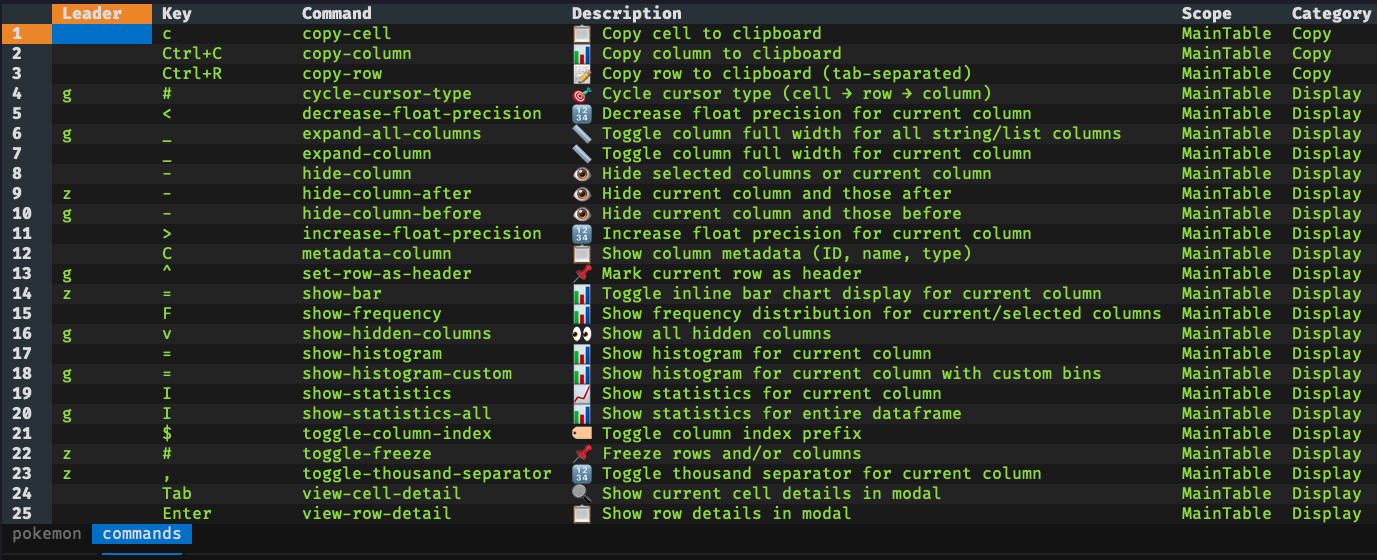
Memorize g vs z Quickly
Use this as a practical memory aid (not a strict rule):
goften means broader scope, global-style behavior, or toward left/up.zis often the opposite: narrower/specific variants, toward right/down, or transform-style/less common actions.
Why this helps:
- In alphabet order,
gcomes beforez, so it is easier to remembergas global/earlier/wider andzas later/narrower. - This pattern appears repeatedly in the command registry and default keybinding registry.
Useful examples from current bindings:
- Scope widening:
,selects matching rows in current column, whileg,selects in all columns./searches current column, whileg/searches all columns.?searches backward in current column, whileg?searches backward in all columns.
- Left/up vs right/down:
g*delete current column and those before (left), whilez*deletes current column and those after (right).gddelete current row and those above, whilezddeletes current row and those below.gbmove tab left, whilezbmoves tab right.
- Specific/transform-style variants under
z:z/andz?search with cursor value (specialized variant).z:joins selected columns.zTtransposes rows/columns.zaadds a link column from a URL template.
Tip: Learn the base key first, then its g and z variants as a small family.
App-Level Controls
File & Tab Management
| Key | Action |
|---|---|
q |
Quit current tab (prompts to save unsaved changes) or view |
gq |
Quit all tabs then app (prompts to save unsaved changes) |
Ctrl+Q |
Force quit app (discards unsaved changes) |
gB |
Toggle tab bar visibility |
B |
Previous tab |
zB |
Jump to last focused tab |
b |
Next tab |
gb |
Move current tab left (wrap to last) |
zb |
Move current tab right (wrap to first) |
Ctrl+T |
Save current tab (or current view) to file |
Ctrl+S |
Save all tabs to file |
w |
Save current tab to file (overwrite without prompt) |
gw |
Save all tabs to file (overwrite without prompt) |
Ctrl+D |
Duplicate current tab |
Ctrl+O |
Open file in a new tab |
Ctrl+N |
Create new tab from Polars expression |
Double-click |
Rename tab |
Tips:
- Tabs with unsaved changes are indicated with a bright background
- Closing a tab with unsaved changes triggers a save prompt
View & Settings
| Key | Action |
|---|---|
F1 |
Toggle help panel |
S |
Show information for all open tabs |
z Ctrl+H / zBackspace |
Show all commands and key bindings |
Ctrl+P -> Screenshot |
Capture terminal view as a SVG image |
gT |
Select theme |
Join Tables
| Key | Action |
|---|---|
& |
Join two tables into a new tab |
Table-Level Controls
Undo/Redo/Reset
| Key | Action |
|---|---|
u / U |
Undo last action |
R |
Redo last undone action |
gU |
Reset to initial state |
Navigation
| Key | Action |
|---|---|
gg |
Go to first row |
G |
Go to last row |
Ctrl+G |
Go to specific row |
← / ↓ / ↑ / → |
Move left/down/up/right |
h / j / k / l |
Move left/down/up/right (Vim-style) |
gh / g← |
Scroll to leftmost column |
gj / g↓ |
Scroll to last row |
gk / g↑ |
Scroll to first row |
gl / g→ |
Scroll to rightmost column |
Home / End |
Go to first/last column |
Ctrl+Home / Ctrl+End |
Go to page top/bottom |
PageUp / Ctrl+B |
Page backward |
PageDown / Ctrl+F |
Page forward |
Display
| Key | Action |
|---|---|
Enter |
Show details for the current row as two-column key–value pairs |
Tab |
Show current cell details |
C |
Show metadata for all columns (name and data type) |
F |
Show frequency distribution for current or selected columns |
I |
Show statistics for current column |
gI |
Show statistics for all columns |
= |
Show histogram for current column |
g= |
Show histogram for current column with custom bins |
z= |
Toggle inline bar chart display for current numeric column |
- (minus) |
Hide selected columns or current column |
g- (minus) |
Hide current column and all columns before it |
z- (minus) |
Hide current column and all columns after it |
gv |
Show all hidden columns |
$ |
Toggle 1-based column index prefixes |
z! |
Toggle freeze rows and/or columns |
_ (underscore) |
Toggle column full width for current column |
g_ (underscore) |
Toggle column full width for all string/list columns |
z_ (underscore) |
Resize current column |
z, |
Toggle thousand separator for current column |
< |
Decrease float precision for current column |
> |
Increase float precision for current column |
g^ |
Set current row as the new header row |
Shift+Tab |
Cycle cursor type (cell -> row -> column) |
Editing
| Key | Action |
|---|---|
Double-click |
Edit cell or rename column header |
Delete |
Clear current cell (set to NULL) |
Shift+Delete |
Clear current column (set matching cells to NULL) |
e |
Edit current cell (respects data type) |
E |
Edit entire column with value/expression |
a |
Add empty column after current |
A |
Add column with name and value/expression |
i |
Add index column after current |
za |
Add a link column from URL template |
^ |
Rename current column |
* |
Delete selected columns or current column |
g* |
Delete current column and all columns before it |
z* |
Delete current column and all columns after it |
d |
Delete current row |
gd |
Delete current row and all those above |
zd |
Delete current row and all those below |
D |
Duplicate current row |
zD |
Duplicate current column |
zU |
Remove duplicate rows (keep first occurrence) |
: |
Split current string column into a new column by delimiter |
g: |
Glue items of a list column into a string column by delimiter |
z: |
Join all selected columns into a new string column by delimiter |
Ctrl+U |
Convert current or selected string column(s) to uppercase |
Ctrl+L |
Convert current or selected string column(s) to lowercase |
zSpace |
Strip leading and trailing whitespaces in current string column |
zf |
Fill null values in current column with a value |
gf |
Fill null values in all columns with a value |
( |
Expand current list column into indexed columns (e.g. col[1], col[2]) |
) |
Contract indexed sibling columns (col[N]) back into a list column |
z( |
Explode current list column into multiple rows |
z) |
Implode current column into a list column |
zT |
Transpose table (swap rows and columns) |
Row/Column Selection
| Key | Action |
|---|---|
, |
Select rows with cell matches or those matching cursor value in current column |
g, |
Select rows with cell matches or those matching cursor value in all columns |
| (pipe) |
Select rows where expression matches in current column |
g| |
Select rows where expression matches in all columns |
\ |
Unselect selected rows where expression matches in current column |
g\ |
Unselect selected rows where expression matches in all columns |
{ |
Go to previous selected row |
} |
Go to next selected row |
s |
Select/deselect current row |
gs |
Select current row and all rows above |
zs |
Select current row and all rows below |
gu |
Unselect all rows |
' (apostrophe) |
Select/deselect current column |
g' |
Select current column and all columns to the left |
z' |
Select current column and all columns to the right |
t |
Toggle row selections (invert) |
T |
Clear all row/column selections and cell matches |
Find & Replace
| Key | Action |
|---|---|
/ |
Search forward in current column with expression |
g/ |
Search forward in all columns with expression |
z/ |
Search forward in current column with cursor value |
? |
Search backward in current column with expression |
g? |
Search backward in all columns with expression |
z? |
Search backward in current column with cursor value |
; |
Search cursor value in all columns and go to first match |
n |
Go to next matching cell |
N |
Go to previous matching cell |
r |
Find and replace in current column (interactive or replace all) |
gr |
Find and replace in all columns (interactive or replace all) |
Filter & Collect
| Key | Action |
|---|---|
v |
Filter rows with cursor value in the current column |
V |
Filter rows with specified value or expression |
f |
Filter rows using values in the current column |
. |
Filter rows with non-null values in the current column |
z. |
Filter rows with null values in the current column |
" (double quote) |
Collect rows/columns to a new tab |
Sorting (supporting multiple columns)
| Key | Action |
|---|---|
[ |
Sort current column ascending |
] |
Sort current column descending |
Reordering
| Key | Action |
|---|---|
H / Shift+← |
Move current column left |
J / Shift+↓ |
Move current row down |
K / Shift+↑ |
Move current row up |
L / Shift+→ |
Move current column right |
gH / gShift+← |
Move column to start |
gJ / gShift+↓ |
Move row to bottom |
gK / gShift+↑ |
Move row to top |
gL / gShift+→ |
Move column to end |
! |
Pin column to start and freeze |
Type Casting
| Key | Action |
|---|---|
~ |
Cast current column to string |
@ |
Cast current column to date |
# |
Cast current column to integer |
% |
Cast current column to float |
z# |
Cast current column to boolean |
Copy
| Key | Action |
|---|---|
c |
Copy current cell to clipboard |
Ctrl+C |
Copy column to clipboard |
Ctrl+R |
Copy row to clipboard (tab-separated) |
SQL & Advanced
| Key | Action |
|---|---|
Q |
SQL query interface (full SQL query with syntax highlight) |
zQ |
SQL query interface (select columns & where clause) |
Space |
Toggle Python console |
gSpace |
Run a command by name with optional arguments |
Features in Detail
1. Undo/Redo/Reset
These actions are the fastest way to get out of trouble after a mistaken edit, delete, sort, filter, or other table change.
U: Undo the last action and restore the previous state.R: Redo the last undone action.gU: Reset the table to its original loaded state if you want to start over.
2. Display & UI
Columns are automatically styled based on their data types (auto-inferred):
| Data Type | Text Color | Alignment |
|---|---|---|
| integer | Cyan | right |
| float | Yellow | right |
| string | Green | left |
| boolean | Blue | centered |
| temporal | Magenta | centered |
These controls change how the table is shown without changing the underlying data.
-: Hide selected columns, or the current column if nothing is selected.g-: Hide the current column and all columns before it.z-: Hide the current column and all columns after it.gv: Show all hidden columns.z!: Freeze rows and/or columns to keep important areas visible while scrolling.$: Toggle a 1-based index prefix in visible column headers such as1_colname._: Toggle full width for the current column.g_: Toggle full width for all string/list columns.z_: Resize the current column from a prompt.z,: Toggle the thousand separator for the current numeric column.</>: Decrease or increase float precision for the current float column. Each column keeps its own precision setting, and0means the default full display.z=: Toggle inline bar chart display for the current numeric column. When active, each cell is rendered as a RichBar, normalized to that column's min/max range. Pressz=again to restore normal value display.
3. Modal Screen
Several features open a modal screen (an overlay table) for inspection or interaction. The following modals share a common set of keyboard shortcuts:
| Modal Screen | Opened With | Purpose |
|---|---|---|
| Sheets Overview | S |
Summary of all open tabs |
| Column Metadata | C |
Column name, data type, and width |
| Row Detail | Enter |
All column values for one row |
| Cell Detail | Tab |
Drill into a single cell value |
| Frequency | F |
Value distribution for a column |
| Statistics | I / gI |
Summary statistics for column or dataframe |
| Histogram | = / g= |
Numeric distribution as histogram |
Common keys available in all modal screens:
| Key | Action |
|---|---|
q / Escape |
Close the modal |
gg |
Scroll to top |
G |
Scroll to bottom |
[ |
Sort by current column ascending |
] |
Sort by current column descending |
, |
Toggle thousand separator for numeric values |
Shift+Tab |
Cycle cursor type (cell → row → column) |
T |
Open modal data as a new tab |
Ctrl+S |
Save the modal table to file |
Individual modals may add extra keys on top of these (documented in each subsection below).
4. Sheets Overview
Press S to open a modal providing a summary view of all currently opened tabs.
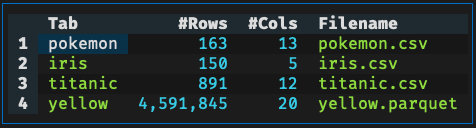
The modal displays a table with the following columns:
| Column | Description |
|---|---|
| Tab | Display name of the tab |
| #Rows | Total number of rows |
| #Cols | Number of columns |
| Filename | Source file path |
Keys inside the modal:
| Key | Action |
|---|---|
Enter |
Close the modal and switch to the tab under the cursor |
e |
Rename the tab under the cursor |
d |
Close the tab under the cursor (prompts if unsaved changes) |
s |
Select or deselect the tab under the cursor |
& |
Join exactly two selected tabs into a new tab |
This is useful for quickly navigating between tabs, reviewing file sizes at a glance, closing tabs you no longer need without switching to them first, or selecting two tabs and pressing & to open the join-table modal.
5. Column Overview
Press C to open a modal displaying details for all columns:
- Column - Column name
- Type - Data type (e.g., Int64, String, Float64, Boolean)
- Width - Column width
Keys inside the modal
- Press
Enterto jump to the selected column in the main table and close the modal - Press
Fto show the frequency table for the selected column - Press
Ito show the statistics table for the selected column - Press
JorShift+↓to move the selected column right (and move the metadata row down) - Press
KorShift+↑to move the selected column left (and move the metadata row up) - Press
eto rename, resize, or cast the selected column - Press
dto delete the selected column from the main table
6. Column Statistics
Show summary statistics such as count, unique count, null count, mean, median, standard deviation, min, max, sum, and etc.
Ishows statistics for the current columngIshows statistics for all columns in the dataframe
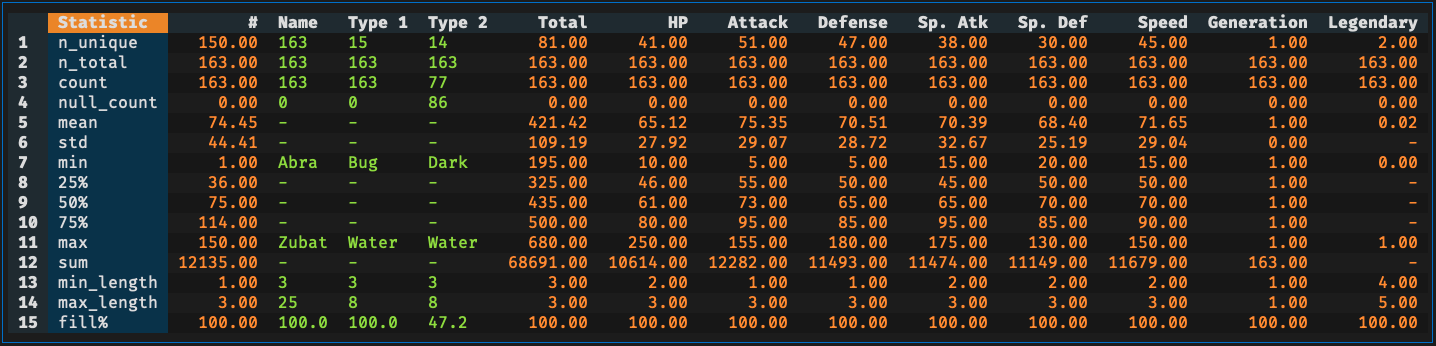
This is useful for:
- Understanding data distributions and overall column behavior
- Identifying outliers and anomalies
- Checking data quality quickly
- Reviewing summary statistics
- Comparing columns at a glance
7. Row Detail View
Press Enter on any row to open a modal showing all column values for that row.
Useful for examining wide table where columns don't fit well on screen.
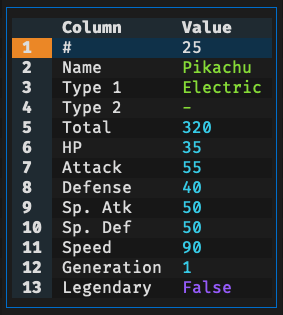
Keys inside the modal:
- Press
vto filter all rows containing the selected column value - Press
"to collect all rows containing the selected column value to a new tab - Press
{to show the previous row - Press
}to show the next row - Press
Fto show the frequency table for the selected column - Press
Ito show the statistics table for the selected column - Press
Tabto open a cell-detail modal for the selected field
8. Cell Detail View
Press Tab in the main table to inspect the current cell in its own modal for complex data or long text
You can also press Tab from the Row Detail modal to drill into the selected field.
Inside the cell-detail modal, press Tab again on the selected row/column to keep drilling into nested values.
- Scalar values are displayed inline. For long text, press
Tabagain to view the full content in a multi-line modal. - String values are split into multiple rows using
|by default - List-like values are expanded into a one-column table
- Dict-like values are shown as key/value columns
9. Frequency Distribution
Press F to see value distributions for the current column. If multiple columns are selected, it shows frequency of value combinations across those selected columns.
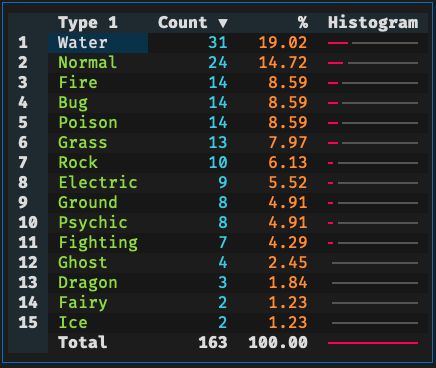
Keys inside the modal:
- Press
vto filter rows matching the selected value (or selected value combinations) - Press
"to collect rows matching the selected value (or selected value combinations) to a new tab - Press
sto select or deselect the current frequency row
This is useful for:
- Understanding value distributions
- Quickly filtering to specific values
- Identifying rare or common values
- Finding the most/least frequent entries
10. Row/Column Selection
The application provides multiple ways to select rows (for filtering or collecting) and columns (for hiding or deleting):
,- Select rows with cell matches or those matching cursor value in current column (respects data type)g,- Select rows with cell matches or those matching cursor value in all columns|- Select rows where expression matches in the current columng|- Select rows where expression matches in all columns\- Unselect currently selected rows where expression matches in the current columng\- Unselect currently selected rows where expression matches in all columnss- Select/deselect current rowgs- Select current row and all rows abovezs- Select current row and all rows belowu- Unselect the current rowgu- Unselect all rows'(apostrophe) - Select/deselect current columng'- Select current column and all columns to the leftz'- Select current column and all columns to the rightt- Flip selections of all rowsT- Clear all row selections, column selections, and cell matches{- Go to previous selected row}- Go to next selected row
Advanced Options:
When searching, you can use checkboxes in the dialog to enable:
- Match option
Nocasefor case-insensitive matching - Match option
Wholeto match full text - Match option
Literalto ignore special regex characters - Match option
Reverseto perform reverse match
These options work with plain text searches. Use Polars regex patterns in expressions for more control. For example, use (?i) prefix in regex (e.g., (?i)john) for case-insensitive matching.
Quick Tips:
- Search results highlight matching rows in red
- Use expression for advanced selection (e.g., $attack > $defense)
- Type-aware matching automatically converts values. Resort to string comparison if conversion fails
11. Find & Replace
Find by value/expression and highlight matching cells:
/- Search forward in current column with expressiong/- Search forward in all columns with expressionz/- Search forward in current column with cursor value?- Search backward in current column with expressiong?- Search backward in all columns with expressionz?- Search backward in current column with cursor value;- Search cursor value in all columns and go to first matchn- Go to next matching cellN- Go to previous matching cell
Replace values in current column (r) or in all columns (gr).
How It Works:
When you press r or gr, enter:
- Find term: Value or expression to search for (done by string value)
- Replace term: Replacement value
- Matching options:
Nocasefor case-insensitive matchingWholeto match full textLiteralto ignore special regex charactersReverseto perform reverse match
- Replace mode: All at once or interactive review
Replace All:
- Replaces all matches with one operation
- Shows confirmation with match count
Replace Interactive:
- Review each match one at a time (confirm, skip, or cancel)
- Shows progress
Tips:
- Search are done by string value (i.e., ignoring data type)
- Type
NULLto find or replace null values
12. Filter & Collect
Both actions work on a subset of the original dataframe, but they serve different workflows.
Filtering options:
Basic Filter (v):
- Opens the chose subset as a derived view inside the current workflow
- Edits made in the filtered view still apply to the original dataframe
- Press
Ctrl+Tto save the current view to a file - Press
qto leave the filtered view and return to the main table
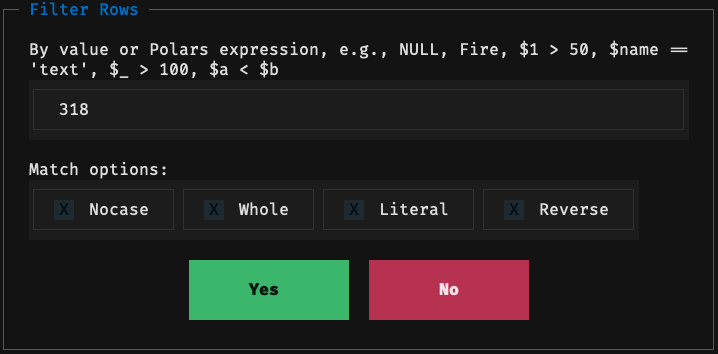
Advanced Filter (V):
- Opens a dialog for value-based or expression-based filtering
- Useful when you want to define the subset directly
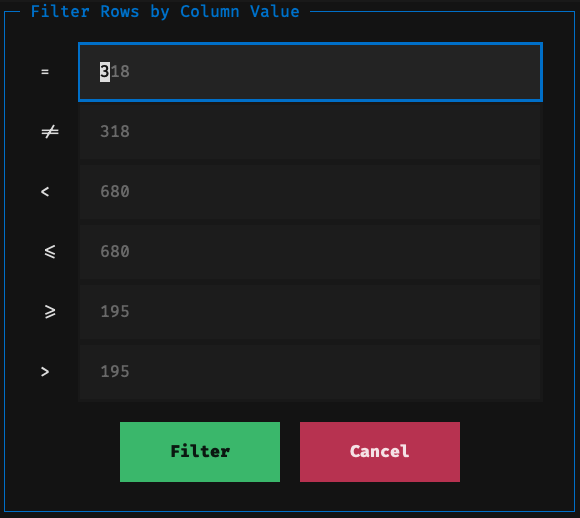
Column Filter (f):
- Opens a type-aware filter dialog for the current column
- Numeric columns support
=,!=,<,<=,>=, and> - String columns support exact match, prefix, suffix, contains, and regex matching
- Boolean columns support true, false, and null filtering
- Temporal columns support the same comparison operators as numeric columns
- List columns support exact-list matching and item membership checks such as "contains"
Collect ("):
- Creates a separate tab containing only the chosen rows/columns
- The collected tab is independent from the source dataframe
- Edits in the collected tab do not modify the original table
For Basic Filter (v) and Collect ("), rows are chosen in this order:
- Use selected rows if any are present
- Otherwise, use rows with active matches from search or find
- Otherwise, use rows whose current-column value matches the current cell
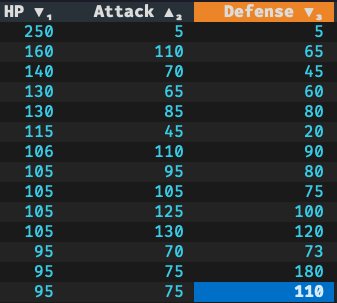
13. Sorting
- Press
[to sort current column ascending - Press
]to sort current column descending - Multi-column sorting supported (press multiple times on different columns)
- Press same key twice to remove the current column from sorting
14. Editing
Editing covers cell updates, structural table changes, and quick cleanup.
eor Double-click: Edit the current cell with type-aware validation.^or Double-click column header: Rename the current column.d: Delete the selected rows, or the current row if nothing is selected.gd: Delete the current row and all rows above it.zd: Delete the current row and all rows below it.*: Delete selected columns, or the current column if nothing is selected.g*: Delete the current column and all columns to its left.z*: Delete the current column and all columns to its right.a: Add an empty column after the current column.A: Add a column after the current column using a value or expression such as$age * 2.i: Insert an index column after the current column.D: Duplicate the current row.zD: Duplicate the current column using a_copysuffix.zU: Remove duplicate rows while keeping the first occurrence, based on visible-column values.:: Split the current string column into a new list column using a delimiter.(: Expand the current list column into indexed columns named likecolname[1],colname[2], etc.): Contract those indexed sibling columns back into a single list column. Position the cursor on any sibling (e.g.colname[2]) and press)to merge allcolname[N]columns back intocolname.Ctrl+U: Convert the current column, or all selected columns that are string type, to uppercase.Ctrl+L: Convert the current column, or all selected columns that are string type, to lowercase.zSpace: Strip leading and trailing whitespaces in the current string column.
15. Column & Row Reordering
Move Columns: Shift+← and Shift+→
- Swaps adjacent columns
HandLprovide the same left/right movementgH/gShift+←moves column to startgL/gShift+→moves column to end- Reorder is preserved when saving
Move Rows: Shift+↑ and Shift+↓
- Swaps adjacent rows
JandKprovide the same down/up movementgK/gShift+↑moves row to topgJ/gShift+↓moves row to bottom- Reorder is preserved when saving
Pin Column: !
- Moves the current column to the leftmost unfrozen position and freezes it
- If columns are already frozen, appends to the frozen set (increments
fixed_columns)
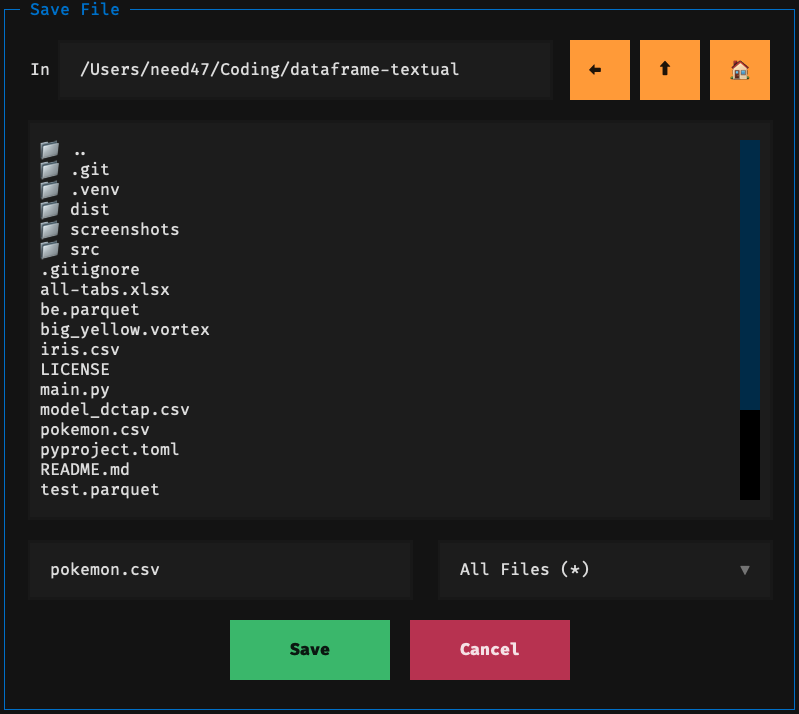
16. Save File
The application provides save actions for the current tab (or active view) and all tabs.
Save Current Tab (Ctrl+T):
- Saves the active tab to file
- If currently in a derived/filtered view, saves the current view instead
- Useful when you want to export only the dataframe you are currently working on
Save All Tabs (Ctrl+S):
- Saves every open tab to file
- Useful after editing multiple datasets in the same session
The output format is determined by the file extension, making it easy to convert between formats such as CSV, TSV, Parquet, or Excel.
17. Clipboard Operations
Copies value to system clipboard with pbcopy on macOS and xclip on Linux.
Note: may require a X server to work.
- Press
cto copy cursor value - Press
Ctrl+Cto copy column values - Press
Ctrl+Rto copy row values (delimited by tab) - Hold
Shiftto select with mouse
18. Polars Expressions
Complex values, filters, and advanced operations can be specified via Polars expressions, with the following adaptions for convenience:
Column References:
$_- Current column (based on cursor position)$1,$2, etc. - Column by 1-based index$age,$salary- Column by name (use actual column names)$`col name`- Column by name with spaces (backtick quoted)
Row References:
$#- Current row index (1-based)
DataFrame References:
self- Current dataframe
Basic Comparisons:
$_ > 50- Current column greater than 50$salary >= 100000- Salary at least 100,000$age < 30- Age less than 30$status == 'active'- Status exactly matches 'active'$name != 'Unknown'- Name is not 'Unknown'$# <= 10- Top 10 rows
Logical Operators:
&- AND|- OR~- NOT
Practical Examples:
($age < 30) & ($status == 'active')- Age less than 30 AND status is active($name == 'Alice') | ($name == 'Bob')- Name is Alice or Bob$salary / 1000 >= 50- Salary divided by 1,000 is at least 50($department == 'Sales') & ($bonus > 5000)- Sales department with bonus over 5,000($score >= 80) & ($score <= 90)- Score between 80 and 90~($status == 'inactive')- Status is not inactive$revenue > $expenses- Revenue exceeds expenses$`product id` > 100- Product ID with spaces in column name greater than 100self.drop(RID).is_duplicated()- Duplicate rows (note: the internal RID column must be excluded)
String Operations: (Polars string API reference)
$name.str.contains("John")- Name contains "John" (case-sensitive)$name.str.contains("(?i)john")- Name contains "john" (case-insensitive)$email.str.ends_with("@company.com")- Email ends with domain$code.str.starts_with("ABC")- Code starts with "ABC"$name.str.len_chars() < 7- Length of name shorter than 7
Number Operations:
$age * 2 > 100- Double age greater than 100($salary + $bonus) > 150000- Total compensation over 150,000$percentage >= 50- Percentage at least 50%
Null Handling:
$column.is_null()- Find null values$column.is_not_null()- Find non-null valuesNULL- a value to represent null for convenience
Tips:
- Use column indices (e.g.,
$1,$2) for faster column access. - Use column names that match exactly (case-sensitive)
- Use parentheses to clarify complex expressions:
($a & $b) | ($c & $d)
19. Link Column Creation
Press za to create a new column containing dynamically generated URLs using template. Links are typically clickable in a terminal emulator using Ctrl+Click.
Template Placeholders:
The link template supports multiple placeholder types for maximum flexibility:
$_- Current column, e.g.,https://example.com/search/$_- Uses values from the current column$1,$2,$3, etc. - Column by 1-based position index, e.g.,https://example.com/product/$1/details/$2- Uses 1st and 2nd columns$name- Column by name (use actual column names), e.g.,https://example.com/$region/$city/data- Usesregionandcitycolumns
Features:
- Multiple Placeholders: Mix and match placeholders in a single template
- URL Prefix: Automatically prepends
https://if URL doesn't start withhttp://orhttps://
20. Join Tables
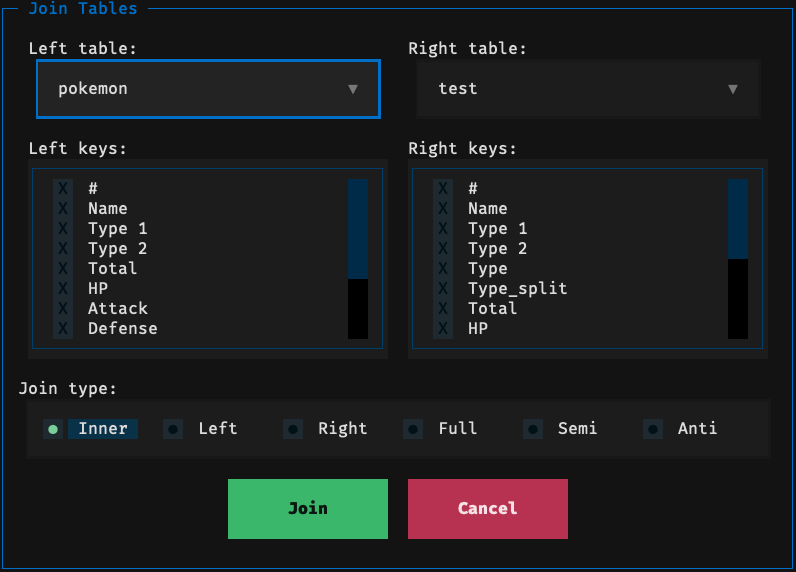
Press & from the main table to open the join-table modal. The modal lets you choose the left and right tables, select matching key columns from each side, choose the join type, and create the joined result as a new tab.
You can also start from the Sheets Overview: press S, select exactly two tabs with s, then press & to open the same join-table modal with those two tables pre-selected.
Supported join types include inner, left, right, full, semi, and anti joins. Select the same number of key columns on both sides before pressing Join.
21. SQL Interface
The SQL interface provides two modes for querying your dataframe:
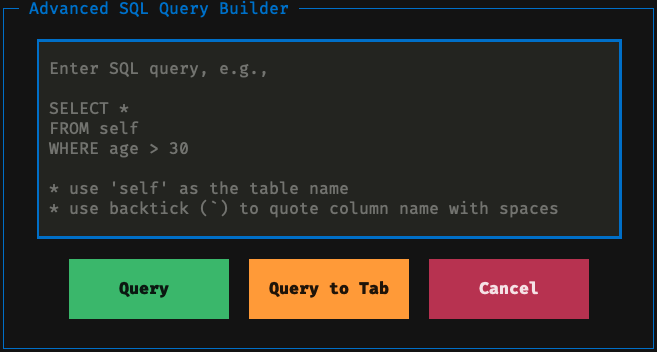
Advanced SQL Interface (Q)
Execute complete SQL queries for advanced data manipulation:
- Write full SQL queries with standard SQL syntax
- Access to all SQL capabilities for complex transformations
- Always use
selfas the table name - Syntax highlighted
Simple SQL Interface (zQ)
SELECT specific columns and apply WHERE conditions without writing full SQL:
- Choose which columns to include in results
- Specify WHERE clause for filtering
- Ideal for quick filtering and column selection
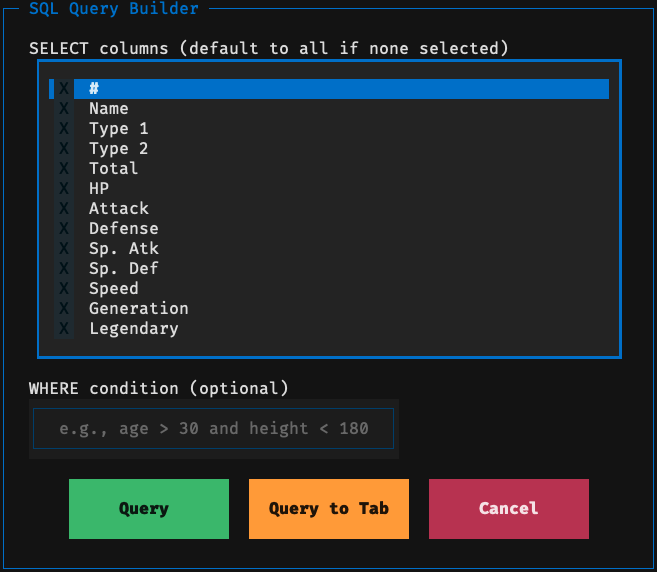
Examples:
-- Filter and select specific rows and/or columns
SELECT name, age
FROM self
WHERE age > 30

-- Use backticks (`) for column names with spaces
SELECT *
FROM self
WHERE `product id` = 7
22. Python Console
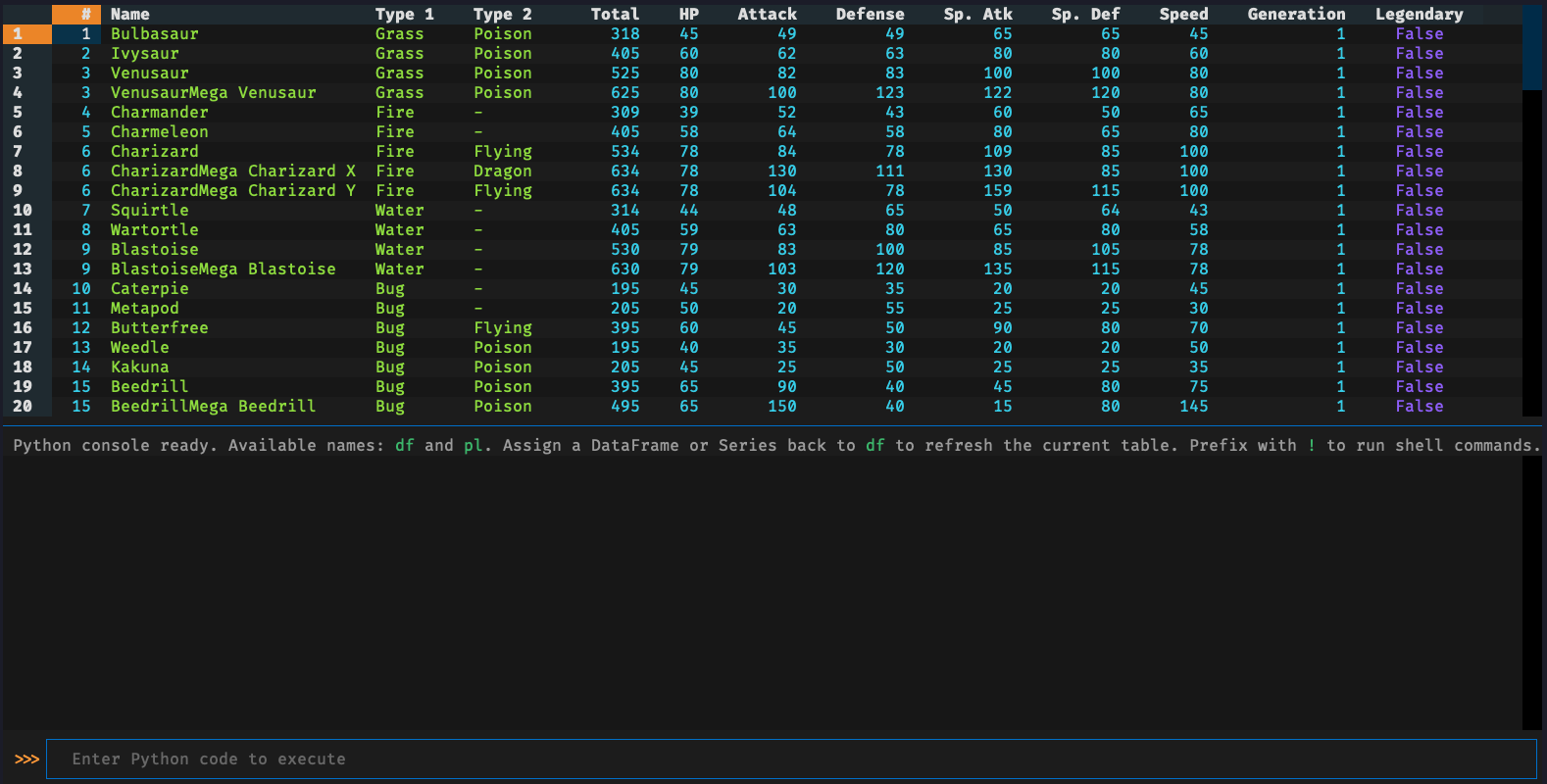
Use the built-in Python console for quick interactive transformations without leaving the TUI.
- Open/close console:
Space - Run shell commands: prefix with
!(example:!ls) - In console:
clearorclsclears console output - In console:
Esccloses the console panel - Available names:
df(active DataFrame),self(active table),app(viewer app),pl(Polars) - Assign a DataFrame or Series back to
dfto refresh the current table immediately
Handling Loading Errors
Most loading failures come from malformed CSV/TSV input, quoting issues, or mixed column types. When this happens, the application prints a hint with a suggested retry option.
Common fixes:
- Use
-Qif quote characters are mismatched, improperly escaped, or should be ignored entirely - Use
-Twhen rows contain more fields than expected and you want to truncate ragged lines - Use
-Lto increase the number of rows used for schema inference when early rows do not represent the full column types - Use
-Ito disable type inference and read CSV/TSV values as strings - Check the delimiter and format options if the input appears empty or unreadable
- Use
-Eas a last resort to ignore recoverable parsing errors
Typical cases:
Malformed CSV or broken quoting:
- Symptom: errors mentioning malformed CSV, mismatched quotes, or improperly escaped fields
- Try:
-Qto disable quoting or choose a different quote character
Ragged lines or inconsistent field counts:
- Symptom: errors saying the input has more fields than defined in the schema
- Try:
-Tto truncate ragged lines
Mixed data types in one column:
- Symptom: errors saying a value could not be parsed as an integer, float, or other inferred type at a specific column
- Try:
-Lfirst, then-Iif the column is genuinely mixed
No data could be loaded:
- Symptom: errors indicating that no data was available to load
- Check: whether the file is empty, the format is correct, and the delimiter matches the input
Fallback option:
- If none of the above helps and the file is mostly usable, retry with
-Eto ignore parsing errors
Examples:
# Disable quote handling when CSV quoting is broken
dv bad.csv -Q

# Truncate ragged lines
dv messy.tsv -T

# Increase schema inference depth
dv mixed_types.csv -L 1000

# Disable type inference entirely
dv mixed_types.csv -I

# Ignore recoverable parsing errors
dv partially_broken.csv -E
Dependencies
- polars: Fast DataFrame library for data loading/processing
- textual: Terminal UI framework
- fastexcel: Read Excel files
- xlsxwriter: Write Excel files
- vortex-data: Read/Write Vortex files (optional)
Requirements
- Python 3.11+
- POSIX-compatible terminal (macOS, Linux, WSL)
- Terminal supporting ANSI escape sequences and mouse events
Acknowledgments
Release history Release notifications | RSS feed


Download files
Download the file for your platform. If you're not sure which to choose, learn more about installing packages.
Source Distribution
Built Distribution
Filter files by name, interpreter, ABI, and platform.
If you're not sure about the file name format, learn more about wheel file names.
Copy a direct link to the current filters
File details
Details for the file dataframe_textual-3.0.0.tar.gz.
File metadata
- Download URL: dataframe_textual-3.0.0.tar.gz
- Upload date:
- Size: 238.8 kB
- Tags: Source
- Uploaded using Trusted Publishing? No
- Uploaded via: uv/0.9.7
File hashes
| Algorithm | Hash digest | |
|---|---|---|
| SHA256 |
33e712e30442f9725e1c3d3418c5b1ed0359965a52932ed9d0db69fb00e49d85
|
|
| MD5 |
5b18f4eb838a5fdf65ace36c6d93129a
|
|
| BLAKE2b-256 |
b01c6233762566ce959ff311d3f822c7ef222949a9215b92f4fce04d25790777
|
File details
Details for the file dataframe_textual-3.0.0-py3-none-any.whl.
File metadata
- Download URL: dataframe_textual-3.0.0-py3-none-any.whl
- Upload date:
- Size: 140.7 kB
- Tags: Python 3
- Uploaded using Trusted Publishing? No
- Uploaded via: uv/0.9.7
File hashes
| Algorithm | Hash digest | |
|---|---|---|
| SHA256 |
3decbbda43d548de97866b238c84c66a26f2d2b7299264890e9f0a2945567dcd
|
|
| MD5 |
7e0472b6aff87fe81d03446abc32bf63
|
|
| BLAKE2b-256 |
63678658440c250fcfebdd278c75fb75315a97eec34a2e82d85b069a407bd16c
|






