
Visualize FastAPI application's routing tree and dependencies

Project description



FastAPI Voyager
Visualize your API endpoints and explore them interactively.
Its vision is to make code easier to read and understand, serving as an ideal documentation tool.
Now supports multiple frameworks: FastAPI, Django Ninja, and Litestar.
This repo is still in early stage, it supports Pydantic v2 only.
- Live Demo: https://www.newsyeah.fun/voyager/
- Example Source: composition-oriented-development-pattern
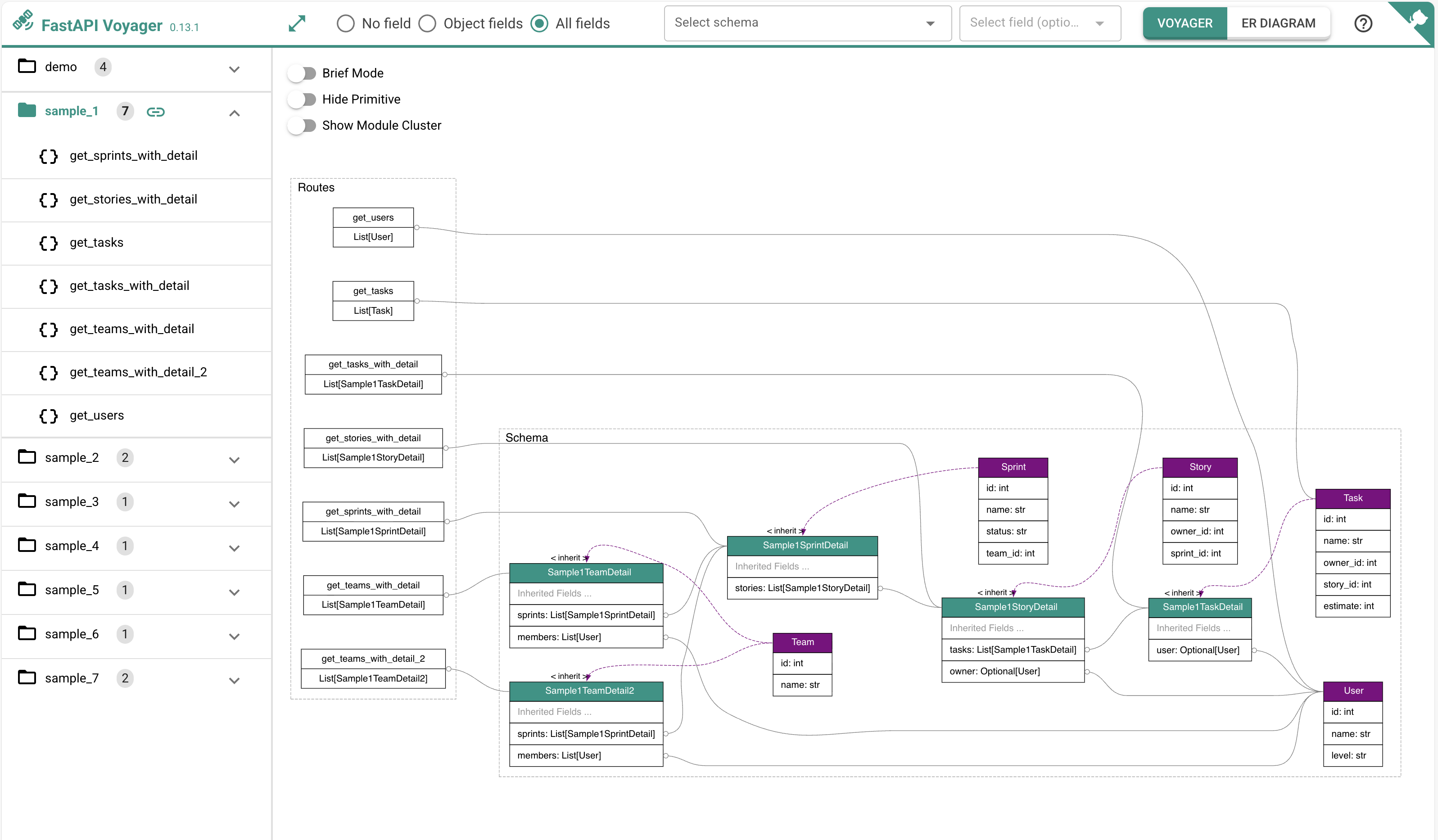
Table of Contents
- Quick Start
- Installation
- Supported Frameworks
- Features
- Command Line Usage
- About pydantic-resolve
- Development
- Dependencies
- Credits
Quick Start
With simple configuration, fastapi-voyager can be embedded into your web application:
from fastapi import FastAPI
from fastapi_voyager import create_voyager

app = FastAPI()

# ... define your routes ...

app.mount('/voyager',
          create_voyager(
            app,
            module_color={'src.services': 'tomato'},
            module_prefix='src.services',
            swagger_url="/docs",
            ga_id="G-XXXXXXXXVL",
            initial_page_policy='first',
            online_repo_url='https://github.com/your-org/your-repo/blob/master',
            enable_pydantic_resolve_meta=True))
Visit http://localhost:8000/voyager to explore your API visually.
For framework-specific examples (Django Ninja, Litestar), see Supported Frameworks.
Installation
Install via pip
pip install fastapi-voyager
Install via uv
uv add fastapi-voyager
Run with CLI
voyager -m path.to.your.app.module --server
For sub-application scenarios (e.g., app.mount("/api", api)), specify the app name:
voyager -m path.to.your.app.module --server --app api
Note: Sub-Application mounts are not supported yet, but you can specify the name of the FastAPI application with
--app. Only a single application (default:app) can be selected.
Supported Frameworks
fastapi-voyager automatically detects your framework and provides the appropriate integration. Currently supported frameworks:
FastAPI
from fastapi import FastAPI
from fastapi_voyager import create_voyager

app = FastAPI()

@app.get("/hello")
def hello():
    return {"message": "Hello World"}

# Mount voyager
app.mount("/voyager", create_voyager(app))
Start with:
uvicorn your_app:app --reload
# Visit http://localhost:8000/voyager
Django Ninja
import os
import django
from django.core.asgi import get_asgi_application
from ninja import NinjaAPI
from fastapi_voyager import create_voyager

# Configure Django
os.environ.setdefault("DJANGO_SETTINGS_MODULE", "myapp.settings")
django.setup()

# Create Django Ninja API
api = NinjaAPI()

@api.get("/hello")
def hello(request):
    return {"message": "Hello World"}

# Create voyager ASGI app
voyager_app = create_voyager(api)

# Create ASGI application that routes between Django and voyager
async def application(scope, receive, send):
    if scope["type"] == "http" and scope["path"].startswith("/voyager"):
        await voyager_app(scope, receive, send)
    else:
        django_app = get_asgi_application()
        await django_app(scope, receive, send)
Start with:
uvicorn your_app:application --reload
# Visit http://localhost:8000/voyager
Litestar
from litestar import Litestar, get
from fastapi_voyager import create_voyager

# Create Litestar app
app = Litestar()

@get("/hello")
def hello() -> dict:
    return {"message": "Hello World"}

# Create voyager app (returns a Litestar app)
voyager_app = create_voyager(app)

# Create ASGI application that routes between main app and voyager
async def asgi_app(scope, receive, send):
    if scope["type"] == "http" and scope["path"].startswith("/voyager"):
        # Remove /voyager prefix for voyager app
        new_scope = dict(scope)
        new_scope["path"] = scope["path"][8:] or "/"
        await voyager_app(new_scope, receive, send)
    else:
        await app(scope, receive, send)
Start with:
uvicorn your_app:asgi_app --reload
# Visit http://localhost:8000/voyager
Features
fastapi-voyager is designed for scenarios using web frameworks with Pydantic models (FastAPI, Django Ninja, Litestar). It helps visualize dependencies and serves as an architecture tool to identify implementation issues such as wrong relationships, overfetching, and more.
Best Practice: When building view models following the ER model pattern, fastapi-voyager can fully realize its potential - quickly identifying which APIs use specific entities and vice versa.
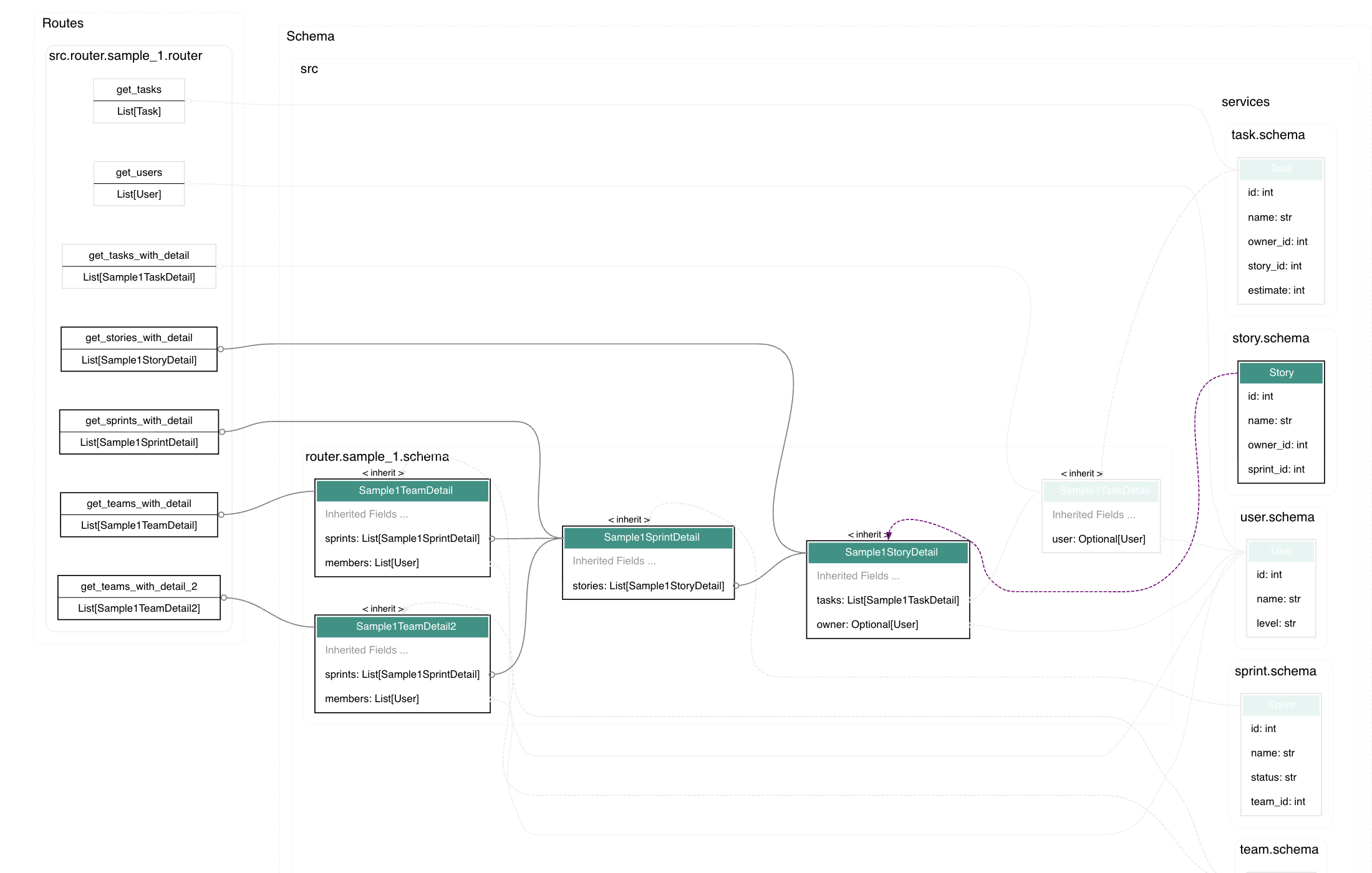
Highlight Nodes and Links
Click a node to highlight its upstream and downstream nodes. Figure out the related models of one page, or how many pages are related with one model.
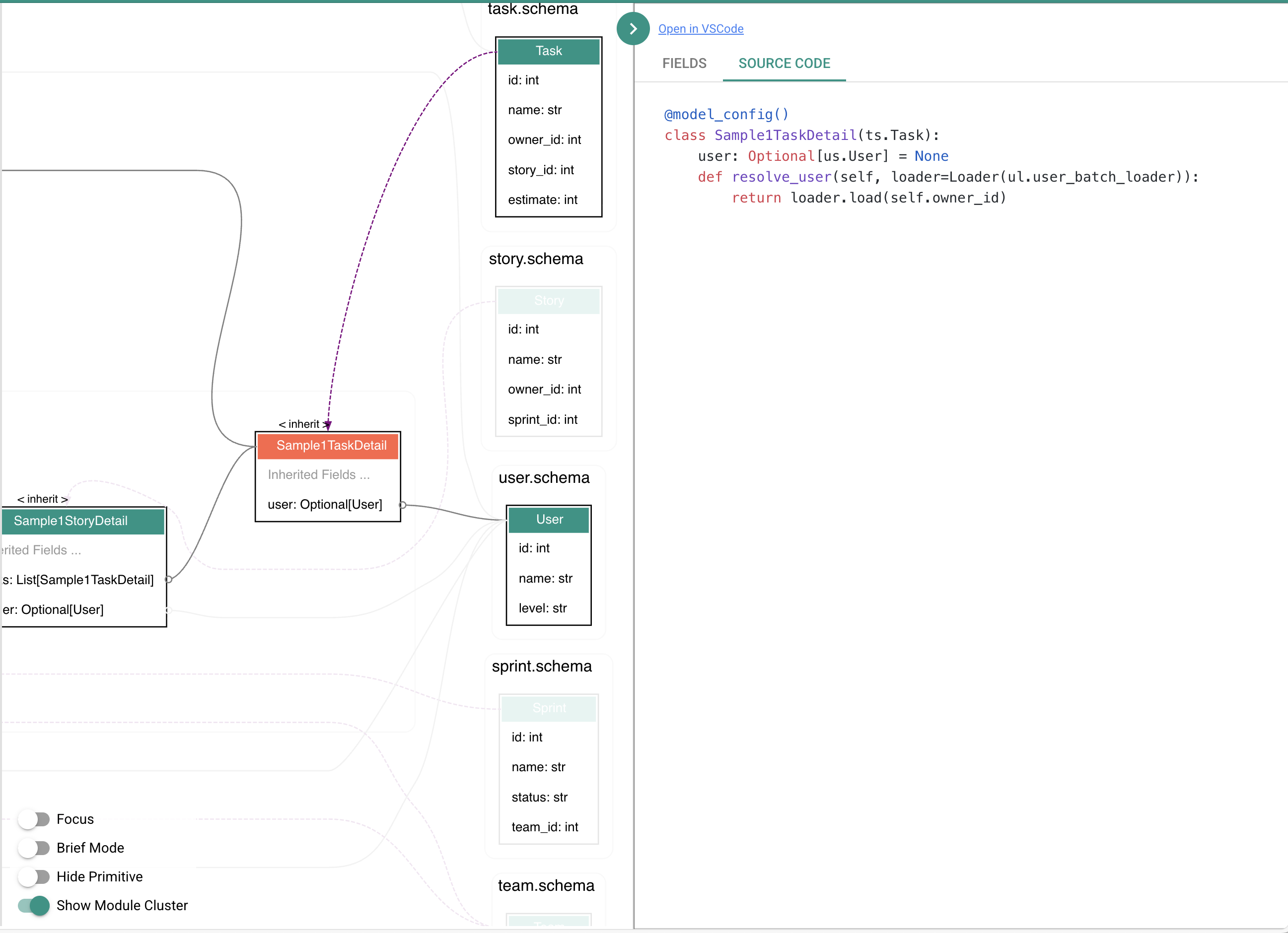
View Source Code
Double-click a node or route to show source code or open the file in VSCode.
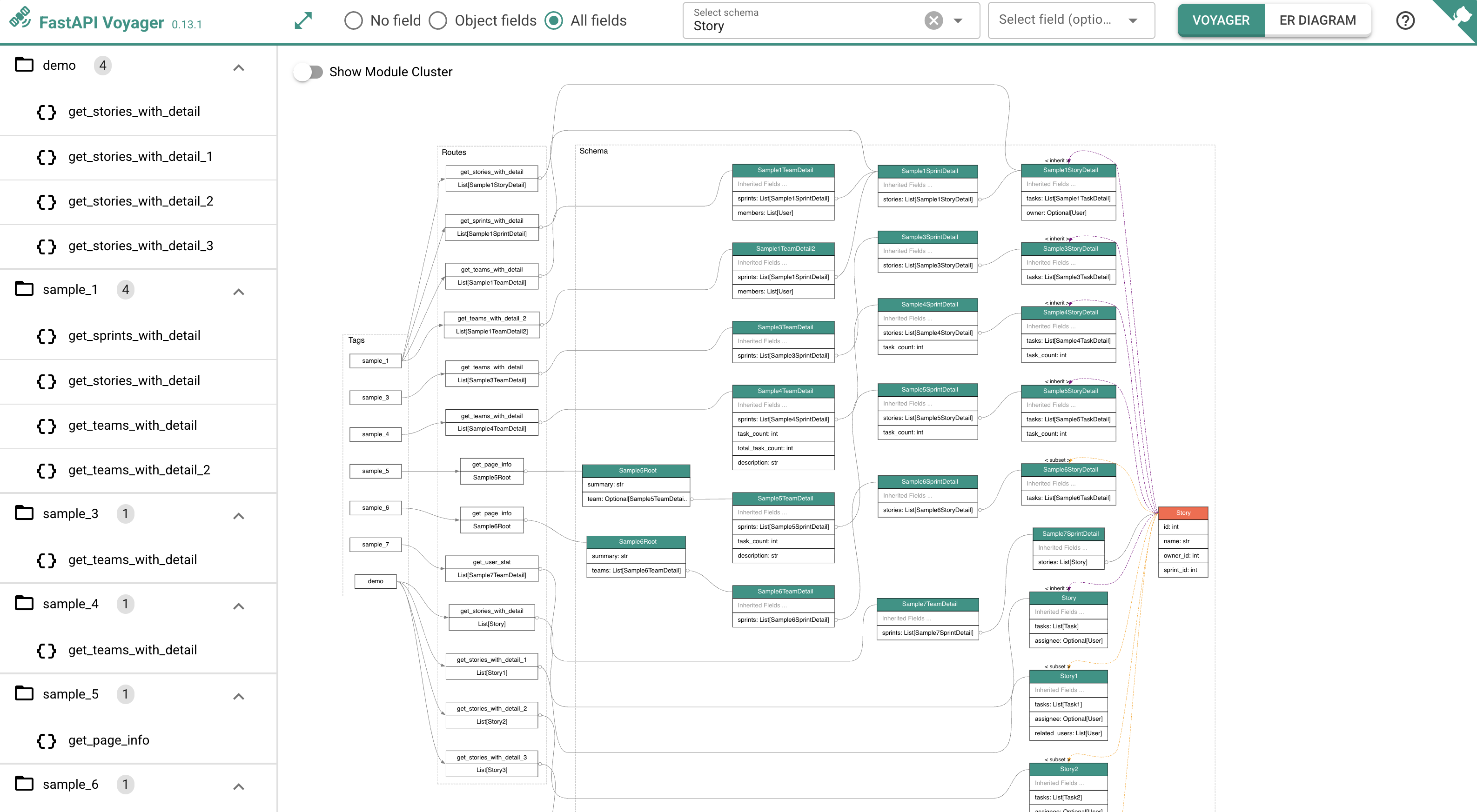
Quick Search
Search schemas by name and display their upstream and downstream dependencies. Use Shift + Click on any node to quickly search for it.
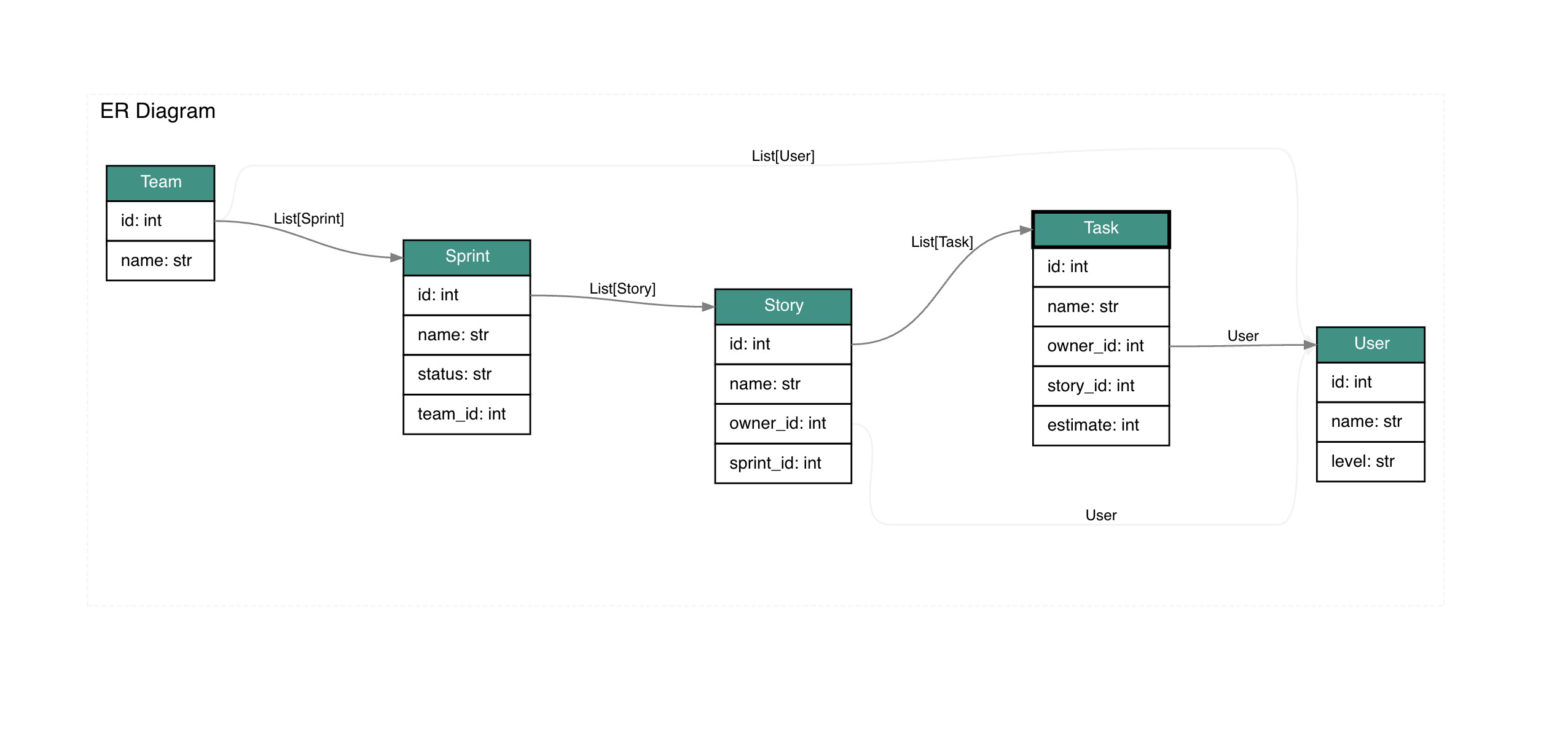
Display ER Diagram
ER diagram is a feature from pydantic-resolve which provides a solid expression for business descriptions. You can visualize application-level entity relationship diagrams.
from pydantic_resolve import ErDiagram, Entity, Relationship

diagram = ErDiagram(
    configs=[
        Entity(
            kls=Team,
            relationships=[
                Relationship(field='id', target_kls=list[Sprint], loader=sprint_loader.team_to_sprint_loader),
                Relationship(field='id', target_kls=list[User], loader=user_loader.team_to_user_loader)
            ]
        ),
        Entity(
            kls=Sprint,
            relationships=[
                Relationship(field='id', target_kls=list[Story], loader=story_loader.sprint_to_story_loader)
            ]
        ),
        Entity(
            kls=Story,
            relationships=[
                Relationship(field='id', target_kls=list[Task], loader=task_loader.story_to_task_loader),
                Relationship(field='owner_id', target_kls=User, loader=user_loader.user_batch_loader)
            ]
        ),
        Entity(
            kls=Task,
            relationships=[
                Relationship(field='owner_id', target_kls=User, loader=user_loader.user_batch_loader)
            ]
        )
    ]
)

# Display in voyager
app.mount('/voyager',
          create_voyager(
            app,
            er_diagram=diagram
          ))
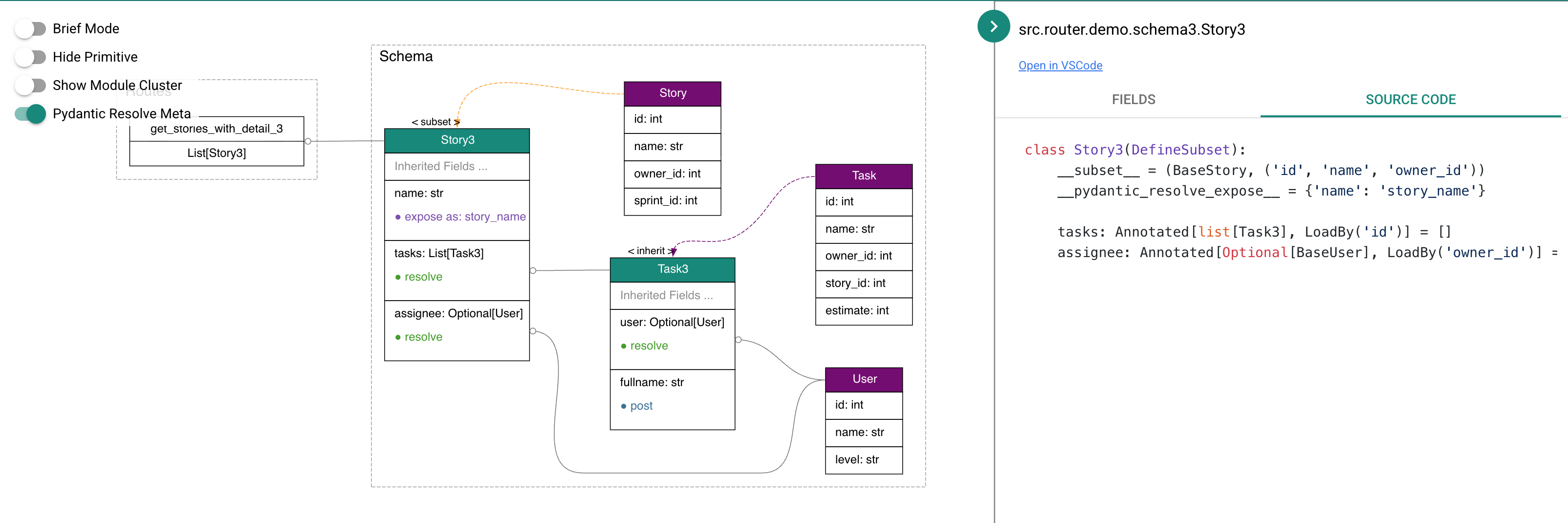
Show Pydantic Resolve Meta Info
Set enable_pydantic_resolve_meta=True in create_voyager, then toggle the "pydantic resolve meta" button to visualize resolve/post/expose/collect operations.
Command Line Usage
Start Server
# Open in browser (default port 8000)
voyager -m tests.demo --server

# Custom port
voyager -m tests.demo --server --port=8002

# Specify app name
voyager -m tests.demo --server --app my_app
Generate DOT File
# Generate .dot file
voyager -m tests.demo

# Specify app
voyager -m tests.demo --app my_app

# Filter by schema
voyager -m tests.demo --schema Task

# Show all fields
voyager -m tests.demo --show_fields all

# Custom module colors
voyager -m tests.demo --module_color=tests.demo:red --module_color=tests.service:tomato

# Output to file
voyager -m tests.demo -o my_visualization.dot

# Version and help
voyager --version
voyager --help
About pydantic-resolve
pydantic-resolve is a lightweight tool designed to build complex, nested data in a simple, declarative way. In v2, it introduced an important feature: ER Diagram, and fastapi-voyager has supported this feature, allowing for a clearer understanding of business relationships.
The @ensure_subset decoratorDefineSubset metaclass helps safely pick fields from the 'source class' while indicating the reference from the current class to the base class.
Developers can use fastapi-voyager without needing to know anything about pydantic-resolve, but I still highly recommend everyone to give it a try.
Development
Setup Development Environment
# Fork and clone the repository
git clone https://github.com/your-username/fastapi-voyager.git
cd fastapi-voyager

# Install uv
curl -LsSf https://astral.sh/uv/install.sh | sh

# Create virtual environment and install dependencies
uv venv
source .venv/bin/activate
uv pip install ".[dev]"

# Run development server
uvicorn tests.programatic:app --reload
Test Different Frameworks
You can test the framework-specific examples:
# FastAPI example
uvicorn tests.fastapi.embedding:app --reload

# Django Ninja example
uvicorn tests.django_ninja.embedding:app --reload

# Litestar example
uvicorn tests.litestar.embedding:asgi_app --reload
Visit http://localhost:8000/voyager to see changes.
Setup Git Hooks (Optional)
Enable automatic code formatting before commits:
./setup-hooks.sh
# or manually:
git config core.hooksPath .githooks
This will run Prettier automatically before each commit. See .githooks/README.md for details.
Project Structure
Frontend:
src/fastapi_voyager/web/vue-main.js- Main JavaScript entry
Backend:
voyager.py- Main entry pointrender.py- Generate DOT filesserver.py- Server mode
Roadmap
Dependencies
Dev dependencies
Credits
- graphql-voyager - Thanks for inspiration
- vscode-interactive-graphviz - Thanks for web visualization
License
MIT License
Release history Release notifications | RSS feed


Download files
Download the file for your platform. If you're not sure which to choose, learn more about installing packages.
Source Distribution
Built Distribution
Filter files by name, interpreter, ABI, and platform.
If you're not sure about the file name format, learn more about wheel file names.
Copy a direct link to the current filters
File details
Details for the file fastapi_voyager-0.16.0a2.tar.gz.
File metadata
- Download URL: fastapi_voyager-0.16.0a2.tar.gz
- Upload date:
- Size: 663.4 kB
- Tags: Source
- Uploaded using Trusted Publishing? No
- Uploaded via: uv/0.9.28 {"installer":{"name":"uv","version":"0.9.28","subcommand":["publish"]},"python":null,"implementation":{"name":null,"version":null},"distro":{"name":"Ubuntu","version":"24.04","id":"noble","libc":null},"system":{"name":null,"release":null},"cpu":null,"openssl_version":null,"setuptools_version":null,"rustc_version":null,"ci":true}
File hashes
| Algorithm | Hash digest | |
|---|---|---|
| SHA256 |
156bc9e562f9feb144f9b1366472c15128f842e5e67c1800c3475fbfab0579fc
|
|
| MD5 |
82aa363eab4a3ef1b24983626d014f75
|
|
| BLAKE2b-256 |
da3f0cae2ad1c649d27b9612f0fd40dd9577ba72509b721dd72e628a9f129077
|
File details
Details for the file fastapi_voyager-0.16.0a2-py3-none-any.whl.
File metadata
- Download URL: fastapi_voyager-0.16.0a2-py3-none-any.whl
- Upload date:
- Size: 563.4 kB
- Tags: Python 3
- Uploaded using Trusted Publishing? No
- Uploaded via: uv/0.9.28 {"installer":{"name":"uv","version":"0.9.28","subcommand":["publish"]},"python":null,"implementation":{"name":null,"version":null},"distro":{"name":"Ubuntu","version":"24.04","id":"noble","libc":null},"system":{"name":null,"release":null},"cpu":null,"openssl_version":null,"setuptools_version":null,"rustc_version":null,"ci":true}
File hashes
| Algorithm | Hash digest | |
|---|---|---|
| SHA256 |
39ca045d90ba0f7a567699625943f8d26db32c85adb349e1f9775ece07b063ad
|
|
| MD5 |
b0b18adf32f29771c57ce43ec93df9b4
|
|
| BLAKE2b-256 |
8d18c88ea9ef6919e5600b74896ea081965ff34ca41694845b18417dbdfb5e31
|






