
figma2lvgl — Figma to LVGL C Code Generator
A code-generation tool that converts Figma UI layouts into LVGL C source files ready to drop into any embedded project.
- Works with any LVGL v9 project (ESP-IDF, Zephyr, bare-metal, etc.)
- Installable via pip — no manual script setup
- Fully cross-platform — Windows, Linux, macOS
✨ Key Features
- 📐 Figma XML → Deterministic, reproducible C code
- 🎨 Figma styles (color, font, radius, border) → LVGL style calls, baked into the generated struct
- 🔤 Figma label text → baked into generated struct as design-time default
- 🧱 Per-screen typed C struct — firmware accesses
home.panel_top.time, notchildren[2] - 📦 Generates self-contained
ui_src/folder - 🧩 Buttons, sliders, bars, images, labels, panels, dynamic containers
- 🎯 Zero dynamic layout parsing at runtime
- 🔁 Named event callbacks — implement
ui_home_on_btn_ok_clicked()and it just works
🚀 Installation
pip install figma2lvgl
Prerequisites
- Figma with the FigML — Figma XML Exporter plugin installed
- Python 3.10+
- LVGL 9.3 in your firmware project. Image files are converted with LVGL's
own
LVGLImage.pyfrom LVGL v9.3.0, which ships inside the package (MIT licence, provenance in its header). Nothing is downloaded. For a different LVGL version, pass that version'sLVGLImage.pywith--lvgl-tool.
📖 Usage
figma2lvgl -x layout.xml
All Arguments
| Argument | Description | Default |
|---|---|---|
-x / --xml |
Path to Figma XML file | Required |
-i / --images |
Folder containing PNG images | Same directory as XML |
-d / --dest |
Destination for generated output | Same directory as XML |
-y / --yes |
Skip the overwrite prompt | off |
--lvgl-tool PATH |
Use a different LVGLImage.py (for example a newer LVGL's) |
bundled (LVGL v9.3.0) |
-f / --color-format |
PNG pixel encoding: RGB565, RGB888, ARGB8888, L8 |
RGB565 |
--patch-esp-includes |
Deprecated — ESP-IDF include patching is now applied automatically to all generated image files. Flag kept for backward compatibility, has no effect. | — |
-v / --verbose |
Enable debug-level logging | off |
--verify-compile |
Syntax-check the generated C with gcc against real LVGL headers before replacing the output; a failed check keeps the previous output |
off |
--lvgl-include PATH |
Include folder for --verify-compile: the LVGL folder with lvgl.h, and the one with lv_conf.h if separate. Repeat as needed |
— |
Outside ESP-IDF, define
LV_LVGL_H_INCLUDE_SIMPLEin your build (for exampletarget_compile_definitions(... PUBLIC LV_LVGL_H_INCLUDE_SIMPLE=1)), so the converted image files include"lvgl.h"like the rest ofui_src/.
Examples
# Minimal — everything next to the XML
figma2lvgl -x layout.xml

# Full control
figma2lvgl -x layout.xml -i assets/images -d build/output

# CI pipeline (no prompts, 32-bit display)
figma2lvgl -x layout.xml --yes -f ARGB8888

# Check the generated C against your LVGL before replacing the output
figma2lvgl -x layout.xml --yes --verify-compile --lvgl-include ../lvgl --lvgl-include ./config

# ESP-IDF — no special flags needed, include patching is automatic
figma2lvgl -x layout.xml
📁 Output Layout
ui_src/
  src/              ← Generated screen .c files (one per Figma frame)
  include/          ← Generated screen .h files
  priv_src/         ← Converted image .c files + ui_style.c
  priv_include/     ← assets.h, ui_config.h, ui_defs.h, ui_style.h
Drop ui_src/ into your project and add the source files to your build system.
Regenerating is safe. The new output is generated and checked next to
ui_src/ (in ui_src.staging/) and only then swapped in, so a failed run
leaves the previous ui_src/ exactly as it was. Files you add to ui_src/
yourself (for example a CMakeLists.txt) are kept across runs. A
ui_src.lock file next to it stops two runs from writing at once. If a run
was killed, the next run tidies up and tells you what it did.
Build system note: ensure
priv_include/is on the include path for all source files inui_src/. ESP-IDF and Zephyr handle this automatically. For bare-metal Makefiles, add-Iui_src/priv_includeto your CFLAGS.
Using a generated screen
#include "ui_home.h"

// Implement event callbacks in your application .c
// (linker error if missing — see Event Callbacks section below)
void ui_home_on_btn_ok_clicked(lv_event_t *e)    { /* navigate, update state */ }
void ui_home_on_btn_ok_long_pressed(lv_event_t *e) { /* hold action */ }

// In your app init:
ui_home_init();   // creates LVGL objects, applies styles, shows Figma text
ui_home_load();   // makes this screen active

// At runtime — update widgets:
ui_home_time_set_text("16:30");
ui_home_battery_bar_set_value(85, 300);   // animated over 300 ms
ui_home_icon_wifi_display();
ui_home_btn_ok_set_label("Confirm");
🎨 Designing in Figma
figma2lvgl reads the Figma node name to identify each UI element type and Figma styles to generate matching LVGL style calls.
Exporting XML from Figma
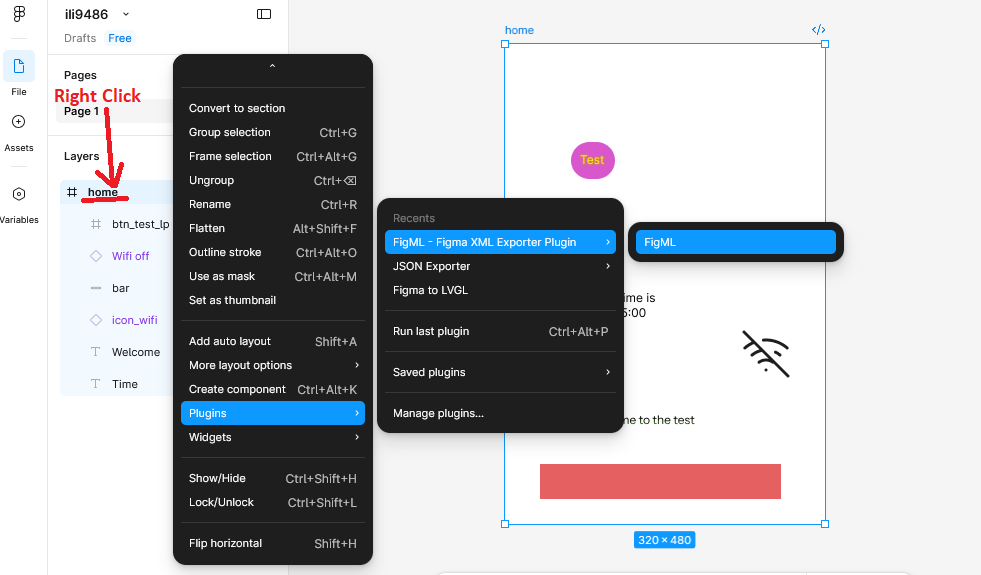
figma2lvgl reads XML exported via the FigML — Figma XML Exporter Plugin.
- Right-click your frame in Figma
- Go to Plugins → FigML - Figma XML Exporter Plugin → FigML
- Export and save the
.xmlfile - Pass it to figma2lvgl with
-x
Supported Widgets
Text / Label
Any Text node is automatically mapped to an LVGL label. The text content
typed in Figma is baked into the generated struct as the initial display value.
Figma node type: Text (automatic)
Figma name:      anything (e.g. "time", "welcome_label", "status")
Maps to:         lv_label_create()
Button
A Frame named with the btn_ or button_ prefix maps to an LVGL button.
The button's text is read from its first Text child node in Figma.
Figma node type: FRAME with fill/border/radius
Figma name:      must start with "btn_" or "button_" (e.g. "btn_ok", "button_cancel")
Maps to:         lv_button_create()
Event suffixes — append to the name to register additional events.
LV_EVENT_CLICKED is always registered regardless of suffix:
| Figma name | Extra event registered |
|---|---|
btn_ok |
click only (default) |
btn_ok_lp |
+ LV_EVENT_LONG_PRESSED |
btn_ok_lpr |
+ LV_EVENT_LONG_PRESSED_REPEAT |
btn_ok_press |
+ LV_EVENT_PRESSED |
btn_ok_release |
+ LV_EVENT_RELEASED |
The suffix is stripped before forming the struct field name — btn_ok_lp
and btn_ok both produce the same btn_ok struct field.
Image / Icon
Any node whose name contains icon or image maps to an LVGL image widget.
The node name (normalized) must match the PNG filename in your images folder.
Figma node type: INSTANCE or FRAME
Figma name:      must contain "icon" or "image" (e.g. "icon_wifi", "image_logo")
Maps to:         lv_image_create()
Asset required:  icon_wifi.png in your images folder
Bar
Any node whose name contains bar maps to an LVGL bar widget.
Encode the value range directly in the name — no code changes needed:
Figma name:      battery_bar          → range 0–100 (default)
                 battery_bar_0_100    → range 0–100
                 temp_bar_n20_50      → range −20–50  (prefix n = negative)
Maps to:         lv_bar_create()
Slider
Figma name:      must start with "slider_" or end with "_slider"
                 brightness_slider_0_255  → range 0–255
Maps to:         lv_slider_create()
Panel (Container)
Any Frame with a fill, border, or meaningful name that doesn't match other widget types is treated as a panel container. Its children are parsed recursively and appear as nested struct fields.
Figma node type: FRAME with visible style or semantic name
Maps to:         lv_obj_create()
Dynamic Container
Containers named with list_ or grid_ prefix are created as scrollable
containers. Their children are not parsed — firmware fills them at runtime.
Figma name:      must start with "list_" or "grid_"
Maps to:         lv_obj_create() with LV_SCROLLBAR_MODE_AUTO
Accessor:        ui_home_get_list_devices() → returns lv_obj_t*
Naming Rules Summary
| Widget | Name Requirement |
|---|---|
| Label | Any Text node — name doesn't matter |
| Button | Starts with btn_ or button_ |
| Image | Contains icon or image |
| Bar | Contains bar |
| Slider | Starts with slider_ or ends with _slider |
| Panel | Frame with fill/border/radius or meaningful name |
| Dynamic | Starts with list_ or grid_ |
Names are case-insensitive —
Bar,BAR, andbarall work.
Unknown nodes are skipped with a warning. figma2lvgl logs the screen name and node name and tells you exactly how to rename it.
Nesting depth limits — depth > 5 emits a warning; depth > 7 skips the subtree with an error. Aim for 2–3 levels in practice.
Structural frames — invisible grouping frames (no fill, no border, auto-generated Figma name like
Frame 12) are silently dropped and their children promoted to the parent level.
Supported Styles
Styles applied in Figma are extracted and baked into the generated C struct.
ui_apply_style() is called at init time — no manual style code needed.
| Figma Property | Applies To | LVGL Call |
|---|---|---|
| Fill color | All widgets | lv_obj_set_style_bg_color |
| Fill opacity | All widgets | lv_obj_set_style_bg_opa |
| Text color | Labels, button labels | lv_obj_set_style_text_color |
| Font size | Labels, button labels | lv_obj_set_style_text_font |
| Corner radius | All widgets | lv_obj_set_style_radius |
| Stroke color | All widgets | lv_obj_set_style_border_color |
| Stroke weight | All widgets | lv_obj_set_style_border_width |
| Opacity | All widgets | lv_obj_set_style_opa |
Button text styles are applied to the internal label child, not the button container — avoids relying on LVGL's style inheritance.
Text alignment is not extracted — FigML does not export horizontal text alignment. LVGL's default (left) applies.
Multiple fills — only the first visible fill is used. If you layer fills in Figma, set a single solid fill for the widget color.
Font Sizes
Figma font sizes are mapped to LVGL Montserrat fonts.
Supported: 10, 12, 14, 16, 18, 20, 22, 24. Any other size falls back to LV_FONT_DEFAULT.
Enable only what your design uses in lv_conf.h:
#define LV_FONT_MONTSERRAT_12  1
#define LV_FONT_MONTSERRAT_14  1
🔔 Event Callbacks
Every button and slider gets named event callback functions declared in its .h:
// Declared in ui_home.h — you must implement these
void ui_home_on_btn_ok_clicked(lv_event_t *e);
void ui_home_on_btn_ok_long_pressed(lv_event_t *e);   // only if btn_ok_lp in Figma
void ui_home_on_brightness_slider(lv_event_t *e);
The generated _init() registers them with lv_obj_add_event_cb() automatically.
You just implement the functions — no registration needed.
void ui_home_on_btn_ok_clicked(lv_event_t *e)
{
    lv_obj_t *btn = lv_event_get_target(e);
    ui_home_welcome_set_text("Button clicked!");
}
Linker error if not implemented. If a callback is declared but you haven't defined it, the linker will report an undefined reference. This is intentional — it makes missing handlers explicit rather than silently doing nothing. Implement a no-op body if you don't need the callback yet:
void ui_home_on_btn_ok_clicked(lv_event_t *e) { (void)e; }
MSVC / Visual Studio:
__attribute__((weak))is not supported on MSVC. figma2lvgl does not use weak linking — callbacks are plainexterndeclarations, so the same linker-error model applies on all compilers including MSVC.
🧠 Architecture Overview
Figma XML + PNG assets
        │
        ▼
    figma_parser.py     reads XML → ParsedScreen / ParsedNode tree
        │
        ▼
    node_emitter.py     emits per-screen typed C struct + initializer
    init_emitter.py     emits flat BFS _init() body
    setter_emitter.py   emits setters + callback declarations
        │
        ▼
    generator.py        assembles .c and .h per screen
        │
        ▼
  ui_src/
    src/            ← ui_home.c, ui_settings.c, ...
    include/        ← ui_home.h, ui_settings.h, ...
    priv_src/       ← image .c files + ui_style.c
    priv_include/   ← assets.h, ui_config.h, ui_defs.h, ui_style.h
The generated struct mirrors the Figma hierarchy exactly:
// Firmware accesses named fields — not generic arrays
s_home.panel_top.time.lv_obj
s_home.panel_top.icon_wifi.lv_obj
s_home.btn_ok.lv_obj
💡 Example Integrations
See the examples/ folder for ready-to-use project setups:
examples/
  espidf/
    ili9486/        ← ESP32 + ILI9486 320×480 display (build steps in its README.md)
More platform examples (STM32, Zephyr, bare-metal) coming soon.
🧪 Development and Tests
The test sessions mirror CI. With nox installed:
nox                  # tests, compile, wheel
nox -s tests         # parser and generator tests
nox -s compile       # generated output compiled as C and C++ against LVGL 9.3
nox -s wheel         # build the wheel, install it offline, run it with no network
nox -s compile_msvc  # the compile check with MSVC (Visual Studio Developer prompt)
nox -s espidf        # build the ESP-IDF example (ESP-IDF terminal)
The compile session fetches LVGL v9.3.0 once into .nox/. To run the
compile tests directly, set LVGL_DIR to an LVGL checkout and run
pytest tests/compile.
🏁 Design Philosophy
| Principle | What it means |
|---|---|
| Figma = layout + style | All geometry, colors, fonts come from Figma — nothing hardcoded in C |
| Naming = semantics | Node name determines widget type; rename in Figma to change the generated widget |
| Struct mirrors hierarchy | Generated struct matches Figma's layer tree exactly — named fields, no generic arrays |
| Output = portable C | No dependencies beyond LVGL v9 |
| Initial state = Figma | Generated structs carry Figma text and styles as the design-time default; firmware updates from there |
1 maintainer

Metadata
1 maintainer
Release files for figma2lvgl 0.4.6
For a detailed explanation of source distributions (sdists) and built distributions (wheels), please see the package formats documentation.
Source distribution (sdist)
| File | Size | Uploaded | Provenance | Actions |
|---|---|---|---|---|
| figma2lvgl-0.4.6.tar.gz | 152.4 kB | With provenance | Details for figma2lvgl-0.4.6.tar.gz |
Built distribution (wheel)
| File | Interpreter | ABI | Platform | Actions Reset |
|---|---|---|---|---|
| figma2lvgl-0.4.6-py3-none-any.whl | Python 3 | none | any | Details for figma2lvgl-0.4.6-py3-none-any.whl |
Total release size: 204.7 kB
Release files / figma2lvgl-0.4.6.tar.gz
| Download URL | figma2lvgl-0.4.6.tar.gz |
|---|---|
| Size | 152.4 kB |
| Tags | Source |
|
SHA-256 checksum How to use checksums |
40fefd11e7be164b9ba295e8c684c6671c08be0540eb8b5ed92a230bbc41c86a
|
|
BLAKE2b-256 checksum How to use checksums |
4b13d5cdac5e7b13becd03ad2eb6cf6cbf0c80f0b73fd53775c186abfcb0e06e
|
| Upload date | |
|
Uploaded using Trusted Publishing? What is trusted publishing? |
Yes |
| Uploaded via |
twine/7.0.0 CPython/3.13.16
|
Provenance
Provenance describes where a file came from. On PyPI, provenance is shared via attestations, which provide a verifiable record of the build or publishing details. View details, limitations and caveats.


PyPI Publish Attestation
PyPI verified that this artifact, at this checksum, originated from the publisher listed below.
Signed by GitHub Actions, verified by PyPI on Nov 26, 2026.
Transparency logRelease files / figma2lvgl-0.4.6-py3-none-any.whl
| Download URL | figma2lvgl-0.4.6-py3-none-any.whl |
|---|---|
| Size | 52.4 kB |
| Tags | Python 3 |
|
SHA-256 checksum How to use checksums |
066a8bfb9a4f3fff79edc5a18d14ec2a020891a8e768910fa5c587abf83158a7
|
|
BLAKE2b-256 checksum How to use checksums |
e5c324a316a074f37d9b394119df567c15d1ecd121fa0f9958825ff6446ff40b
|
| Upload date | |
|
Uploaded using Trusted Publishing? What is trusted publishing? |
Yes |
| Uploaded via |
twine/7.0.0 CPython/3.13.16
|
Provenance
Provenance describes where a file came from. On PyPI, provenance is shared via attestations, which provide a verifiable record of the build or publishing details. View details, limitations and caveats.
PyPI Publish Attestation
PyPI verified that this artifact, at this checksum, originated from the publisher listed below.
Signed by GitHub Actions, verified by PyPI on Nov 26, 2026.
Transparency logSecurity for figma2lvgl 0.4.6
Provenance
Provenance describes where a file came from. On PyPI, provenance is shared via attestations, which provide a verifiable record of the build or publishing details. View details, limitations and caveats.
Full provenance
Both files in this release have been uploaded with provenance metadata.
Attestation for figma2lvgl-0.4.6.tar.gz
PyPI Publish Attestation
PyPI verified that this artifact, at this checksum, originated from the publisher listed below.
Signed by GitHub Actions, verified by PyPI on Nov 26, 2026.
Transparency logA note on package security
PyPI is a repository for distributing packages, not a service for auditing them. While third-party security researchers and our staff do their best to detect and remove malicious packages, PyPI cannot guarantee the quality, security or suitability of any given package.
To learn more about protecting yourself from malicious actors, visit our package security documentation.














