



gcf-python
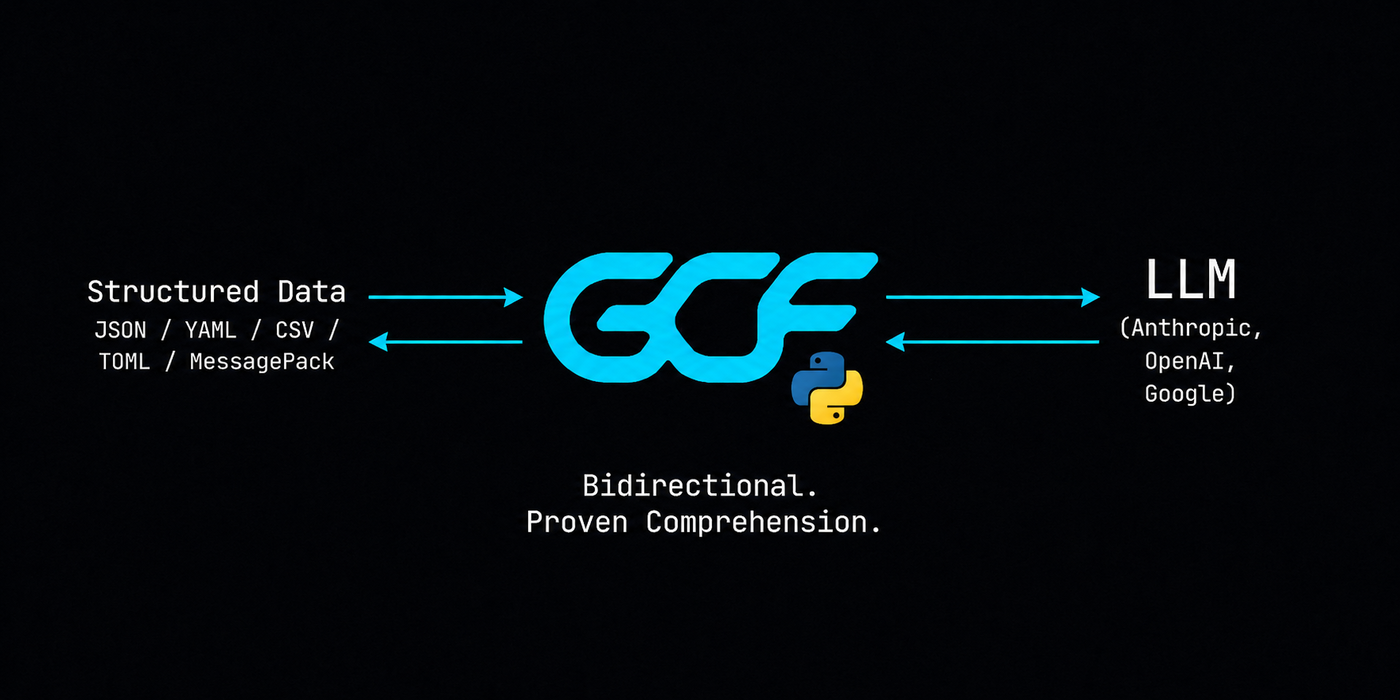
Python implementation of GCF, the most token-efficient wire format for LLMs. A drop-in alternative to JSON and TOON for any structured data.


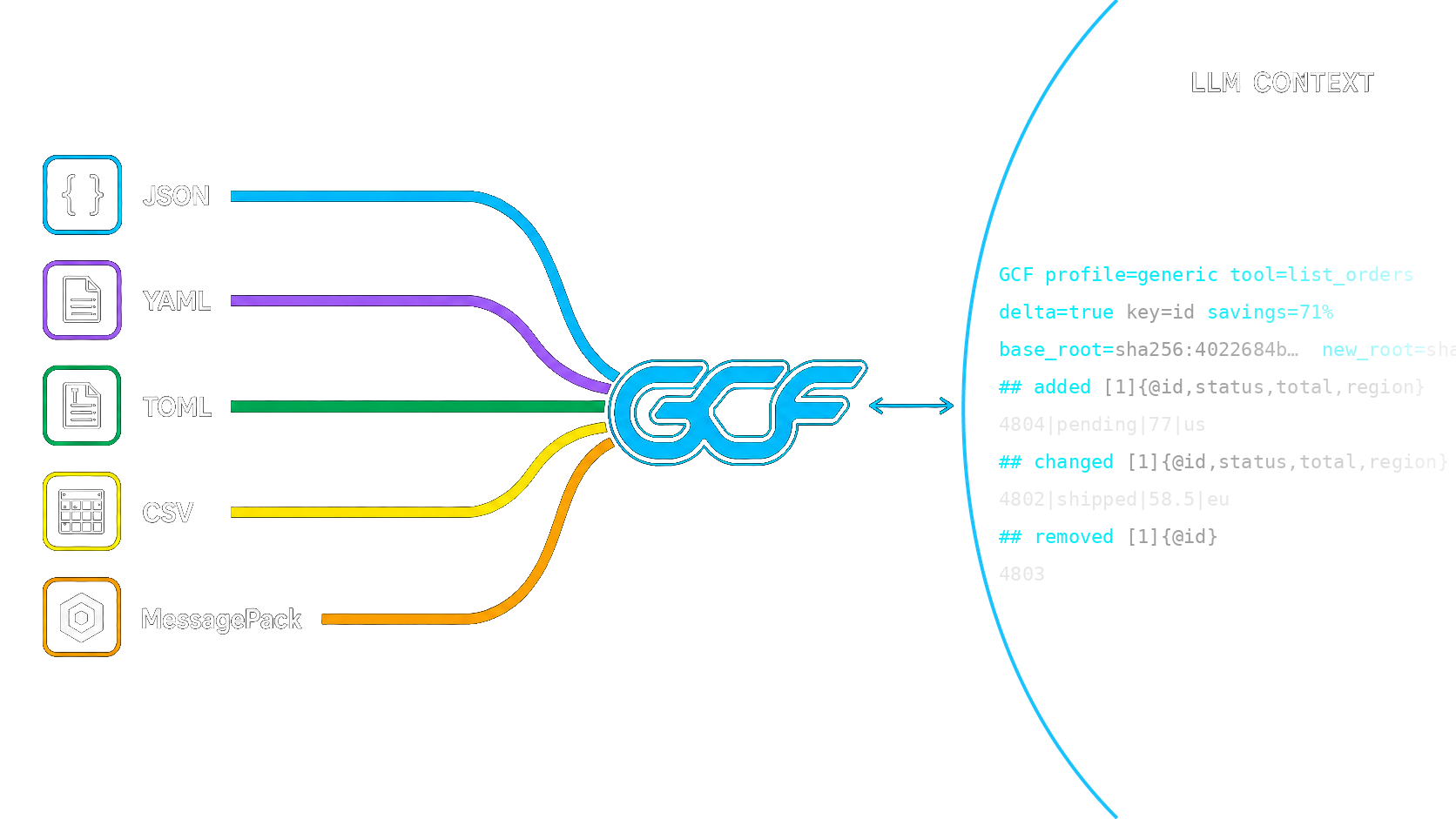
Built for the agentic loop, where the same structured context crosses the model boundary turn after turn. A single payload is 50-92% smaller than JSON, but GCF also deduplicates repeated structure across turns and sends only deltas when context changes, so by the 5th overlapping call each response costs 99% fewer tokens than JSON, and a 10-call session runs 94.4% cheaper than re-sending JSON every turn. Session dedup and delta both need local IDs and a multi-turn design that neither JSON nor TOON has.
- 100% comprehension on every frontier model, zero training. 29% fewer tokens than TOON and 56% fewer than JSON across 16 datasets; 91.2% on structurally complex code graphs (vs TOON 68.8%, JSON 54.1%).
- Proven lossless across 43,000,000,000+ round-trips in 5 formats and 6 languages. Zero runtime dependencies.
- One format, four properties no other single format holds at once: schema-free, lossless, token-compact (50-92% vs JSON), and model-readable with zero training. JSON is verbose, Protobuf needs a schema, MessagePack is binary, and TOON isn't reliably lossless.
2,500+ LLM evaluations. Full benchmarks.
Docs: gcformat.com · Playground · GCF vs TOON
Install
pip install gcf-python
Zero dependencies. Pure Python. Python 3.9+. Includes CLI. Don't want to change code? Use the MCP proxy for zero-code adoption.
CLI
gcf encode < payload.json    # JSON to GCF
gcf decode < payload.gcf     # GCF to JSON
gcf stats  < payload.json    # token comparison with visual bar
Payload: 50 symbols, 20 edges

  JSON  ██████████████████████████████  4,200 tokens
  GCF   ████████░░░░░░░░░░░░░░░░░░░░░░  1,150 tokens

  Savings: 73% fewer tokens with GCF
Library
Quick Start
from gcf import encode_generic

output = encode_generic({
    "employees": [
        {"id": 1, "name": "Alice", "department": "Engineering", "salary": 95000},
        {"id": 2, "name": "Bob", "department": "Sales", "salary": 72000},
    ],
})
Output:
## employees [2]{id,name,department,salary}
1|Alice|Engineering|95000
2|Bob|Sales|72000
Decode
from gcf import decode

p = decode(input_text)
print(p.tool, len(p.symbols), "symbols", len(p.edges), "edges")
Session Deduplication
Track transmitted symbols across multiple tool responses. Previously-sent symbols become bare references instead of full declarations:
from gcf import encode_with_session, Session, Payload, Symbol

sess = Session()

out1 = encode_with_session(payload1, sess)  # full declarations
out2 = encode_with_session(payload2, sess)  # reused symbols as "@N  # previously transmitted"
By the 5th call in a session: 86% fewer tokens than JSON from dedup alone, 99% stacked with delta encoding.
Streaming Encode
Write GCF output incrementally as symbols and edges arrive. Zero buffering, O(1) memory per row:
from gcf import StreamEncoder, Symbol, Edge

enc = StreamEncoder(sys.stdout, "context_for_task", token_budget=5000)

enc.write_symbol(Symbol(qualified_name="pkg.Auth", kind="function", score=0.95, provenance="lsp", distance=0))
enc.write_symbol(Symbol(qualified_name="pkg.Server", kind="function", score=0.60, provenance="lsp", distance=1))
enc.write_edge(Edge(source="pkg.Server", target="pkg.Auth", edge_type="calls"))
enc.close()  # emits ##! summary trailer
Output:
GCF tool=context_for_task budget=5000
## targets
@0 fn pkg.Auth 0.95 lsp
## related
@1 fn pkg.Server 0.60 lsp
## edges [?]
@0<@1 calls
##! summary symbols=2 edges=1 counts=1,1,1
The writer is any object with a write(s: str) method. Thread-safe. Standard decode() handles streaming output with no changes.
Delta Encoding
When the consumer already has a prior context pack, send only what changed:
from gcf import encode_delta, DeltaPayload, Symbol, Edge

delta = DeltaPayload(
    tool="context_for_task",
    base_root="aaa111",
    new_root="bbb222",
    removed=[Symbol(qualified_name="pkg.OldFunc", kind="function")],
    added=[Symbol(qualified_name="pkg.NewFunc", kind="function", score=0.85, provenance="rwr")],
    delta_tokens=30,
    full_tokens=200,
)

output = encode_delta(delta)
81.2% savings on re-queries where the pack changed slightly.
Generic Encoding
Encode any Python value (not just graph payloads) into GCF tabular format:
from gcf import encode_generic

output = encode_generic({
    "employees": [
        {"id": 1, "name": "Alice", "department": "Engineering", "salary": 95000},
        {"id": 2, "name": "Bob", "department": "Sales", "salary": 72000},
    ],
})
Output:
## employees [2]{id,name,department,salary}
1|Alice|Engineering|95000
2|Bob|Sales|72000
Works on dicts, lists, and primitives. Lists of uniform dicts get tabular rows. Nested dicts use ## key section headers.
Generic-Profile Delta (multi-turn)
In an agent loop the same keyed table gets re-queried turn after turn. Instead of re-sending the whole table each time, send only the changed rows (SPEC §10a):
from gcf import GenericSet, diff_generic_sets, encode_generic_delta, verify_generic_delta

base = GenericSet(key="id", fields=["id", "status"], rows=[
    {"id": 1001, "status": "pending"},
    {"id": 1002, "status": "shipped"},
])
nxt = GenericSet(key="id", fields=["id", "status"], rows=[
    {"id": 1001, "status": "shipped"},   # changed
    {"id": 1003, "status": "pending"},   # added (1002 removed)
])

d = diff_generic_sets(base, nxt)
wire = encode_generic_delta(d)                       # ## added / ## changed / ## removed
held = verify_generic_delta(base, d, d.new_root)     # atomic apply + new_root verification
Opt-in and bilateral, keyed on content-addressed pack roots. By the 5th overlapping call, ~97% fewer tokens than re-sending JSON.
Re-anchor session helper
GenericDeltaSession manages the delta/re-anchor cadence for you: each next() returns either a compact delta or, on its cadence, a full re-anchor (which re-grounds the consumer), updating its held base.
from gcf import GenericDeltaSession, fixed_n, size_guard

sess = GenericDeltaSession(base, tool="orders", policy=size_guard())
wire = sess.current_full()                # transmit the base once to establish it
for snapshot in stream:                   # each turn's current GenericSet
    wire, is_full = sess.next(snapshot)    # a compact delta, or a periodic full re-anchor
fixed_n(15) re-anchors every N turns; size_guard() (recommended) re-anchors once the cumulative delta reaches a full payload's size. It introduces no new wire syntax and the decoder stays cadence-agnostic, so a re-anchor is just the protocol's "full" outcome on a schedule.
API
| Function | Description |
|---|---|
encode(p: Payload) -> str |
Encode a graph payload to GCF text |
encode_generic(data: Any) -> str |
Encode any value to GCF tabular format |
decode(input_text: str) -> Payload |
Parse GCF text back to a Payload |
encode_with_session(p: Payload, s: Session) -> str |
Encode with session deduplication |
encode_delta(d: DeltaPayload) -> str |
Encode a graph delta (added/removed only) |
diff_generic_sets(base, next) -> GenericDeltaPayload |
Diff two keyed record sets (generic profile) |
encode_generic_delta(d) -> str / decode_generic_delta(s) |
Generic-profile delta wire (§10a) |
verify_generic_delta(base, d, root) -> GenericSet |
Atomic apply + new_root verification |
GenericDeltaSession(base, tool, policy) |
Producer-side re-anchor cadence helper (§10a.8) |
Session() |
Create a new session tracker (thread-safe) |
Types
| Type | Purpose |
|---|---|
Payload |
Full GCF payload: tool, budget, symbols, edges, pack root |
Symbol |
Graph node: qualified name, kind, score, provenance, distance |
Edge |
Directed relationship: source, target, edge type |
DeltaPayload |
Diff between two graph packs: added/removed symbols and edges |
GenericSet / GenericDeltaPayload |
Keyed record set and its generic-profile diff (§10a) |
GenericDeltaSession |
Stateful producer that schedules delta vs full re-anchor (§10a.8) |
Session |
Thread-safe tracker for multi-call deduplication |
KIND_ABBREV / KIND_EXPAND |
Bidirectional kind abbreviation dicts |
Benchmarks
2,500+ LLM evaluations across 11 models, 4 providers, and 50+ independent test runs.
| GCF | TOON | JSON | |
|---|---|---|---|
| Comprehension (23 runs, 10 models) | 91.2% | 68.8% | 54.1% |
| Generation (28 runs, 9 models) | 5/5 | 1.0/5 | 5.0/5 |
| Input tokens (500 symbols) | 11,090 | 16,378 | 53,341 |
| Output tokens (100 symbols) | 5,976 | 8,937 | 16,121 |
GCF wins 15/16 datasets on the expanded token efficiency benchmark. Full results: gcformat.com/guide/benchmarks
Implementations
| Language | Package | Repository |
|---|---|---|
| Go | go get github.com/blackwell-systems/gcf-go |
gcf-go |
| TypeScript | npm install @blackwell-systems/gcf |
gcf-typescript |
| Python | pip install gcf-python |
gcf-python |
| Rust | cargo add gcf |
gcf-rust |
| Swift | Swift Package Manager | gcf-swift |
| Kotlin | JitPack | gcf-kotlin |
| MCP Proxy | pip install gcf-proxy |
gcf-proxy (bidirectional, session dedup, HTTP frontend) |
| Claude Code Plugin | /plugin install |
gcf-claude-plugin (one-command install, session stats hook) |
| Codex Plugin | codex plugin add |
gcf-codex-plugin (one-command install, session stats hook) |
| VS Code | ext install blackwell-systems.gcf-vscode |
gcf-vscode (syntax highlighting) |
| n8n | npm install n8n-nodes-gcf |
gcf-n8n-nodes (workflow encode/decode) |
| Tree-sitter | npm install tree-sitter-gcf |
tree-sitter-gcf |
Zero runtime dependencies. Permanently. All six implementations depend only on their language's standard library. No transitive dependencies. No supply chain risk. This is a permanent commitment: GCF will never take on external runtime dependencies. MIT licensed. All implementations support both generic profile (encodeGeneric) and graph profile (encode). CLI included in all 6 languages.
Specification: SPEC v3.4.1 Stable with 204 conformance fixtures, 43,000,000,000+ lossless round-trips verified across 5 formats and 6 languages. All implementations at v2.4.0+ (Go v1.5.0). Cross-language 6x6 matrix verified.
Adopted by
| Project | |
|---|---|
| Chrome DevTools MCP | 47K★ · the Google Chrome DevTools team's MCP server; exposes live browser state (DOM, network, console, performance) to AI coding agents |
| Speakeasy | OpenAPI tooling (customers include Google, Verizon, Mistral AI, DocuSign, Vercel); GCF is a native output format in their oq CLI |
| OmniRoute | 17K★ · AI gateway, registry, and proxy between AI clients and model providers; GCF vendored into its compression engine |
| NetClaw | 610★ · AI-powered network automation (113 skills, 66 MCP integrations); replaced TOON with GCF across every MCP server |
| ctx | 552★ · real-time context selector for Claude Code; surfaces only the relevant tools from a 103K-node knowledge graph |
| Lynkr | 531★ · local LLM gateway for AI coding clients; GCF as a drop-in tool-result compressor alongside TOON |
| Open Data Products SDK | Linux Foundation · Python toolkit and MCP server for data-product standards; GCF sidecars for agent context |
| NeuroNest | agent-first IDE; first commercial GCF adoption, across four encoding surfaces with session dedup and delta |
| Raycast | JSON-to-GCF Converter extension in the Raycast Store, for the macOS productivity launcher |
License
MIT - Dayna Blackwell
1 maintainer

Download files
Download the file for your platform. If you're not sure which to choose, learn more about installing packages.
Source Distribution
Built Distribution
Filter files by name, interpreter, ABI, and platform.
If you're not sure about the file name format, learn more about wheel file names.
Copy a direct link to the current filters
File details
Details for the file gcf_python-2.5.0.tar.gz.
File metadata
- Download URL: gcf_python-2.5.0.tar.gz
- Upload date:
- Size: 1.2 MB
- Tags: Source
- Uploaded using Trusted Publishing? No
- Uploaded via: twine/7.0.0 CPython/3.12.13
File hashes
| Algorithm | Hash digest | |
|---|---|---|
| SHA256 |
e0057bb753195a8d4e2dc0caebdebd1e1229eaadbedab4c7a34605f37e2be6ec
|
|
| MD5 |
22b6a0c10936059e7700017588ae045b
|
|
| BLAKE2b-256 |
9cbdb227e07decf554445cb43f5e0569f8eb9ce36b3d90a0258a1bed60d34731
|
File details
Details for the file gcf_python-2.5.0-py3-none-any.whl.
File metadata
- Download URL: gcf_python-2.5.0-py3-none-any.whl
- Upload date:
- Size: 47.1 kB
- Tags: Python 3
- Uploaded using Trusted Publishing? No
- Uploaded via: twine/7.0.0 CPython/3.12.13
File hashes
| Algorithm | Hash digest | |
|---|---|---|
| SHA256 |
e4c9f7645ad72dff3539e443a95e09070e804868a4045bd468da2cade422a4ad
|
|
| MD5 |
d6d85ce2f3ee49764fb159941606d1f4
|
|
| BLAKE2b-256 |
92e2b1e875048c16e36b6fc0c7ccb05ce5e99dc079699dd0e43d1740f5d973e6
|







